DEEP RESEARCH · TES/3D NAND EQUIPMENT
TES: AI Storage Supercycle and 3D NAND Layering Beneficiary
How hardmask deposition and dry etch equipment connect to eSSD investment in the AI inference era
0. Bottom line first
TES's investment point is not HBM itself, but renewed NAND investment driven by AI inference. Nvidia's Rubin platform and ICMS concept can increase eSSD demand, while 300-layer-plus 3D NAND raises demand for hardmask ACL deposition and GPE dry etch equipment.
Preliminary 2025 results already confirm a turnaround: KRW 351.1 billion in revenue, up 46.3% YoY, and KRW 57.8 billion in operating profit, up 50.3% YoY. The source presents a possible 2026 path to KRW 425.0 billion in revenue and KRW 88.0 billion in operating profit, with SK hynix M15X, Samsung V10/P4/P5, and Nvidia Rubin/eSSD as key catalysts.
1. AI infrastructure bottleneck: storage after GPUs
The 2026 semiconductor industry sits at a turning point as AI expands from training into inference. While market attention was concentrated on GPUs and HBM over the past two years, the next bottleneck may be context-data handling and high-capacity, high-speed NAND flash eSSDs.
Interpretation: As AI models scale to trillions of parameters and agentic AI workflows expand, the ability to store and retrieve intermediate context and state data becomes critical. That can restart NAND vendors' high-layer competition and increase TES's earnings sensitivity to process equipment.
2. 3D NAND layering and HARC process difficulty
Official fact: 3D NAND technology shifted from planar scaling to vertical stacking. When layer counts move beyond 200 toward the 300-layer range, such as SK hynix 321-layer NAND and Samsung V10, HARC, or High Aspect Ratio Contact, etch difficulty rises sharply.
HARC etches channel holes vertically through an ON Stack of hundreds of alternating silicon oxide and nitride layers. Above 300 layers, aspect ratios can exceed 100:1. Etch time increases, masks may be consumed first, and profile defects such as tapering or bowing can occur.
Mask loss
Deeper etch requires longer plasma exposure. If the protective mask is etched away, the upper structure can collapse.
Profile defects
Ultra-high aspect ratios require stronger, more uniform hardmasks to prevent tapering and bowing.
More process steps
SK hynix's 321-layer 3-Plug approach structurally increases hardmask deposition demand because each plug formation requires masking.
3. TES solutions: ACL, Cygnus, Tetra, and GPE
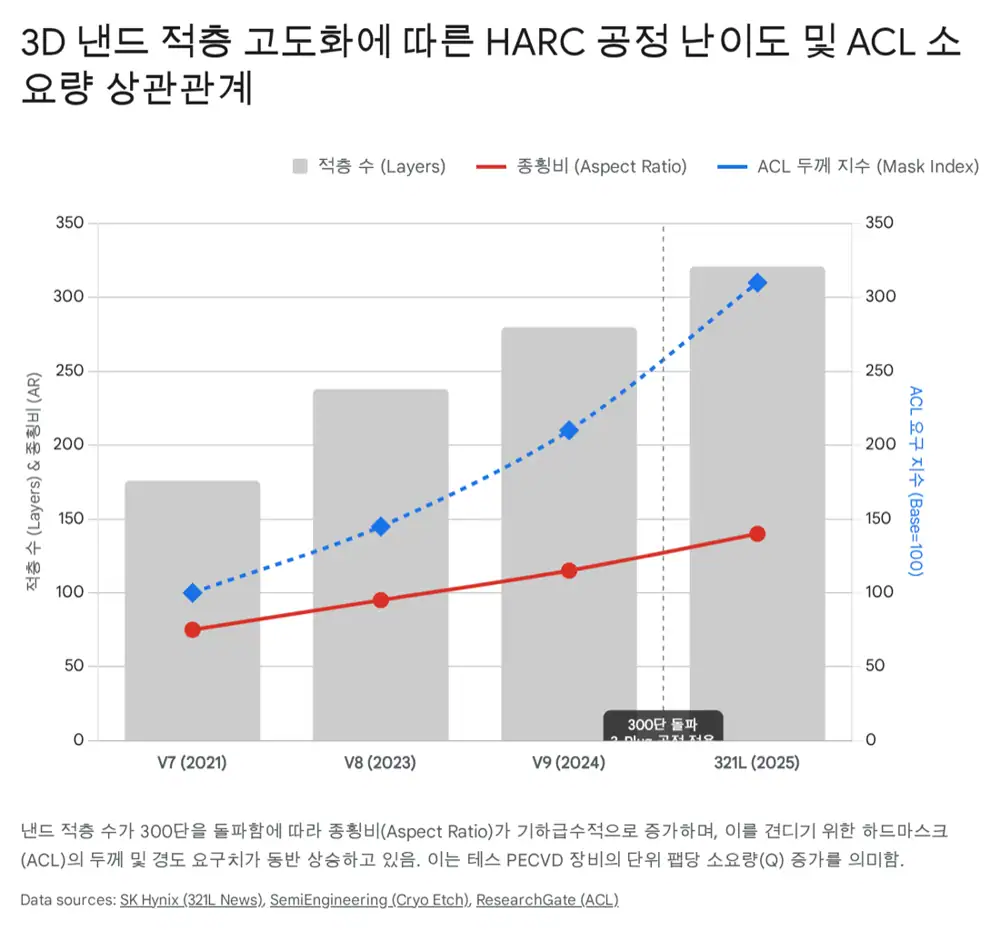
Official fact: The key material for solving HARC difficulty is ACL, or Amorphous Carbon Layer. The source says TES has a dominant domestic position in PECVD tools that deposit ACL.
- Challenger and Cygnus: Tool lines specialized in strengthening ACL film hardness by maximizing carbon bonding under high-temperature and high-power plasma environments.
- High selectivity: A higher ratio of oxide etch rate to ACL etch rate allows deeper etch with a thinner film or more process margin at the same thickness.
- Step coverage: Uniform ACL deposition on fine patterns and complex 3D surfaces improves accuracy in subsequent photolithography.
- Cygnus: An HD ACL deposition tool with much higher density than conventional ACL, targeting cryogenic etch and ultra-high-aspect-ratio etch requirements.
- Tetra: A quad-chamber evolution from dual chambers, designed to improve throughput and fab-space efficiency.
- GPE: A dry etch/cleaning tool using HF gas, avoiding surface-tension and pattern-leaning problems in wet etch. It has expanded from DRAM contact cleaning toward 3D NAND contact pretreatment.
4. Customer CAPEX: Samsung Electronics and SK hynix
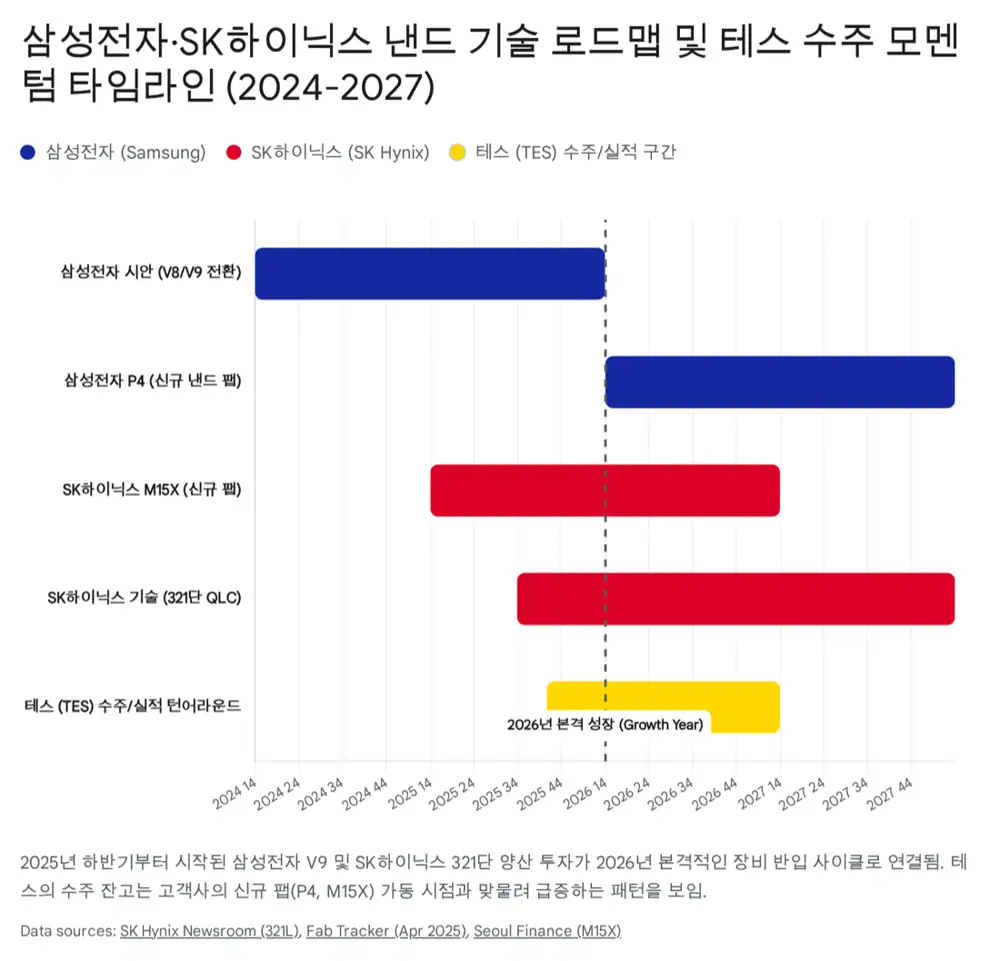
The source expects Samsung Electronics to accelerate transition from V9, in the 290-layer range, toward V10, either 400 layers or a late-300-layer hybrid-bonding approach, from the first half of 2026. It is also speeding legacy-line technology migration to regain leadership in QLC NAND.
Interpretation: The source believes TES maintains high share in Samsung's 3D NAND ACL hardmask deposition tools, with advantages over SEMES and Wonik IPS in mass-production experience and customized recipes. The 4Q25 earnings surge was attributed largely to Samsung Pyeongtaek P4 Phase 1 NAND tool move-in, while remaining P4 investment and Xi'an fab V6/V7 to V9 upgrades could support 2026 revenue.
Official fact: SK hynix announced mass production of the world's first 321-layer 4D NAND in 3Q25. The Cheongju M15X fab was known for HBM, but the source says NAND capacity allocation is expanding because of AI data-center eSSD demand.
SK hynix's 321-layer 3-Plug approach divides cell-hole formation into three plug steps and connects them. That means hardmask deposition is needed for each plug formation, increasing TES's equipment quantity demand. The source expects M15X tool move-in to begin in late 2025 and peak in the first half of 2026.
5. Rubin, ICMS, and eSSD: new NAND demand
Official fact: Nvidia's Rubin platform, expected in 2026, is described as introducing ICMS, or Inference Context Memory Storage, in addition to HBM4. The architecture adds high-speed, high-capacity SSDs to each GPU server rack for AI inference data processing.
- Major investment-bank analysis suggests Rubin can sharply increase storage capacity required per GPU.
- An NVL72 rack is estimated to require about 1.1PB of NAND storage.
- The source says a single Nvidia platform could absorb about 3% to 10% of global NAND demand in 2026-2027.
- QLC NAND is important for delivering large storage capacity at reasonable cost and power. Since QLC stores four bits per cell, it requires more precise process control.
Interpretation: If the Rubin/eSSD thesis is right, TES can benefit from AI infrastructure even without being a direct AI chip equipment supplier. If the market still sees TES only as a traditional NAND equipment stock, that connection can support valuation re-rating.
6. 2025 results and 2026-2027 outlook
| Item | 2024 | 3Q25 cumulative | 2025 preliminary | 4Q25 estimate | YoY |
|---|---|---|---|---|---|
| Revenue | KRW 240.1bn | KRW 234.1bn | KRW 351.1bn | KRW 117.0bn | +46.3% |
| Operating profit | KRW 38.5bn | KRW 45.1bn | KRW 57.8bn | KRW 12.7bn | +50.3% |
| Operating margin | 16.0% | 19.3% | 16.5% | 10.9% | +0.5%p |
| Net income | KRW 42.7bn | KRW 46.9bn | KRW 57.2bn | KRW 10.3bn | +34.0% |
Revenue of about KRW 117.0 billion in 4Q alone reverses typical seasonal weakness. The source interprets it as a strong signal that tool move-ins for Samsung P4 and SK hynix M15X were concentrated in 4Q. The estimated 4Q OPM of 10.9% is attributed to year-end bonuses and initial setup costs for new tools, not fundamental deterioration.
| Item | 2025 preliminary | 2026E | 2027E | 26E YoY |
|---|---|---|---|---|
| Revenue | KRW 351.1bn | KRW 425.0bn | KRW 480.0bn | +21.0% |
| Operating profit | KRW 57.8bn | KRW 88.0bn | KRW 110.0bn | +52.2% |
| OPM | 16.5% | 20.7% | 22.9% | +4.2%p |
| EPS | KRW 2,900 estimate | KRW 3,859 | KRW 4,500 | +33% |
The source identifies 2Q26 as the earnings turning point. Completion of SK hynix M15X 321-layer NAND setup, Samsung V10 pilot investment, and potential all-time-high backlog could converge around that time.
7. Risks and bear cases
The largest technical concern is cryogenic etching led by Tokyo Electron. Etching below minus 70 degrees Celsius can improve speed and profile verticality, so some investors worry that thick and expensive ACL hardmasks may become less necessary.
Cryogenic etch threat
If etch efficiency improves, hardmask usage could decline and TES PECVD revenue could structurally fall.
Limited adoption
Cryogenic etch requires expensive chillers and special gases, so it may be limited to the hardest upper-layer steps rather than all NAND processes.
Complementary role
Sidewall protection and high-density ACL may still be needed under cryogenic conditions, and Cygnus targets low-temperature, high-density film quality.
- Lam Research: A dominant etch equipment company and potential competitor with its own deposition solutions. The source argues TES has long-developed customized recipes with Samsung and SK hynix, plus price and customer-service advantages.
- China geopolitical risk: U.S. semiconductor restrictions can delay advanced-node upgrades at Xi'an and Wuxi fabs. However, the source expects maintenance and some migration investment to continue through channels such as VEU approval for legacy equipment.
8. Valuation and final strategy
Official fact: The source presents a TES share price of about KRW 64,300 as of February 10, 2026, 2026E EPS of about KRW 3,859, forward PER of 16.6x, and PBR of 1.4x. It also notes that TES reached 3.0x PBR during the prior NAND big cycle in 2017-2018.
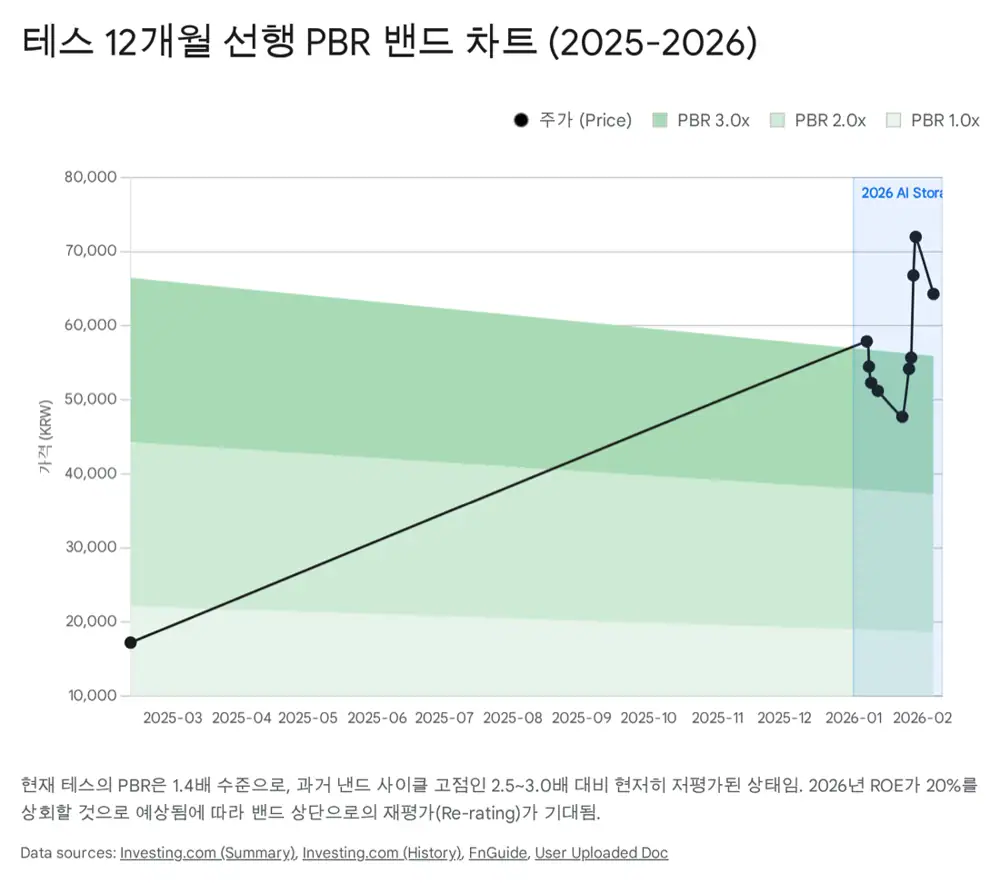
Interpretation: The market still tends to treat TES as a traditional NAND equipment stock, leaving it discounted versus HBM-related names. But AI data-center eSSD demand and 300-layer-plus NAND competition can strengthen TES's ACL moat. The source argues that PBR above 2.0x is reasonable if ROE returns to the 20% range in 2026.
The source's final strategy states Buy with a target price of KRW 85,000. The calculation applies a target PER of 22x to 2026E EPS of KRW 3,859, adding a 50% structural AI infrastructure premium to the 15x average PER for Korean semiconductor materials, parts, and equipment names.
Key KPIs
- SK hynix M15X tool order disclosure: A large supply contract in 1H26 would signal 321-layer mass production ramp.
- Nvidia Rubin launch timing and SSD specifications: The more concrete and higher the storage capacity guidance per server rack becomes, the stronger the NAND layering beneficiary thesis gets.
Sources
- Original Naver Blog post: https://m.blog.naver.com/PostView.naver?blogId=star_of_self&logNo=224182184791
- Financial Supervisory Service DART disclosures and internal estimates from the source
- NVIDIA Kicks Off the Next Generation of AI With Rubin — Six New Chips, One Incredible AI Supercomputer: https://nvidianews.nvidia.com/news/rubin-platform-ai-supercomputer
- Inside the NVIDIA Rubin Platform: Six New Chips, One AI Supercomputer: https://developer.nvidia.com/blog/inside-the-nvidia-rubin-platform-six-new-chips-one-ai-supercomputer/
- [집중분석] 엔비디아의 ICMS 등장…'에이전틱 AI시대' 낸드의 재발견 - 더퍼블릭: https://www.thepublic.kr/news/articleView.html?idxno=292770
- SK hynix Begins Mass Production of 321-Layer QLC NAND Flash: https://news.skhynix.com/sk-hynix-begins-mass-production-of-321-layer-qlc-nand-flash/
- SK hynix Starts Mass Production of World's First 321-High NAND: https://news.skhynix.com/sk-hynix-starts-mass-production-of-world-first-321-high-nand/
- Process Optimization of Amorphous Carbon Hard Mask in Advanced 3D-NAND Flash Memory Applications - ResearchGate: https://www.researchgate.net/publication/352229598_Process_Optimization_of_Amorphous_Carbon_Hard_Mask_in_Advanced_3D-NAND_Flash_Memory_Applications
- Step Coverage and Dry Etching Process Improvement of Amorphous Carbon Hard Mask: https://www.mdpi.com/2079-9292/10/20/2512
- Samsung Begins Industry's First Mass Production of QLC 9th-Gen V-NAND for AI Era: https://news.samsung.com/global/samsung-begins-industrys-first-mass-production-of-qlc-9th-gen-v-nand-for-ai-era
- Samsung V-NAND : A Landmark of the Hyperscale AI Era: https://semiconductor.samsung.com/news-events/tech-blog/samsung-v-nand-landmark-of-the-hyperscale-ai-era/
- Fab-Tracker-April-2025.pdf: https://s29.q4cdn.com/619069826/files/doc_downloads/2025/04/28/Fab-Tracker-April-2025.pdf
- [2026년 D램] SK하이닉스, 30조 투자·M15X 가속 'HBM 초격차' 굳히기 - 서울파이낸스: https://www.seoulfn.com/news/articleView.html?idxno=615057
- Introducing NVIDIA BlueField-4-Powered Inference Context Memory Storage Platform for the Next Frontier of AI: https://developer.nvidia.com/blog/introducing-nvidia-bluefield-4-powered-inference-context-memory-storage-platform-for-the-next-frontier-of-ai/
- Oh no: NVIDIA's next-gen Vera Rubin AI systems to eat up MILLIONS of terabytes of SSDs: https://www.tweaktown.com/news/109677/oh-no-nvidias-next-gen-vera-rubin-ai-systems-to-eat-up-millions-of-terabytes-of-ssds/index.html
- Nvidia Rubin AI Servers Could Consume 9% of Global Supply - AI Flow Review: https://aiflowreview.com/nvidia-rubin-ai-ssd-nand-supply/
- SSD shortages might hit hard in 2026 thanks to NVIDIA, AI - Windows Central: https://www.windowscentral.com/hardware/nvidia/nvidia-rubin-ssd-nand-shortage-prediction
- 테스(A095610) | Consensus | Company Guide: https://comp.fnguide.com/SVO2/asp/SVD_Consensus.asp?gicode=A095610&MenuYn=Y
- SK Hynix reportedly tests Tokyo Electron's cryogenic etching equipment - EEWORLD: https://en.eeworld.com.cn/news/manufacture/eic667699.html
- Cryogenic Etch Re-Emerges: https://www.cryogenicsociety.org/index.php?option=com_dailyplanetblog&view=entry&category=industry-news&id=244:cryogenic-etch-re-emerges
- Plasma Enhanced Chemical Vapor Deposition System Market Outlook 2026-2034: https://www.intelmarketresearch.com/plasma-enhanced-chemical-vapor-deposition-system-market-29744
- Lam Research outlines $135B WFE forecast for 2026 as AI-driven demand accelerates: https://seekingalpha.com/news/4543950-lam-research-outlines-135b-wfe-forecast-for-2026-as-ai-driven-demand-accelerates
- Tes Co Ltd Stock Price Today | KQ: 095610 Live - Investing.com: https://www.investing.com/equities/tes-co-ltd