DEEP RESEARCH · UNITEST/PEROVSKITE SOLAR CELLS
UniTest Perovskite Solar Cell Business Analysis
A review of how semiconductor equipment DNA is being extended into solar-cell mass production and the 2035 market opportunity
0. Bottom line first
I see UniTest's perovskite business not as a simple side project, but as a structural transition that moves a semiconductor test-equipment company's precision process-control capability into next-generation solar-cell mass production. The key is that large-area high efficiency, Pyeongtaek pilot production, and Saemangeum large-scale investment all point in the same direction.
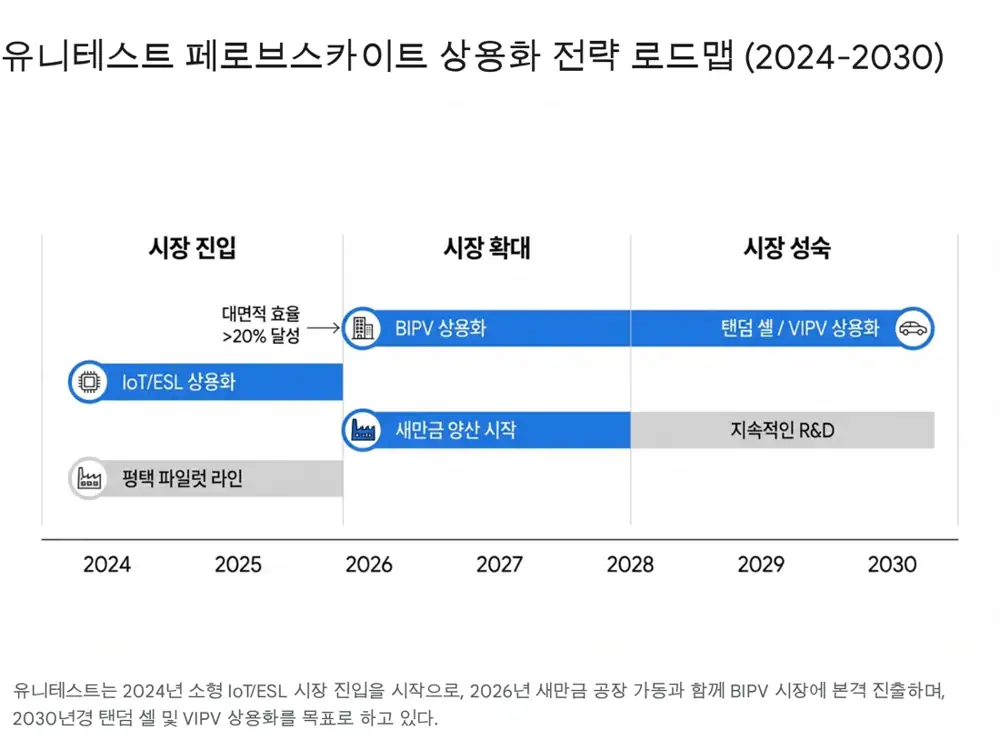
The source says UniTest received U.S. NREL certification for 14.8% efficiency on a large-area sub-module in 2019 and, with the Korea Research Institute of Chemical Technology, exceeded 20% efficiency on areas larger than 200cm². Since late 2024, it has begun producing indoor solar cells for ESL and IoT devices at the Pyeongtaek pilot line, while building a KRW 121.3 billion large-scale manufacturing facility in the Saemangeum National Industrial Complex.
1. Company DNA evolution: from semiconductor to energy
Official fact: Since its founding in 2000, UniTest has built technology in memory semiconductor back-end test equipment, especially burn-in testers and memory component testers. The core processes for perovskite solar cells, including thin-film coating, laser patterning, and deposition, are technically similar to semiconductor and display processes.
Interpretation: The important point is that UniTest is not merely a solar-cell manufacturer; it is an equipment-based manufacturer with internal production-equipment technology. That structure can support process black-boxing, yield control, and cost competitiveness.
| Financial metric | 3Q25 cumulative | Note |
|---|---|---|
| Revenue | KRW 82,861,640 thousand, about KRW 82.9bn | Semiconductor equipment plus solar EPC |
| Operating profit | -KRW 8,824,253 thousand, about -KRW 8.8bn | Semiconductor cycle weakness and higher R&D investment |
| R&D expense | KRW 9,581,201 thousand, about KRW 9.6bn | 11.56% of revenue |
| Solar EPC revenue | KRW 18,969,801 thousand, about KRW 19.0bn | 22.89% of total revenue |
2. Perovskite advantages and UniTest milestones
Perovskite is a material with an ABX3 crystal structure and is presented as a next-generation material that can overcome limits of conventional silicon solar cells.
High efficiency potential
The source says theoretical efficiency is higher than silicon and can exceed 35% in silicon-combined tandem structures.
Low-temperature process
Unlike silicon's high-temperature process above 1,000℃, perovskite can use solution processes below 200℃ to lower production cost.
Flexible and semi-transparent
Thin, light films, curved application, and tunable transmittance make it suitable for BIPV.
Official fact: Through joint research with KRICT, UniTest achieved more than 20% efficiency on large-area sub-modules above 200cm². In November 2019, it also received U.S. NREL certification for 14.8% efficiency on a perovskite mini-module.
- Large-area coating: The team secured process technology to coat perovskite solution uniformly on a large substrate.
- Laser patterning: Precision laser scribing minimizes dead zones between cells and increases effective module area.
- Low-light optimization: Device structure was optimized to generate power under weak indoor lighting, supporting ESL and IoT product competitiveness.
3. Value chain and partnerships
The perovskite industry value chain is not yet fully established. In this early market, UniTest is building a vertically integrated model across materials, equipment, cell/module manufacturing, and EPC/construction.
| Layer | UniTest position | Key partner/effect |
|---|---|---|
| Upstream | Capability to internalize or custom-develop coaters, deposition systems, and laser equipment | Material supply-chain cooperation with LK Chem for perovskite precursors |
| Midstream | Direct cell and module production at Pyeongtaek and future Saemangeum plants | Process black-boxing and direct quality control |
| Downstream | Solar power plant EPC through the green-energy division | Track records and validation data from captive projects |
| Partner | Cooperation area | Meaning |
|---|---|---|
| KRICT | Original technology transfer, large-area coating, high-efficiency device joint research | Technology foundation |
| KEPCO | Commercialization of glass-window BIPV solar cells, 200W-class modules, and 800cm²+ large-area technology | BIPV market-entry partner |
| LK Chem | Core materials and precursor supply, tandem-cell material co-development | Material supply-chain stabilization |
| Solar One No. 4 and others | Solar power plant construction projects and validation | EPC business linkage |
Interpretation: Cooperation with KEPCO is especially important. Combining KEPCO's prior small-area glass-window technology, around 2.5cm x 2.5cm, with UniTest's scale-up technology could connect to energy-independent smart-building projects.
4. 2025-2035 market size and target markets
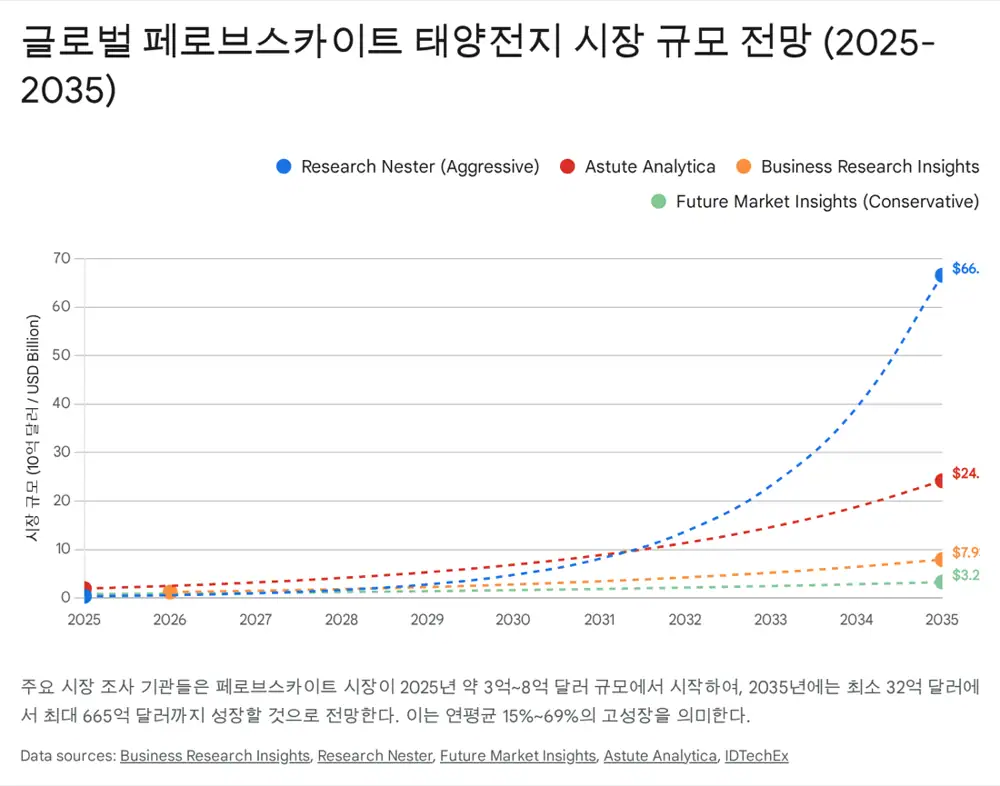
The source expects the perovskite market to pass through an opening phase in 2025-2026 and enter a full growth phase after 2030. The common point across market forecasts is a CAGR above 30%.
- Initial growth phase, 2025-2026: Research Nester forecasts the 2025 market at USD 342.14 million, while Business Research Insights forecasts USD 1.21 billion in 2026. IoT, consumer-electronics power sources, and small BIPV validation projects are expected to lead this phase.
- Growth acceleration, 2030-2035: Research Nester projects USD 66.58 billion in 2035, Astute Analytica USD 24.19 billion, IDTechEx USD 12.0 billion, and Future Market Insights a conservative USD 3.2 billion.
| Market segment | 2025 market size | 2035 market size | CAGR | UniTest strategy |
|---|---|---|---|---|
| BIPV | USD 8.9bn | USD 28.6bn | 12.4% | Glass-window modules, KEPCO cooperation, internal EPC |
| VIPV | USD 0.73bn | USD 2.24bn | 11.9% | Flexible devices and tandem-cell high-efficiency modules |
| Total PSC | USD 0.34bn to 1.9bn | USD 3.2bn to 66.5bn | Above 30% | Internalized materials/equipment and mass-production system |
BIPV is UniTest's core target. As zero-energy building mandates spread, demand for buildings that generate their own electricity should rise, and perovskite is well suited to windows and exterior walls because transparency and color can be controlled. VIPV integrates solar cells into EV roofs or hoods, where flexible perovskite's curved-surface advantage matters. ESL and IoT are smaller markets, but useful for early cash flow and mass-production learning.
5. Production sites and mass-production roadmap
Official fact: The Pyeongtaek plant began operating pilot and mass-production equipment for perovskite solar cells in 4Q24. It mainly focuses on small ESL and IoT modules and process/yield stabilization.
Official fact: The Saemangeum plant is being built on a 66,000㎡, about 20,000-pyeong site in Lot 1 of the Saemangeum National Industrial Complex, with total investment of KRW 121.3 billion. Investment began sequentially in late 2024, with full-scale operation targeted around 2026.
Interpretation: Saemangeum is both the production base for large-area BIPV modules and infrastructure that can later expand into tandem cells. It is the key event for confirming whether UniTest moves beyond R&D into manufacturing.
6. Risks and checkpoints
Chinese competition
Chinese companies such as GCL and Microquanta are already operating large pilot lines and pushing cost competitiveness.
Long-term reliability
Perovskite remains vulnerable to moisture and heat. BIPV entry requires 20-year-plus lifetime assurance and outdoor long-term data.
Response strategy
UniTest needs to emphasize quality reliability, BIPV specialization, encapsulation, new materials, and KEPCO validation data rather than simple price competition.
7. Final take
UniTest is accelerating an identity shift from semiconductor equipment company to perovskite solar leader as of 2025. The evidence is more than 10 years of R&D, partnerships with KRICT and KEPCO, and investment in the Saemangeum production line.
The KPIs I would watch are visibility of 2025 IoT product revenue, Pyeongtaek yield stabilization, Saemangeum operation in 2026, and long-term BIPV reliability data. If successful, UniTest could become not only a growth story as an individual company, but also a first-mover case for Korea's next-generation solar market.
Sources
- Original Naver Blog post: https://m.blog.naver.com/PostView.naver?blogId=star_of_self&logNo=224175891576
- Data synthesis: Research Nester, Future Market Insights, Global Growth Insights
- 화학연 '페로브스카이트 태양전지' 연구, 국가 연구개발 우수성과 100선 최우수 기술 선정: https://www.etnews.com/20251224000163
- 새만금산업단지, 차세대 페로브스카이트 태양전지 상용화 시동 - 대한민국 정책브리핑: https://www.korea.kr/briefing/pressReleaseView.do?newsId=156476124
- 페로브스카이트 태양전지 모듈 시장 규모, 점유율 및 예측 보고서(2035년): https://www.businessresearchinsights.com/ko/market-reports/perovskite-solar-cells-module-market-102080
- 페로브스카이트 태양 전지 시장 규모, 점유율 및 추세 예측 2035 - Research Nester: https://www.researchnester.com/kr/reports/perovskite-solar-cell-market/6346
- Perovskite Market | Global Market Analysis Report - 2035 - Future Market Insights: https://www.futuremarketinsights.com/reports/perovskite-market
- 건물 일체형 태양광발전(BIPV) 시장 규모, 점유율, 예측(2035년): https://www.globalgrowthinsights.com/ko/market-reports/building-integrated-photovoltaic-bipv-market-101884
- Perovskite solar cells: Progress continues in efficiency, durability, and commercialization: https://ceramics.org/ceramic-tech-today/perovskite-solar-cells-progress-2025/
- 한전, 유리창호형 태양전지 사업화 기술개발 - 프레시안: https://www.pressian.com/pages/articles/2020082612500121281
- Perovskite Solar Cells Market Size, Share | Growth [2035] - Astute Analytica: https://www.astuteanalytica.com/industry-report/perovskite-solar-cells-market
- Perovskite Photovoltaic Market 2025-2035: Technologies, Players & Trends - IDTechEx: https://www.idtechex.com/en/research-report/perovskite-photovoltaic-market-2025/1062
- Vehicle Integrated Solar Panels Market | Global Market Analysis Report - 2035: https://www.futuremarketinsights.com/reports/vehicle-integrated-solar-panels-market
- Solar Vehicle Market Size, Share and Trends 2026 to 2035 - Precedence Research: https://www.precedenceresearch.com/solar-vehicle-market