DEEP RESEARCH · VINATECH
VinaTech: A Carbon-Materials Platform for AI Power Infrastructure and Hydrogen Fuel Cells
An energy-transition report combining the supercapacitor cash cow with vertically integrated hydrogen fuel-cell components
0. Bottom line first
VinaTech should not be viewed as two unrelated businesses. Supercapacitors and hydrogen fuel-cell components share the same foundation: more than 20 years of carbon-control technology. The story is strongest when AI data-center power volatility and hydrogen supply-chain localization open at the same time.
Official fact: The source describes VinaTech as founded in 1999, entering supercapacitor manufacturing in 2004 and hydrogen fuel-cell materials in 2013, with headquarters in Jeonju, a production base in Wanju, and a Vietnam production entity.
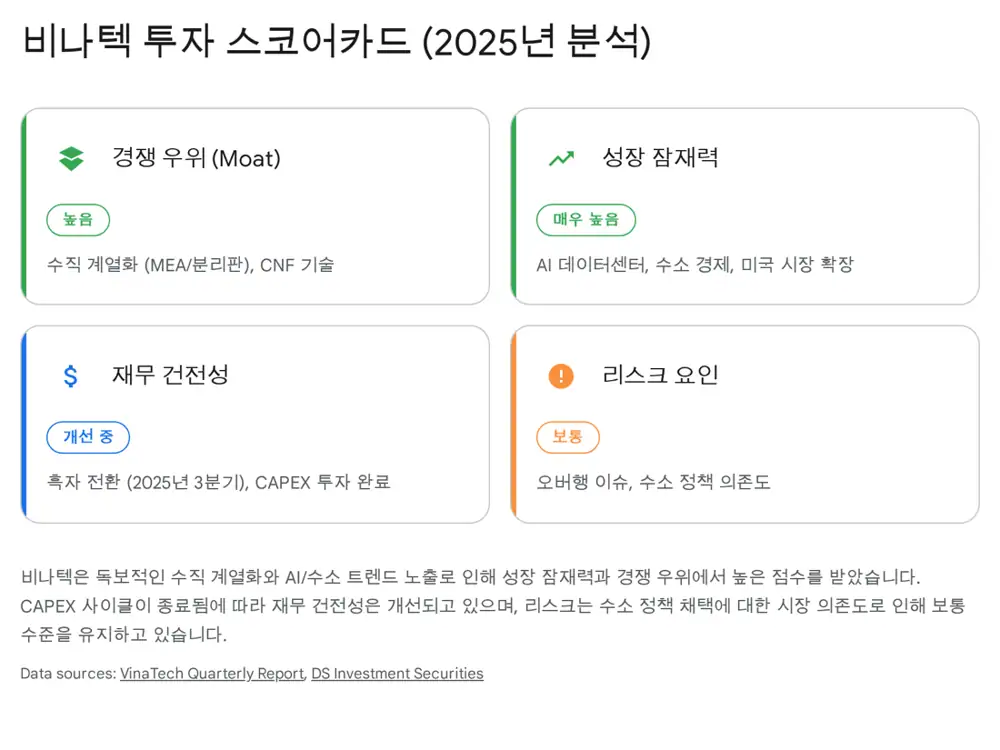
Interpretation: The 3Q25 turnaround and the end of the Wanju Plant 2 CAPEX cycle should be read as a shift from growing pains to harvest.
1. Two business engines
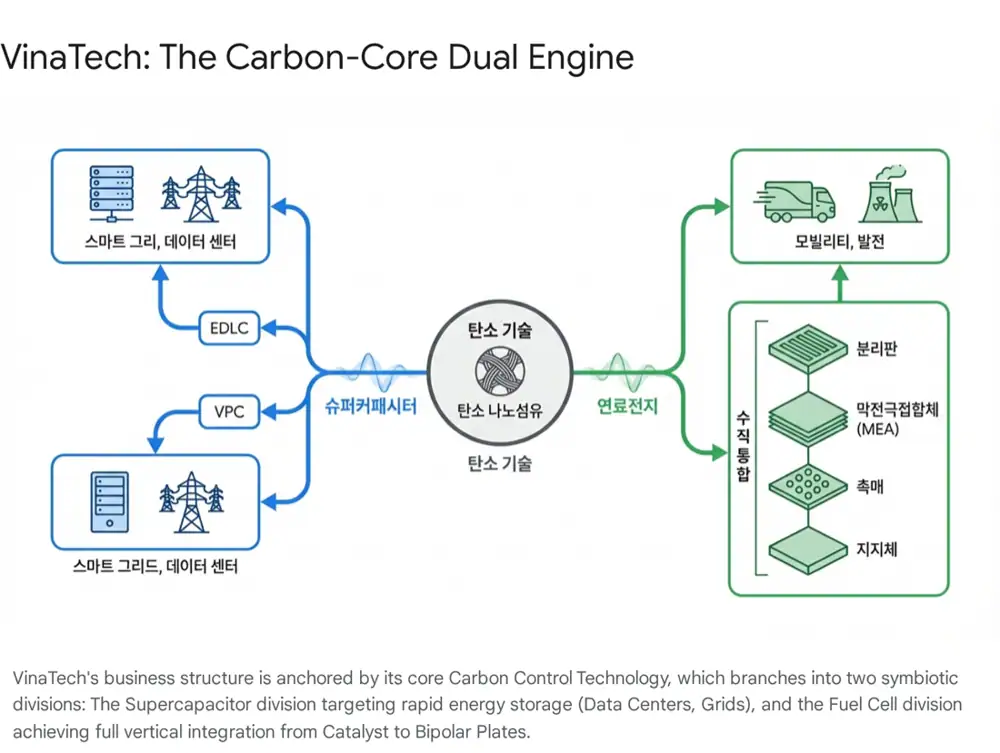
Supercapacitors store energy through physical ion adsorption and desorption, giving them high power density, long life, and fast charge/discharge. The source says VinaTech is No. 1 globally in the mid-sized 1F-1000F supercapacitor market.
EDLC
Used in smart meters, vehicle black boxes, and wind-turbine pitch control. The post notes world-first mass production of 3.0V high-voltage products.
Hybrid capacitor
Combines lithium-ion battery concepts to lift energy density while reducing fire risk.
Solution shift
Cells, balancing circuits, and customer-specific voltage/capacity are bundled into modules.
2. Hydrogen fuel cells
VinaTech internalizes supports, catalysts, MEAs, and bipolar plates. The source describes this as a rare materials-to-components integrated production system.
| Part | Role | Source point |
|---|---|---|
| Support | Hosts platinum catalyst | CNF support improves durability and corrosion resistance |
| Catalyst | Disperses Pt particles | Maintains performance while reducing platinum use |
| MEA | Core reaction site | Manufactured in-house from support and catalyst technology |
| Bipolar plate | Gas separation and current collection | Carbon-composite plate secured through the 2021 Ace Creation acquisition |
3. Markets: AI power and hydrogen policy
Official fact: The source cites Goldman Sachs for data-center power demand rising 165% by 2030 versus 2023.
Supercapacitors fit peak shaving and backup power. Bridge-time support before emergency generators start is tied to preventing data loss and lowering total cost of ownership.
Official fact: The source says the global supercapacitor market grows from about USD 5.08 billion in 2024 to about USD 11.16 billion in 2030, with a CAGR of about 14.0%.
Official fact: The hydrogen fuel-cell market is presented as growing from about USD 5.54 billion in 2025 to USD 32.63 billion in 2035, with a CAGR of about 19.4%.
4. Moat and milestones
- Competitors: Maxwell, Skeleton Technologies, Nippon Chemi-Con, Johnson Matthey, and Umicore are named in the source.
- Moat: CNF control at nano scale, vertical integration from support synthesis to bipolar plates, and customer lock-in after qualification.
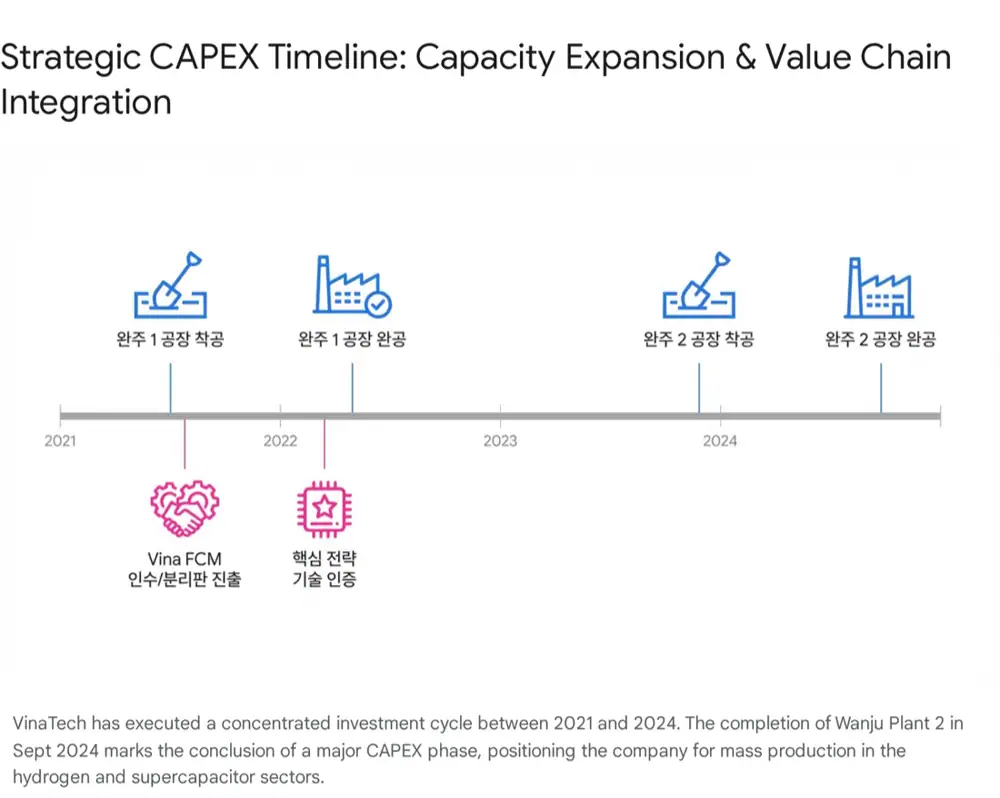
- Wanju Plant 2: completed in September 2024 for fuel-cell components and high-capacity supercapacitors.
- Bloom Energy: U.S. data-center supercapacitor supply is framed as a symbolic shift into global energy infrastructure.
5. Financial and shareholder checks
The source says recent CAPEX, including Wanju Plants 1 and 2 and the Ace Creation acquisition, focused on capacity expansion and value-chain integration, with about KRW 86 billion invested.
| Item | Source detail |
|---|---|
| Shares outstanding | About 5.8 million at end-2023 to about 6.41 million at 3Q25 |
| Largest shareholder | CEO Sung Do-kyung about 27.54%; over 30% including related parties |
| Stock dividends | 0.05 share per share in 2023 and 0.03 share per share decided in December 2025 |
| Long-term vision | KRW 1 trillion revenue by 2030 |
Interpretation: Short-term overhang and share-count growth need monitoring, but FCF improvement after the CAPEX cycle is the central investment check.
Sources
- Source 1: https://m.blog.naver.com/PostView.naver?blogId=star_of_self&logNo=224172254425
- Source 2: https://drive.google.com/open?id=1jA35gJHMxGxZcOZFDobBaf4YdfinvLWXOnSgHaV-0R8
- Source 3: http://www.ntrexgo.com/archives/38965
- Source 4: https://www.fortunebusinessinsights.com/ko/supercapacitors-market-105750
- Source 5: https://www.giikorea.co.kr/report/smrc1503332-supercapacitor-market-forecasts-global-analysis-by.html
- Source 6: https://www.dbpia.co.kr/journal/articleDetail?nodeId=NODE11966002
- Source 7: https://www.kaeri.re.kr/fileDownload?titleId=10399&fileId=1&fileDownType=C¶mMenuId=MENU01137
- Source 8: https://www.researchnester.com/kr/reports/hydrogen-fuel-cell-market/6348
- Source 9: https://www.ds-sec.co.kr/bbs/board.php?bo_table=sub03_02&wr_id=2943
- Source 10: https://cm.asiae.co.kr/en/article/2025052209224826343
- Source 11: https://marketin.edaily.co.kr/News/ReadE?newsId=04674006642400160