DEEP RESEARCH · GALAXIA MONEYTREE
Galaxia Moneytree Deep Dive: Where STO Legislation Meets Stablecoin Competition
Assessing whether a payment cash cow can become a digital-asset finance platform
0. Bottom line first
I view Galaxia Moneytree not merely as a payment gateway company, but as a candidate digital-asset finance platform using stable payment cash flow to fund STO and blockchain infrastructure. The constraint is valuation: as of January 2026, the source cites a PER of about 80x and a 3Q25-end debt ratio of 252.9%, meaning a lot of optimism is already priced in.
54.65%
Total friendly stake held by Cho Hyun-joon and related parties.
14.8% OPM
Revenue fell 1.8% to KRW 96.4 billion, while operating profit rose 45.9% to KRW 14.3 billion.
KRW 367T
BCG's cited 2030 Korean STO market forecast.
Official fact: The source frames the January 15, 2026 passage of amendments to the Capital Markets Act and the Electronic Securities Act as the key STO institutionalization event. It says enforcement is expected one year after promulgation, around January 2027.
Interpretation: The important question is not only who issues the stablecoin, but who controls distribution, wallets, merchant acceptance, and settlement. Even if banks lead issuance, payment infrastructure players such as Galaxia Moneytree can still matter at the use-case layer.
1. Governance: ownership that can push new businesses
As of the end of 3Q25, Galaxia Moneytree has a clear ownership structure centered on Cho Hyun-joon, chairman of Hyosung Group. I read this as a structure that can support long-term investment and fast decisions in a rapidly changing regulated fintech market.
| Shareholder | Relationship | Shares held | Stake | Meaning |
|---|---|---|---|---|
| Cho Hyun-joon | Largest shareholder | 12,940,141 | 32.99% | Hyosung Group chairman |
| Galaxia SM | Related party | 4,844,961 | 12.35% | Company controlled by Cho |
| Trinity Asset Management | Related party | 3,299,420 | 8.41% | Cho's private company |
| Other related parties | Executives, etc. | 354,994 | 0.90% | Friendly stake |
| Total largest shareholder group | - | 21,439,516 | 54.65% | Stable control |
| Other shareholders | Minority shareholders | 17,790,322 | 45.35% | Free float |
| Total | - | 39,229,838 | 100.00% | - |
The source says no meaningful selling or stake change by the largest shareholder group was reported from 4Q25 through January 2026. This can be read as a signal that payment cash flow is helping fund new-business investment and that insiders remain committed.
2. Business portfolio: from payments to token infrastructure
The subsidiary structure combines payments, blockchain, and overseas expansion. Galaxia Metaverse handles GXA and MetaGalaxia, GALAXIA SG PTE. LTD. serves as a Singapore base for global blockchain projects, and MoneyTree Vietnam supports O2O coupon and payment expansion in Southeast Asia.
3. Policy landscape: stablecoins and STOs open at the same time
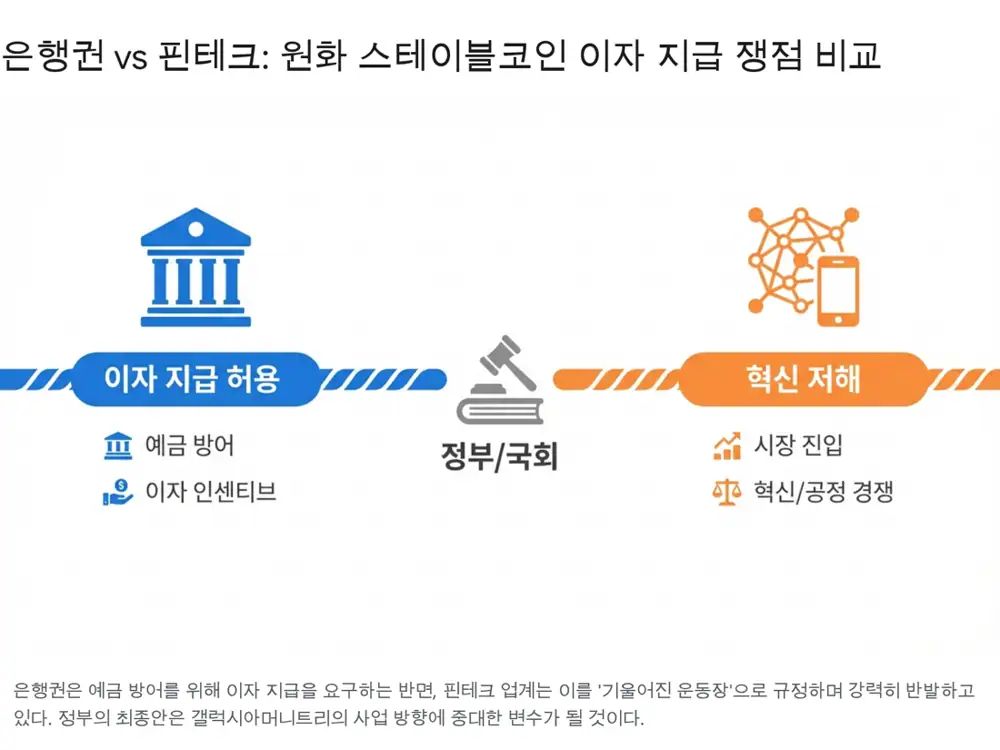
The source treats January 2026 as a turning point for Korean digital finance. Banks discussed bank-led KRW stablecoin issuance and permission to pay interest, while fintech players pushed back against a bank-favored market structure.
| Policy axis | Core issue | Implication for Galaxia Moneytree |
|---|---|---|
| Bank stablecoins | Bank-led issuance and interest payments under discussion | Banks may lead issuance, but use cases, settlement, wallet links, and merchants remain open opportunities |
| Fintech pushback | Interest payments may turn stablecoins from payment infrastructure into investment-like products | The company can argue for innovation and global regulatory consistency |
| STO legislation | Distributed ledgers recognized as legally effective securities ledgers; OTC distribution of investment-contract and trust-beneficiary securities allowed | Legal foundation for tokenizing non-standard assets such as aircraft engines and renewable-energy assets |
| Issuer-distributor split | Issuers and distributors separated to prevent conflicts of interest | The company can build pipelines on both infrastructure and platform sides |
Official fact: The source says the FSC formed a token-securities consultative body and began drafting detailed rules before the law takes effect.
Interpretation: Even though legal enforcement is expected in January 2027, 2026 is the infrastructure land-grab year. Firms with innovative-finance-service designations can create references before full implementation.
4. Earnings and roadmap: the numbers show core-business improvement
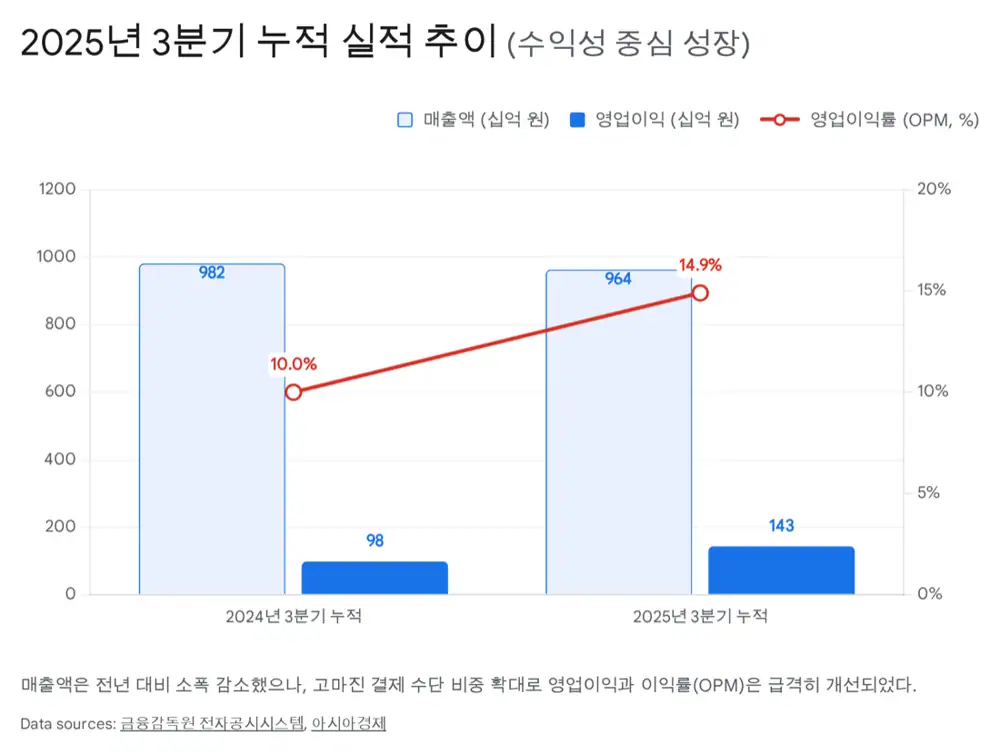
For the first nine months of 2025, revenue was KRW 96.4 billion, down 1.8% from KRW 98.2 billion a year earlier. Operating profit was KRW 14.3 billion, up 45.9% from KRW 9.8 billion. OPM improved from 10.0% to 14.8%, a gain of 4.8 percentage points.
The source attributes the margin improvement to a deliberate reduction in low-margin mobile micro-payment exposure, increased higher-margin credit-card and large B2B merchant transactions, and more than 70% year-on-year revenue growth at subsidiary Moneytree Card.
Innovative finance
In April 2024, the aircraft-engine trust-beneficiary-certificate trading service was designated an innovative financial service.
Applied in Sep. 2025
The trust-beneficiary securities brokerage application is part of a broader STO value-chain strategy.
50K stores / 5M app
The company has a convenience-store payment network of over 50,000 locations and the Moneytree app with 5 million downloads.
The aircraft-engine trust-beneficiary model is described as an SPC purchasing and entrusting aircraft engines, issuing beneficiary certificates, and distributing lease income as dividends. The claimed differentiation versus real estate or artwork fractional investing is clearer global demand, lease cash flow, and residual-value estimation.
5. Opportunities and risks
Opportunities
- When the STO market opens under legislation, the innovative-finance track record and differentiated aircraft-engine asset can create first-mover advantage.
- The government's 2026 growth strategy includes digital-asset institutionalization, raising the possibility of institutional capital entering the STO market.
- Improved payment-business profitability can buffer new-business investment.
Risks
- If stablecoin issuance becomes bank-exclusive, fintech expansion may be constrained.
- If STO OTC exchange licensing is delayed or the standards become too strict, commercialization may slow.
- The source cites a January 2026 PER of about 80x, implying heavy valuation pressure.
- The debt ratio stood at 252.9% at the end of 3Q25, up 27.7 percentage points from the previous year-end. Even if much of this is operating funding such as pre-settlement loans, financing cost must be monitored in a high-rate environment.
6. My view
I would summarize the investment point as “usage and distribution infrastructure, not issuance alone.” Even if banks issue KRW stablecoins, actual payment, settlement, wallet integration, and merchant acquisition are separate competitions.
That said, expectations are already high. In 2026, I would watch actual transaction volume, the speed of aircraft-engine STO product launch, brokerage licensing, and whether the core payment business can keep OPM around the mid-teens.
Sources
- 원문: https://m.blog.naver.com/PostView.naver?blogId=star_of_self&logNo=224153772411
- 서울경제: 토큰증권 제도권 안착: https://www.sedaily.com/NewsView/2K7CMOZ6K5
- 이투데이: 토큰증권법 본회의 통과: https://www.etoday.co.kr/news/view/2546043
- 금융위원회 보도자료: https://www.fsc.go.kr/no010101/86064?srchCtgry=&curPage=&srchKey=&srchText=&srchBeginDt=&srchEndDt=
- 전자신문: 은행권 스테이블코인 이자 논의: https://www.etnews.com/20260119000315
- WiseReport 지분현황: https://comp.wisereport.co.kr/company/c1070001.aspx?cmp_cd=094480&cn=
- 아이뉴스24: 갤럭시아그룹 지배구조: https://www.inews24.com/view/1537778
- 파이낸스스코프: 갤럭시아 스테이블코인: https://www.finance-scope.com/article/view/scp202507010011
- 전자신문 모바일: 은행권 이자 허용 요구: https://m.etnews.com/20260119000315
- Bank Policy Institute: Stablecoin interest risks: https://bpi.com/the-risks-from-allowing-stablecoins-to-pay-interest/
- Galaxy: GENIUS Act stablecoin regulation: https://www.galaxy.com/insights/research/genius-act-stablecoin-regulation
- 연합인포맥스: 한국형 스테이블코인 쟁점: https://news.einfomax.co.kr/news/articleView.html?idxno=4393298
- KDI 경제정보센터: 토큰증권 법안 통과: https://eiec.kdi.re.kr/policy/materialView.do?num=276006
- 아시아경제: 결제 사업 실적 견인: https://cm.asiae.co.kr/article/2025121508241069475
- 프라임경제: 스테이블코인·STO 모멘텀: https://m.newsprime.co.kr/section_view.html?no=694879
- 인사이드비나: 에셋체인 투자: http://www.insidevina.com/news/articleView.html?idxno=24539
- 뉴시스: 지엘리서치 분석: https://mobile.newsis.com/view/NISX20250703_0003237244
- 조세일보: 토큰증권 법안 통과: https://m.joseilbo.com/news/view.htm?newsid=560854
- 연합뉴스: 2026 성장전략: https://www.yna.co.kr/view/AKR20260109031100002
- 시사오늘: STO 인가지연: http://www.sisaon.co.kr/news/articleView.html?idxno=179676
- Goover: 갤럭시아머니트리 분석: https://seo.goover.ai/report/202601/go-public-report-ko-66094a89-1969-4c64-8fa1-21acdaf08755-0-0.html
- Investing.com: Galaxia Moneytree: https://in.investing.com/equities/galaxia-communications-co-ltd