DEEP RESEARCH · G2GBIO
G2GBIO: InnoLAMP Long-Acting Platform and 2026 Catalysts
A review of long-acting injectables, the microsphere platform, and clinical turning points for GB-5001, GB-6002, and GB-7001.
0. Bottom line first
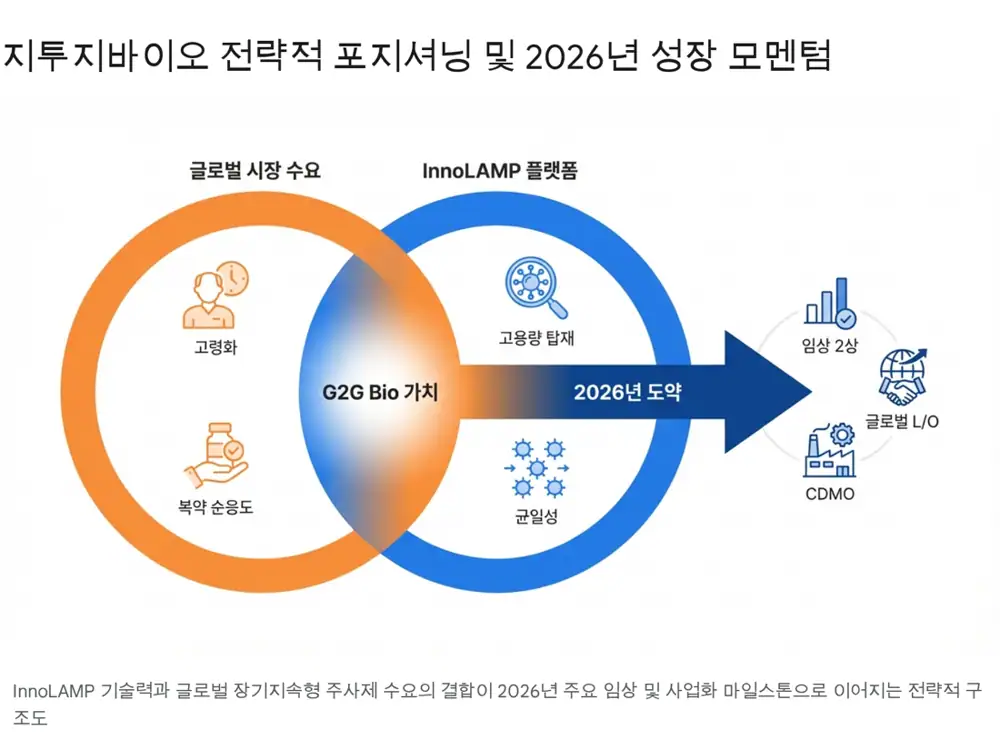
The key question is whether G2GBIO can be valued not as a simple reformulated-drug developer, but as a long-acting DDS platform company whose membrane-emulsification-based InnoLAMP can carry small molecules, peptides, and antibodies.
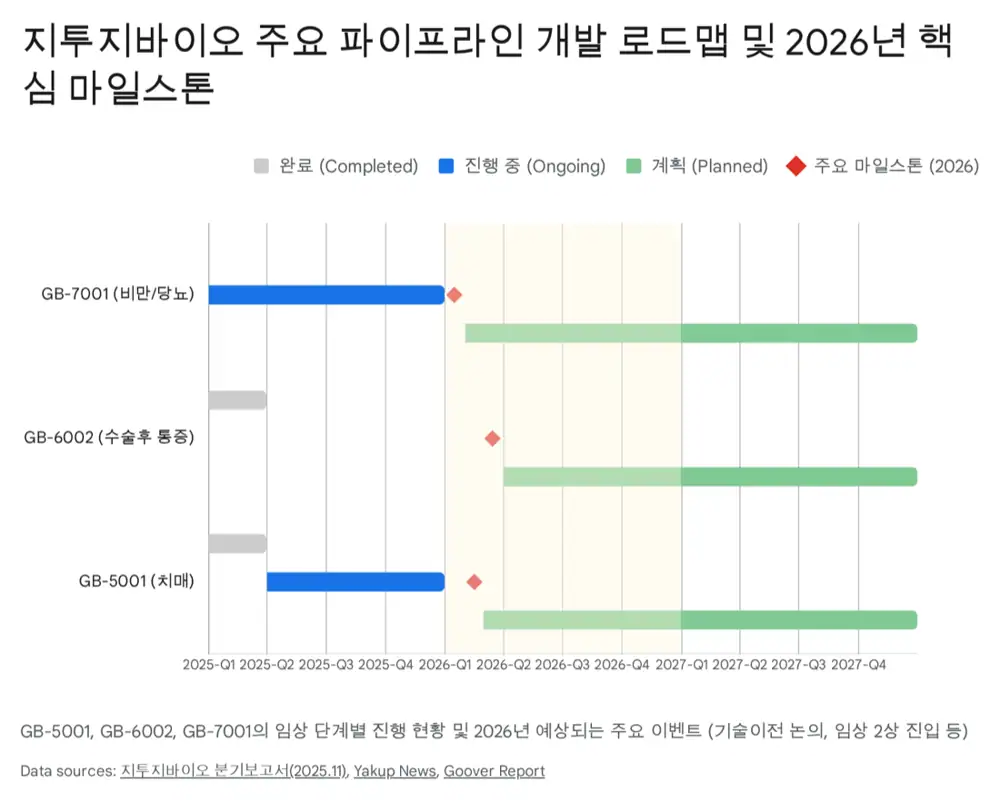
Official fact: The source says G2GBIO listed on KOSDAQ through the technology-special listing track in August 2025, and frames 2026 as the first year in which GB-5001, GB-6002, and GB-7001 clinical data and global partnering may turn into measurable business results.
Interpretation: The key catalysts are global phase 2 entry for GB-5001, phase 2 postoperative-pain data for GB-6002, and phase 1 entry for the once-monthly GLP-1 candidate GB-7001. The August 2026 one-year lock-up expiry is the supply-side risk.
1. Company history and funding
Official fact: G2GBIO was founded in March 2017. G2G stands for Good to Great, and the source describes the team, including CEO Lee Hui-yong, as veterans of long-acting drug technology from companies including Peptron.
| Period | Source content | Meaning |
|---|---|---|
| 2017-2019 | Corporate research institute established, InnoLAMP foundation built, KRW 8.0bn Series A in 2018 | Platform base formed |
| 2020-2022 | KRW 11.4bn Series B in 2020, KRW 2.0bn bridge in 2021, Osong GMP plant built, Canadian phase 1 IND approval for GB-5001 | Global clinical and manufacturing standards prepared |
| 2023-present | KRW 21.8bn Pre-IPO in 2023, cumulative investment about KRW 58.0bn, KOSDAQ technology-special listing in August 2025 | Entry into commercialization and partnering stage |
2. Structural growth in LAIs
The source views long-acting injectables as formulation change that improves both convenience and adherence. It also links demand to originator pharma's lifecycle-management strategy around patent expiries.
USD 16.9bn-34.2bn in 2024
The range presented as the starting point for the global LAI market.
USD 57bn-100bn
The market forecast around 2030, with more than 10% annual growth.
Adherence
The core demand is reducing missed daily doses and improving chronic-disease treatment efficiency.
- Obesity/diabetes: beyond weekly GLP-1 products such as Wegovy and Zepbound, the source sees unmet demand for once-monthly dosing.
- CNS: in Alzheimer's and schizophrenia, patients may struggle to self-administer daily medication, making injectable conversion potentially faster.
- LCM: changing patent-expiring drugs into LAI formulations can extend product life cycles.
3. InnoLAMP technology structure
Official fact: InnoLAMP is a microsphere-manufacturing platform based on microfluidics and membrane emulsification. The source differentiates it from conventional stirring, spray drying, and traditional emulsion approaches through particle uniformity, initial-burst control, high loading, and continuous-production potential.
| Category | G2GBIO InnoLAMP | Peptron SmartDepot | Alkermes Medisorb |
|---|---|---|---|
| Core technology | Membrane emulsification | Ultrasonic spray drying | Traditional emulsion/solvent evaporation |
| Particle uniformity | Very high, monodispersed | High | Average, polydispersed |
| Drug loading | High, up to over 60% | Mid to high | Mid |
| Initial release control | Strong structural control | Controlled through surface coating and other methods | Control challenges remain |
| Production efficiency | Continuous process advantage, high yield | Efficient drying process | Batch production centered |
| Applicable drugs | Peptides, small molecules, antibodies and more | Peptide centered | Small molecules and peptides |
4. Core pipelines
| Pipeline | Core content | 2026 checkpoint |
|---|---|---|
| GB-5001 donepezil | Once-monthly dementia injection. The Alzheimer's market is presented at about USD 14.8bn in 2026. Phase 1 trials in Canada and Korea are complete, with one-month effective concentration without initial blood-level spike and Tmax of 25-34 days. | Global phase 2 entry and global L/O discussion. The source says domestic commercialization preparation is underway with Korea Pharma and Humedix partnerships. |
| GB-6002 ropivacaine | A 3+ day postoperative-pain therapy. It is a non-opioid local anesthetic, with lower cardiac-toxicity risk and faster onset versus bupivacaine-based Exparel, according to the source. | After Korean phase 1 completion and CSR receipt, data showed 72+ hour pain control and lower Cmax. Phase 2 surgical-patient data and North American cooperation are the checkpoints. |
| GB-7001 semaglutide | A once-monthly diabetes/obesity GLP-1 candidate. The strategy is reducing annual injections from 52 under weekly Wegovy to 12. | Preclinical work confirmed one-month duration and positive ADA data, according to the source. 2026 domestic phase 1, first-in-human safety/PK data, and global co-development are key. |
5. Financials and overhang
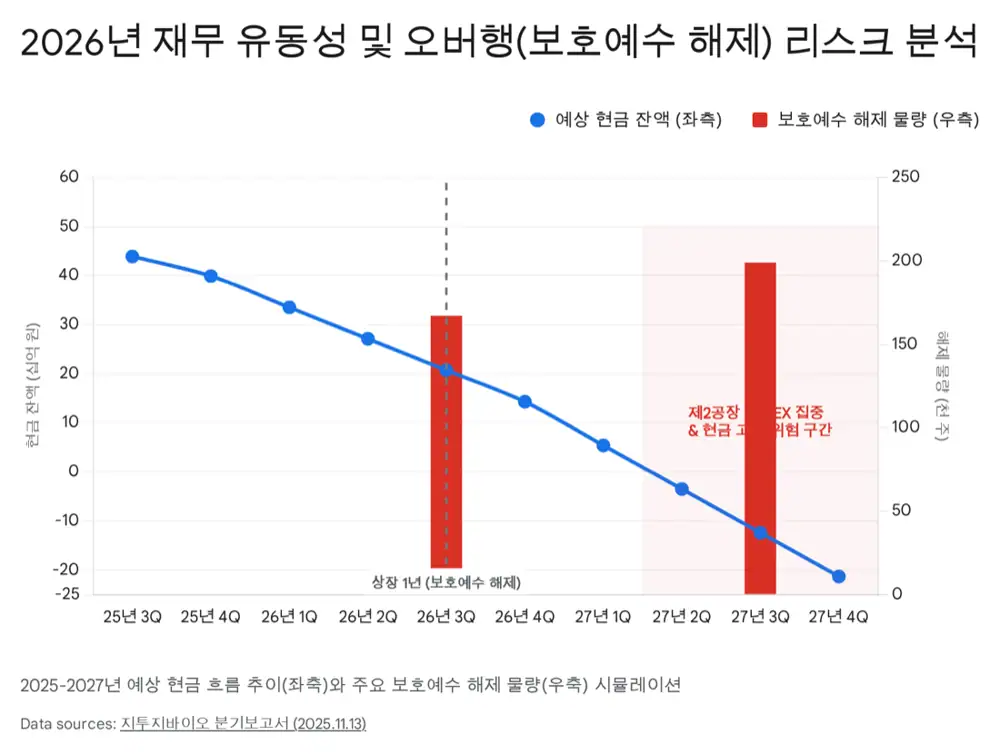
Official fact: At the end of Q3 2025, cash and cash equivalents were about KRW 16.9bn and short-term financial instruments were KRW 27.0bn, for KRW 43.9bn in available cash. Given quarterly operating loss of about KRW 3.5bn, the source judges this as more than two to three years of runway.
| Item | Source figure | Interpretation point |
|---|---|---|
| Q3 2025 cumulative revenue | About KRW 0.22bn | Mostly technology-transfer and service revenue before full product sales |
| Q3 2025 cumulative operating loss | About KRW 9.2bn | R&D-stage biotech loss structure |
| Second GMP plant CAPEX | About KRW 41.0bn | Planned across 2025-2027 |
| Cumulative investment raised | About KRW 58.0bn | VC exit supply variable |
| January 2025 conversion request | About 2.13mn shares | CB/RCPS mostly converted to common shares, easing debt risk but increasing float |
| August 2026 | One-year lock-up expiry | Potential volatility around first listing anniversary |
6. Risks and strategy
- Clinical risk: if GB-5001, GB-6002, and GB-7001 data miss source expectations, the platform valuation can weaken.
- Overhang: the August 2026 expiry of one-year lock-up shares held by venture finance and professional investors is the key supply risk.
- CAPEX: second GMP plant investment may create additional financing needs after the second half of 2026.
- Partnering: if global L/O and co-development deals are delayed, the path to profitability also moves out.
7. My conclusion
G2GBIO enters 2026 with a platform that needs proof through real clinical data and partnering. I would check GB-5001 phase 2, GB-6002 surgical-patient data, and GB-7001 first-in-human data in that order. On the supply side, the August 2026 overhang window must be monitored at the same time.
Sources
- Source 1: https://m.blog.naver.com/PostView.naver?blogId=star_of_self&logNo=224149386659
- Source 2: https://www.g2gbio.com/en/m11.php?section=1
- Source 3: https://www.verifiedmarketresearch.com/product/longacting-injectables-market/
- Source 4: https://www.marketsandmarkets.com/Market-Reports/injectable-drug-delivery-market-150.html
- Source 5: https://www.precedenceresearch.com/long-acting-injectables-market
- Source 6: https://www.medicopharma.co.kr/news/articleView.html?idxno=66691
- Source 7: https://mobile.newsis.com/view/NISX20251216_0003442842
- Source 8: https://drug-dev.com/market-brief-alzheimers-disease-market-report-2016-2026/
- Source 9: https://pubmed.ncbi.nlm.nih.gov/11104896/
- Source 10: https://www.g2gbio.com/en/m21.php
- Source 11: https://www.g2gbio.com/en/board/board.php?bo_table=news_en&idx=19
- Source 12: https://www.koreabiomed.com/news/articleView.html?idxno=29989
- Source 13: http://m.yakup.com/news/?mode=view&cat=12&cat2=121&cat3=0&nid=321140
- Source 14: https://seo.goover.ai/report/202508/go-public-report-ko-b4369077-55d0-4e7f-a369-4ff59e92efaf-0-0.html
- Source 15: http://m.yakup.com/news/index.html?mode=view&nid=321054
- Source 16: https://g2gbio.com/en/board/board.php?bo_table=news_en&idx=12
- Source 17: https://www.biospectator.com/news/view/25917