DEEP RESEARCH · ABL BIO
ABL Bio Deep Dive: Grabody Platform and Three 2026 Clinical Catalysts
A review of how ABL001 commercialization, ABL301 BBB shuttle validation, and bispecific ADC entry could reshape value.
0. Bottom line first
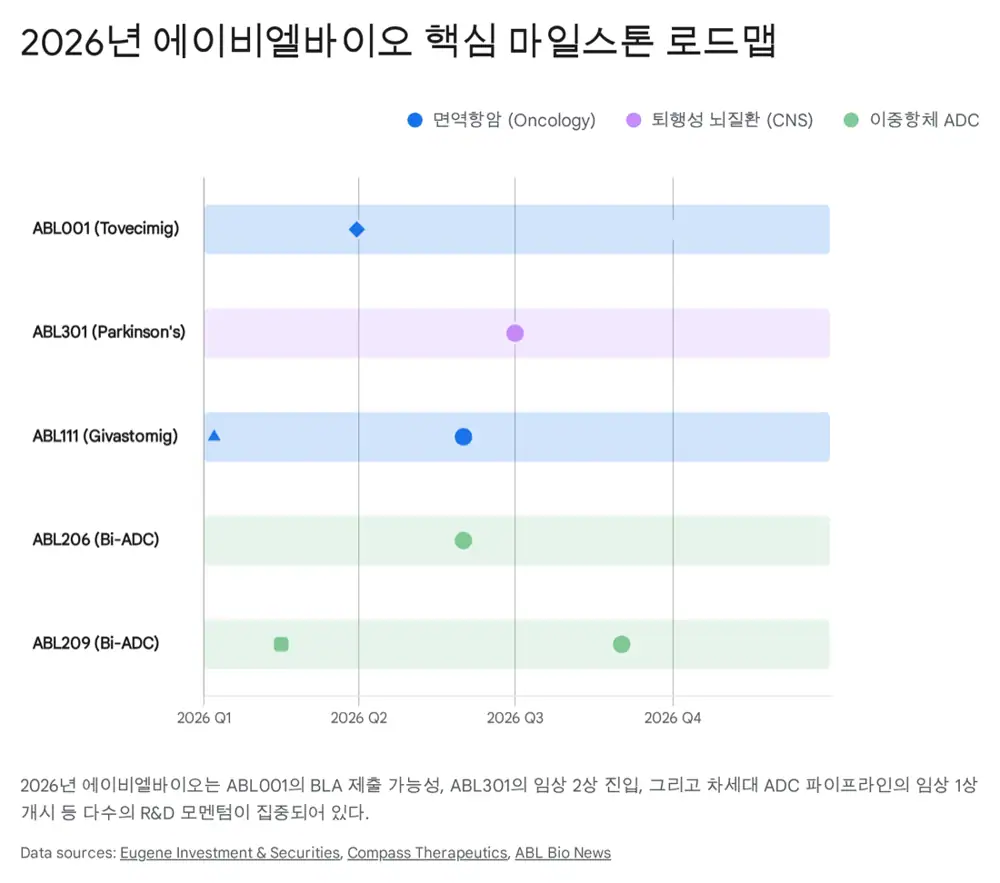
I read 2026 for ABL Bio as the year when the story can move from platform expectation to commercialization and later-stage clinical data. The core is the overlap of ABL001’s biliary-tract-cancer BLA path, ABL301’s global Phase 2 start, and follow-on value from ABL111 and bispecific ADCs.
Commercial visibility
COMPANION-002 final OS/PFS data are expected in 1Q 2026, with an FDA BLA targeted for the second half if positive.
BBB shuttle validation
Sanofi-led global Phase 2 entry is the human-efficacy test for Grabody-B.
Next modality
ABL206 and ABL209 add a bispecific ADC growth axis and potential partnering optionality.
1. Platform and strategy: the scalability of Grabody
Official fact: The source frames ABL Bio’s core edge as the bispecific-antibody Grabody platform. Grabody-T is a 4-1BB tumor-microenvironment immuno-oncology platform, Grabody-B is an IGF1R-based BBB shuttle, and Grabody-I targets two immune checkpoints at once.
Official fact: The source cites the November 2025 Lilly partnership at about KRW 3.8 trillion, or $2.6 billion. It includes a $40 million upfront payment and a $15 million, about KRW 21.7 billion, third-party equity issuance.
Interpretation: The deal matters beyond cash. It signals strategic validation of the BBB shuttle and platform scalability by a global pharma company, while also giving ABL Bio more room to fund in-house clinical work.
2. ABL001: the biliary-cancer commercialization test
Official fact: ABL001, or tovecimig, is a VEGF-A x DLL4 bispecific antibody licensed to Compass Therapeutics. The source states that Compass plans to report final OS and PFS analyses for COMPANION-002 at the end of 1Q 2026 and, if positive, submit a BLA to the U.S. FDA in the second half of 2026.
| Drug/regimen | Stage | Population | ORR | mOS | mPFS | Note |
|---|---|---|---|---|---|---|
| Tovecimig + Paclitaxel | Phase 2/3 COMPANION-002 | Second-line, all patients | 17.1% | Pending, 1Q 2026 | Pending, 1Q 2026 | FDA Fast Track |
| Paclitaxel alone | Phase 2/3 COMPANION-002 | Second-line control | 5.3% | - | - | Concurrent trial control |
| FOLFOX | Phase 3 ABC-06 | Second-line standard | 5.0% | 6.2 months | 4.0 months | Current standard of care |
| Nal-IRI + 5-FU/LV | Phase 2b NIFTY | Second-line | 14.3% | 8.6 months | 7.1 months | Approved in Korea and some markets |
| Regorafenib | Phase 2 | Second-line | 11.0% | 5.3 months | 3.0 months | Limited efficacy |
Interpretation: The 17.1% ORR cited in the source is more than triple the roughly 5% FOLFOX level. But final judgment depends less on ORR and more on whether OS/PFS meaningfully beat FOLFOX’s 6.2-month mOS.
3. ABL301: human validation of the BBB shuttle
Official fact: ABL301 is a Parkinson’s-disease bispecific antibody targeting alpha-synuclein aggregates. The source says the September 2025 Phase 1 data showed safety and tolerability without serious adverse events even at high doses, enabling a Sanofi-led global Phase 2 in 2026.
| Company | Pipeline | Shuttle receptor | Indication | Stage | Main issue |
|---|---|---|---|---|---|
| ABL Bio | ABL301 | IGF1R | Parkinson’s disease | Phase 2 entry in 2026 | Sanofi partnership, safety and half-life expectations |
| Roche | Trontinemab | TfR | Alzheimer’s disease | Phase 3 planned | Source cites 91% amyloid removal and ARIA <5% |
| Roche/Prothena | Prasinezumab | No shuttle | Parkinson’s disease | Phase 2b PADOVA | Primary endpoint missed |
| Denali | DNL310 | TfR | Hunter syndrome | BLA submitted, April 2026 decision | First TfR-based approval attempt, anemia and other issues |
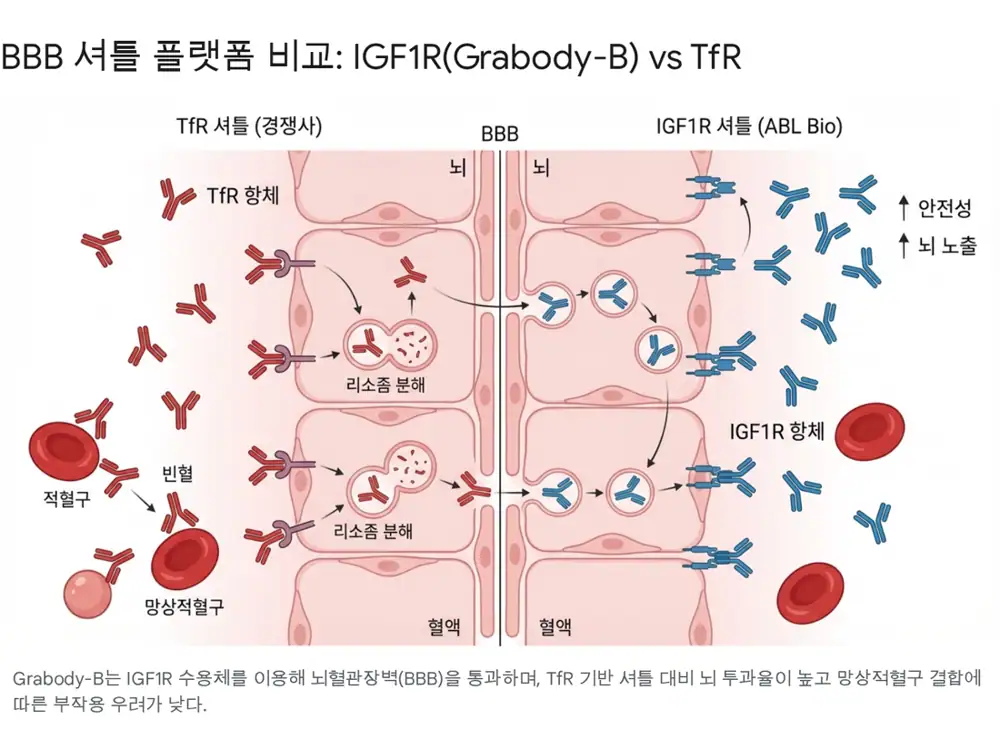
Interpretation: I see ABL301 as the largest option value in ABL Bio. Roche’s non-shuttle Prasinezumab miss highlights the need for brain delivery, and the source’s IGF1R-versus-TfR argument matters for chronic neurodegenerative dosing if peripheral side effects are lower.
4. ABL111 and bispecific ADCs: follow-on growth axes
Claudin 18.2 x 4-1BB
Full Phase 1b dose-expansion data and global Phase 2 initiation are expected in 1Q 2026. The source cites an interim ORR of 77% at 8mg/kg.
ROR1 x B7-H3 ADC
The source describes an FDA IND filing in late 2025 and first U.S. Phase 1 dosing expected in the first half of 2026.
Follow-on ADC
The stated target is an IND filing and clinical entry in early 2026.
Interpretation: ABL111 tests whether adding 4-1BB can make a best-in-class Claudin 18.2 asset after zolbetuximab. Bispecific ADCs aim to select cancer cells expressing both antigens, so strong early data could create partnering momentum quickly.
5. Financials, overhang, and watchlist
Official fact: The source cites cash and equivalents of about KRW 124.3 billion at the end of 3Q 2025 and estimates available cash of about KRW 200 billion in early 2026 after Lilly’s investment and the January 2026 equity raise. It also states that this cash could support operations through 2028 without additional financing.
| Item | Source checkpoint |
|---|---|
| Overhang | 172,553 new shares issued in January 2026 are locked up for one year |
| 1Q 2026 | ABL001 final OS/PFS data; ABL111 full Phase 1b data and Phase 2 start |
| 2Q 2026 | Denali DNL310 FDA decision may affect sentiment toward BBB shuttle platforms |
| 2H 2026 | ABL001 FDA BLA submission and ABL301 Phase 2 patient dosing ramp |
Interpretation: The share price can still move sharply around trial events, but the cash runway and Lilly deal reduce the near-term financing risk that usually weighs on biotech. My key 2026 question is whether each event converts expectation into data and cash-flow visibility.
Sources
- Source 1: https://m.blog.naver.com/PostView.naver?blogId=star_of_self&logNo=224149338641
- Source 2: https://synopulse.com/abl-bios-grabody-lands-2-6b-deal-with-lilly/
- Source 3: https://www.koreabiomed.com/news/articleView.html?idxno=29647
- Source 4: https://biz.chosun.com/en/en-science/2026/01/16/GQ2WRK2IBVFXHJHPWNYUQHXISU/
- Source 5: https://www.mk.co.kr/en/it/11935113
- Source 6: https://www.ablbio.com/en/company/news_view/895?keyword=
- Source 7: https://investors.compasstherapeutics.com/news-releases/news-release-details/compass-therapeutics-reports-third-quarter-2025-financial
- Source 8: https://www.nasdaq.com/press-release/compass-therapeutics-provides-corporate-update-2026-01-06
- Source 9: https://investors.compasstherapeutics.com/news-releases/news-release-details/tovecimig-ctx-009-meets-primary-endpoint-ongoing-randomized
- Source 10: https://www.ablbio.com/en/company/news
- Source 11: https://www.ablbio.com/en/company/news_view/877?keyword=
- Source 12: https://www.koreabiomed.com/news/articleView.html?idxno=28799
- Source 13: https://www.roche.com/media/releases/med-cor-2025-06-16
- Source 14: https://investingnews.com/novabridge-presents-positive-givastomig-dose-expansion-data-from-the-phase-1b-combination-study-in-patients-with-1l-metastatic-gastric-cancer/
- Source 15: https://delta.larvol.com/Products/?ProductId=84074513-6ab4-44c0-bb76-d5c7f54a7b1b
- Source 16: https://www.koreabiomed.com/news/articleView.html?idxno=30055
- Source 17: https://www.ablbio.com/en/company/financials
- Source 18: https://www.sec.gov/Archives/edgar/data/1738021/000117184325007005/cmpx20250930_10q.htm
- Source 19: https://www.investing.com/news/analyst-ratings/denali-therapeutics-stock-maintains-buy-rating-at-goldman-sachs-on-pipeline-progress-93CH-4448987