DEEP RESEARCH · SciNeuro/Novartis BBB shuttle
SciNeuro-Novartis deal analysis: how BBB shuttles could reshape Alzheimer antibody competition
A report on first-generation antibody delivery limits, next-generation shuttle platforms, and the ABL Bio comparison
0. Bottom line first
My view is that the Novartis-SciNeuro agreement is not just an Alzheimer antibody in-license. It is a USD 1.7 billion strategic bet on owning the delivery layer into the brain.
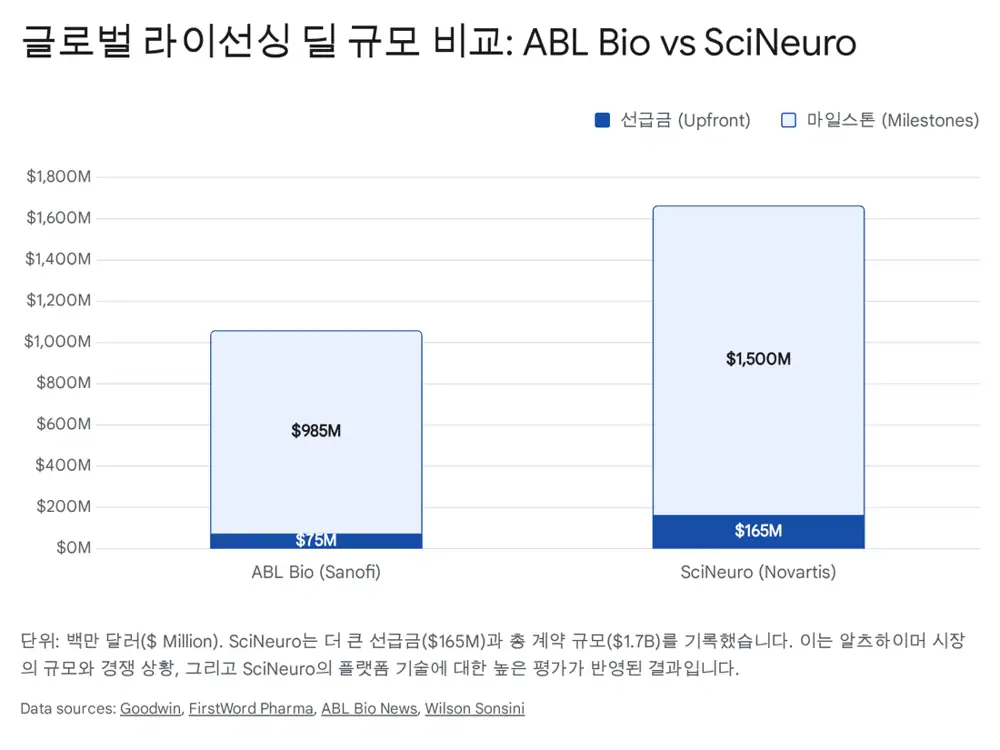
Official fact: The source describes a deal worth up to USD 1.7 billion, including USD 165 million upfront, more than USD 1.5 billion in development, regulatory, and commercial milestones, plus tiered royalties for SciNeuro's next-generation Alzheimer program.
Interpretation: An upfront payment near 10% of total deal value signals that Novartis assigned meaningful probability and market value to the combination of a BBB shuttle and anti-Aβ antibody. The program is still early, so Phase 1 data, CSF drug concentration, and ARIA incidence remain the real tests.
Up to USD 1.7bn
The core is USD 165m upfront and more than USD 1.5bn in milestones.
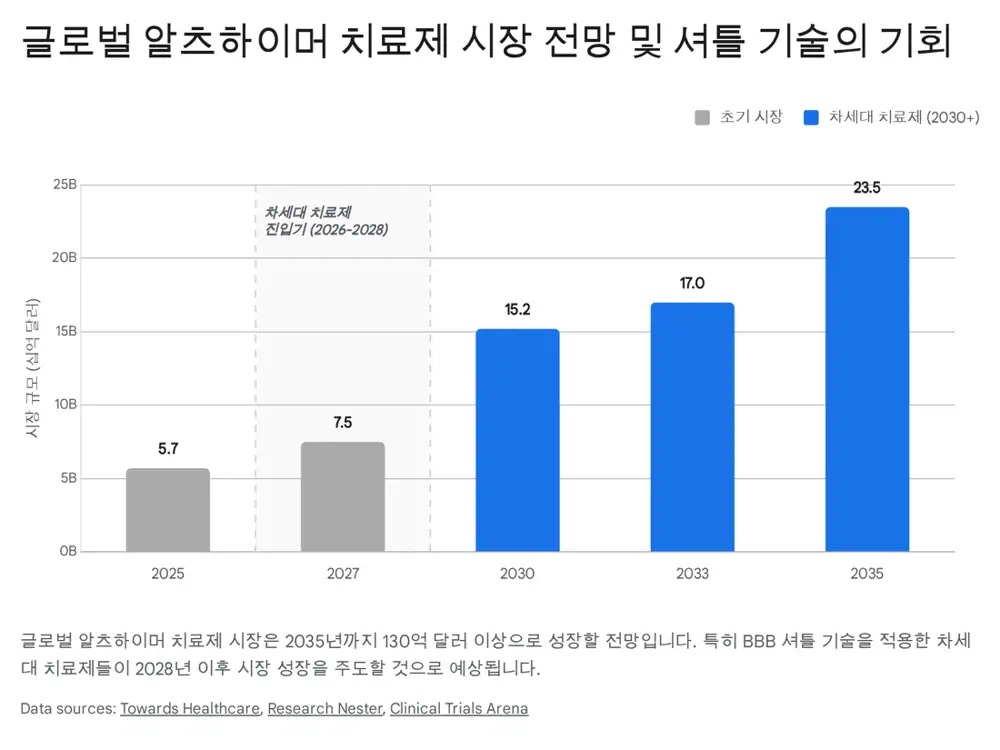
USD 5.7bn → 13-23bn
The source cites Alzheimer therapeutics market growth from about USD 5.7bn in 2025 to USD 13-23bn by 2035.
0.1-0.2%
Only a tiny fraction of a conventional antibody dose reaches the brain target, which is the first-generation antibody bottleneck.
1. Deal structure: Novartis fills a missing link
SciNeuro is a CNS biotech founded in 2020 with operations around Rockville, Maryland, and Shanghai. The source reads the deal as Novartis filling a gap in antibody-based brain disease therapeutics and large-molecule CNS delivery after years of focus on radioligand and RNA therapeutics.
| Item | Source number or detail | Meaning |
|---|---|---|
| Total value | Up to USD 1.7bn, about KRW 2.3tn | A premium for entry into a large Alzheimer market |
| Upfront | USD 165m, about KRW 220bn | The source says this is far above the usual USD 30-50m upfront for many preclinical or early Phase 1 single assets |
| Recent financing | USD 53m in December 2025 | A signal that insiders backed the company before the deal |
| Initial backing | USD 100m Series A in 2020 | Early support from Lilly Asia Ventures, Arch Venture Partners, and other biotech investors |
2. Industry background: antibodies exist, but they do not enter the brain well
Leqembi and Kisunla opened the clinical path for amyloid plaque removal in 2023 and 2024. The source argues that the next bottleneck is not only whether amyloid is the right direction, but how much drug actually gets into the brain.
- The blood-brain barrier is a tight endothelial defense system that blocks toxic material from entering the brain.
- Large 150kDa-class antibodies barely cross it; the source cites only about 0.1-0.2% of an IV dose reaching the brain target.
- High dosing to reach therapeutic brain concentration can raise treatment cost, systemic exposure, and ARIA-E or ARIA-H risk.
3. SciNeuro assets: shuttle, antibody, and neurobiology
Official fact: Founder and CEO Min Li, Ph.D., is described as a former Johns Hopkins neurology professor of more than 20 years and former GSK global neuroscience R&D head and China R&D general manager.
Interpretation: For an early biotech, that academic and big-pharma background can matter in clinical design, data packaging, and partnership negotiation.
Anti-Aβ aggregate antibody
The source views it as a next-generation antibody designed to bind toxic aggregates rather than normal monomers.
BBB shuttle platform
The asset value is not only one drug, but the extensibility of a brain delivery platform.
Lp-PLA2 inhibitor
An oral small molecule cited as having completed Alzheimer Phase 1 and being in Phase 2 for DME.
LRRK2 ASO and α-syn antibody
The pipeline extends into Parkinson's disease, showing SciNeuro is not just a single-platform company.
4. Competitive map: Leqembi, trontinemab, and SNP234
The Novartis-partnered program is described officially as a novel anti-amyloid antibody program. Based on public SciNeuro assets, the source infers that SNP234 and the BBB shuttle platform are likely central.
| Item | Leqembi | Trontinemab | SNP234/SciNeuro |
|---|---|---|---|
| Developer | Biogen/Eisai | Roche | Novartis/SciNeuro |
| Target | Aβ protofibrils | Aβ plaque + TfR1 shuttle | Aβ aggregates + next-gen shuttle |
| Brain penetration | Conventional antibody, about 0.1% | Shuttle-enabled | Designed for PK and efficiency optimization |
| Stage | Commercialized | Promising Phase 2 data | Preclinical or early clinical by source inference |
| Main watchpoint | First-mover position | Plaque clearance speed | De novo design and safety proof |
5. Appendix comparison: ABL Bio Grabody-B and SciNeuro
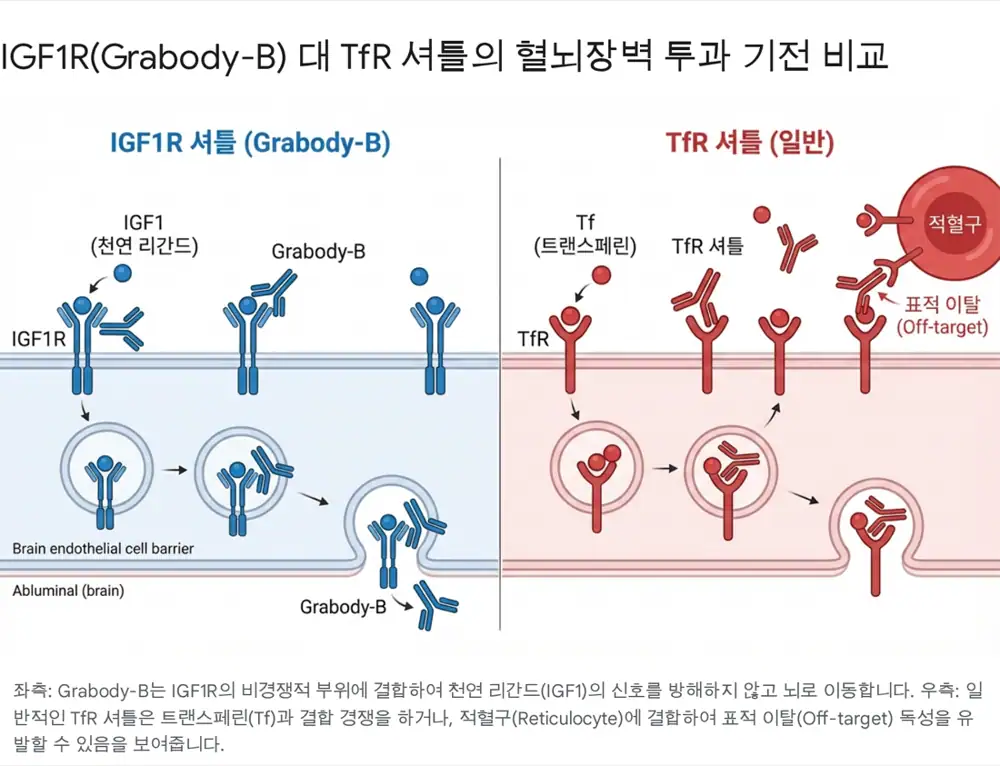
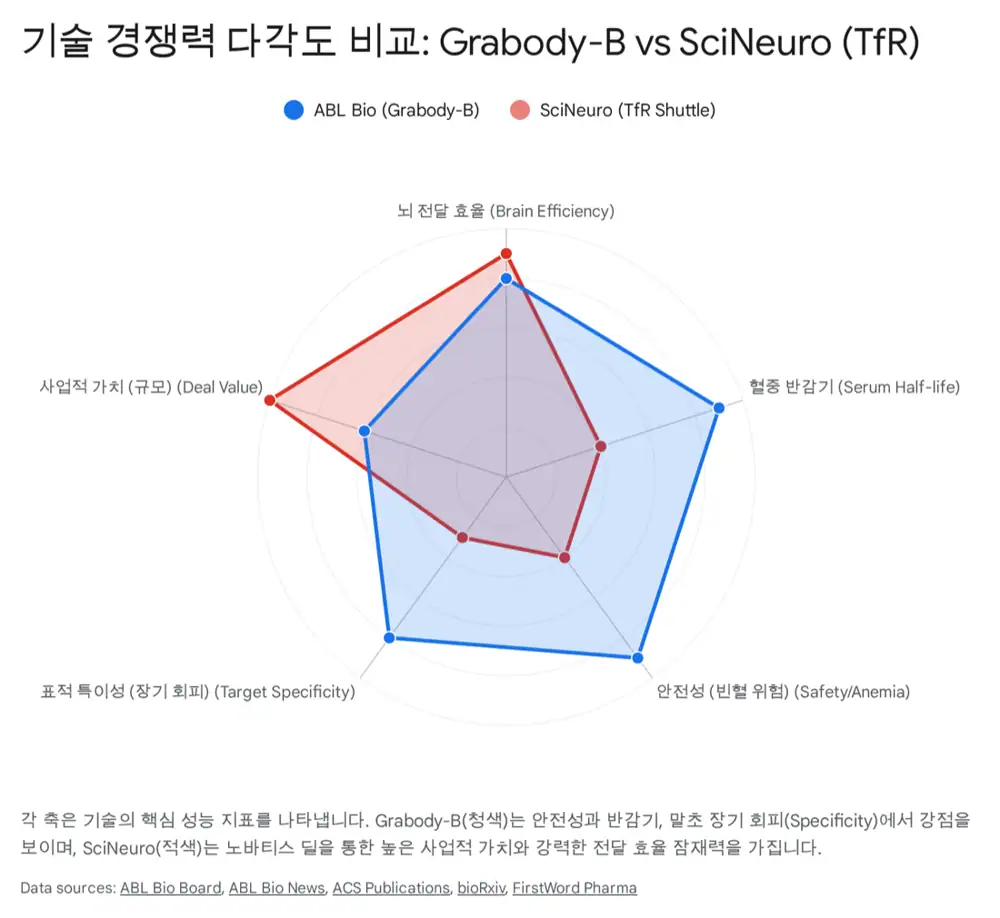
The latter half of the source compares ABL Bio's IGF1R-based Grabody-B platform with SciNeuro's presumed TfR-based shuttle. The point is that even within RMT, receptor choice changes safety, peripheral sink, half-life, and clinical risk.
| Item | ABL Bio | SciNeuro |
|---|---|---|
| Representative pipeline | ABL301 | Anti-Aβ program, SNP837 |
| Indication | Parkinson's disease | Alzheimer's disease |
| Payload | Alpha-synuclein | Amyloid beta |
| Shuttle | Grabody-B, IGF1R-targeting | Proprietary shuttle, presumed TfR-based |
| Stage | U.S. Phase 1 completed, Sanofi-led Phase 2 expected | Preclinical and early development |
| Deal | Sanofi 2022 deal of about USD 1.06bn, USD 75m upfront | Novartis 2026 deal up to USD 1.7bn, USD 165m upfront |
Private elevator analogy
The source explains Grabody-B as binding an epitope different from the natural IGF1/IGF2 ligand site, reducing receptor signaling disruption.
Crowded subway analogy
TfR is broadly expressed across the body and on reticulocytes, so peripheral sink and anemia risk require careful engineering.
118 hours
The source cites ABL Bio data showing a roughly 118-hour half-life in a mouse model for Grabody-B.
6. What investors should watch
- Timing and early safety data for SNP234 Phase 1
- How much CSF drug concentration improves versus conventional antibodies
- Whether ARIA incidence stays low
- Whether Novartis expands the platform beyond Aβ into tau or other CNS targets
- Whether SciNeuro pursues a Nasdaq or Hong Kong IPO
The message from the deal is clear: the next Alzheimer battleground is not only the target, but the delivery technology. Biotechs with credible brain-entry platforms are becoming strategically more valuable.
Sources
- 원문 / Original: https://m.blog.naver.com/PostView.naver?blogId=star_of_self&logNo=224146640247
- AAIC Grabody-B abstract: https://alz.confex.com/alz/2025/meetingapp.cgi/Paper/103122
- NIH RMT receptor expression: https://pmc.ncbi.nlm.nih.gov/articles/PMC7376922/
- ABL Bio Grabody-B document: https://www.ablbio.com/ctrlDownload/document_download/board/623
- PubMed Grabody-B: https://pubmed.ncbi.nlm.nih.gov/36452865/
- Fierce Biotech SciNeuro-Novartis: https://www.fiercebiotech.com/clinical-data/novartis-pays-scineuro-165m-ticket-another-shuttle-brain
- PR Newswire SciNeuro-Novartis: https://www.prnewswire.com/news-releases/scineuro-and-novartis-enter-into-a-licensing-and-collaboration-agreement-for-next-generation-therapeutics-to-treat-alzheimers-disease-302658400.html
- Cure Alzheimer's Fund Guojun Bu: https://curealz.org/researchers/guojun-bu/
- HKUST Guojun Bu: https://life-sci.hkust.edu.hk/team/guojun-bu/
- NIH TREM2 antibody: https://pmc.ncbi.nlm.nih.gov/articles/PMC10474563/
- ResearchGate TREM2 paper: https://www.researchgate.net/publication/390110488_Enhancing_TREM2_expression_activates_microglia_and_modestly_mitigates_tau_pathology_and_neurodegeneration
- SciNeuro pipeline: https://scineuro.com/pipeline/
- SciNeuro-Novartis company release: https://scineuro.com/scineuro-and-novartis-enter-into-a-licensing-and-collaboration-agreement-for-next-generation-therapeutics-to-treat-alzheimers-disease/
- SciNeuro SNP318 phase 1 release: https://scineuro.com/scineuro-completes-dosing-in-its-phase-1-clinical-trial-of-snp318-an-oral-therapeutic-for-alzheimers-disease-and-other-neurodegenerative-diseases/
- ACS Molecular Pharmaceutics TfR antibody: https://pubs.acs.org/doi/abs/10.1021/acs.molpharmaceut.8b00730
- bioRxiv VNAR TfR1: https://www.biorxiv.org/content/10.1101/816900v2.full-text
- MDPI TfR1 BBB delivery: https://www.mdpi.com/1422-0067/26/19/9793
- Larvol SAR446159: https://delta.larvol.com/Products/?ProductId=e6142673-c950-475f-939f-eaa0e3230ca9
- Korea Biomedical Review ABL301: https://www.koreabiomed.com/news/articleView.html?idxno=28799
- ABL Bio news: https://ablbio.com/en/company/news/54?
- Wilson Sonsini Sanofi-ABL Bio: https://www.wsgr.com/en/insights/wilson-sonsini-advises-abl-bio-on-global-collaboration-license-agreement-with-sanofi.html
- FirstWord Novartis bet: https://firstwordpharma.com/story/7058163
- Goodwin SciNeuro-Novartis: https://www.goodwinlaw.com/en/news-and-events/news/2026/01/announcements-lifesciences-goodwin-advises-scineuro-in-entering
- BioSpace Novartis-SciNeuro: https://www.biospace.com/deals/novartis-makes-1-5b-alzheimers-play-with-chinas-scineuro
- FirstWord SciNeuro financing: https://firstwordpharma.com/story/6722642
- SEC Adagene filing: https://www.sec.gov/Archives/edgar/data/1818838/000104746921000256/a2242871zf-1a.htm
- Pharmaceutical Technology JPM26: https://www.pharmaceutical-technology.com/analyst-comment/jpm26-novartis-strengthens-neuroscience-portfolio-with-bolt-on-deals/
- Clinical Trials Arena AD market: https://www.clinicaltrialsarena.com/analyst-comment/alzheimers-disease-market-17bn-8mm-2033/
- Towards Healthcare AD market: https://www.towardshealthcare.com/insights/alzheimers-therapeutics-market-sizing
- Research Nester AD market: https://www.researchnester.com/reports/alzheimers-disease-therapeutics-market/7599
- Biocytogen TfR1 CD98HC: https://biocytogen.com/blogs/breaking-barriers-tfr1-and-cd98hc-as-dual-gateways-to-the-brain
- Cyagen BBB models: https://www.cyagen.com/cyagen-lab-notes/cns-bbb-models
- Roche AAIC 2025: https://www.roche.com/media/releases/med-cor-2025-07-28
- PubMed dual TfR CD98hc: https://pubmed.ncbi.nlm.nih.gov/40705600/
- Biocytogen BBB shuttle antibodies: https://biocytogen.com/blogs/bbb-shuttle-antibodies-cns-drug-delivery
- General Atlantic SciNeuro launch: https://www.generalatlantic.com/media-article/scineuro-pharmaceuticals-launches-to-bring-innovative-treatments-for-cns-diseases/
- PR Newswire SciNeuro financing: https://www.prnewswire.com/news-releases/scineuro-pharmaceuticals-announces-53-million-financing-to-further-advance-pipeline-of-therapies-for-neurodegenerative-diseases-and-appointment-of-chief-financial-officer-302632639.html
- BioPharma Dive SciNeuro financing: https://www.biopharmadive.com/news/scineuro-biotech-arch-lav-capital-raise-neuro-drug/807076/
- PMC SNP234: https://pmc.ncbi.nlm.nih.gov/articles/PMC12741480/
- SciNeuro SNP614 MJFF: https://scineuro.com/scineuro-pharmaceuticals-to-accelerate-novel-lrrk2-therapeutic-snp614-development-with-an-award-from-the-michael-j-fox-foundation/
- bioRxiv dual targeting PDF: https://www.biorxiv.org/content/10.1101/2025.03.24.645085v1.full.pdf
- PMC restoring brain barriers: https://pmc.ncbi.nlm.nih.gov/articles/PMC12243347/
- ClinicalTrials.gov NCT07199777: https://clinicaltrials.gov/study/NCT07199777
- LeadIQ SciNeuro overview: https://leadiq.com/c/scineuro-pharmaceuticals/61b3b7ca3ce4facddb142804
- Roche AD/PD 2025: https://www.roche.com/media/releases/med-cor-2025-04-03
- Pharmaceutical Technology SciNeuro-Novartis: https://www.pharmaceutical-technology.com/news/scineuro-novartis-global-licensing-deal/
- Hankyung Novartis-SciNeuro: https://www.hankyung.com/amp/202601137117i
- O'Melveny SciNeuro financing: https://www.omm.com/news/press-releases/o-melveny-advises-scineuro-in-us-53-million-financing/
- BCC Research AD diagnostics market: https://www.bccresearch.com/pressroom/phm/global-alzheimers-disease-therapeutics-and-diagnostics-market
- MedPath Trontinemab: https://trial.medpath.com/news/520a9aa4a5042a23/roche-s-trontinemab-shows-92-success-rate-in-clearing-alzheimer-s-amyloid-plaques