DEEP RESEARCH · FOOD POLICY
2025-2030 U.S. Dietary Guidelines: Real Food Shift and Food-Stock Repricing
An industry report on ultra-processed-food pressure, protein and full-fat dairy reappraisal, SNAP and school-meal enforcement, and the kimchi/K-Food opportunity
0. Bottom Line First
My core view is that the 2025-2030 U.S. Dietary Guidelines are not just health advice. They are a policy event that can force food companies to redesign products and portfolios through public procurement and welfare spending.
- The guidelines released on January 7, 2026 put “Real Food” and the MAHA agenda at the center, increasing pressure on ultra-processed foods, added sugar, and refined grains.
- The protein recommendation rises from 0.8g/kg to 1.2-1.6g/kg, while red meat, poultry, eggs, and dairy are reappraised as high-quality nutrient-dense foods.
- Added sugar moves from less than 10% of daily calories to less than 10g per meal; the source notes that one 12-ounce soda contains about 39g of sugar, roughly four times the per-meal limit.
- Policy beneficiaries skew toward meat, egg, and fermented-food names such as Tyson, Hormel, Cal-Maine, and kimchi companies, while pressure rises on processed-food and beverage firms such as Coca-Cola, PepsiCo, General Mills, Kraft Heinz, and Mondelez.
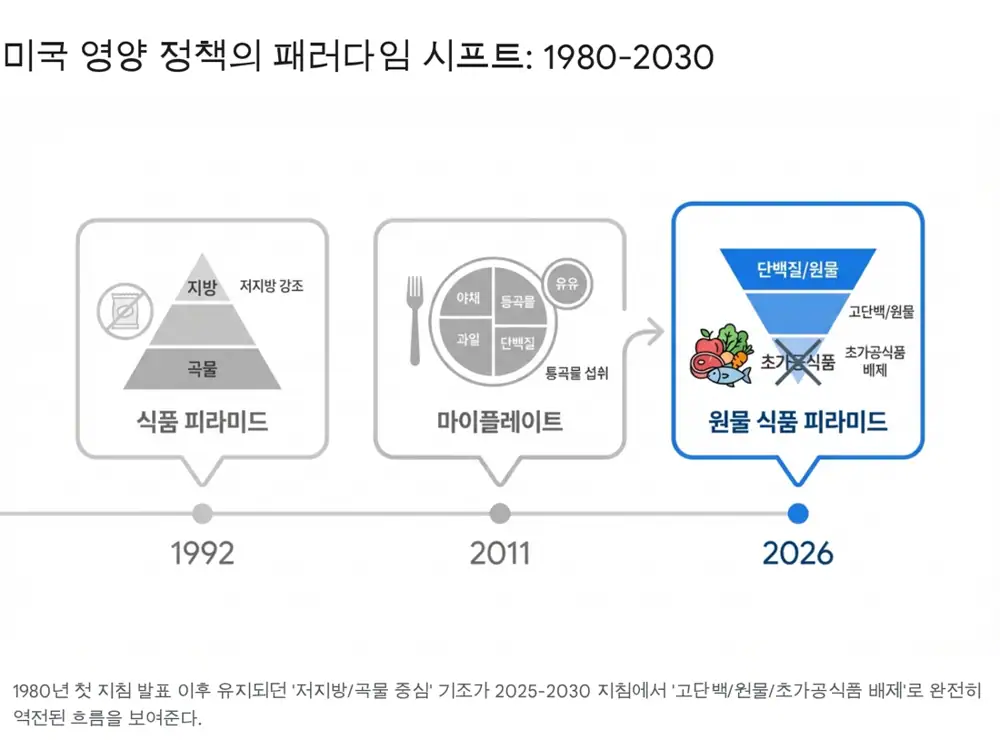
1. Policy Paradigm: From Low-Fat Grains to Real Food
Official fact: The source says HHS Secretary Robert F. Kennedy Jr. and USDA Secretary Brooke Rollins jointly announced the 2025-2030 Dietary Guidelines for Americans in Washington, D.C. on January 7, 2026.
The source frames the guidelines as a rejection of roughly 40 years of low-fat, grain-centered nutrition policy and the policy embodiment of the Trump administration's “Make America Healthy Again” campaign. It also interprets the policy as a macroeconomic restructuring effort that starts from the idea that about 90% of U.S. healthcare costs are spent on diet-related chronic disease treatment, and aims to move supply chains away from Big Food's processed-food model toward whole foods.
2. Core Nutrition Changes: Four Pillars
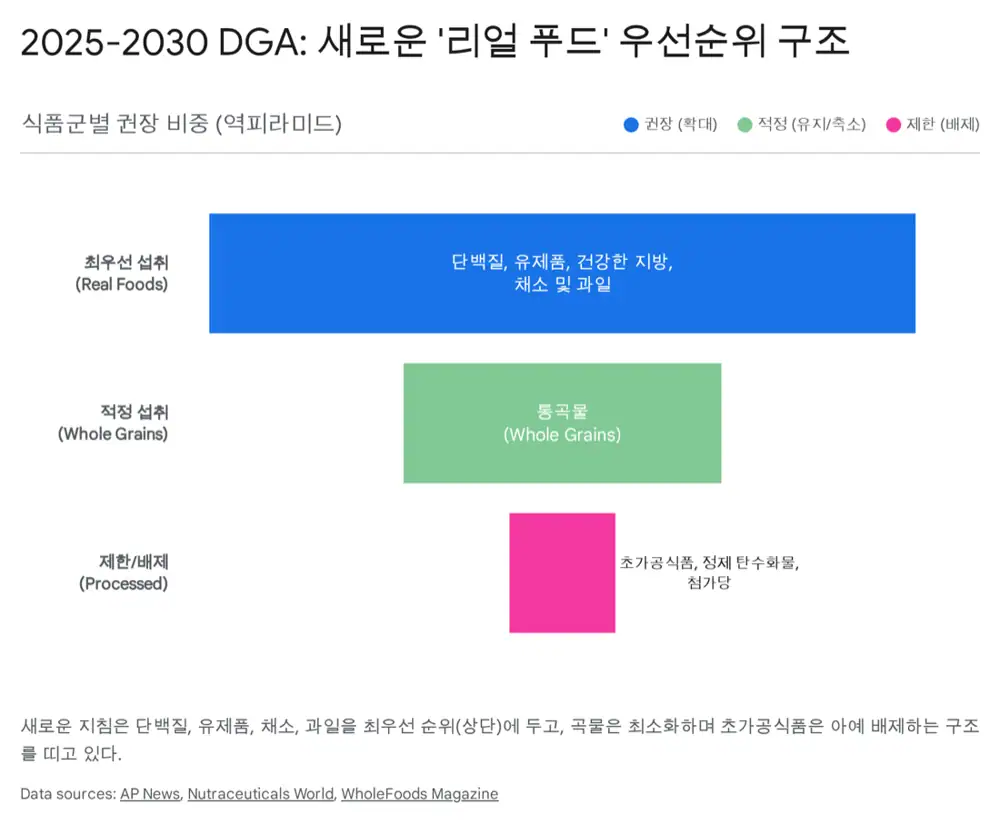
| Category | 2020-2025 guideline | 2025-2030 guideline | Main impact |
|---|---|---|---|
| Protein | 0.8g/kg recommended | 1.2-1.6g/kg | Beneficiary logic for Tyson, Hormel, Cal-Maine and other meat/egg companies |
| Sugar | Less than 10% of total daily calories | Less than 10g per meal | Pressure on Coca-Cola, PepsiCo, General Mills, Mars |
| Fat | Low-fat or fat-free dairy preferred | Full-fat dairy allowed, animal fats reappraised | Beneficiary logic for dairy, butter, and cheese producers |
| Processed food | Weak explicit limit | Strong advice to avoid ultra-processed foods | Pressure on Kraft Heinz, Mondelez, Kellogg |
| Keyword | Nutrition balance | Eat Real Food | Beneficiary logic for Whole Foods Market, Sprouts, kimchi and fermented foods |
Ultra-processed foods are the largest target. The source says the guidelines recommend avoiding salty or sweet packaged foods, prepared foods, and ready-to-eat items such as chips, cookies, and candy, linking them to obesity, diabetes, and cardiovascular disease. The source says HHS aims to sharply reduce the ultra-processed-food share, which it describes as more than 50% of the American diet.
The inverted pyramid is also symbolic. Grains, the base of the old pyramid, move to the narrow bottom, while protein, healthy fats, vegetables, and fruit move to the center. Whole milk and full-fat dairy are allowed, refined seed oils such as soybean and corn oil face more negative perception, and traditional fats such as butter, lard, and olive oil return to the table in the source's interpretation.
3. Enforcement Mechanism: School Meals and SNAP
About 30 Million Children Daily
The National School Lunch Program is both a stable revenue channel and a way for food companies to shape future consumers.
Product-Level Sugar Limits
Strict added-sugar limits apply to categories such as cereal, yogurt, and flavored milk.
Weekly Aggregate Rule
Added sugar must be below 10% of weekly meal calories, and school-lunch sodium is to be cut by an additional 15% from current standards.
The source says, similar to California's “Real Food, Healthy Kids Act,” federal restrictions are strengthening against processed foods with additives such as Red 40, Yellow 5, and titanium dioxide in schools. That creates an environment where clean-label products are more likely to survive in school meals.
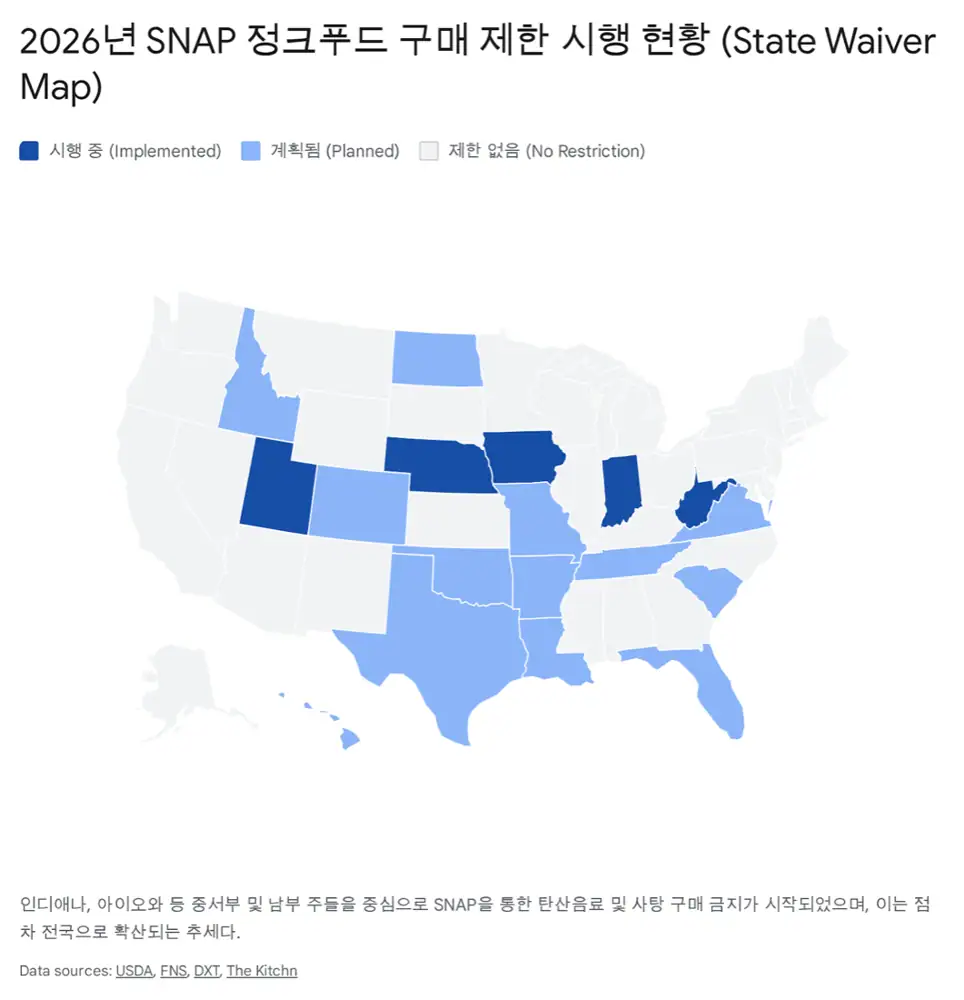
Official fact: The source describes SNAP as a low-income nutrition program with about $100 billion of annual purchasing power.
The USDA is pursuing SNAP reform by approving state waivers that restrict harmful-food purchases. The source says Indiana, Iowa, Utah, West Virginia, and Nebraska began banning soda, candy, and energy-drink purchases with SNAP cards on January 1, 2026, and that 13 more states, including Missouri, Texas, and South Carolina, are expected to join during 2026.
4. Winners and Losers: Food-Industry Polarization
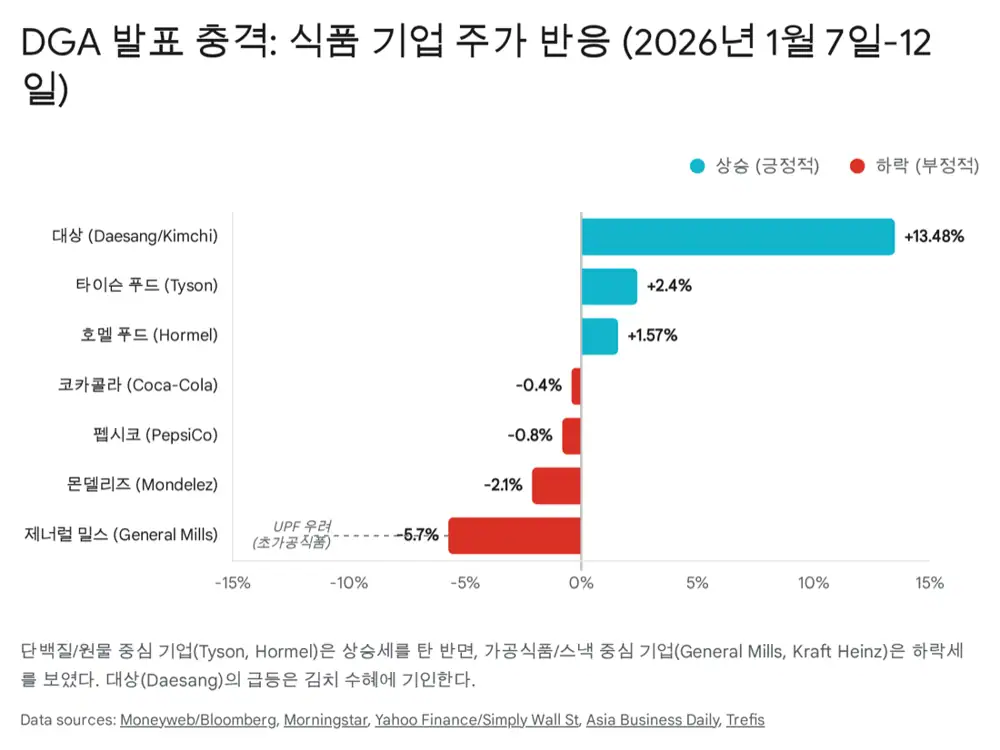
| Bucket | Main companies | Market reaction and logic in source |
|---|---|---|
| Processed food and beverages under pressure | PepsiCo, Coca-Cola, Mondelez, General Mills, Kraft Heinz | On January 7, 2026: General Mills -5.7%, Mondelez -2.1%, PepsiCo -0.8%, Coca-Cola -0.4%; Kraft Heinz hit a 52-week low |
| Meat and dairy beneficiaries | Tyson Foods, Hormel Foods, Cal-Maine Foods | Protein emphasis and fat reappraisal; the source says Tyson and Hormel rose for four consecutive days after the guideline release |
| Fermented-food beneficiaries | Daesang, Pulmuone, CJ CheilJedang | Kimchi was named as a recommended fermented food; the source says Daesang Holdings jumped 13.48% right after the announcement |
Processed-food companies face three risks: stigma from being officially framed as health enemies, sales decline from SNAP restrictions and tougher school-meal rules, and litigation/regulatory risk such as potential ultra-processed-food lawsuits in some local governments including San Francisco and warning-label legislation in Texas.
By contrast, meat and dairy companies benefit from a near-doubling of protein intake guidance and reduced fear of saturated fat, which can improve the sales environment for high-margin products such as steak, bacon, and butter. But these firms also need to focus on whole cuts and less-processed products because the guidelines prefer fresh meat over processed meat such as hot dogs and sausages.
5. Kimchi and K-Food: When Fermentation Becomes Policy Language
Official fact: The source says kimchi was named together with sauerkraut and kefir as a recommended fermented food for gut health.
This can move kimchi from a niche Asian-grocery product to a functional health food. The source's marketing point is that U.S. consumers may begin to treat kimchi like yogurt or kombucha: something intentionally consumed for health.
Local Production and Mainstream Retail
The source says Daesang's U.S. plant and channels such as Walmart and Costco position it to strengthen mainstream distribution.
Nasoya Brand
Pulmuone can use its Nasoya kimchi brand in the U.S. to emphasize a plant-based fermented-food image.
Low-Sodium, Vegan, Extensions
The source calls for lowering sodium concerns, adding vegan kimchi, emphasizing probiotic labeling, and expanding into kimchi sauce and seasoning.
6. Corporate Response: Reformulation and Portfolio Reshaping
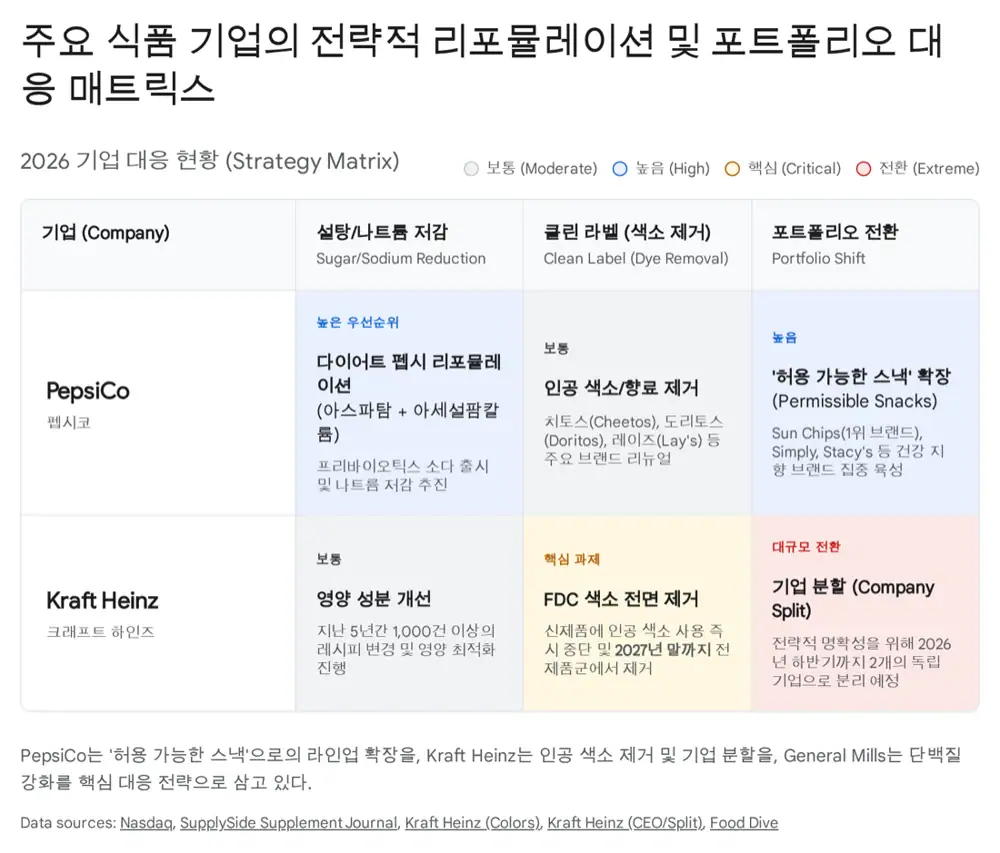
| Company or strategy | Source detail | Meaning |
|---|---|---|
| Kraft Heinz | Remove FD&C Colors such as Yellow 5 and Red 40 from U.S. products by the end of 2027, and stop using them immediately in new U.S. products | Preemptive acceptance of MAHA concerns about artificial colors |
| Natural colors | Turmeric, beet juice, spirulina | Substitutes to preserve product appearance after dye removal |
| PepsiCo | Change Diet Pepsi sweetener mix to aspartame plus acesulfame potassium, and release dye-free/low-sodium versions of Cheetos and Doritos | Preserve snack-market power while expanding permissible-snack lines |
| Sugar alternatives | Allulose, monk fruit, stevia, and food tech that delivers sweetness with less sugar | Core R&D area for the 10g rule |
| General Mills & Kellogg | Rebrand cereal with added soy or whey protein | Meet school-meal protein standards and recover adult breakfast demand |
Kraft Heinz's potential split is also symbolic. The source interprets separating the higher-growth, relatively less-processed sauces and condiments business from North American grocery brands such as Oscar Mayer, Mac & Cheese, and Lunchables as a financial-engineering response to isolate regulated assets from better assets. Large-company M&A may also move toward brands with real-food images, such as Simple Mills and Primal Kitchen.
7. Final Read
Interpretation: The 2025-2030 Dietary Guidelines force a shift from selling convenience to selling health and transparency. In the near term, processed-food companies may face higher R&D, ingredient replacement, supply-chain adjustment costs, and sales pressure, increasing share-price volatility. Meanwhile, companies built around whole-food portfolios, meat, eggs, dairy, kimchi, and fermented foods can treat the change in policy language as a growth opportunity.
For Korean companies, kimchi's fermentation and plant-based identity match what the U.S. government is encouraging. Public-meal market entry, locally adapted products, and low-sodium, vegan, probiotic-label strategies could help K-Food grow from a trend into a durable food-culture category.
Sources
- Original Naver Blog post: https://m.blog.naver.com/PostView.naver?blogId=star_of_self&logNo=224145387663
- US redraws its food map. Is India ready to learn?: https://www.indiatoday.in/health/story/new-dietary-guidelines-for-americans-and-message-it-has-for-india-2848782-2026-01-08
- Perspectives from the UC Davis Department of Nutrition on the 2025-2030 Dietary Guidelines for Americans: https://nutrition.ucdavis.edu/news/perspectives-department-nutrition-dietary-guidelines-americans-2025-2030
- New dietary guidelines urge Americans to avoid processed foods and added sugar: https://apnews.com/article/dietary-guidelines-health-agriculture-federal-nutrition-2d8fa56be3c5900fc45116af7c69d786
- Fact Sheet: Trump Administration Resets U.S. Nutrition Policy, Puts Real Food Back at the Center of Health | HHS.gov: https://www.hhs.gov/press-room/fact-sheet-historic-reset-federal-nutrition-policy.html
- New US dietary guidelines urge people to avoid processed foods, added sugar: https://indianexpress.com/article/world/new-us-dietary-guidelines-urge-people-to-avoid-processed-foods-added-sugar-10460833/
- The Uncompromised Dietary Guidelines for Americans, 2025–2030 - Center for Science in the Public Interest: https://www.cspi.org/sites/default/files/2026-01/20260107_CSPI_uncompromisedDGA_report_4_FINAL.pdf
- Lessons from the new U.S. Dietary Guidelines for Americans - CAP Reform: https://capreform.eu/lessons-from-the-new-u-s-dietary-guidelines-for-americans/
- Digesting the New Dietary Guidelines with Key Takeaways for Regulated Entities | Akin: https://www.akingump.com/en/insights/alerts/digesting-the-new-dietary-guidelines-with-key-takeaways-for-regulated-entities
- 2025-2030 Dietary Guidelines for Americans Released: https://www.cacfp.org/2026/01/08/2025-2030-dietary-guidelines-for-americans-released/
- New dietary guidance pushes whole milk, warns against processed food: https://www.washingtonpost.com/health/2026/01/06/new-dietary-guidelines-whole-foods/
- New US Food Guidelines Prioritize Emissions-Intensive Meat and Dairy Industries: https://earth.org/new-us-food-guidelines-prioritize-emissions-intensive-meat-and-dairy-industries/
- US to urge Americans to cut down on added sugars in new diet guidelines - Moneyweb: https://www.moneyweb.co.za/news/international/us-to-urge-americans-to-cut-down-on-added-sugars-in-new-diet-guidelines/
- New federal dietary guidelines, which shape school meals, recommend first limits on highly processed food - EdNC: https://www.ednc.org/1-07-2026-new-dietary-guidelines-for-americans-which-shape-school-meals-recommend-first-limits-on-highly-processed-food/
- Bryan Johnson shares longevity tweaks on the new HHS-recommended food pyramid for Americans: https://www.hindustantimes.com/lifestyle/health/bryan-johnson-shares-longevity-tweaks-on-the-new-hhs-recommended-food-pyramid-for-americans-101768028784240.html
- New Dietary Guidelines Focus on Whole Foods, Protein, and Caution Against Ultra-Processed Foods - Nutraceuticals World: https://www.nutraceuticalsworld.com/breaking-news/new-dietary-guidelines-focus-on-whole-foods-protein-and-caution-against-ultra-processed-foods/
- New dietary guidelines: More protein, fewer ultra-processed foods: https://www.k12dive.com/news/new-dietary-guidelines-more-protein-fewer-ultra-processed-foods/809040/
- Here is what is in new dietary guidelines from the Trump administration | PBS News: https://www.pbs.org/newshour/health/heres-whats-in-new-dietary-guidelines-from-the-trump-administration
- Implementation Timeline for Updating The School Meal Standards Final Rule: https://fns-prod.azureedge.us/sites/default/files/resource-files/cn-implementation-timeline-infographic-042424.pdf
- Implementation Timeline for Updated Nutrition Requirements in School Meals: https://www.fns.usda.gov/cn/school-nutrition-standards-updates/implementation-timeline-school-meals
- A First-Of-Its-Kind California Law Takes Aim At Ultra-Processed Foods: https://www.tastingtable.com/2070341/california-food-law-ultra-processed-school-lunch-2026/
- Trump administration advises more protein, less sugar in new dietary guidelines By Reuters: https://www.investing.com/news/commodities-news/trump-administration-advises-more-protein-less-sugar-in-new-dietary-guidelines-4435502
- SNAP Food Restriction Waivers - USDA Food and Nutrition Service: https://www.fns.usda.gov/snap/waivers/foodrestriction
- New SNAP Food Restrictions in 2026: 18 States to Ban Soda, Candy, and Junk Food: https://dxtadaptado.com/en/new-snap-food-restrictions-in-2026-18-states-to-ban-soda-candy-and-junk-food/
- Secretary Rollins Signs Six New State Waivers to Make America Healthy Again by Removing Unhealthy Foods from SNAP in Hawaii, Missouri, North Dakota, South Carolina, Virginia, and Tennessee | USDA: https://www.usda.gov/about-usda/news/press-releases/2025/12/10/secretary-rollins-signs-six-new-state-waivers-make-america-healthy-again-removing-unhealthy-foods
- Kraft Heinz and Mondelez shares drop as Trump officials blast ultraprocessed foods and unveil new food pyramid | Morningstar: https://www.morningstar.com/news/marketwatch/20260107214/kraft-heinz-and-mondelez-shares-drop-as-trump-officials-blast-ultraprocessed-foods-and-unveil-new-food-pyramid
- Label Alert for January 2026: https://www.primelabel.com/labelalert/la202601.html
- Hormel Foods Corporation Stock Price: Quote, Forecast, Splits & News (HRL) - Perplexity: https://www.perplexity.ai/finance/HRL
- Tyson Foods Stock Price Forecast. Should You Buy TSN? - StockInvest.us: https://stockinvest.us/stock/TSN
- Eat kimchi: US dietary guidelines highlight fermented foods - The Korea Times: https://www.koreatimes.co.kr/world/20260109/eat-kimchi-us-dietary-guidelines-highlight-fermented-foods
- US dietary guideline recommends kimchi for 1st time, as real food is emphasized: https://www.koreaherald.com/article/10652475
- Market Focus: Kimchi Stocks Surge as Kimchi Included for the First Time in Official U.S. Dietary Guidelines for Gut Health - 아시아경제: https://cm.asiae.co.kr/en/article/2026010909521524325
- Kimchi-related stocks are soaring after the U.S. government officially announced that it recommends kimchi - MK: https://www.mk.co.kr/en/stock/11927864
- Kraft Heinz Commits to Remove FD&C Colors From Its U.S. Portfolio Before the End of 2027 and Will Not Launch New Products in the U.S. With FD&C Colors, Effective Immediately: https://news.kraftheinzcompany.com/press-releases-details/2025/Kraft-Heinz-Commits-to-Remove-FDC-Colors-From-Its-U-S--Portfolio-Before-the-End-of-2027-and-Will-Not-Launch-New-Products-in-the-U-S--With-FDC-Colors-Effective-Immediately/default.aspx
- PepsiCo Rolling Out Reformulated Diet Pepsi - SupplySide Supplement Journal: https://www.supplysidesj.com/weight-management/pepsico-rolling-out-reformulated-diet-pepsi
- PepsiCo PFNA Struggles: Can Permissible Snacks Revive Volumes? - Nasdaq: https://www.nasdaq.com/articles/pepsicos-pfna-struggles-can-permissible-snacks-revive-volumes
- The food and beverage trends to watch in 2026 | Food Dive: https://www.fooddive.com/news/food-beverage-trends-2026/809061/
- Kraft Heinz split may come too late to fend off growing MAHA threat: https://bbc.bm/kraft-heinz-split-may-come-too-late-to-fend-off-growing-maha-threat
- The Kraft Heinz Company Names Steve Cahillane Chief Executive Officer: https://news.kraftheinzcompany.com/press-releases-details/2025/The-Kraft-Heinz-Company-Names-Steve-Cahillane-Chief-Executive-Officer/default.aspx