DEEP RESEARCH · DEEPX
DEEPX: A Game Changer for the On-Device AI Era
A private AI fabless review centered on Samsung 2nm GAA, Gaonchips, DX-M1/DX-M2, and the IPO roadmap.
0. Bottom line first
DEEPX's thesis is that as AI shifts from cloud training toward edge inference, low-power NPUs and the Samsung Foundry-Gaonchips collaboration model can be leveraged together. But as a private fabless company, cash flow, 2nm yield, and conversion of customer PoCs into mass production are the key tests.
1. Paradigm: from training GPUs to edge inference NPUs
The source argues that NVIDIA GPUs led LLM training over the past five years, but the market is shifting toward running trained models on real-world devices. On-device AI addresses cloud AI bottlenecks around cost, power, latency, and security.
2. Samsung-Gaonchips-DEEPX triangle
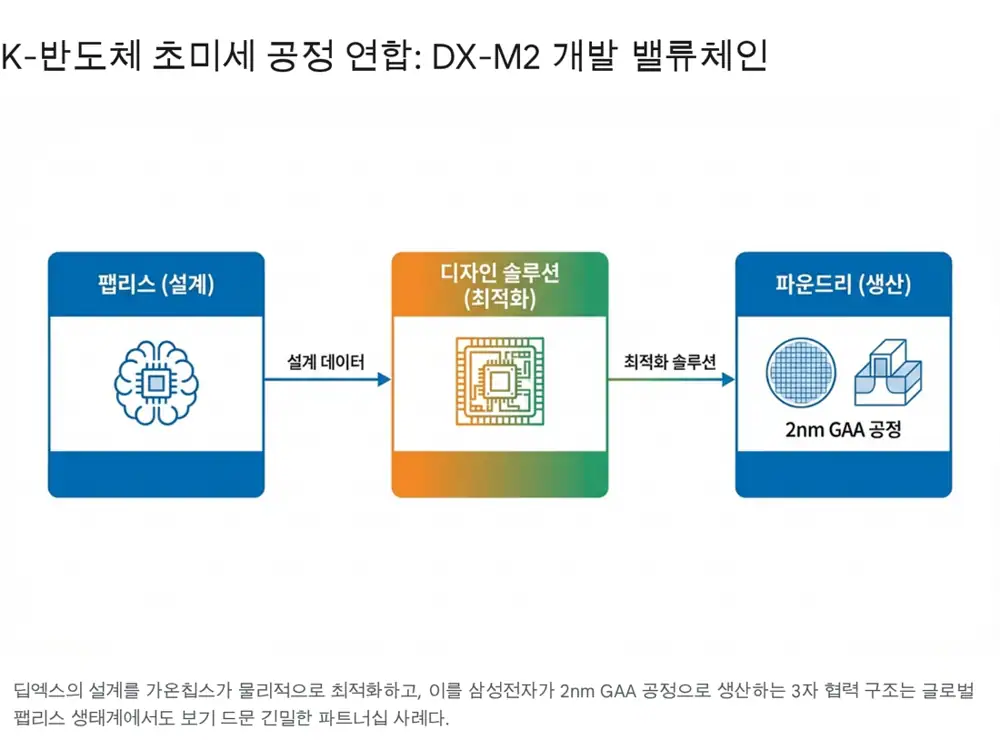
Official fact: The source describes the 2024 DEEPX-Samsung Foundry-Gaonchips agreement as a milestone for Korea's system semiconductor industry. The core plan is to implement DX-M2, a next-generation generative AI chip, on Samsung's 2nm SF2 GAA process.
NPU architecture
Designs AI semiconductors for power, heat, and size constraints at the edge.
Design solution
Turns logic into physical wafer implementation and links yield, packaging, and test.
From 5nm to 2nm
Builds on DX-M1 5nm experience and pushes DX-M2 toward 2nm GAA.
3. Technology moat: 2nm GAA, DX-M2, IQ8
Official fact: The source states Samsung's 2nm process can improve power efficiency by about 25% or more, performance by 12%, and area by 5% versus 5nm.
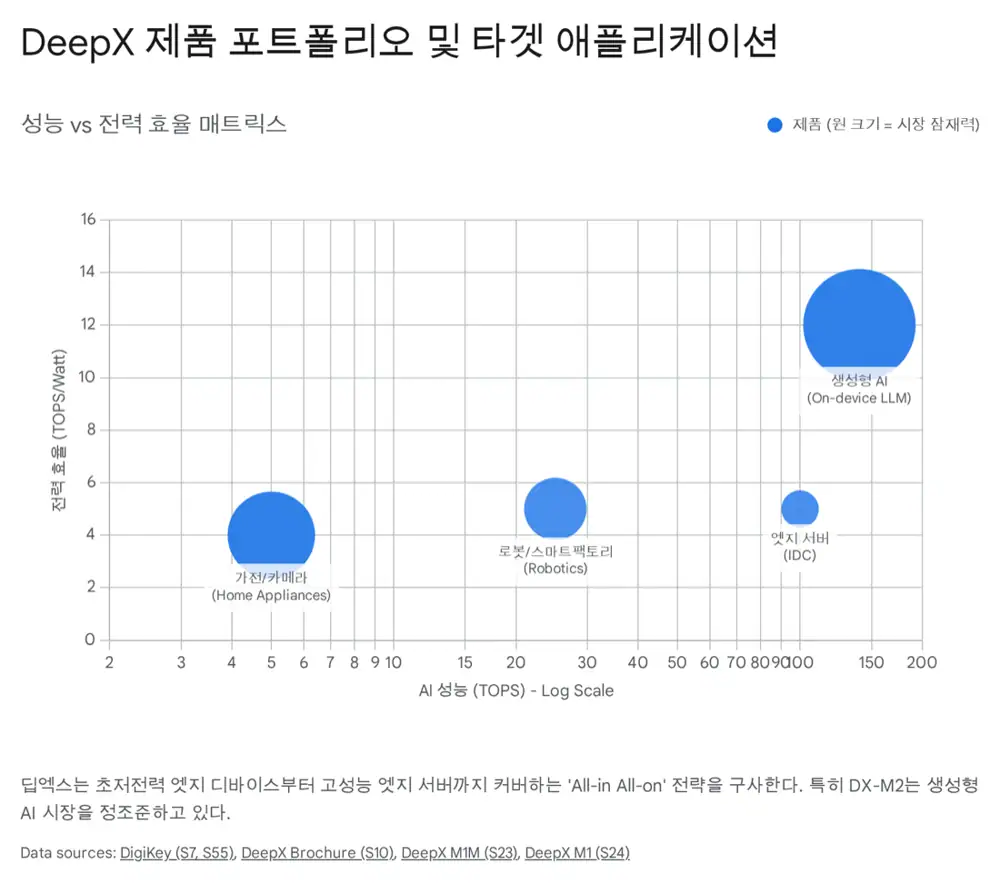
- DX-V1/DX-V3: vision-focused line for smart cameras, CCTV, and appliances.
- DX-M1: 5nm flagship product for robots, smart factories, and drones, presented as 25 TOPS at about 5W.
- DX-H1: inference accelerator card for edge servers and data centers.
- DX-M2: 2nm generative AI chip for on-device LLM and multimodal workloads, targeting 2027 mass production.
4. Financials and shareholders
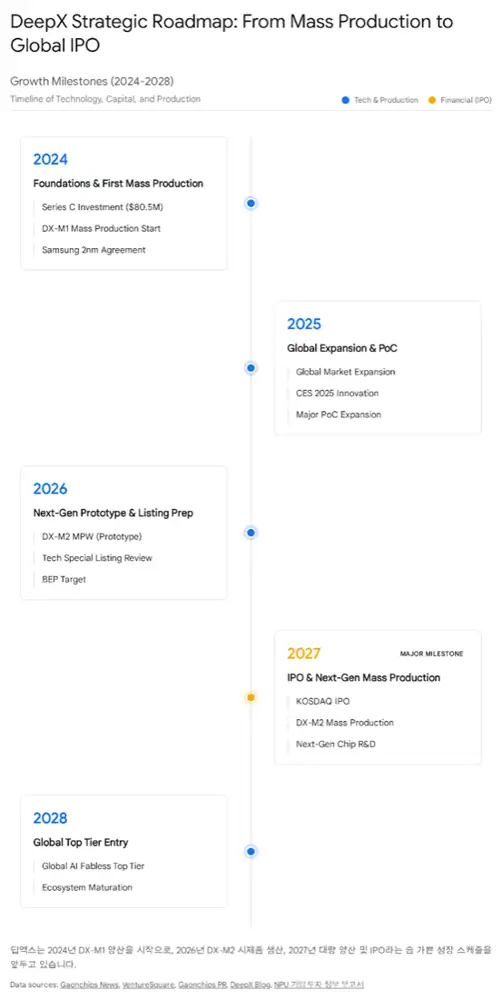
Official fact: DEEPX raised KRW 110bn, about USD 80.5mn, in Series C funding in May 2024. The source cites a post-money valuation of about KRW 529bn and cumulative funding above KRW 150bn.
| Area | Source view | Investor checkpoint |
|---|---|---|
| CFO | Still negative | Talent, EDA tools, MPW, and R&D costs |
| CFI | Negative due to 2nm and overseas expansion | CAPEX-like spending for future competitiveness |
| CFF | Large positive in 2024 from Series C | Runway for 2-3 years |
| IPO | Targets KOSDAQ in 2027 | Samsung Securities selected; tech-special listing possible |
5. Competition and growth strategy
Interpretation: If Rebellions and FuriosaAI lean more toward server inference and data centers, DEEPX is positioned around robots, appliances, smart cameras, and AIoT devices where power and price constraints are severe.
- United States: collaborates with big tech and security companies through a Silicon Valley entity.
- Greater China and Asia: targets smart-factory and AIoT demand in manufacturing hubs.
- Customer validation: Hyundai-Kia Robotics Lab, POSCO DX, Jahwa Electronics, and PoCs with over 120 global companies are mentioned.
- Policy: K-Cloud and the KRW 1tn AI semiconductor innovation/design center and fabless fund are presented as tailwinds.
6. Conclusion and risks
DEEPX is a candidate to move from promising startup to global fabless company in 2026-2028. The bull case is the opening of on-device AI, stable Samsung 2nm yield, and conversion of 120-plus PoCs into mass-production contracts. Risks are post-IPO overhang, dilution from additional funding while losses continue, and Samsung 2nm process delay or yield failure.
Sources
- Source 1: https://m.blog.naver.com/PostView.naver?blogId=star_of_self&logNo=224140942422
- Source 2: https://www.gaonchips.com/en/sub/news/view.php?idx=268
- Source 3: https://www.gaonchips.com/en/sub/news/view.php?idx=295
- Source 4: https://www.venturesquare.net/en/999685
- Source 5: https://www.bisinfotech.com/deepx-partners-with-samsung-for-2nm-ai-chip/
- Source 6: https://www.semiconductor-digest.com/deepx-signs-2nm-process-agreement-with-samsung-foundry-to-develop-worlds-first-on-device-generative-ai-chip-dx-m2/
- Source 7: https://www.youtube.com/watch?v=pRqMoy16kuU
- Source 8: https://www.smbom.com/news/32013
- Source 9: https://www.digikey.com/en/product-highlight/d/deepx/dx-m1-m2-ai-acceleration-module
- Source 10: https://deepx.ai/products/dx-m1m/
- Source 11: https://deepx.ai/products/dx-m1/
- Source 12: https://deepx.ai/wp-content/uploads/2025/05/09183545/DEEPX-AI-Accelerator-Products-E-Brochure_2025-0509.pdf
- Source 13: https://deepx.ai/products/dx-h1-v-npu/
- Source 14: https://www.edgeaifoundation.org/posts/new-strategic-partner-welcome-deepx-to-the-edge-ai-foundation
- Source 15: https://deepx.ai/company/our-story/
- Source 16: https://semiengineering.com/startup-funding-q2-2024/
- Source 17: https://www.youtube.com/watch?v=L8PhlC2xHe4
- Source 18: https://deepx.ai/
- Source 19: https://deepx.ai/deepx-ramps-up-mass-production-chip-supply-for-the-global-market-bolstering-tangible-business-expansion/
- Source 20: https://www.kedglobal.com/artificial-intelligence/newsView/ked202405100013
- Source 21: https://pitchbook.com/profiles/company/466596-82
- Source 22: https://www.prnewswire.com/news-releases/korean-semiconductor-industry-titans-back-deepx-in-series-c-funding-round-302141172.html
- Source 23: https://www.mk.co.kr/en/business/11012780
- Source 24: https://hardwarebee.com/news/deepx-secures-805m-funding-for-ai-advancement/
- Source 25: https://koreatechdesk.com/upstage-ipo-korea-ai-venture-policy-future-rebellions-deepx
- Source 26: https://koreatechdesk.com/rebellions-series-c-u-s-vc-backing-kindred-ventures-ttcp
- Source 27: https://biz.chosun.com/en/en-it/2025/03/10/J6CLVDM7TJFUVCDTGOBS6KGVRQ/
- Source 28: https://deepx.ai/category/press/
- Source 29: https://www.edge-ai-vision.com/2024/05/korean-semiconductor-industry-titans-back-deepx-in-series-c-funding-round/
- Source 30: https://drive.google.com/open?id=1-nyvYyXDg6_OQEiYAEMX9AX_EFgZ3ezpT7Pfhk0Ezqo
- Source 31: https://ideas.repec.org/a/eee/finana/v95y2024ipbs1057521924003429.html
- Source 32: https://www.lw.com/en/insights-landing/admin/upload/SiteAttachments/Demystifying-Convertible-Bonds-April-2024.pdf