DEEP RESEARCH · JAEYOUNG SOLUTEC
Jaeyoung Solutec: Nanophotonics Shift and Structural Turnaround
A Q·P·C improvement story driven by OIS adoption, Vietnam automation, and business restructuring
0. Bottom line first
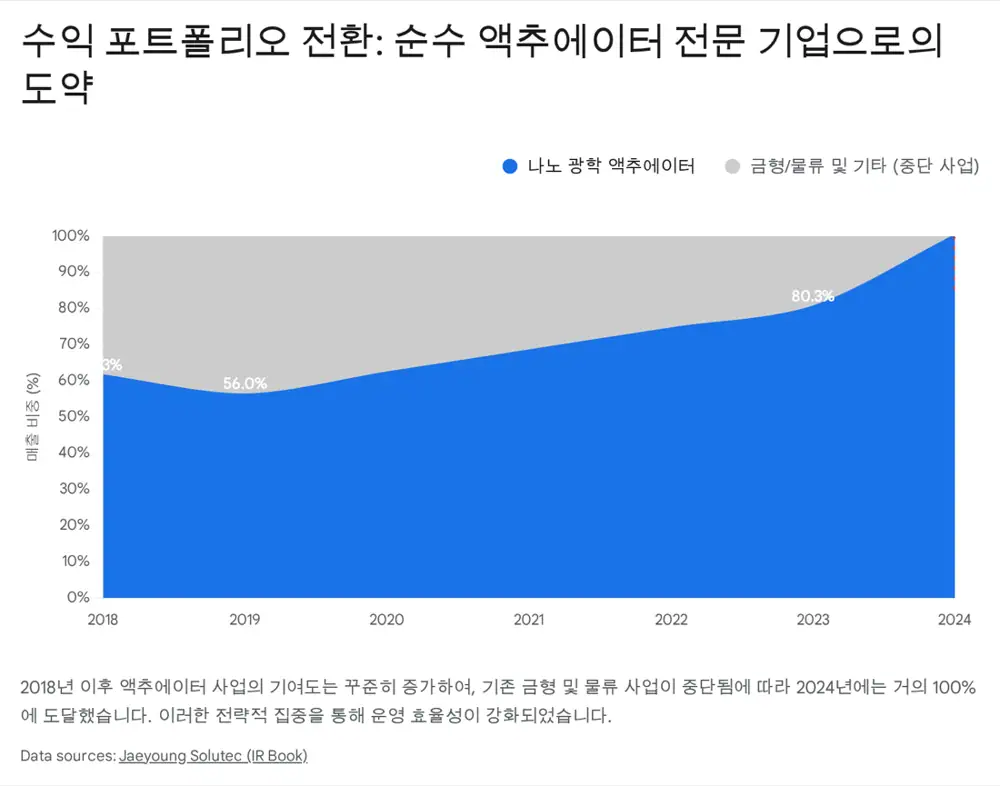
Jaeyoung Solutec has exited low-margin mold and logistics-equipment businesses and has effectively refocused on smartphone camera actuators, especially OIS-centered nanophotonics. The source frames 2025 as the first turnaround year and 2026 as the harvesting period.
1. Business shift: from plastics to nanophotonics
Official fact: The source says Jaeyoung Solutec was founded in 1976 and grew from plastic molds and injection molding, but classified and sold the mold and logistics-equipment businesses as discontinued operations in 2024.
Official fact: Actuator revenue, which was 61.3% of total revenue in 2018, is described as approaching 100% by 2024, creating a near pure-play structure.
2. Technology portfolio and production edge
Basic AF
A lens drive method using Lorentz force; simple structure and cost competitiveness make it useful for entry-level autofocus.
Precision control
A position-sensor-based method that detects lens position in real time and controls it through feedback.
Core growth axis
OIS moves the lens on X and Y axes as well as the Z axis to correct hand shake. The source emphasizes structural simplification and cost competitiveness versus ball-type OIS.
Official fact: Jaeyoung VINA is described as a 100%-owned subsidiary established in Hanoi, Vietnam in August 2016, with a 3,200-pyeong cleanroom and capacity for more than 10 million actuators per month.
Interpretation: A one-stop automated system covering cleaning, sub-assembly, full assembly, performance inspection, visual inspection, and final cleaning, together with a 99% yield, supports both cost and quality advantages.
3. End market: quality over volume
- Global smartphone shipments are described as stagnant at about 1.1-1.2 billion units per year.
- The smartphone camera actuator market is cited at about USD 3.7 billion in 2025, with a 2.3% CAGR through 2033.
- The foldable smartphone market is cited as expected to grow 30% YoY in 2026.
- The Galaxy S series is compared at about 30 million units per year, while the Galaxy A series is described as a mass model selling hundreds of millions of units.
4. 3Q 2025 results and valuation view
| Metric | 3Q 2025 |
|---|---|
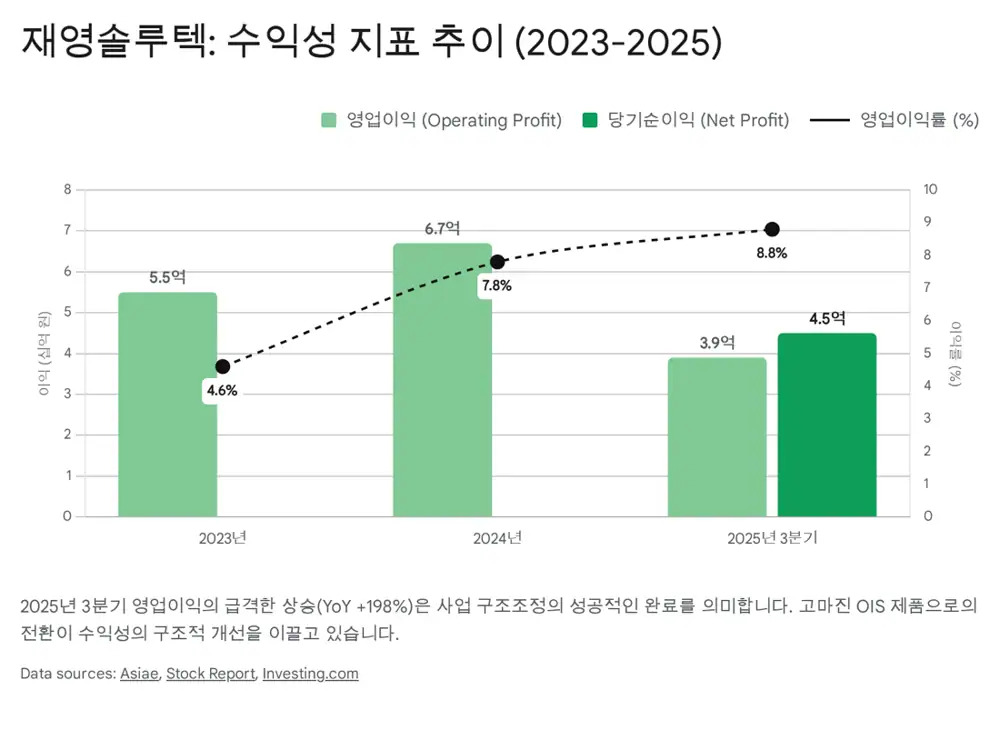
| Revenue | KRW 44.4bn, +82% YoY, excluding discontinued operations |
| Operating profit | KRW 3.9bn, +198% YoY, excluding discontinued operations |
| Net income | KRW 4.5bn, turned profitable |
| OIS revenue | More than tripled YoY |
The source presents an OIS revenue mix above 50% and annual OIS revenue of KRW 100bn through 2026 as possible re-rating grounds.
5. Risks and investment strategy
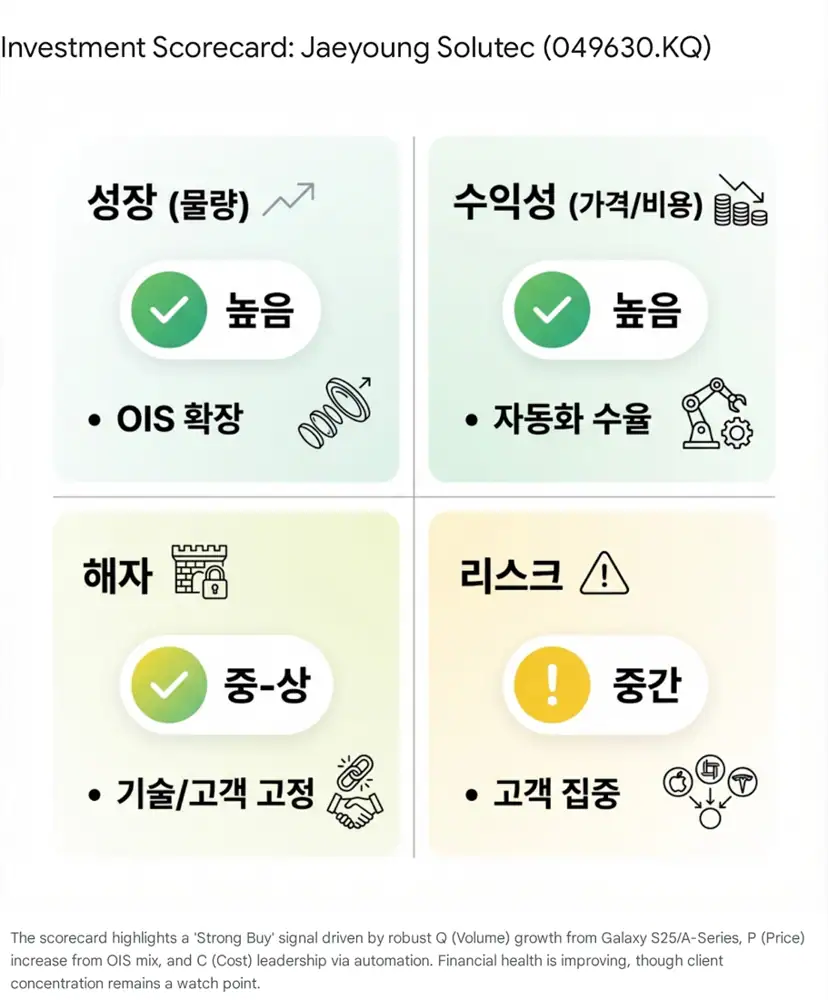
- Samsung Electronics dependence: smartphone sales weakness or vendor diversification could increase earnings volatility.
- Raw materials and FX: copper, rare-earth magnet prices, and Vietnam-subsidiary FX exposure need monitoring.
- Semiconductor supply shortage: the source flags possible smartphone production disruption from memory shortages in 2026.
Sources
- 원문 블로그
- Asiae Q3 operating profit
- Market Insights Report smartphone camera actuator
- Valuates smartphone camera actuator market
- Samsung Newsroom Galaxy A series
- IDC foldable smartphone market
- TelecomTV foldable market
- Jobpost Galaxy S25 actuator
- Newsprime Galaxy S25 actuator
- Investing.com Jahwa comparison
- MacTech 2026 smartphone shipments
- SamMobile memory shortage