DEEP RESEARCH · JS LINK/RARE-EARTH MAGNETS
JS Link: A Radical Pivot from Bio to Non-China Rare-Earth Permanent Magnets
A review of Kenji Konishi’s role, Japanese-style production, the Yesan plant, and logistics synergy with Juseong CN Air.
0. Bottom line first
The key point is that former genomic-analysis company DNA Link changed its name on March 26, 2025 and effectively rebuilt its identity around rare-earth permanent magnet manufacturing. The opportunity is the non-China supply gap in a market where China controls roughly 94% of the rare-earth permanent magnet chain; the risk is that a company with seven consecutive years of losses must survive capex, ramp-up yield, and financing pressure.
94% China dependence
China’s dominance in NdFeB magnets used in EVs, wind power, and defense creates demand for non-China sources.
Kenji Konishi and Japanese engineers
The company hired Japanese specialists to import tacit knowledge in high-performance sintered magnet production.
1,000-ton pilot-to-mass scale
The Yesan plant’s initial capacity is presented at 1,000 tons per year, with 42SH prototype success as the first milestone.
1. Why rare-earth permanent magnets
Official fact: The source states that China vertically integrates rare-earth mining, refining, and final permanent magnet manufacturing, controlling about 94% of the global market. The U.S. IRA and EU CRMA are presented as policy drivers pushing for non-China material sourcing and differentiated subsidies.
Interpretation: JS Link’s logic is not to beat China on cost. It is to become an alternative supplier when U.S. and European customers need a non-China source, using Korean manufacturing infrastructure and Japanese technology.
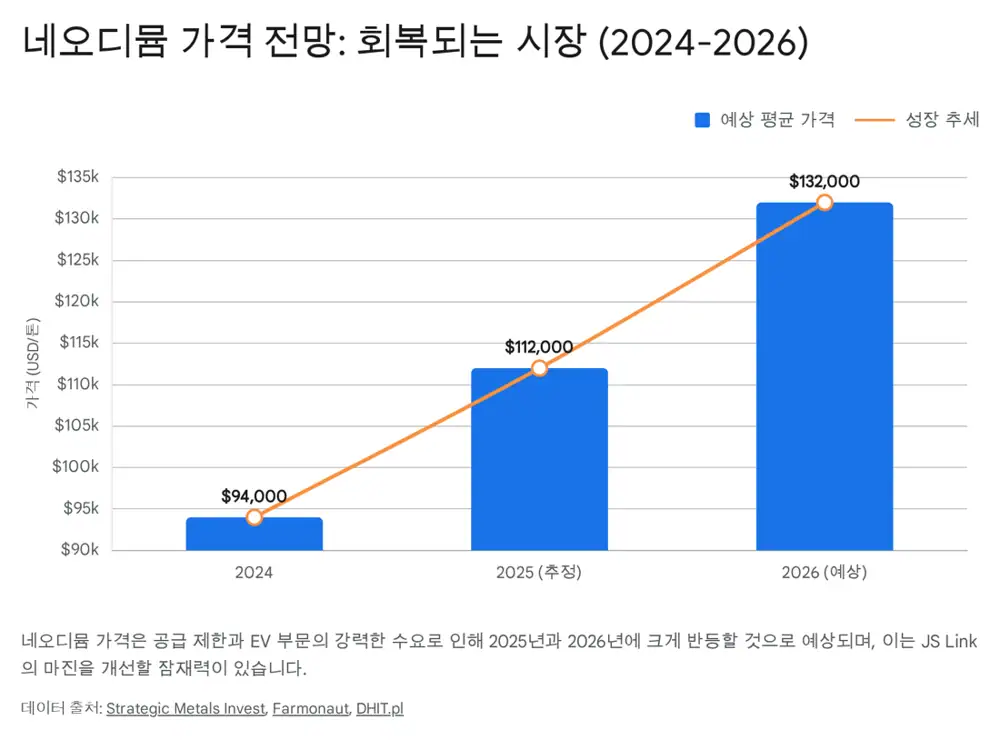
| Raw-material price outlook | Source figure | Meaning |
|---|---|---|
| 2024 neodymium price | About $94,000 per ton | Reference point after a correction from the peak |
| 2025 outlook | About $112,000 | Reflects EV/wind demand recovery and supply constraints |
| 2026 outlook | About $132,000 | Potential pricing upside and raw-material burden |
A rebound in neodymium and praseodymium prices can help inventory gains and selling prices, but it also makes stable sourcing essential. The source highlights cooperation with non-China suppliers such as Lynas Rare Earths as a key success variable.
2. Corporate transformation: from DNA Link to JS Link
Official fact: On March 26, 2025, the company changed its name from DNA Link to JS Link, Inc. As of Q3 2025, its articles of incorporation included permanent magnet and related applied-product production, sales, distribution, import/export as item 28 and rare-earth magnet recycling as item 29.
The former genomic-analysis business had reached financial limits after seven consecutive years of losses, while competition weakened growth prospects. This transition is closer to a survival pivot than optional diversification.
Official fact: In March 2025, former largest shareholder OrbitEc sold its stake to logistics company Juseong CN Air. Juseong CN Air is led by Jin-soo Park and specializes in sea and air freight forwarding, with North America logistics capabilities and potential use of LA/Long Beach port logistics centers.
Interpretation: Rare-earth magnets require a chain from raw-material imports from places such as Australia and Vietnam, to Korean processing, to U.S. and European exports. The new largest shareholder’s logistics capability is therefore closer to execution synergy than a passive financial investment.
3. Japanese technical leadership: Kenji Konishi and the engineering team
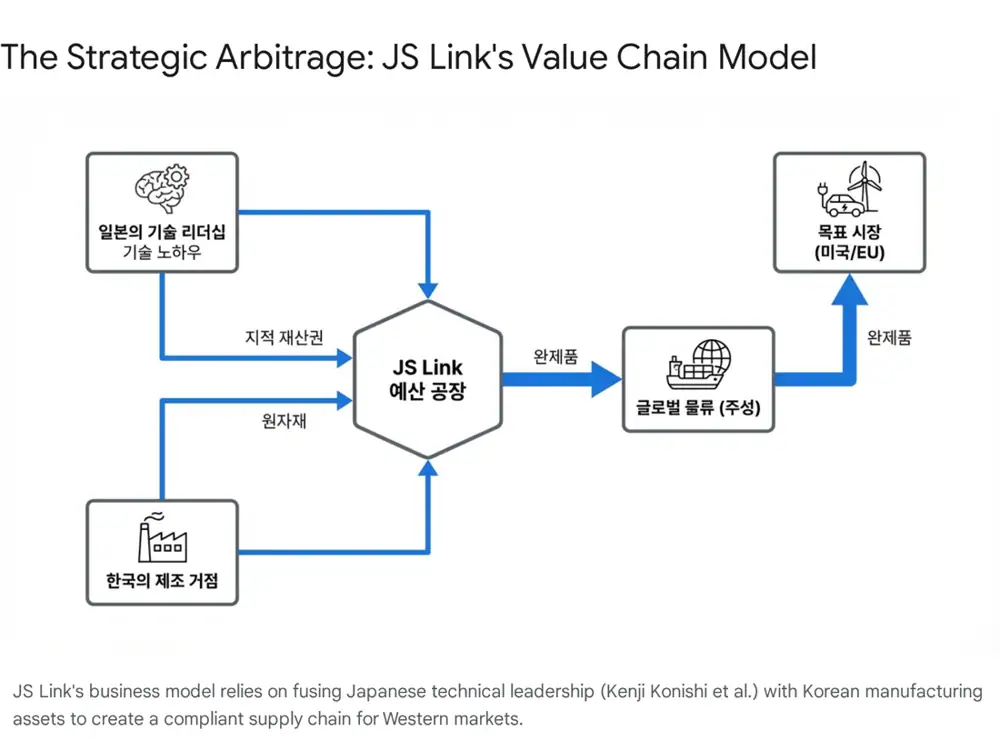
Official fact: JS Link hired rare-earth permanent magnet expert Kenji Konishi as vice president and inside director. The source describes him as a chemical engineering graduate who studied permanent magnets in graduate school and has practical experience across raw-material blending, sintering, and surface treatment.
Interpretation: The largest barrier is not buying equipment; it is the tacit knowledge of sintered magnet mass production. Because Japan, with companies such as Hitachi Metals, TDK, and Shin-Etsu Chemical, is one of the few countries outside China with advanced sintered magnet know-how, hiring Konishi is a shortcut to compress R&D and trial-and-error time.
4. Yesan plant and Japanese-style production line
Official fact: The company purchased a plant in Yesan, Chungnam for about KRW 10B and remodeled it as a dedicated production base. Key Japanese equipment includes Hosokawa Micron jet mills and ULVAC vacuum induction melting and sintering furnaces.
Powder uniformity determines magnetic properties, and rare-earth processing requires strict oxygen isolation. High-end Japanese equipment raises upfront costs, but it creates an environment familiar to the Japanese technical team and is intended to stabilize early yield.
Official fact: The original target was pilot production around late July 2025, but utility work such as electricity and gas was delayed by about one month after equipment-specification changes. The large melting furnace arrived through Pyeongtaek Port, and commissioning was underway.
Official fact: The source treats successful production of a 42SH permanent magnet prototype as the first milestone showing commercial product capability. 42SH is described as a general high-performance heat-resistant grade used in EV drive motors. Initial Yesan capacity is cited at 1,000 tons per year.
5. Supply chain and U.S. market strategy
To qualify as a non-China magnet, Korean final production is not enough; rare-earth oxide inputs also need non-China sourcing. That is why purchase negotiations with Lynas and the creation of multiple supply channels matter.
Official fact: JS Link established a U.S. subsidiary, JS LINK America, and remitted initial capital of $2M. The source also states that the company contracted Baker & Hostetler for U.S. government-relations activity and hired former Republican lawmakers as lobbyists.
Interpretation: This looks like an attempt to be included in U.S. supply-chain restructuring funds or manufacturing revival programs rather than simply exporting parts. Rare-earth magnets are a technology business, but also a policy, subsidy, and origin-certification business.
6. Risks and checklist
| Risk | Content | Indicator to watch |
|---|---|---|
| Financial fragility | High dependence on CBs and paid-in capital increases after seven years of losses | Financing terms, dilution, overhang |
| Scale-up | Pilot success and mass-production yield are different problems | 42SH qualification, yield, defect rate |
| Geopolitical two-sidedness | If U.S.-China tension eases or China-origin magnets enter through third countries, JS Link’s price disadvantage may widen | Origin rules, tariffs, customer qualification policy |
| Raw-material sourcing | Without non-China raw materials, the non-China magnet premium weakens | Formal supply contract with Lynas or similar suppliers |
Interpretation: The three core monitoring points are 1) a formal raw-material supply contract with Lynas, 2) 42SH qualification from global automakers, and 3) timing of real mass-production revenue. If these are confirmed, JS Link can become a meaningful candidate in the non-China rare-earth supply chain.
Sources
- Original post: https://m.blog.naver.com/PostView.naver?blogId=star_of_self&logNo=224139434391
- ESNews 희토류 영구자석 공급망: https://www.esnews.kr/news/articleView.html?idxno=621
- KIND 정정 사업보고서: https://kind.krx.co.kr/common/disclsviewer.do?method=searchInitInfo&acptNo=20250814002964&docno=
- supermagnete 네오디뮴 가격: https://www.supermagnete.de/eng/faq/What-is-the-development-of-neodymium-magnet-prices
- Farmonaut 네오디뮴/프라세오디뮴 가격 전망: https://farmonaut.com/mining/neodymium-price-praseodymium-price-per-ton-trends-2026
- Chosunbiz 100억원대 건물: https://biz.chosun.com/stock/market_trend/2025/03/31/RSUDWILF2NHCHK62QS64DB4Y3A/
- 더퍼블릭 주성씨앤에어 지원: https://www.thepublic.kr/news/articleView.html?idxno=247058
- Bloter 주성씨앤에어 장내매수: https://www.bloter.net/news/articleView.html?idxno=650905
- 뉴스드림 미국 로비활동: http://www.newsdream.kr/news/articleView.html?idxno=77257
- 부산파이낸셜뉴스 검색결과: https://busan.fnnews.com/search?search_txt=%ED%9D%AC%ED%86%A0%EB%A5%98%20%EC%98%81%EA%B5%AC%EC%9E%90%EC%84%9D
- ZUM 뉴스 유틸리티 공사 일정 조정: https://m.news.zum.com/articles/98948637/eb8d94ebb2a8-eca09cec9db4ec9790ec8aa4eba781ed81ac-ec9881eab5acec9e90ec849d-eab3b5ec9ea5-ec9ca0ed8bb8eba6aced8bb0-eab3b5ec82ac-ec9dbceca095-eca1b0eca095
- 머니투데이 공급망 확보: https://www.mt.co.kr/stock/2025/11/17/2025111709029670338
- 한국경제 52주 신고가: https://www.hankyung.com/article/202509228553L
- 그린이코노미 오르비텍 M&A: https://www.greened.kr/news/articleView.html?idxno=335123