DEEP RESEARCH · SMART RADAR SYSTEM
Smart Radar System: 4D Imaging Radar Expansion into Counter-Drone and Maritime Autonomy
How AI sensing that visualizes the invisible can expand from mobility into defense, special vehicles, and autonomous ships
0. Bottom line first
The core point is that Smart Radar System is trying to move 4D imaging radar beyond automotive ADAS into higher-value counter-drone defense and maritime autonomy. But the Anduril angle should be read as ecosystem access through Mara Solutions, not a direct confirmed equity relationship. Real orders and U.S. defense-security compliance are the re-rating tests.
4D imaging radar
It adds elevation to range, velocity, and azimuth to create point-cloud data; the source emphasizes what it calls world-first sub-1° resolution.
Mara Solutions link
The April 2025 strategic equity investment of about USD 100,000 and Spike counter-drone platform supply partnership are the key link.
HD Hyundai Avikus
Autonomous vessels provide a radar reference where sea fog and long-range detection matter.
1. Technology moat: turning invisible conditions into point clouds
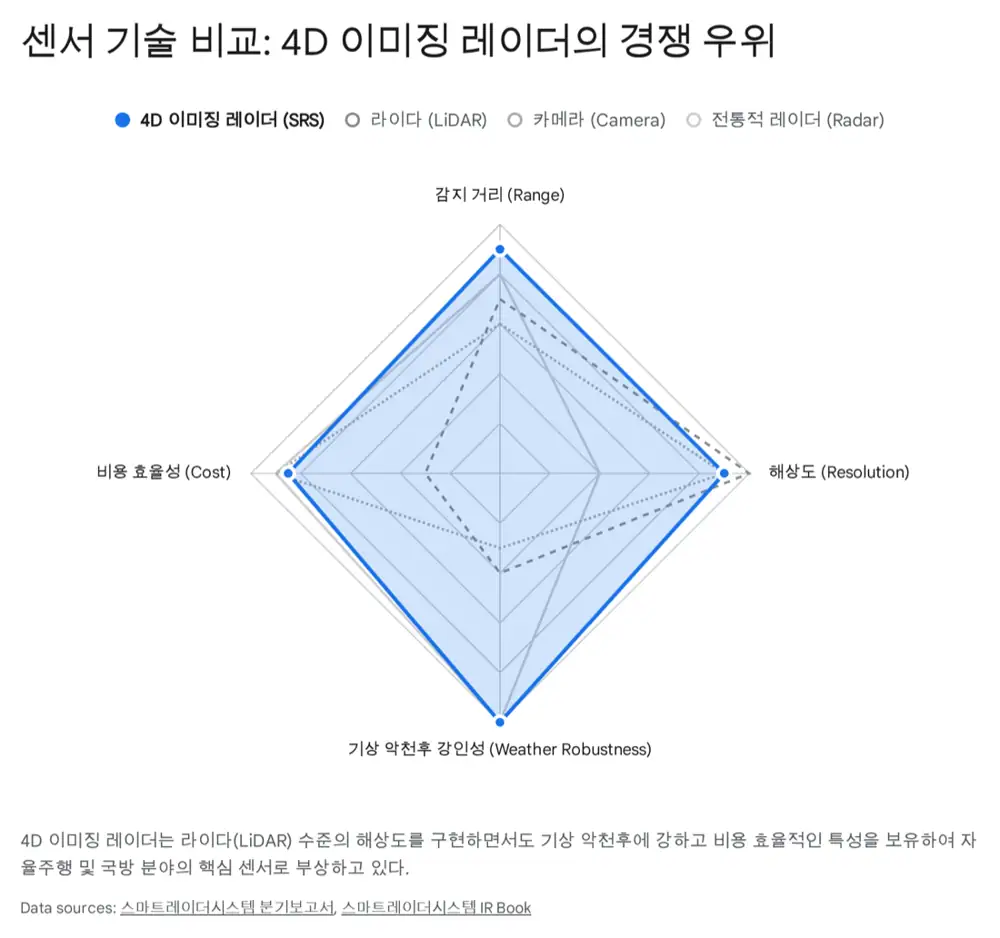
Official fact: In conventional sensing, cameras are vulnerable to weather and lighting, lidar is precise but expensive and durability-sensitive, and legacy radar works in all weather but has low resolution.
Official fact: Smart Radar System's 4D imaging radar adds elevation to range, Doppler velocity, and azimuth, generating four-dimensional data. The source says this enables point-cloud visualization of the surrounding environment.
Official fact: The source says SRS achieved sub-1° ultra-high resolution and can distinguish vehicles, pedestrians, guardrails, and obstacles at distances above 300 meters.
2. Hardware and software: non-uniform antenna and SDIR
Official fact: SRS's hardware edge is non-uniform array antenna design. Instead of packing antenna elements densely, it arranges them irregularly to expand the virtual aperture with fewer channels.
Interpretation: This can be read as a cost moat because it targets high resolution while reducing chipset cost.
Official fact: The SDIR, or Software Defined Imaging Radar, architecture announced at CES 2023 allows radar performance and functions to change through software updates without hardware changes. The source gives examples of long-range highway mode and wide-angle urban mode.
Interpretation: SDIR fits the software-defined vehicle trend. For OEMs, one hardware platform that can support multiple models and driving conditions reduces parts-management cost and system complexity.
3. Anduril ecosystem read: Mara link, not direct relationship
Official fact: The source explains that the SRS-Anduril connection is concretized through Mara Solutions rather than direct equity exchange. Mara is a defense startup backed by investors including Palmer Luckey, Andreessen Horowitz, and Khosla Ventures, and is developing next-generation counter-drone systems.
Official fact: In April 2025, SRS resolved to acquire shares in Mara Solutions and made a strategic equity investment of about USD 100,000. The source says the investment is premised on supplying SRS 4D imaging radar to Mara's next-generation counter-drone platform Spike.
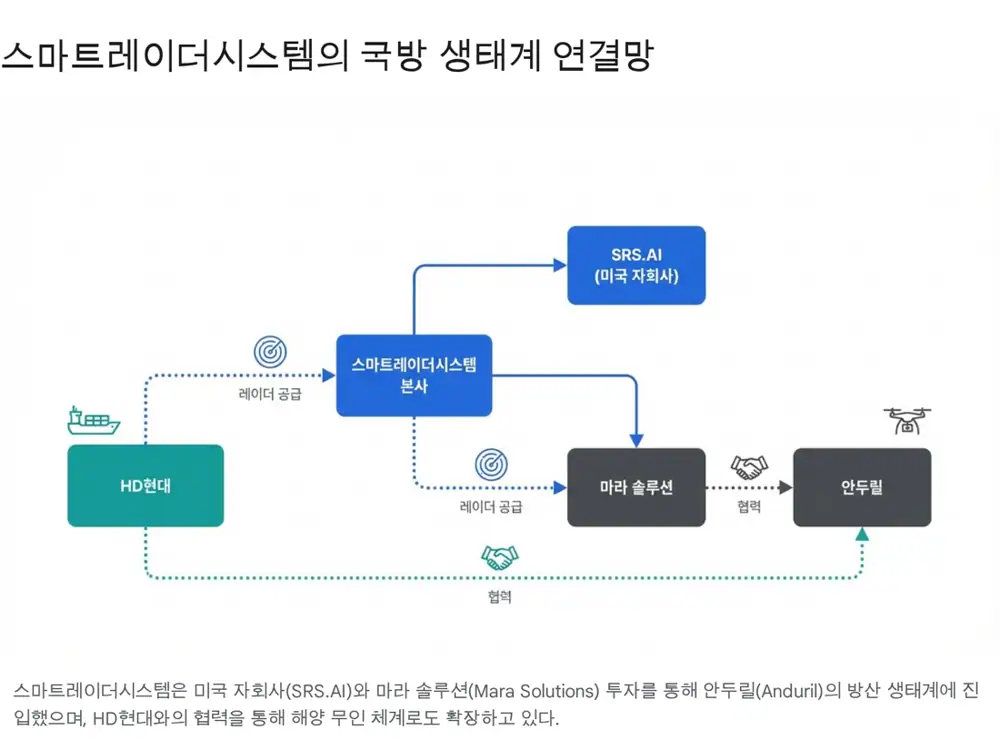
- Ecosystem entry: The source interprets Mara as a family-style company sharing Anduril's founder/investor network and technology philosophy.
- Supplier position: The source says SRS secured exclusive Korean supply rights for the Spike product family and non-exclusive rights for Indonesia and the Philippines.
- Anduril context: Anduril has been strengthening Lattice OS hardware capability by acquiring radar and sensor-fusion businesses such as Numerica.
Interpretation: I would not overstate this as confirmed direct supply to Anduril. The more precise reading is an option into the U.S. defense ecosystem through Mara. Enterprise-value impact should be verified through Spike deployments and SRS radar shipment volume.
4. Role in the counter-drone market
Official fact: The source says the Ukraine war and Middle East conflicts have increased the small-UAV threat, exposing the cost asymmetry of using expensive missiles against low-cost drones.
Official fact: Small drones can have radar cross-section below 0.01㎡, making them difficult for legacy radar to detect or distinguish from birds. SRS's sub-1° resolution and AI object-recognition algorithms can be used to track small-drone position, speed, and altitude and separate drones from birds.
5. U.S. entities, capital raise, and governance noise
Official fact: SRS is strengthening SRS.AI and SRS.MOBILITY, LLC for the U.S. market. In February and April 2025, the board increased capital and acquired existing shares to expand control over U.S. entities.
Official fact: The source says SRS.MOBILITY is building references for U.S. government procurement through school-bus safety solutions in Florida and elsewhere.
Official fact: On September 2, 2025, SRS resolved a third-party allotment capital increase of about KRW 5.9 billion, and outside director Won-ki Min opposed the agenda item.
Interpretation: The financing can be read as operating capital for global expansion, but the outside-director objection creates questions about use of proceeds, terms, and recipients. Follow-up disclosure on capital deployment and dilution is necessary.
6. Operating frame: Q, P, C inflection
| Frame | Source content | Investor checkpoint |
|---|---|---|
| Q: quantity | Defense/counter-drone demand and HD Hyundai Avikus maritime autonomy demand | Spike system adoption and HiNAS Control vessel expansion |
| P: price | Defense radar can command higher ASP due to MIL-SPEC durability and reliability, plus possible software license or development revenue | Whether SRS gains pricing power as an intelligent module, not a simple sensor |
| C: cost | Non-uniform antennas and software-centered architecture can lower marginal cost after production scale | Operating leverage after R&D front-loading |
Official fact: Through Q3 2025, revenue was about KRW 6.4 billion and operating loss about KRW 4.1 billion. Q2 2025 revenue rose 187% year over year to about KRW 2.6 billion, and net income turned positive at KRW 1.16 billion.
Official fact: The source links Q2 growth to higher mix from high-margin categories including special vehicles at 44.7% and industrial at 23.6%. HD Hyundai Avikus is described as having secured supply contracts for HiNAS Control, its autonomous-navigation solution for large vessels, for more than 30 ships.
Interpretation: SRS is still loss-making on a cumulative basis, but the key is whether the quality of revenue shifts toward special vehicles, industrial, defense, and maritime. Software-heavy products can show sharp margin improvement once volume passes a threshold.
7. Valuation and risks
Official fact: The source argues PSR is more appropriate than PER because SRS is in market-penetration phase rather than earnings-harvest phase. It compares global autonomous-driving sensor companies at roughly 5-10x PSR and AI defense companies at 15x+ PSR.
- Defense partnership: Mara-based access to the Anduril ecosystem and expected CES 2026 Spike disclosure are near-term catalysts in the source's framing.
- Maritime mobility: HD Hyundai Avikus cooperation is a reference in a maritime field where autonomous technology may monetize earlier.
- Niche-market strategy: Special vehicles, drones, and ships may be more profitable than the crowded passenger-car ADAS market.
- Overhang and governance: The September 2025 capital raise and outside-director opposition leave dilution and transparency questions.
- Security regulation: The U.S. defense market applies strict security standards to foreign companies. U.S. entity expansion helps, but cybersecurity audit and technology-leak concerns remain.
8. Final view
I read Smart Radar System as a candidate AI sensing platform, not merely an automotive sensor supplier. The current operating loss looks like front-loaded investment in core technology and U.S. expansion. To validate that thesis, Mara/Spike, HD Hyundai maritime projects, and special-vehicle sales need to convert into real orders and recurring revenue from 2026 onward.
Sources
- Naver Blog original: https://m.blog.naver.com/PostView.naver?blogId=star_of_self&logNo=224139380936
- Toss Securities - Smart Radar and Mara Solutions news: https://www.tossinvest.com/stocks/A424960/news?symbol-or-stock-code=A424960&contentType=news&contentParams=%7B%22id%22%3A%22hankyung_X20251113.133419%22%7D
- VentureSquare EN - SRS strategic cooperation MOU with Mara Solutions: https://www.venturesquare.net/en/1023524
- VentureSquare KR - Smart Radar and Mara Solution MOU: https://www.venturesquare.net/1014073
- Anduril acquires Numerica radar and C2 businesses: https://www.anduril.com/news/anduril-acquires-radar-and-command-and-control-businesses-of-numerica-corporation
- ASDNews - Maxar partners with Anduril: https://www.asdnews.com/news/defense/2025/09/08/maxar-partners-with-anduril-power-us-armys-mixedreality-combat-system
- Maeil Business - Smart Radar KRW 5.9B capital increase: https://www.mk.co.kr/news/stock/11409299
- Edaily Marketin - Smart Radar KRW 5.9B third-party allotment: https://marketin.edaily.co.kr/News/ReadE?newsId=03755606642296184
- Electrical Times - HD Hyundai Avikus autonomous navigation order: https://www.electimes.com/news/articleView.html?idxno=347785
- Webull - Smart Radar Q2 2025 earnings: https://www.webull.com/news/13348301807256576