DEEP RESEARCH · SNT MOTIV
SNT Motiv: Core Engine of the Physical AI Drivetrain
How defense-grade reliability, automotive mass production, and motor technology extend into robot actuators and global supply chains
0. Bottom line first
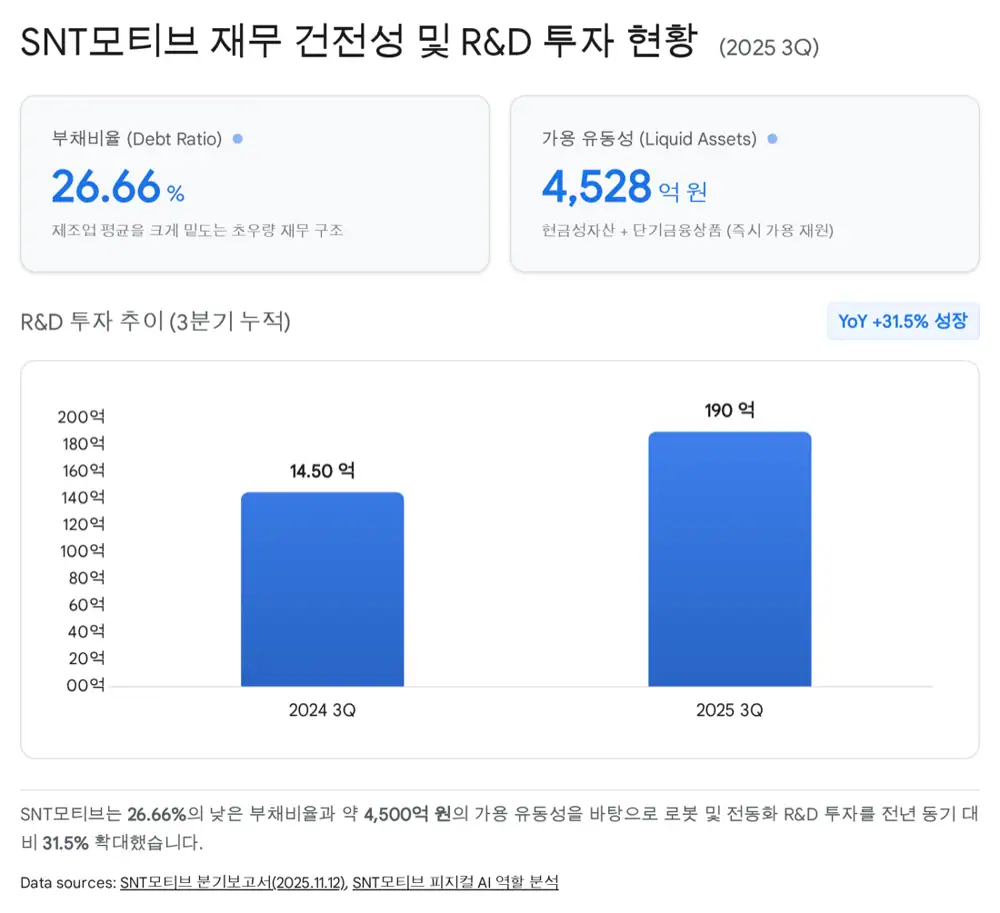
SNT Motiv owns motor and actuator capabilities, the “muscle” of robot drivetrains. The August 2025 acquisition of 100% of SNT Robotics, about KRW 450B in available cash-like resources, and a 26.66% debt ratio show the financial capacity to push a robot mass-production strategy.
1. Industry Shift: Physical AI and the Great Convergence of Chassis Technology
Generative AI and LLMs changed intelligence in virtual space; physical AI is the stage where software defines hardware motion. In that world, value comes not only from cognition but from the precision, efficiency, and reliability of the drivetrain that turns decisions into physical action.
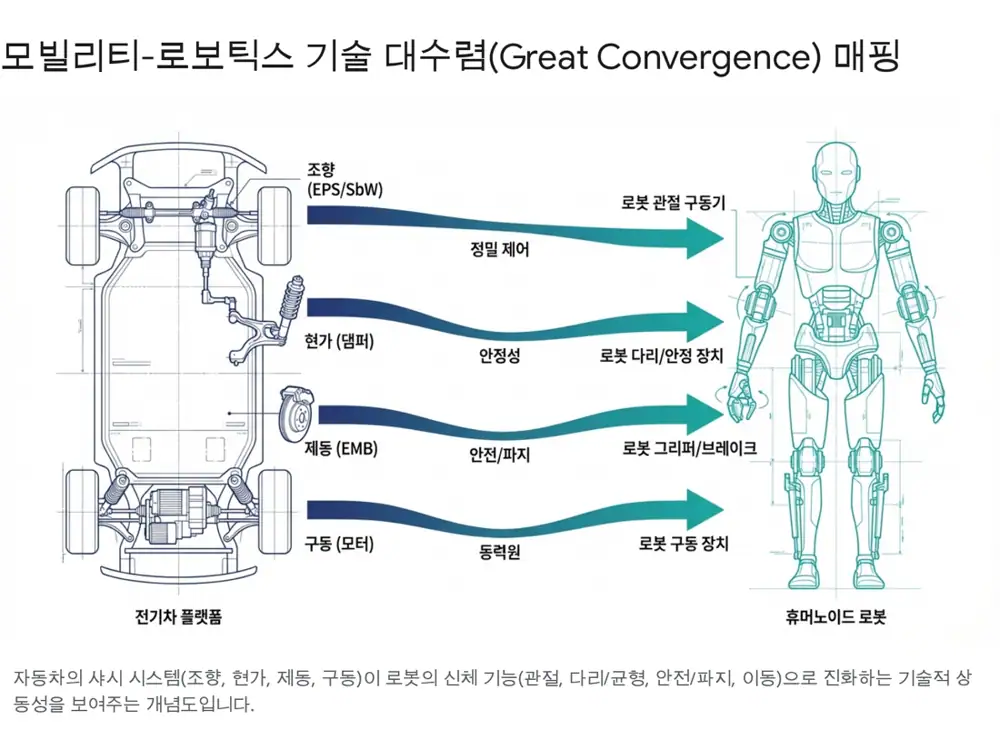
- Steering translates into robot direction change and position control.
- Suspension translates into shock absorption and posture stabilization for walking robots.
- Braking translates into precise stopping and gripping-force control for robot grippers.
- SDV strategies turn cars into intelligent robots and open new markets for chassis suppliers.
2. SNT Motiv: Financial Fortress and Strategic Inflection
Official fact: SNT Motiv originated from Daewoo Telecom’s precision-machinery business, was spun off in 2002, and joined SNT Group in 2006. Its DNA combines defense-grade harsh-condition reliability with automotive mass-production capability.
| Item | Source number / detail | Meaning |
|---|---|---|
| Q3 2025 results | Consolidated revenue KRW 714.8B, operating profit KRW 71.7B, net income KRW 56.7B | The net-income decline is interpreted as FX-loss and financial-cost effects from currency volatility. |
| SNT Robotics | 100% stake acquired in August 2025; KRW 30.4B in assets | Signals a shift from robotics as R&D to manufacturing and mass production. |
| North America and India entities | SNT USA, SNT Defense, SNT Property in 2024; SNT Global in May 2025; SNT Motiv India in October 2024 | Positions the company for IRA, Hyundai HMGMA, and GM North American EV supply chains. |
3. Motors and Actuators: SNT Motiv’s Core Technology
- Traction motors and drive units: through Hyundai Mobis, SNT supplies core motor parts for Hyundai/Kia EVs and fuel-cell vehicles. It also supplies GM with integrated drive units combining motor, inverter, and reducer, and the source cites GM Supplier of the Year recognition.
- MDPS and HSG: MDPS motors convert steering intent into wheel movement, directly matching precision position control for robot joints. Hybrid starter-generator technology can support efficient power management.
- Defense technology: defense products account for about 20% of sales, and the durability and precision metal machining learned from firearms such as the K2 rifle can help minimize tolerances in robot gears and reducers.
4. Financial Capacity: Dry Powder for the Robotics Shift
| Item | Source figure | Investment read-through |
|---|---|---|
| Debt ratio | 26.66% | An exceptionally strong balance sheet for a manufacturer. |
| Cash and cash equivalents | About KRW 234.8B | Immediately available liquidity. |
| Short-term financial instruments | About KRW 218.0B | Together with cash, about KRW 450B of dry powder. |
| R&D expense | KRW 19.0B cumulative Q3 2025, up 31.5% from KRW 14.4B a year earlier | The company is prioritizing motor and robotics source technology over near-term net-income defense. |
5. Comparable Companies: HL Mando, Hyundai Wia, and CTR
HL Mando
- Robot actuators are presented as key components accounting for 40-60% of total robot cost. HL Mando targets KRW 2.3T in robot-actuator sales and 10% global share by 2035.
- The roadmap is three master models and nine lineup specs in 2025, validation in 2026, and North American mass production from 2028.
- Parkie is a 90mm-thick indoor autonomous parking robot that can improve space efficiency by more than 30% and won a CES 2024 Best of Innovation award. Goalie is an autonomous patrol robot.
Hyundai Wia
- Supplies AMR/AGV and integrated control systems for smart-factory solutions at global production sites such as HMGMA.
- Signed a 2025 MOU with Hyundai E&C for robot-parking solutions, aiming for application to existing self-parking lots and about 30% better parking efficiency.
- Plans to present mobility solutions such as AI-based personalized HVAC at CES 2026.
CTR
- Extends ball-screw technology into linear actuators for humanoid legs and high-load industrial robot joints.
- Changed its name to CTR Mobility in 2023 and targets annual revenue of KRW 76B and cumulative revenue of KRW 270B by 2030.
- Uses open innovation through Formation Labs with THiRA-UTECH and investment in quality-inspection robot start-up AiV.
6. Competitive Matrix by Company
| Company | Core strength | Key metric to verify |
|---|---|---|
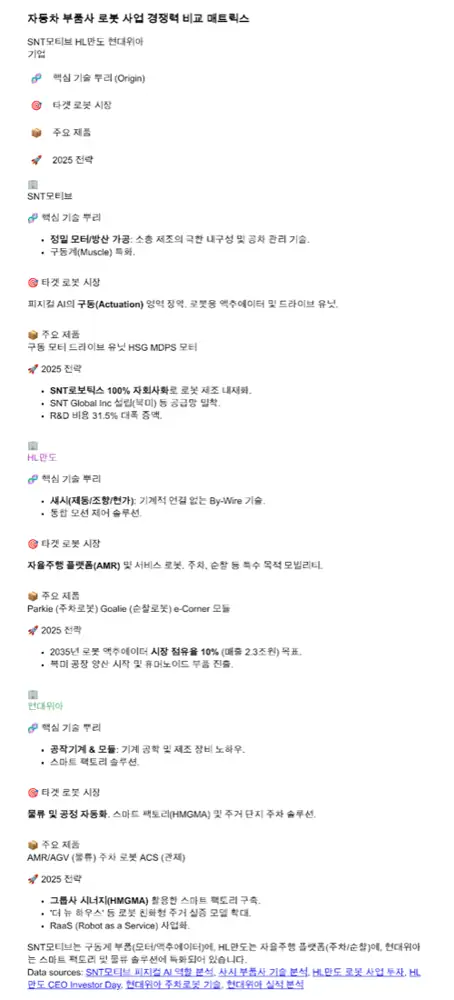
| SNT Motiv | Financial capacity, defense reliability, motor technology, SNT Robotics acquisition | Robotics component mass-production orders and revenue contribution from North America/India entities |
| HL Mando | Integrated chassis control, actuator roadmap, finished-robot expansion | PoC and mass-production contracts toward the 2035 KRW 2.3T target |
| Hyundai Wia | Smart factories and logistics robots with group captive demand | Orders from HMGMA and construction/parking-robot solutions |
| CTR | Ball screws and linear-actuator element technology | Expansion of humanoid and industrial-robot customers and new-business revenue |
7. Final View
For automotive chassis suppliers, entering robotics is a survival strategy amid shrinking internal-combustion parts and commoditizing EV hardware. SNT Motiv is a candidate to lead robot-parts mass production thanks to strong finances and defense-rooted motor technology. I would track 1) actual mass-production orders, 2) preservation of cash generation in the existing auto-parts business, and 3) concrete timing of robotics revenue.
Sources
- Original post: https://m.blog.naver.com/PostView.naver?blogId=star_of_self&logNo=224133943897
- SNT모티브 피지컬 AI 역할 분석: https://drive.google.com/open?id=1eoeDbeuejFtwv5_Gfy4ggoretYrOt8pMutH7YUN5xjA
- 샤시 부품사, 로봇 기술 연관성 분석: https://drive.google.com/open?id=1WOSn32TX4Semkvb1gskGh0IO3AFmPYmLB0FRatxmL50
- SNT모티브 분기보고서(2025.11.12): https://drive.google.com/open?id=1ROVMWR7S_2ZEUr7__qELbVHTB-Ya0HdK
- HL만도 리서치 자료: https://static.roa.ai/research/company/20251212_company_894741000.pdf
- 국민연금공단 HL만도 지분 10.01%: https://www.digitaltoday.co.kr/aigongsi/4115/major-shareholder-national-pension-service-hl-mando-stake
- 현대건설 로봇 기반 미래형 공간 혁신: https://www.hdec.kr/kr/newsroom/news_view.aspx?NewsSeq=1387&NewsType=LATEST&NewsListType=news_clist
- 현대위아 Goover 리포트: https://seo.goover.ai/report/202512/go-public-report-ko-e8a9a5ef-4e47-4887-8b70-146c76a45ff1-0-0.html
- 현대위아 YouTube 리포트: https://www.youtube.com/watch?v=MTP8VM2Ed3I
- 씨티알모빌리티 매거진한경 기사: https://magazine.hankyung.com/business/article/202304119748b
- 티라유텍·센트랄 합작법인 설립: https://ls-thirautech.com/2020/04/10/%ED%8B%B0%EB%9D%BC%EC%9C%A0%ED%85%8D-%EC%84%BC%ED%8A%B8%EB%9E%84%EA%B3%BC-%EB%AA%A8%EB%B9%8C%EB%A6%AC%ED%8B%B0-%EC%86%94%EB%A3%A8%EC%85%98-%EC%A0%84%EB%AC%B8-%ED%95%A9%EC%9E%91%EB%B2%95%EC%9D%B8/
- 조선비즈: CTR 매출 2조 눈앞: https://biz.chosun.com/industry/company/2024/01/27/5UVBEWDCGNFFXLFI6576KX2W24/