DEEP RESEARCH · HL MANDO
HL Mando: A Leading Case of the Chassis-to-Robot Shift
How braking, steering, and suspension capabilities extend into robot actuators, AMRs, and smart-factory components
0. Bottom line first
Robot entry by automotive chassis suppliers is not just a theme; it is technology transfer. HL Mando has braking, steering, suspension, and integrated-control software, and it presents one of the most concrete roadmaps into the robot-actuator market.
1. Industry Background: Why Chassis Companies Move Into Robots
Official fact: The source explains that automotive steering, suspension, and braking correspond closely to robot direction change, shock absorption/posture control, and precise stopping/position control.
- Hydraulics to electrification: EPS and EMB overlap with robot-joint actuator technology.
- Precision-control software: integrated-control capabilities built for SDVs can transfer into multi-joint robot control.
- TAM expansion: global auto sales are stagnant around 90M units per year, while Goldman Sachs estimates a US$38B humanoid-robot market by 2035, roughly KRW 53T.
- Quality moat: automotive components require reliability for more than 10 years under harsh temperature and vibration conditions, which matters in robot-parts mass production.
2. HL Mando: Core Company in Integrated Motion Control
HL Mando began as Hyundai Yanghaeng in 1962, helped localize auto parts, and was split from Halla Holdings in 2014. It evolved from mechanical braking and steering into ABS, ESP, and by-wire technologies, building a base for robotics.
Stable governance
HL Holdings and related parties hold 30.26%. The National Pension Service is cited at 10.01%, with a recent filing trend toward 12.17%.
HL Klemove and HMG
HL Klemove owns sensor and integrated-controller technology, while Hyundai Motor Group is a major customer at about 44% of revenue and a strategic robotics partner.
Vice Chairman Cho Sung-hyun
An engineer-CEO from Korea University mechanical engineering who presented a 2035 robot-actuator revenue target of KRW 2.3T.
3. Technology Moat and Robot-Actuator Roadmap
- By-wire and redundancy: electric-signal-only steering and braking are foundations for robot-joint control and safety.
- Ball-screw internalization: in-house precision ball screws improve cost and supply stability for robot actuators.
- MiCOSA: integrated control of braking, steering, and suspension extends into robot posture and balance algorithms.
- Global production: 19 sites across Korea, the U.S., China, India, Europe, and other regions.
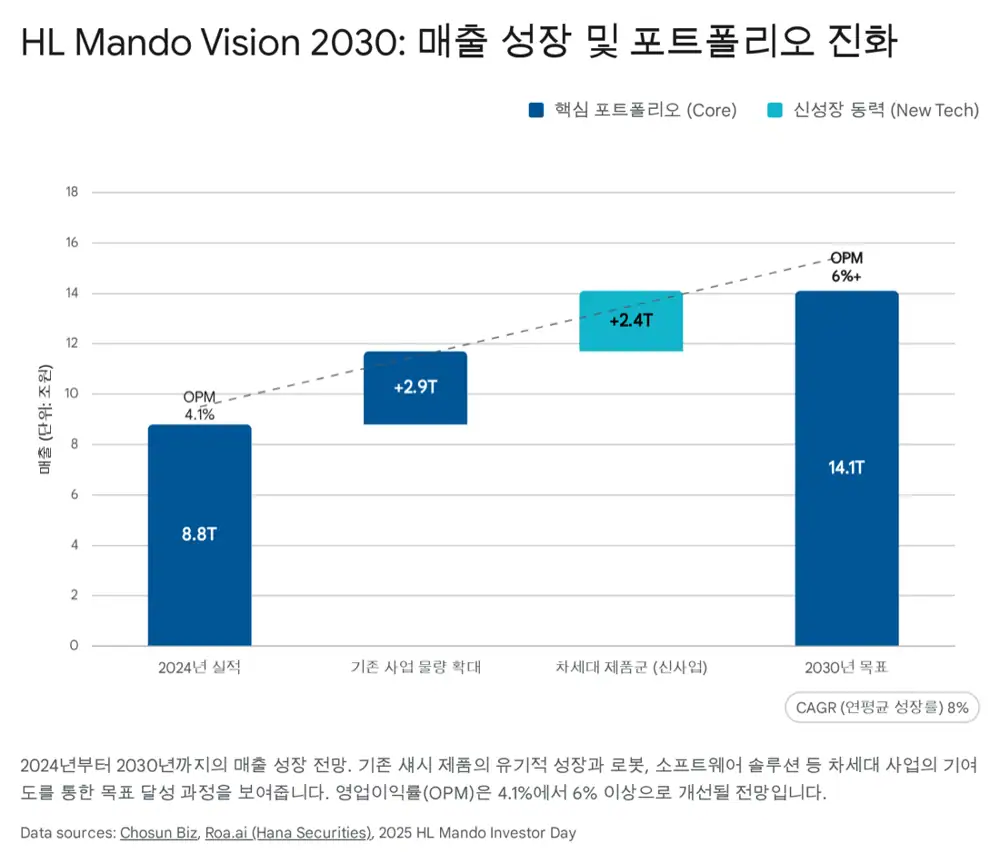
| Category | Source detail |
|---|---|
| Sales target | KRW 8.8T in 2024 → KRW 14.1T in 2030, targeting 8% CAGR |
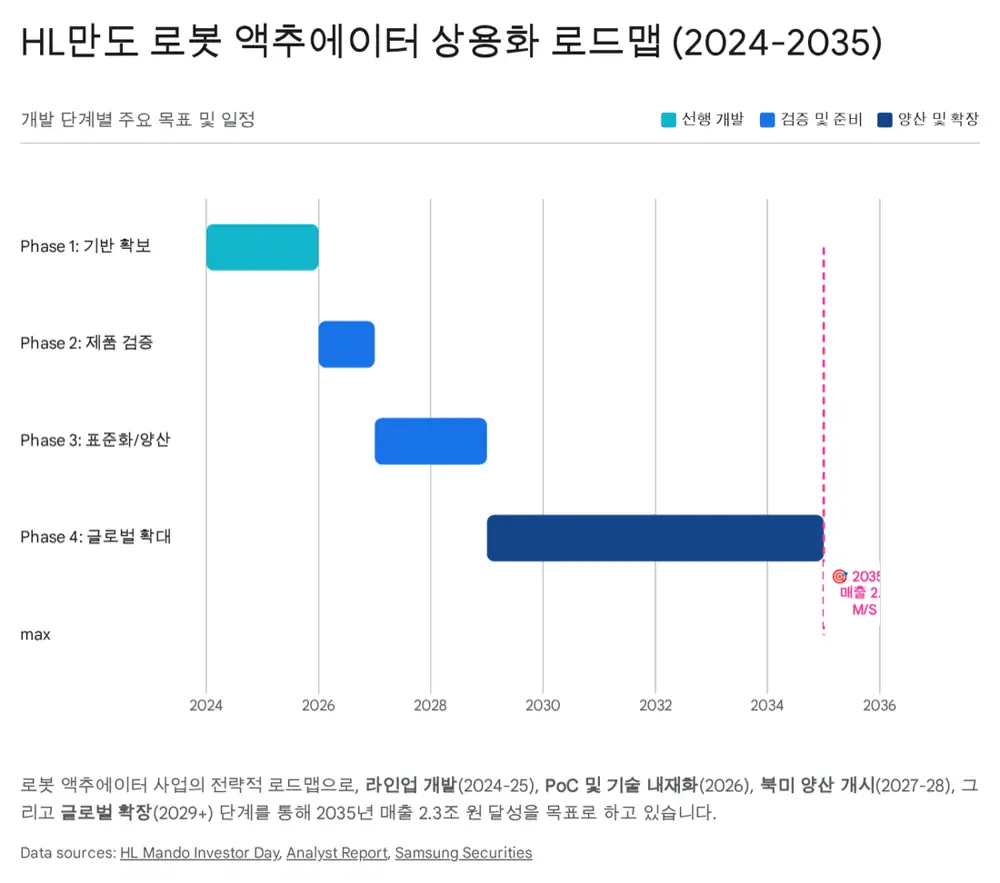
| Robot lineup | 2024-2025 completion and prototype validation of three master actuator models and nine derivatives |
| Validation | 2026 PoC with core customers and internalization of technology |
| Mass production | 2027-2028 mass production centered on North America |
| 2035 target | 10% robot-actuator market share and KRW 2.3T revenue |
| CAPEX | 4-5% of annual sales, allocated to by-wire, robot actuators, and North America/India expansion |
4. Comparables: Hyundai Wia, SNT Dynamics, SL, and CTR
| Company | Core role | Source number / roadmap |
|---|---|---|
| Hyundai Wia | AMRs, parking robots, collaborative robots, and smart-factory solutions | Hyundai Motor 25.35%, Kia 13.46%, NPS 10.04%; 2027 target of KRW 1T in electrification/new-business sales |
| SNT Dynamics | Precision reducers and unmanned-ground-vehicle drive modules | SNT Holdings 42.27%, NPS 8.20%; SNT Robotics established in 2025, 70-ton autonomous-mobility platform target by 2027 |
| SL | Vision sensors, indicators, and BMS | Lee Sung-yeop and related parties about 60%, NPS 9.26%; supply references for Boston Dynamics Spot and Stretch |
| CTR Mobility | Precision ball screws and linear actuators | Kang Sang-woo and related parties 48.64%; benefits from Hyundai robotics lab and EV-platform supply |
5. Summary Matrix and Investment Implications
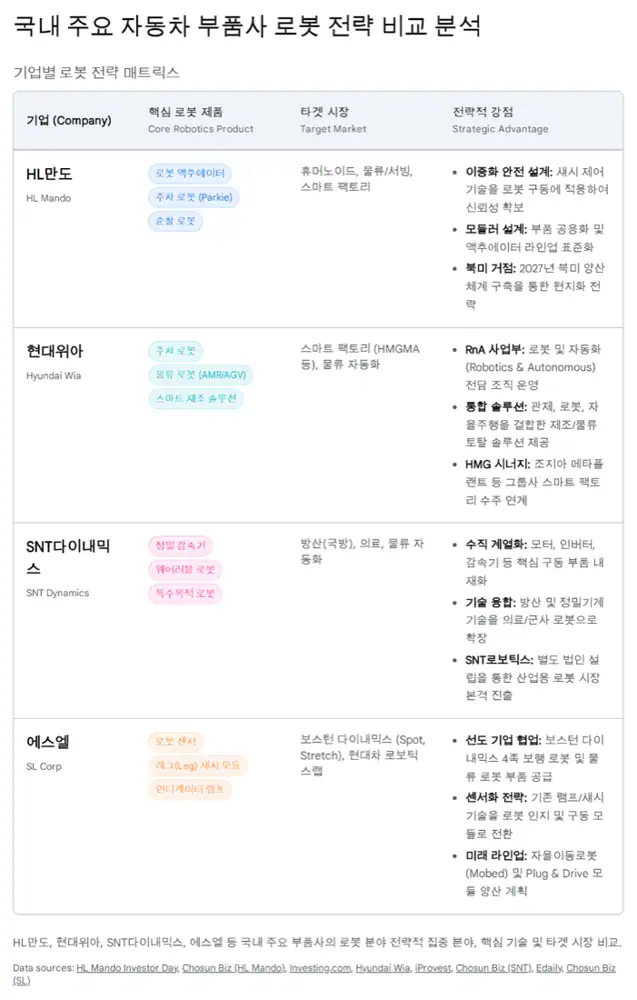
Interpretation: HL Mando is the robot-actuator candidate with hardware and software integration; Hyundai Wia is smart-factory infrastructure with group captive demand; SNT Dynamics is defense-grade precision reducers; SL is sensors and indicators; CTR is ball screws.
6. Final View
The point for HL Mando is not who says they will build robots, but who can mass-produce robot joints. I would track whether North America and India production, MiCOSA, ball-screw internalization, and the 2035 KRW 2.3T actuator target convert into real orders and revenue.
Sources
- Original post: https://m.blog.naver.com/PostView.naver?blogId=star_of_self&logNo=224133939030
- Goldman Sachs: humanoid robots could reach $38B by 2035: https://www.goldmansachs.com/insights/articles/the-global-market-for-robots-could-reach-38-billion-by-2035
- 국민연금공단 HL만도 지분 10.01%: https://www.digitaltoday.co.kr/aigongsi/4115/major-shareholder-national-pension-service-hl-mando-stake
- 국민연금공단 HL만도 지분 12.17%: https://www.datatooza.com/article/202504021744579223f2b9585b1_80
- 에스엘 로봇 신사업 관련 기사: https://marketin.edaily.co.kr/News/ReadE?newsId=02646966642299136
- 알파경제: HL만도 2035년 로봇 액추에이터 매출 2.3조 목표: https://alphabiz.co.kr/news/view/1065579236552700
- HL만도 리서치 자료: https://static.roa.ai/research/company/20251212_company_894741000.pdf
- CHOSUNBIZ: HL Mando pivots to humanoid actuators: https://biz.chosun.com/en/en-finance/2025/12/15/T4ZDB2SVJBC6HGYXJG33WPVSYQ/
- CHOSUNBIZ: Hana Securities lifts HL Mando target: https://biz.chosun.com/en/en-finance/2025/12/12/YY2YZ4IP4RBI7N3GCTAICLNIWU/
- 현대위아 2023 지속가능성보고서: https://en.hyundai-wia.com/upload/download/2023_Sustainability_Ko_2.0.pdf
- 현대위아 리서치 자료: https://stock.pstatic.net/stock-research/company/2/20250728_company_497174000.pdf
- 알파경제: 현대위아 사업구조 변화: https://kr.investing.com/news/stock-market-news/article-949577
- 머니S: 현대위아 열관리: https://www.moneys.co.kr/article/2024070110204641016
- 현대위아 RnA 사업개요: https://www.hyundai-wia.com/business/rna.asp
- MK: Hyundai Wia and Hyundai E&C robot parking: https://www.mk.co.kr/en/business/11464670
- HyundaiNews: Hyundai Motor Group $26B U.S. investment: https://www.hyundainews.com/releases/4537
- Hyundai.com: Hyundai Motor Group $26B investment: https://www.hyundai.com/worldwide/en/newsroom/detail/hyundai-motor-group-increases-u.s.-investment-to-%252426-billion-to-accelerate-growth-and-innovation-0000001003
- SNT다이내믹스 기업개요: https://comp.wisereport.co.kr/company/c1020001.aspx?cmp_cd=003570&cn=
- SNT다이내믹스 지분현황: https://comp.wisereport.co.kr/company/c1070001.aspx?cmp_cd=003570&cn=
- SNT다이내믹스 리서치 자료: https://file.alphasquare.co.kr/media/pdfs/company-report/_22073153-003570.pdf
- 한화에어로스페이스 무인차량 성능시험: https://www.hanwhaaerospace.com/kor/media/newsroom/view.do?seq=384
- MK: SNT Dynamics next-generation mobility development: https://www.mk.co.kr/en/society/11158700
- 교보증권 자동차 자료: https://www.iprovest.com/upload/research/report/cominf/20250912/2052547/20250912_064960_20250021_21.pdf
- CHOSUNBIZ: SNT Group expands into robotics: https://biz.chosun.com/en/en-industry/2025/09/17/F363USDXTNHN3IP2I7D4JWP2SU/
- 조선비즈: 에스엘 로봇 사업 역할 확대: https://biz.chosun.com/stock/stock_general/2025/12/16/TLHLB4LESJFWXE45PSKPM626Q4/
- 에스엘 리서치 자료: https://static.roa.ai/research/company/20251216_company_915514000.pdf
- KRX: 씨티알모빌리티 사업보고서: https://kind.krx.co.kr/common/disclsviewer.do?method=search&acptno=20250319000600&docno=&viewerhost=&
- 뉴스핌: 센트랄모텍 볼스크류 공급: https://www.newspim.com/news/view/20210120000241
- 씨티알모빌리티 지분현황: https://comp.wisereport.co.kr/company/c1070001.aspx?cmp_cd=308170&cn=