DEEP RESEARCH · Vitzro Nextech / Fusion Infrastructure
Korea's Fusion Industry Inflection 2025 — Vitzro Nextech's KFE Order and National R&D Governance Reshuffle
A KRW 6.3B SUCCEX helium refrigerator order and the appointment of Dr. Kyungsoo Lee as Vice Chair signal Korea's pivot from basic research to engineering demonstration and industrialization.
0. Bottom line first
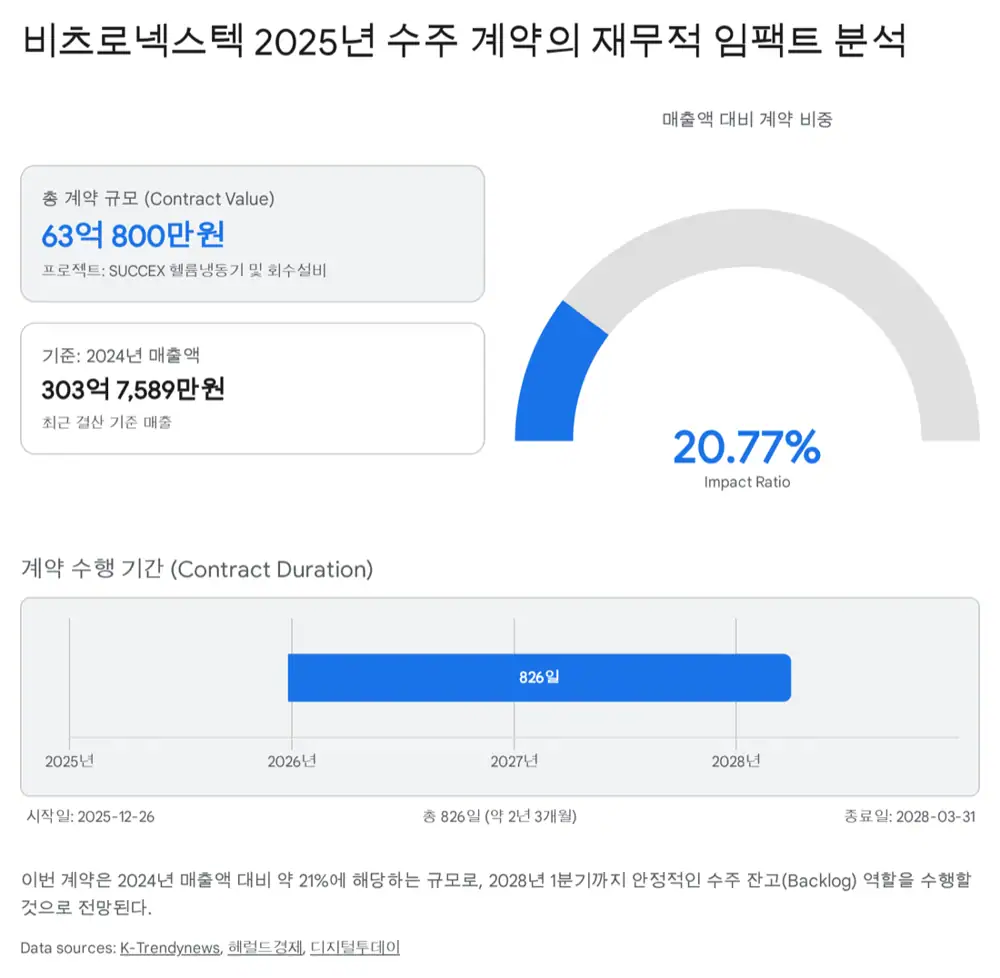
On Dec 26, 2025, Vitzro Nextech secured a KRW 6.308B contract from the Korea Institute of Fusion Energy (KFE) to build the helium refrigerator and recovery system for SUCCEX. This equals 20.77% of 2024 revenue (KRW 30.37B), and the 826-day contract spans into Q1 2028 — recognized progressively across three fiscal years. The same week, Dr. Kyungsoo Lee — architect of KSTAR and former ITER deputy director-general — was appointed Vice Chair (minister-level) of Korea's Presidential Advisory Council on S&T, synchronizing the 'industrialize fusion' policy momentum.
1. Contract analysis
| Item | Detail | Note |
|---|---|---|
| Contract title | SUCCEX helium refrigerator & recovery system construction | National core research infrastructure |
| Customer | Korea Institute of Fusion Energy (KFE) | Government-funded research institute |
| Amount | KRW 6.308B | VAT-exclusive |
| vs revenue | 20.77% | Of FY2024 consolidated revenue ~KRW 30.37B |
| Period | 2025-12-26 ~ 2028-03-31 | 826 days (~2 years 3 months) |
| Type | Single sale/supply contract | Systems integration & build |
2. SUCCEX and the helium refrigerator — the heart of cryogenic operations
2.1 K-DEMO and superconducting conductors
Fusion commercialization requires confining 100M-degree plasmas via strong magnetic fields — the role of superconducting magnets. SUCCEX (Superconducting Conductor Experiment Facility), to be built on the KENTECH campus in Naju, will test 16-Tesla-class next-gen superconducting conductors for the K-DEMO program under cryogenic, high-field, and high-current conditions. It will be the only such facility in Korea, at world-class scale.
2.2 What the helium refrigerator does
Superconductors such as Nb3Sn reach zero resistance below −269°C (4.5 K). The refrigerator compresses and expands helium gas to produce liquid helium and circulate it through superconducting magnets, removing heat. The recovery system captures, purifies, and recycles the expensive helium.
2.3 Moat — onshoring of cryogenic systems
Official fact: Large helium refrigeration systems for Korean big-science facilities have historically been dominated by global firms (Linde, Air Liquide).
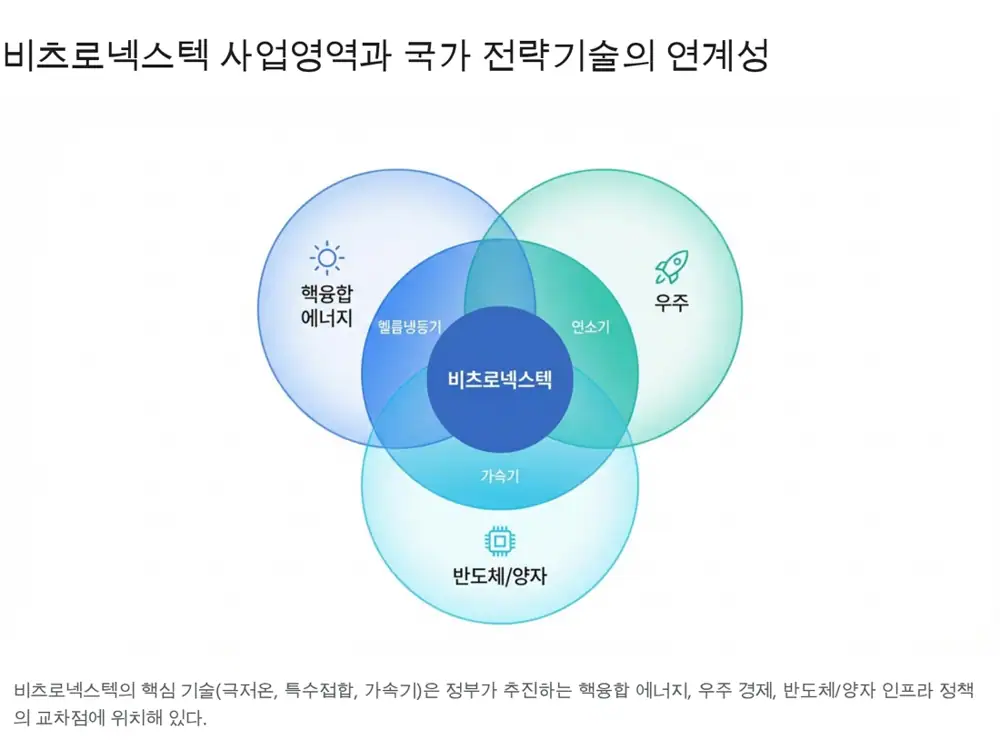
Interpretation: This win signals the end of foreign dependence. Track record built on KSTAR contributions, ITER (VS Coil, blanket shield blocks, diagnostic first-walls), plus cryogenics/brazing/precision-machining expertise from the accelerator business has graduated Vitzro Nextech from component supplier to systems integrator. Adjacent expansion opportunities: quantum-computer cryogenics, hydrogen liquefaction plants.
3. Vice Chair Kyungsoo Lee's appointment — governance reshuffle
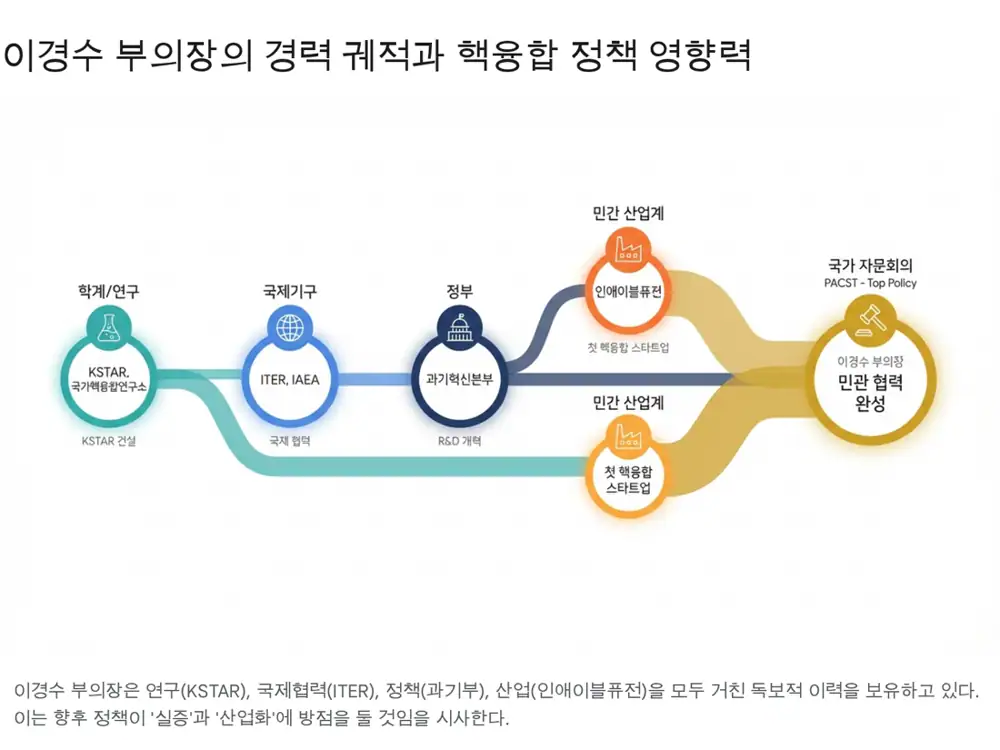
From the 1990s
Led construction of Korea's superconducting tokamak. Lifted Korea from periphery to fusion leadership.
International body
ITER Deputy Director-General & Board Vice-Chair. Coordinated humanity's largest science project (7 countries).
Innovation HQ
Vice-Ministerial Head of S&T Innovation under President Moon. Drove independence of national R&D budgeting.
EnableFusion
Founder/Chair of Korea's first private fusion startup. A vocal advocate for 'lab → industry'.
Interpretation: The Office of the President framed the appointment as fueling Korea's 'top-3 AI / top-5 S&T' goals — implicitly pointing at fusion as the answer to AI-data-center power demand. Dr. Lee has long argued that 'just as SpaceX turned space from government-led to private-led, fusion needs a New Space-style private-led ecosystem.' Expect a clear shift from closed government-lab R&D to open innovation.
4. Vitzro Nextech ↔ EnableFusion — value-chain linkage
5. Vitzro Nextech deep dive
5.1 Financials — solid IPO debut
Official fact: On Nov 10, 2025 the amended filing fixed the IPO price at the top of the band, KRW 6,900, raising KRW 30.36B in total. FY2024 revenue was ~KRW 30B, but operating profit was depressed by aggressive R&D spend.
Interpretation: The SUCCEX win is the spark for fixed-cost absorption and cash-flow improvement. Backlog visibility extends through 2028.
5.2 Technical moat — special-process expertise
Brazing
Bonding dissimilar metals (e.g., tungsten + copper) below their melting points — essential for rocket combustion chambers and fusion divertors.
E-Beam welding
Electron-beam welding in vacuum. Required for accelerator components demanding extreme precision and strength.
Track record
Nuri-ho engine combustors and gas generators; KSTAR tungsten divertors; ITER blanket shield blocks and VS Coils. A portfolio of the world's hardest physical-engineering challenges.
5.3 Competition — 'super Tier-1' position
Adjacent peers include Dawonsys (power supplies), MOBIS, Iljin Power. Vitzro Nextech leads in mechanical structures, thermal control, special-material processing — and especially in delivering cryogenic utility systems like helium refrigerators.
6. Macro environment — K-DEMO and AI energy
- FY2026 budget: R&D and preliminary feasibility budgets for K-DEMO continue to expand. Korea's roadmap targets a post-2035 demonstration reactor, implying significant CAPEX over the next decade.
- Global race: US, China, EU treat fusion as energy security and tech sovereignty. Surging AI-data-center power demand boosts the role of fusion and SMRs as baseload candidates.
- PPP model: Dr. Lee's appointment signals an acceleration toward Public-Private Partnership for commercialization.
7. Scenarios
Bull
- K-DEMO procurement ramps → backlog accumulates to 1–2× annual revenue.
- EnableFusion wins global fusion projects (e.g., CFS, TAE) → backflow of Korean manufacturing to Vitzro Nextech.
Base
- Some IPO/CB overhang appears, offset by the KRW 6.3B order plus follow-on momentum.
- Steady 2026–2028 progress-based revenue recognition.
Bear
- K-DEMO schedule slips, or ITER additional-contribution talks stall.
- Key engineer attrition, sudden helium-price spikes.
8. Conclusion
The SUCCEX order and Dr. Lee's appointment are not coincidences. Technical self-reliance (helium refrigerator onshoring) + policy evolution (accelerated industrialization) + corporate re-rating (long contract visibility) align as a structural signal. Korea's fusion industrial ecosystem has entered its blossoming phase.
Sources
- Naver blog original: https://m.blog.naver.com/PostView.naver?blogId=star_of_self&logNo=224126287066
- Vitzro Nextech KRW 6.3B contract (K-Trendynews): k-trendynews.com
- KFE 64억 contract (DigitalToday): digitaltoday.co.kr
- Vitzro Nextech 63억 contract (HeraldK): heraldk.com
- Naju SUCCEX 국비 120억 (Electimes): electimes.com
- Naju SUCCEX budget (MT): mt.co.kr
- Helium refrigeration plants (Linde Kryotechnik): linde-kryotechnik.ch
- SHMFF Helium Refrigerator commissioning: english.hmfl.cas.cn
- VITZRO history: vitzrotech.com
- VITZRO NEXTECH group page: vitzrotech.com
- S&T Advisory Council Vice Chair Lee (Nocut News): nocutnews.co.kr
- Vice Chair fusion expert Lee (Munhwa): munhwa.com
- Vice Chair appointment (Kado): kado.net
- Fusion scholar Lee (MK): mk.co.kr
- Kyungsoo Lee (Namuwiki): namu.wiki
- ITER deputy director Lee (YTN Science): youtube.com
- Vice Chair profile (Yonhap): yna.co.kr
- Dr. Lee artificial-sun interview (Daum): v.daum.net
- Vice Chair AI power source fusion (Hankyung): hankyung.com
- Korea fusion commercialization by 2040 (Korea JoongAng Daily): koreajoongangdaily.joins.com
- EnableFusion Inc.: enablefusion.com
- KEPCO E&C × Vitzro Nextech fusion MOU: kepco-enc.com
- Public-startup fusion ecosystem (Energy News): energy-news.co.kr
- Vitzro Nextech overhang / 2027 secondary (Smart Today): smarttoday.co.kr
- Vitzro Nextech company info (DeepSearch): deepsearch.com
- VITZRO NEXTECH EN home: vitzronextech.com
- Vitzro/Dawonsys fusion strength (PointDaily): pointdaily.co.kr
- Hyundai Rotem vs Hanwha Aerospace (Naver Premium): contents.premium.naver.com
- Korea 2026 budget (Korea Herald): koreaherald.com
- South Korea $866M fusion (NEI Magazine): neimagazine.com
- South Korea $866M fusion (TÜNAŞ): tunas.gov.tr
- DOE FES FY2026 Budget Request: science.osti.gov