DEEP RESEARCH · ENABLEFUSION
EnableFusion: Architect of the Global Fusion Supply Chain
A fabless engineering strategy that supplies the critical infrastructure of the fusion economy rather than betting only on owning power plants
0. Bottom line first
The investment point is not a pure bet on fusion ignition. It is a bet that someone will have to build fusion devices. EnableFusion positions itself as a fusion foundry and fabless engineering platform connecting global developers with Korea’s precision-manufacturing ecosystem.
1. Founding Background and Leadership
Official fact: EnableFusion is described as Korea’s first private fusion specialist, founded in December 2023 by leadership with KSTAR and ITER experience.
Chairman Gyung-Su Lee
Former head of the National Fusion Research Institute and former ITER deputy director-general. The source treats his December 28, 2025 appointment as vice chair of the National Science and Technology Advisory Council as a policy signal.
Co-CEO Doo-hwan Choi
Former CEO of POSCO ICT, now POSCO DX, and KT. He complements the science team with large-organization management, systems engineering, and B2B commercialization.
Advisors and board
Former POSCO chair Oh-Joon Kwon, former ITER Korea head Ki-Jung Chung, and Seoul National University professor Yong-Seok Hwang support technical advice and manufacturing partnerships.
Interpretation: In deep tech, leadership background is part of the credit profile. EnableFusion’s early credibility comes from combining scientific authority with industrial execution.
2. Business Model: Fabless Fusion and Supply-Chain Orchestration
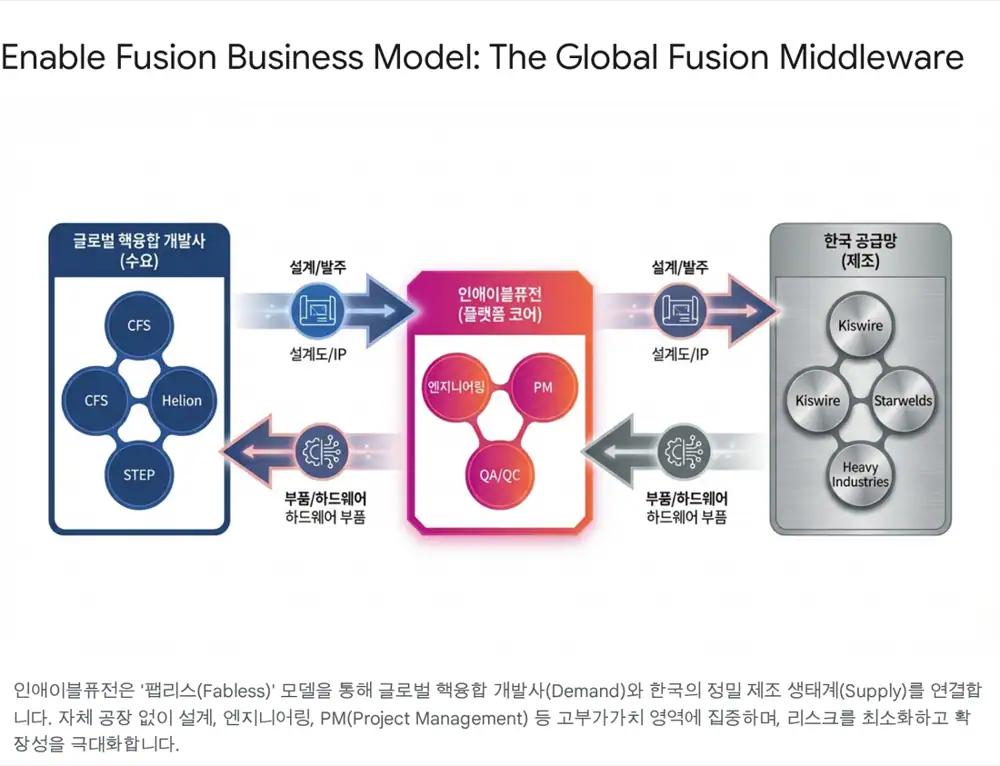
- Fabless engineering: the company focuses on device design, engineering, and project management instead of owning a large production factory.
- Supply-chain orchestration: it connects fabrication to more than 250 Korean manufacturing partners tested through KSTAR and ITER, while managing quality, schedule, and integration.
- Value proposition: overseas fusion start-ups can use Korea’s high-end manufacturing capacity almost like Manufacturing as a Service, reducing cost and time to market.
3. Capital Structure and Early Revenue Visibility
| Item | Source figure | Meaning |
|---|---|---|
| Seed capital | About KRW 30B, or roughly US$22M, at founding in December 2023 | A relatively strong starting base for a deep-tech start-up. |
| Kiswire | About KRW 6B invested; estimated 26.67% stake | A strategic manufacturing shareholder with KSTAR/ITER superconducting-wire experience. |
| LS Electric / Solid | About KRW 1.5B each; around 7% / 5.77% stakes | Adds power-supply, control, and communications capabilities. |
| Series A plan | About US$100M, or roughly KRW 140B | Targets valuation step-up and overseas network expansion through global VC and institutions. |
| Use of funds | Engineering hires, V-KSTAR/AI design tools, bidding working capital | Capital goes to high-end engineering and software rather than factory construction. |
| Revenue visibility | Potential hundreds of billions of won in revenue from DTT and similar projects starting in 2025 | The post emphasizes earlier revenue than typical long-cycle deep tech. |
4. Technology and the DTT Reference
Official fact: The source describes EnableFusion’s moat as tacit engineering know-how from KSTAR and ITER rather than a single patent: system integration, project management, and integration of superconducting magnets, vacuum vessels, thermal shields, and diagnostics.
Italy’s DTT, Divertor Tokamak Test, is a fusion experiment facility near Frascati with a budget of about EUR 600M, roughly KRW 880B. The Korean consortium is presented as a strong candidate to supply the DTT vacuum vessel, with an estimated contract size near KRW 40B. The source treats this as an unusually large overseas reference for a very young company.
5. Competitive Position: Kyoto Fusioneering and CFS
| Comparison | EnableFusion | Kyoto Fusioneering | CFS |
|---|---|---|---|
| Country base | Korea | Japan | United States |
| Core model | Integrated engineering platform | Subsystem technology supplier | Plant owner and operator |
| Strength | System integration, vacuum vessels, superconducting magnets, manufacturing SCM | Gyrotrons, thermal and fuel-cycle systems | HTS magnets and plasma physics |
| Manufacturing base | Shipbuilding, steel, heavy-industry partnerships | Precision machinery centered | Internal plus global sourcing |
| Risk | Project-management execution risk | Adoption risk for specific technologies | Whether the fusion technology itself succeeds |
Interpretation: CFS is more a potential customer than a direct peer, while Kyoto Fusioneering is the closer competitor. EnableFusion’s differentiation is integration and large-structure supply, not a narrow component niche.
6. Growth Roadmap and Risks
Phase 1: European beachhead, 2024-2025
- Complete the DTT order and prove the Fabless Fusion model, then pursue follow-on bids such as the UK STEP program.
Phase 2: U.S. expansion, 2025-2026
- Use Series A funding to establish a U.S. office and expand contracts with private fusion companies such as CFS, Helion, and Thea Energy.
Phase 3: Digital solutions, 2026 onward
- Build high-margin recurring revenue from AI-based fusion-reactor design and operation software while participating in K-DEMO.
Risks
- Execution risk: a small young organization must manage complex overseas projects worth hundreds of billions of won.
- Geopolitical risk: U.S.-China tensions and raw-material supply can be a threat, though Korean supply chains may become a trusted Western alternative.
- Conflict-of-interest risk: Chairman Lee’s policy role could create governance noise around private-company activities.
7. Final View
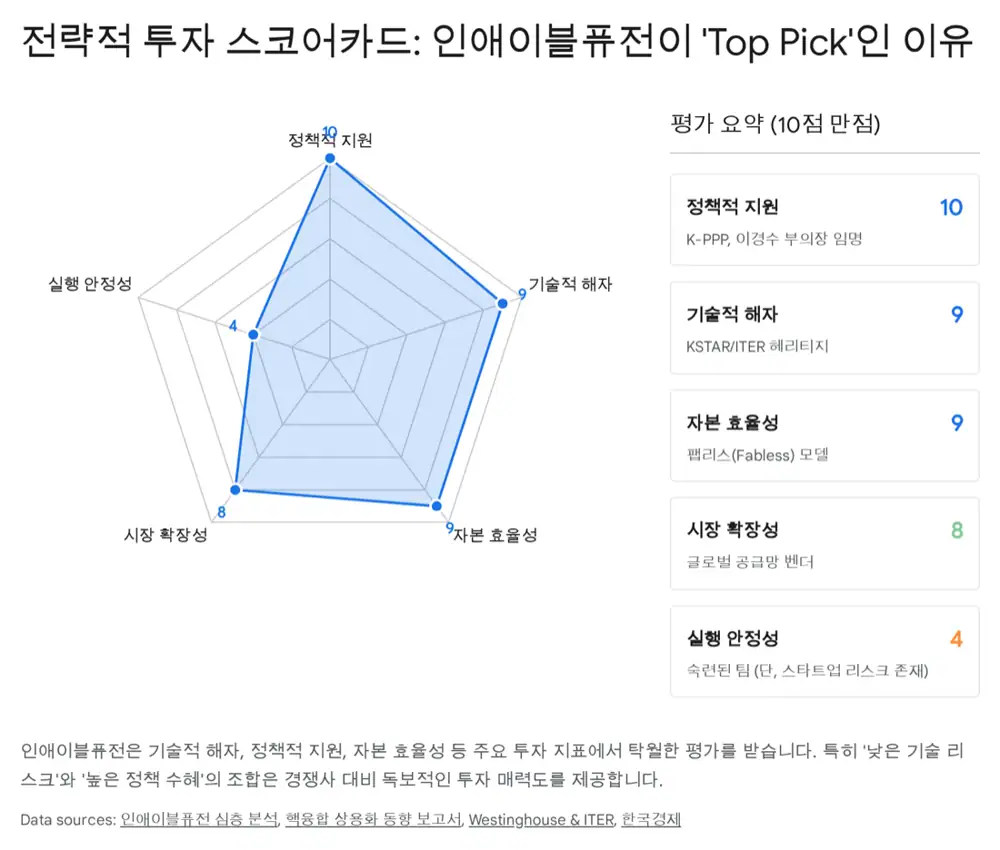
The source selects EnableFusion as a 2026-2028 Top Pick in the fusion sector. The argument is 1) asymmetric risk/reward from supplying critical equipment rather than betting only on net energy, 2) hard-to-copy manufacturing know-how and a network of more than 250 Korean suppliers, and 3) catalysts from a near-term DTT contract, a medium-term US$100M Series A, and longer-term K-DEMO plus major U.S. orders. I summarize the thesis as the picks-and-shovels strategy for fusion.
Sources
- Original post: https://m.blog.naver.com/PostView.naver?blogId=star_of_self&logNo=224126014231
- 이경수 인애이블퓨전 대표, 과기자문회의 부의장 임명: https://m.mk.co.kr/amp/11868479
- 핵융합 에너지 상용화 동향 및 인애이블퓨전 심층 분석 보고서: https://drive.google.com/open?id=1yOpBdIb1i1huQn_9n_x8qdjyr6_J66wc-ifWkFKYYQk
- 인애이블퓨전 심층 분석 및 탑픽 제시: https://drive.google.com/open?id=1IWRk4MJNzLdenjuPpFEjKRceT7NsNkwsYYtsXmbM9BQ
- Korea aims to commercialize nuclear fusion by 2040: https://koreajoongangdaily.joins.com/news/2025-06-09/business/tech/Korea-aims-to-commercialize-nuclear-fusion-by-2040-Is-that-possible/2325226
- EnableFusion Teams: https://www.enablefusion.com/teams
- Kyungsoo Lee appointed Vice Chairman of National Science and Technology Advisory Council: https://www.asiae.co.kr/en/article/2025122815055626882
- EnableFusion Inc.: https://www.enablefusion.com/
- Kiswire 감사보고서: https://www.kiswire.com/korean/cyberpr/file/%EA%B0%90%EC%82%AC%EB%B3%B4%EA%B3%A0%EC%84%9C_2025.pdf
- 인애이블퓨전·스타웰즈 MOU: http://starwelds.kr/STbbs/board.php?bo_table=video&wr_id=5
- MK: Korea nuclear fusion start-up business: https://www.mk.co.kr/en/it/11269536
- Commonwealth Fusion Systems raises $863M Series B2: https://cfs.energy/news-and-media/commonwealth-fusion-systems-raises-863-million-series-b2-round-to-accelerate-the-commercialization-of-fusion-energy/
- 전자신문: 인애이블퓨전 인터뷰: https://v.daum.net/v/20250902120251013?f=p
- EUROfusion/Cineca 50 million euro service: https://euro-fusion.org/member-news/agreement-50-million-euro-supercomputing-service/
- Italian companies support DTT fusion project: https://www.neimagazine.com/news/italian-companies-support-dtt-fusion-project-7753786/
- 국내 핵융합 컨소시엄, 이탈리아 DTT 수주 도전: https://zdnet.co.kr/view/?no=20240722174657
- Westinghouse awarded $180M ITER contract: https://www.ans.org/news/article-7170/westinghouse-awarded-180m-iter-contract/
- Kyoto Fusioneering technology: https://kyotofusioneering.com/en/technology
- Kyoto Fusioneering whitepaper: https://kyotofusioneering.com/kfwp/wp-content/uploads/2024/06/KF_whitepaper.pdf
- Kyoto Fusioneering profile: https://tracxn.com/d/companies/kyoto-fusioneering/__w_jpXB89-HmRSrY0oHyrQuvBvdS6fCI6I9KjlxJpSaI
- 핵융합 에너지 실현 위해 1.2조 투입: https://www.fnnews.com/news/202407221148598210
- MSIT: Transition to a Pioneering R&D System: https://www.msit.go.kr/eng/bbs/view.do?sCode=eng&mId=4&bbsSeqNo=42&nttSeqNo=1033