DEEP RESEARCH · DATA-CENTER POWER
Data-Center Power Bottlenecks: Demand for Aircraft-Engine Generation
Why aeroderivative gas turbines are rising as AI data centers prioritize speed over efficiency
0. Bottom line first
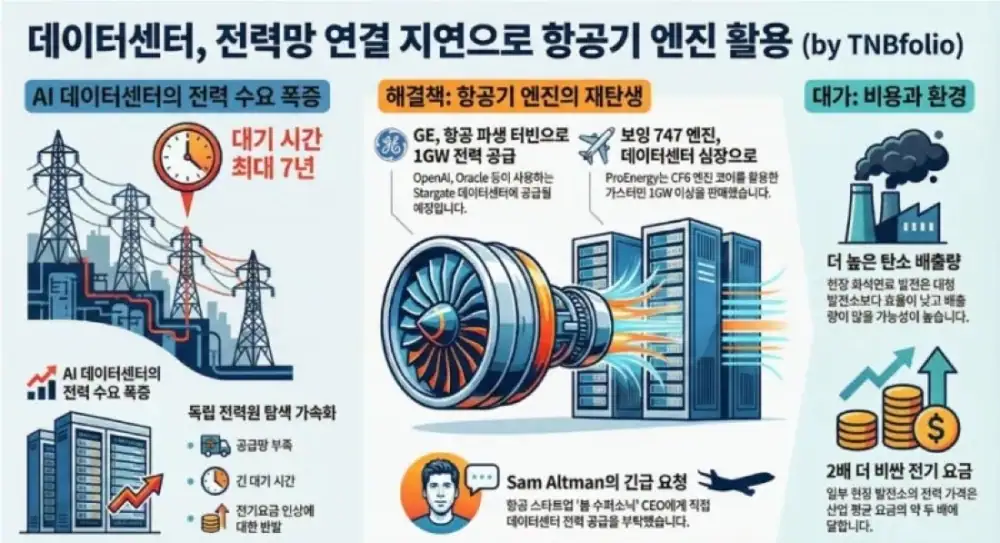
The question “Wouldn’t a large gas power plant be better?” is correct in terms of long-run efficiency and cost. But AI data centers need power now, while grid connection, plant construction, and turbine supply chains can take four to seven years. In this market, speed is beating efficiency.
Official fact: The source links to TNBfolio Telegram and fact-checks grid-connection delays, use of aircraft-engine-based generators, and the Sam Altman / Boom Supersonic discussion.

1. The core problem: time, not cost
From a traditional power-engineering perspective, mounting aircraft engines on the ground as generators looks inefficient. Large combined-cycle gas plants can deliver thermal efficiency above 60% and low generation cost, while aircraft-engine-based generation has lower efficiency and higher maintenance cost.
Interpretation: Even so, time efficiency now dominates cost efficiency in the data-center market. Data-center buildings can be ready for servers in 18 to 24 months, while large gas plants require at least four to five years for site selection, environmental review, construction, and commissioning.
4-7 years
In dense data-center regions such as Loudoun County and Silicon Valley, high-voltage lines and substations take time to expand.
Up to 7 years
The source describes surging order backlogs at major turbine makers such as Siemens Energy, GE Vernova, and Mitsubishi Power.
18-24 months
Buildings and servers move faster than power infrastructure. A three-year gap is material in the AI race.
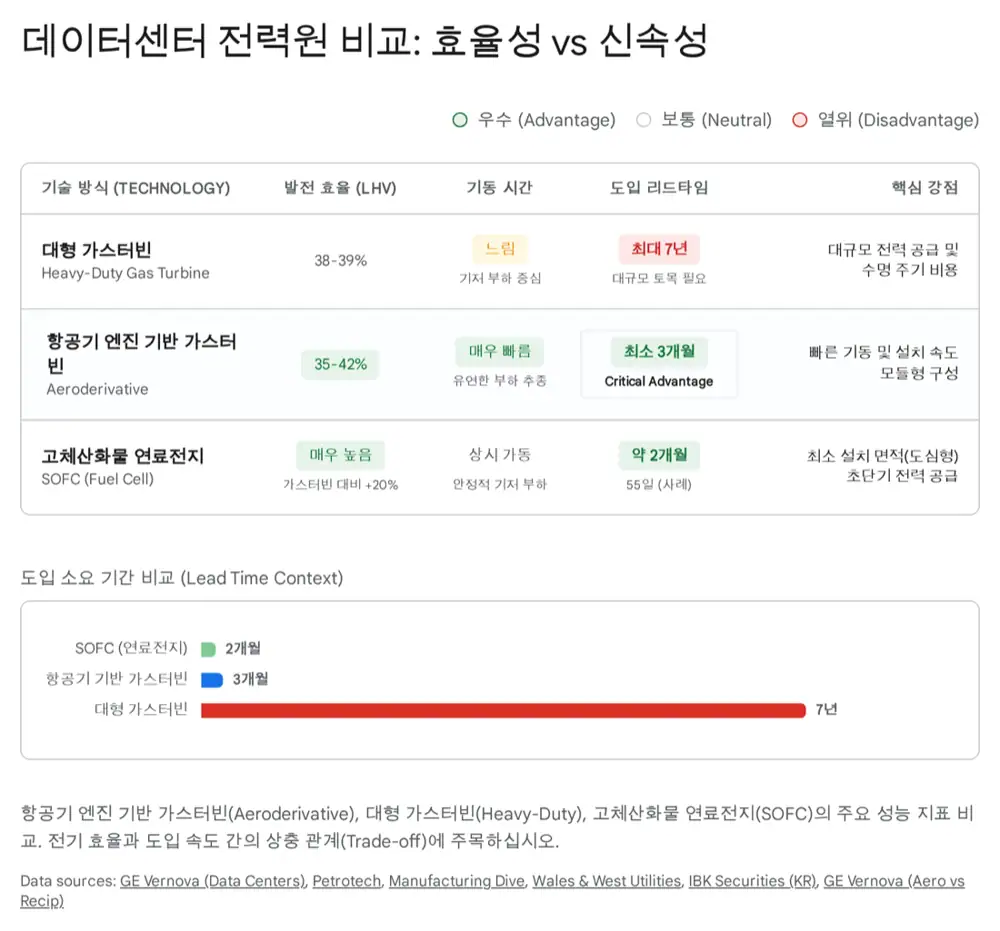
2. Technology comparison: heavy-duty vs aeroderivative
Gas turbines fall into two broad groups: heavy-duty turbines used in conventional power plants and aeroderivative turbines adapted from jet engines for ground power generation.
| Category | Heavy-duty gas turbine | Aeroderivative gas turbine |
|---|---|---|
| Structure | Thick casing, large blades, optimized for long baseload operation | Aircraft-engine base, lightweight and modular |
| Efficiency | 40-60% on combined-cycle basis, better large-plant cost | Lower efficiency, but better response and installation speed |
| Startup | 30 minutes to several hours from cold stop to full output | Full output within five minutes, some models within two minutes |
| Installation | Concrete foundations, cooling-water systems, large site requirement | Trailer/modular format; two weeks to three months after arrival |
| Data-center fit | Good for long-term baseload, but deployment time is the bottleneck | Well suited for peaking, backup, and bridge power |
Official fact: The source describes GE’s CF6-based LM6000 and LM2500 models and says LM2500XPRESS is shipped 95% factory-assembled and can be installed on site in two weeks.
3. Power architecture: hybrid microgrid
Modern data centers are moving toward behind-the-meter generation rather than relying only on external grids. In normal operation, they draw from the grid or fuel cells. During peaks or emergencies, aeroderivative gas turbines produce power within minutes. BESS and UPS bridge the two-to-five-minute gap before turbines are online.
Official fact: The source says fuel cells can be highly efficient, above 60%, but have difficulty reacting instantly to load changes. Aeroderivative turbines are described as starting within five minutes to cover AI workload spikes or grid instability.
4. Global supply chain: who makes the engines
The source frames aircraft-engine technology as concentrated around Big 4 players because of precision and durability requirements: GE, Rolls-Royce, Pratt & Whitney, and Safran. In derived power-generation markets, GE Vernova, Siemens Energy, Mitsubishi Power Aero, and Rolls-Royce Power Systems are emphasized.
| Company | Core product or background | Data-center meaning |
|---|---|---|
| GE Vernova | LM2500, LM6000, CF6 base, LM2500XPRESS | AI power partner directly contracting with developers such as Crusoe Energy |
| Siemens Energy | Acquired Rolls-Royce Energy gas turbine business in 2014; SGT-A35/A65 | A large aeroderivative lineup rooted in RB211 and Trent 60 technology |
| Mitsubishi Power Aero | Acquired P&W power turbine business; FT8 MOBILEPAC | Specialized in trailer-mobile power deployment |
| Rolls-Royce Power Systems | mtu Series 4000 gas gensets and long-term SMR vision | Emergency backup, small-scale continuous power, and longer-term nuclear option |
5. Korean companies: Hanwha Aerospace and Doosan Enerbility
Korean companies have limited independent aircraft-engine design capability, but they participate through partnerships and manufacturing capacity with global Big 4 players.
- Hanwha Aerospace: Korea’s only aircraft-engine manufacturer and an RSP partner to GE, P&W, and Rolls-Royce. It supplies core parts such as blades and cases and performs licensed production.
- Hanwha Power Systems: Works on gas turbine retrofit and hydrogen co-firing, and with GE on LM2500 marine gas-turbine packaging and modularization. The source sees potential expansion into data-center generation modules.
- Doosan Enerbility: Not aircraft-engine based, but independently developed the DGT6-300H heavy-duty gas turbine as the fifth company in the world to do so. A recent US data-center gas turbine supply contract targets large campus data-center demand.
6. Outlook: the bridge-power era
In the long term, large gas plants can be the better answer. But data centers that need power right now cannot accept five-to-seven-year construction and transmission waits. Aeroderivative generators can be moved by trailer and produce electricity in two to three months where grid connection is missing.
Interpretation: The next five to ten years may be a bridge-power era for data-center electricity. Until grids expand or SMRs commercialize, aeroderivative gas turbines and fuel cells can fill the gap. For investors, the key is which need each company’s portfolio satisfies: speed, scale, or lower-emission power.
Sources
- Naver Blog source: https://m.blog.naver.com/PostView.naver?blogId=star_of_self&logNo=224124618208
- TNBfolio Telegram: https://t.me/TNBfolio
- 두산퓨얼셀·Bloom Energy 리포트 PDF: https://drive.google.com/open?id=1sFfaVL4GjjPr03NpQ65bXR_2g2DPLgHz
- The Register - datacenter jet engines: https://www.theregister.com/2025/10/22/datacenter_jet_engines/
- Boom Supersonic - AI power and grid: https://boomsupersonic.com/flyby/ai-needs-more-power-than-the-grid-can-deliver-supersonic-tech-can-fix-that
- Tom's Hardware - ex-airliner engines: https://www.tomshardware.com/tech-industry/data-centers-turn-to-ex-airliner-engines-as-ai-power-crunch-bites
- GE Vernova - LM2500XPRESS Crusoe case: https://www.gevernova.com/gas-power/resources/case-studies/crusoe-ai-data-centers-lm2500xpress
- Turbomachinery Magazine - gas turbine selection: https://www.turbomachinerymag.com/view/gas-turbine-selection-heavy-frame-or-aeroderivative
- GE Aerospace - LM2500 datasheet: https://www.geaerospace.com/sites/default/files/2023-11/LM2500-Datasheet.pdf
- GE Vernova - LM2500 turbines: https://www.gevernova.com/gas-power/products/gas-turbines/lm2500
- Petrotech - aeroderivative vs frame turbine: https://petrotechinc.com/aeroderivative-vs-frame-gas-turbine-difference-in-functionality-and-control/
- Utility Dive - fuel cells for data centers: https://www.utilitydive.com/spons/why-fuel-cells-are-redefining-on-site-power-for-data-centers/803449/
- Turbomachinery Magazine - 29 LM2500XPRESS packages: https://www.turbomachinerymag.com/view/ge-vernova-delivers-29-lm2500xpress-aeroderivative-gas-turbine-packages-to-crusoe-ai-data-centers
- Siemens PDF - Rolls-Royce Energy acquisition: https://assets.new.siemens.com/siemens/assets/api/uuid:79c71513-687b-46e2-8bce-cecd86f6ea85/AXX20140536e.pdf
- Siemens press release - Rolls-Royce Energy acquisition: https://press.siemens.com/global/en/pressrelease/siemens-acquire-rolls-royce-energy-gas-turbine-and-compressor-business-and-enter-long
- Mitsubishi Power Aero history: https://power.mhi.com/group/aero/company/history
- Power Engineering - PW Power Systems rename: https://www.power-eng.com/gas/turbines/gas-turbine-maker-pw-power-systems-changing-name-to-mitsubishi-power-aero/
- Data Centre Magazine - Rolls-Royce SMR data centres: https://datacentremagazine.com/news/smrs-how-rolls-royce-will-use-nuclear-to-power-ai
- 항공우주·방위산업 리포트 PDF: https://drive.google.com/open?id=1aShQadKwoD4Kl0w4ZHLjs0WVrX2XhPCK
- GE Aerospace - Hanwha Aerospace MOU: https://www.geaerospace.com/news/press-releases/hanwha-aerospace-and-ge-aerospace-sign-mou-jointly-develop-naval-gas-turbine
- Hanwha Power Systems: https://www.hanwha.com/companies/hanwha-power-systems.do
- Doosan Enerbility - gas turbines: https://www.doosanenerbility.com/en/business/gas_turbine_product
- Doosan Enerbility - US gas turbine export: https://www.doosanenerbility.com/en/about/news_board_view?id=21000756
- Chosun - Doosan gas turbine supply gap: https://www.chosun.com/english/industry-en/2025/12/11/32B7ZQYH7NB4VDKJCSMEIKJMMQ/