DEEP RESEARCH · SUKGYUNG AT
Sukgyung AT: Where Nano Materials Meet the Energy Transition
A review centered on the Gimje third plant, solid-state battery materials, and 5G/6G, TIM, and SMR expansion.
0. Bottom line first
Sukgyung AT is moving from a niche leader in dental fillers and cosmetic pigments toward a nano-materials platform targeting solid-state batteries, communications, heat dissipation, and SMR materials. Q3 2025 profitability suggests this transition is being built on real cash generation, not only a theme.
1. Fundamentals visible in the numbers
Official fact: The source reports Q3 2025 revenue of about KRW 4.126bn, up 13.8% year over year. Cumulative Q3 2025 revenue was KRW 15.0bn, up 52%, and cumulative operating profit was KRW 5.5bn, up 247%.
| Item | Source figure | Reading |
|---|---|---|
| Q3 revenue | About KRW 4.126bn | Up 13.8% year over year |
| Cumulative revenue | KRW 15.0bn | Up 52% year over year |
| Cumulative operating profit | KRW 5.5bn | Up 247% year over year |
| Cumulative OPM | About 37% | Evidence of pricing power in nano materials |
Interpretation: This level of margin despite higher R&D expense points to both product-mix improvement and profitable magnetic-material processing orders. The Yeongam second-plant fire should be separated as a one-off factor.
2. Gimje third plant: relieving the CAPA bottleneck
The Gimje third plant reads as more than expansion. It is a dedicated base for strategic next-generation materials. The source lists solid electrolytes, hollow silica, thermal materials, and spherical glass as key production targets.
Solid electrolyte
A production line for borate-based solid electrolytes.
Hollow silica
A low-k material for 5G/6G and semiconductor substrates.
TIM filler
MgO and alumina-based inorganic fillers for EV and electronics heat control.
Spherical glass
A next-generation dental-material product line.
3. Solid-state batteries: the borate path
Solid-state battery material is the central re-rating driver. The source says sulfide electrolytes have high ionic conductivity but react with moisture to generate hydrogen sulfide, requiring expensive dry-room infrastructure.
Interpretation: Sukgyung AT's borate-based electrolyte is an alternative path emphasizing safety, process convenience, and economics. The key is whether the company's claimed conductivity improvement turns into customer evaluation success and mass-production approval.
4. Portfolio expansion
- Hollow silica: a low-dielectric and low-loss material for reducing signal loss in 5G/6G mmWave bands.
- TIM thermal filler: MgO and Al2O3-based materials for EV battery and AI semiconductor heat issues.
- SMR shielding: the source presents high-purity MgO shielding material replacing BeO as hidden value, with potential demand of about 300 tons per reactor if reflected in SMR designs around 2027.
5. Conclusion
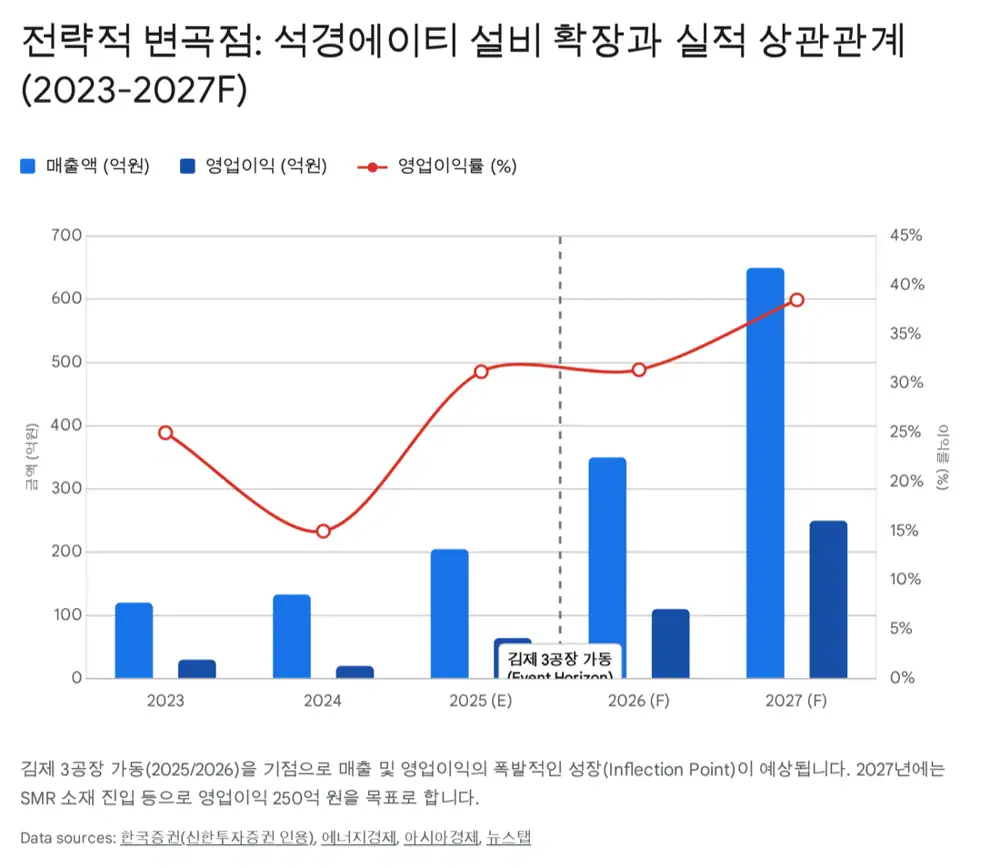
My conclusion is that 2026 will determine whether Sukgyung AT truly steps up. The source presents forecasts of revenue above KRW 30.0bn in 2026 and about KRW 60.0bn in 2027, with operating profit rising from KRW 6.4bn in 2025 to KRW 11.0bn in 2026 and KRW 25.0bn in 2027. To validate that path, I would track Gimje utilization, solid-state material approval, and hollow-silica/TIM customer test results.
Sources
- Source 1: https://m.blog.naver.com/PostView.naver?blogId=star_of_self&logNo=224124475783
- Source 2: https://www.newstap.co.kr/news/articleView.html?idxno=228109
- Source 3: https://www.ksdaily.co.kr/news/articleView.html?idxno=107372
- Source 4: https://www.asiae.co.kr/article/2025112110162242649
- Source 5: https://www.sentv.co.kr/article/view/sentv202508130104
- Source 6: https://m.ekn.kr/view.php?key=20251121025509747
- Source 7: https://m.skyedaily.com/news_view.html?ID=270283
- Source 8: https://www.chemlocus.co.kr/news/view/138617?url=L25ld3MvZGFpbHkvNTAvMTc/Y2F0ZWdvcnk9MDEwMw==
- Source 9: https://www.kspost.biz/ko-kr/articles/121
- Source 10: https://www.ebn.co.kr/news/articleView.html?idxno=1648775
- Source 11: https://marketin.edaily.co.kr/News/ReadE?newsId=04001606642367360
- Source 12: https://m.finance.daum.net/quotes/A357550/news/stock/20240521174203445
- Source 13: http://ansancci.korcham.net/front/board/boardContentsView.do?boardId=10185&contId=103225&menuId=10032
- Source 14: https://m.ilyoweekly.co.kr/news/newsview.php?ncode=1065578523705251
- Source 15: https://deepsearch.com/analytics/documents/news?doc-sec=economy%3Btech&doc-q=%EC%A0%84%EA%B3%A0%EC%B2%B4+%EB%B0%B0%ED%84%B0%EB%A6%AC&doc-from=2024-12-24&doc-to=2025-12-24
- Source 16: https://www.mpenews.co.kr/news/articleView.html?idxno=1943
- Source 17: https://orangeboard.co.kr/@999/%EC%84%9D%EA%B2%BD%EC%97%90%EC%9D%B4%ED%8B%B0-4%ED%8E%B8-TIM%EC%9A%A9-%ED%95%84%EB%9F%AC-%EB%A7%A4%EC%B6%9C-%EC%B6%94%EC%A0%95-%ED%99%95%EC%9E%A5%EC%84%B19