DEEP RESEARCH · EZCARETECH (099750)
EzCaretech: A Structural Turnaround Through Cloud HIS and Saudi Expansion
A review of the hospital information-system cash cow, public-cloud migration, and Middle East healthcare digitization
0. Bottom line first
The core question for EzCaretech is whether it has entered a phase where earnings grow faster than revenue. BESTCare 2.0 hospital references, the EDGE&NEXT cloud transition, the Saudi Lean/HHC pipeline, and Korea’s public-medical-cloud policy together make the 2025 operating-profit growth estimate of +105.0% look like a possible structural signal rather than a one-off improvement.
1. Business Model: Three Pillars of Hospital IT
Official fact: EzCaretech builds and operates hospital information systems that manage clinical care, administration, and data. Its 2001 spin-off history from Seoul National University Hospital and its large-hospital operating experience are core assets.
On-premise HIS
Targets tertiary and large general hospitals with at least 500 beds. The source cites roughly 26% share in Korea’s tertiary-hospital market and references such as Seoul National University Hospital, Bundang SNU Hospital, and Asan Medical Center.
Cloud HIS
A SaaS HIS for small and midsize hospitals, public medical centers, and long-term-care hospitals. It reduces hospital-by-hospital customization burden and supports recurring subscription revenue.
Service and maintenance
Ongoing support, feature improvements, and incident response after deployment. Because hospitals must keep operating, this business is a stabilizer for earnings volatility.
Interpretation: Large implementation projects used to pressure margins. If cloud customers pass breakeven and SM contract values rise, incremental revenue can flow more directly into operating profit.
2. Competitive Edge: Clinical Workflow and Public References
- SNU Hospital DNA: medical IT errors can affect patient safety, so systems designed around real clinical workflows matter.
- Global certification: HIMSS EMRAM Stage 7 raises trust in security, digitization, and data-utilization capabilities.
- All-in-one platform: BESTCare integrates clinical, nursing, administration, and claims workflows while expanding toward third-party plug-ins such as AI diagnostic support, voice-recognition EMR, and wearable integration.
- Public-cloud experience: leading MEDIRO, the integrated cloud HIS for nine national hospitals under Korean public health agencies, is an important reference for regional medical-center migration.
3. Saudi Arabia and Korean Policy: Two External Drivers
| Driver | Key figure in the source | Investment read-through |
|---|---|---|
| Saudi HIS market | US$2.16B in 2024 → US$5.09B in 2033, about 10% CAGR | Cloud-based solutions are expected to exceed 70%, matching EDGE&NEXT’s direction. |
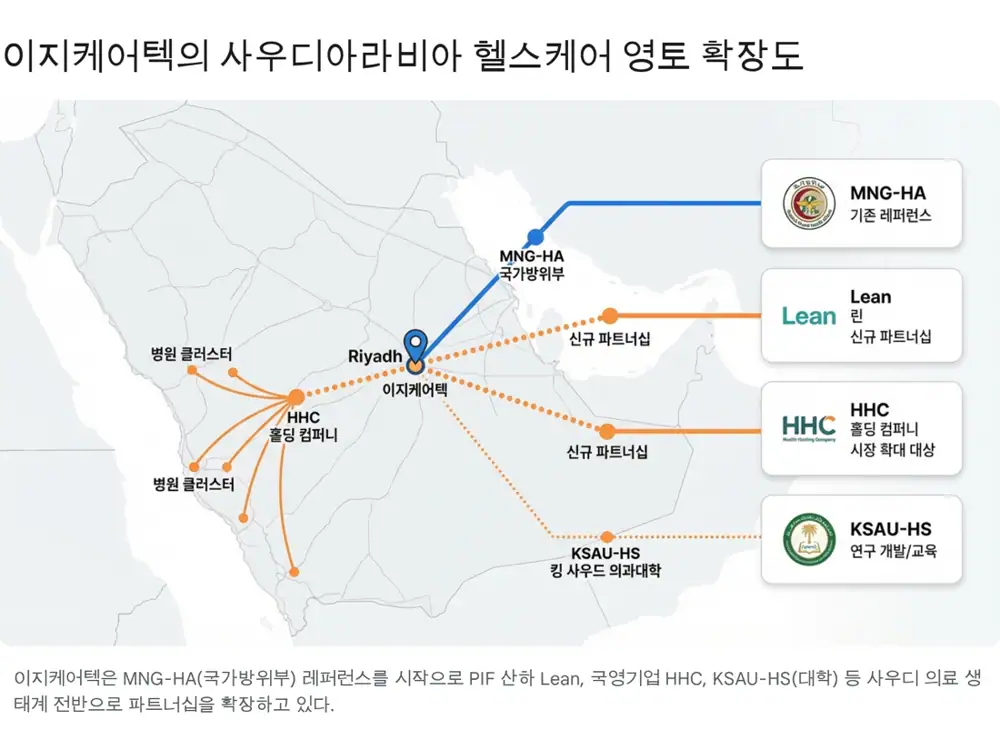
| Lean Business Services | Saudi Ministry of Health digital-transformation executor; more than 200 hospitals under its umbrella | If the MOU becomes a main contract, it becomes an access route to a public-hospital network. |
| HHC | 363 general hospitals and 2,160 primary-care institutions | The 20-cluster system represents a very large potential customer group. |
| Korean regional medical centers | KRW 15B budget from 2026; 37 regional medical centers to migrate to cloud by 2030 | MEDIRO experience can function as a proven public-sector reference. |
Interpretation: Saudi Arabia supports overseas revenue and valuation premium, while Korea’s public-cloud program supports stable order flow. The deciding evidence will be signed contracts and recognized revenue.
4. 2025 Earnings Variables: Q, P, and C
| Item | 2025 estimate / issue | Meaning |
|---|---|---|
| Revenue | KRW 76.1B, +4.8% YoY | A phase focused more on internal quality than headline growth. |
| Operating profit | KRW 4.5B, +105.0% YoY | The key metric showing cost-ratio improvement. |
| Controlling-shareholder net income | KRW 5.2B, +126.3% YoY | Reflects better non-operating items such as financial and FX income. |
| Credit rating | BBB → A- in July 2025 | Recognizes cash generation and financial stability; may lower funding cost. |
| Bonus issue | Ex-rights on 2025-12-18; one-for-one shares; ex-rights reference price KRW 11,110 | A liquidity and shareholder-friendly signal, but also a short-term overhang risk. |
| Valuation | PER about 101x on 2024 earnings → 58.5x on 2025E; 2025F PBR about 7.3x | The absolute multiple is high, so earnings speed and overseas expansion must justify it. |
5. Risks and Monitoring
Saudi project delays
- Because national projects can move slowly, the time from MOU to main agreement, buildout, and revenue recognition may lengthen.
Hospital SI order slowdown
- Recession, medical-sector disruptions, and weaker hospital finances could defer next-generation HIS investment.
Bonus-issue overhang
- With the share count doubled, short-term profit-taking can appear after new-share listing. In the source’s view, this is more a supply-demand issue than fundamental damage.
6. Final View
The original post takes a Strong Buy view, citing OP +105% from structural cost improvement, Saudi order potential through Lean and HHC, and a strong market position to capture public-medical-cloud policy benefits. I preserve that view, but my monitoring checklist is concrete overseas orders and revenue recognition after 2026, cloud-customer count, and whether the 72.1% cost-ratio estimate is actually achieved.
Sources
- Original post: https://m.blog.naver.com/PostView.naver?blogId=star_of_self&logNo=224124184572
- EzCaretech wins Saudi MNG-HA oncology module project: https://m.newsprime.co.kr/section_view.html?no=647329&menu=1
- Seoul Economic Daily: 100% bonus issue: https://www.sedaily.com/NewsView/2H1LMOFAF6
- Bit Computer research material: https://static.roa.ai/research/company/20251205_company_800024000.pdf