DEEP RESEARCH · 3billion
3billion: an AI diagnostics platform for the genomic interpretation bottleneck
A review of rare-disease WES/WGS demand, AI variant interpretation, and the U.S. CLIA-lab strategy
0. Bottom line first
The 3billion thesis depends on whether AI can reduce the remaining bottleneck after sequencing costs fell: the cost and time of genomic interpretation.
Official fact: The source describes 3billion as a rare-disease diagnostics company with AI-based genetic variant interpretation engines such as 3ASC, ZEBRA, 3Cnet, and AIVARI. The U.S. subsidiary and CLIA-lab strategy in 2025 are central to global expansion.
Interpretation: This looks more like genomic interpretation automation software and a data platform than a simple diagnostic-kit company.
500m+
Global rare-disease affected population cited in the source.
Within 5 min
Time to analyze millions of variants and identify pathogenic candidates.
48%
U.S. single-country share of the global rare-disease genetic testing market.
1. Why the rare-disease market is not small
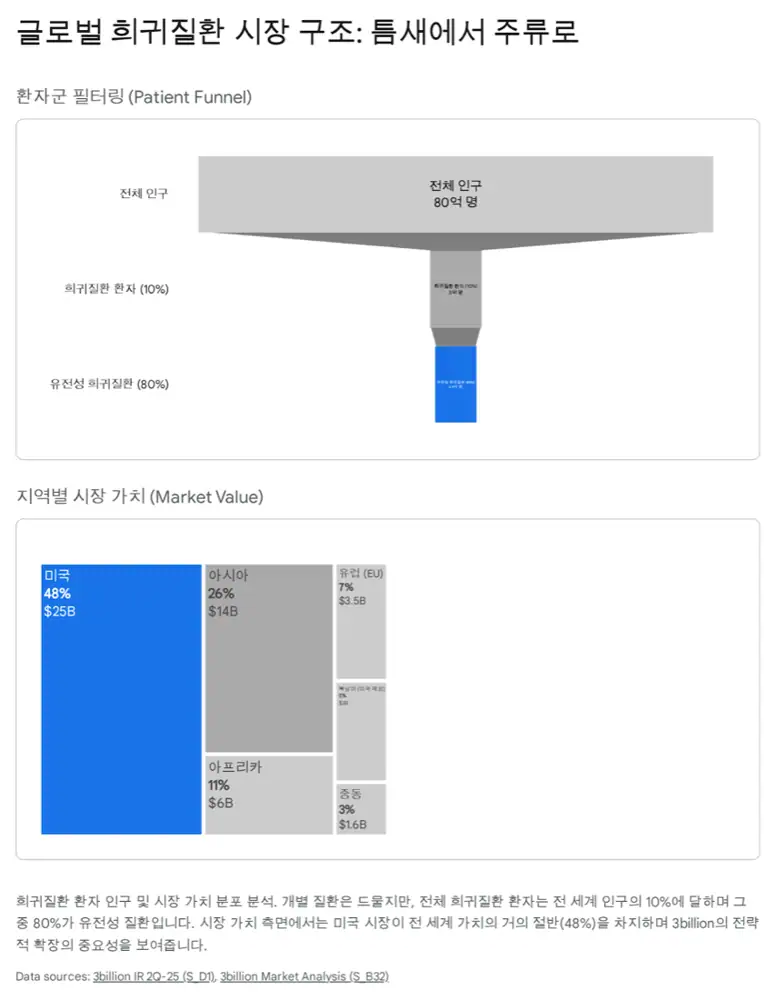
Rare disease means low prevalence per condition, not a small total market. The source cites more than 10,000 reported rare diseases and 200-300 newly identified diseases each year.
| Market indicator | Source number | Meaning |
|---|---|---|
| Affected population | About 6-8% of the world, more than 500 million people | A large TAM created by the long tail |
| Genetic origin | About 80% of rare diseases | About 8,000 diseases are potential genetic-test targets |
| U.S. cost | About USD 1tn per year | Medical cost plus productivity losses |
Interpretation: Because the United States has 48% single-country market share and strong reimbursement capacity, 3billion's U.S. subsidiary and CLIA lab are core strategy, not optional expansion.
2. From diagnostic odyssey to WES/WGS standardization
Rare-disease diagnosis previously relied on single-gene or panel tests. The source says patients wander through more than 17 hospitals for an average of 6 years and incur about KRW 300m per person during the process.
With NGS progress, WES and WGS have become more economical ways to read the exome or whole genome at once. Organizations such as ACMG, AES, and AAP increasingly recommend WES/WGS as first-tier tests for unexplained developmental delay, intellectual disability, and congenital anomalies.
Official fact: One patient's WES/WGS data can produce tens of thousands to millions of variants. The source says 3billion's AI system analyzes millions of variants within 5 minutes and identifies pathogenic variants with 99.4% accuracy.
3. Technology, data, and regulatory moats
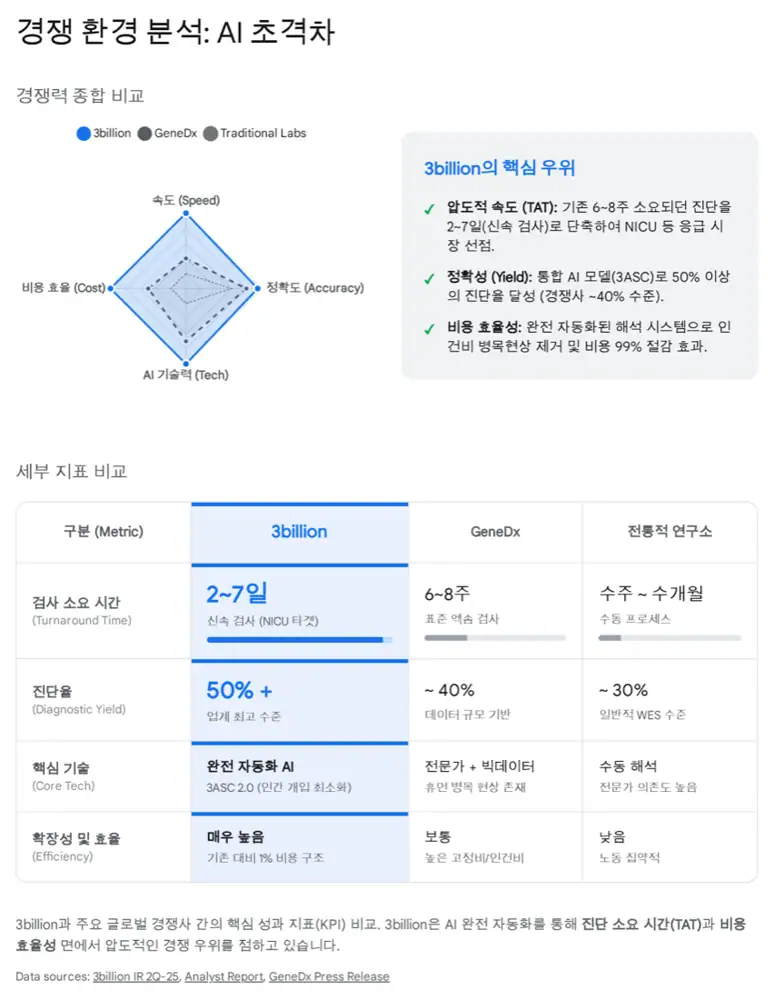
Official fact: The source says 3Cnet recorded AUROC 1.000 versus 0.957 for AlphaMissense in a third-party performance evaluation. 3ASC 2.0 integrates phenotype and genomic data to prioritize causal variants, while AIVARI uses an LLM to generate ACMG-guideline evidence sentences.
Interpretation: If competitors using manual interpretation need 6-8 weeks of TAT while 3billion provides rapid results in 2-7 days, speed becomes a difference in cost and market access.
AUROC 1.000
Source number for 3Cnet, above AlphaMissense at 0.957.
70+ countries, 100k+ patients
Rare-disease patient data including non-Western diversity.
CAP·CLIA·CDPH
Lab quality and state trust credentials needed for U.S. entry.
Official fact: The source says 3billion has CAP, CLIA, and CDPH certifications, and the CLIA certificate renewed in April 2025 is valid through 2027.
4. Revenue model and U.S. roadmap
| Revenue pillar | Source detail | Meaning |
|---|---|---|
| Full Service | Sample collection, sequencing, AI analysis, and final report as turnkey service; about 86% of revenue | Current cash cow, 85% recurring order rate |
| SaaS | GEBRA subscription for large hospitals and labs | High-margin and scalable because sequencing/logistics cost is absent |
| Data and pharma partnering | Rare-disease patient discovery and drug-target projects with Novartis, Takeda, and others | Potential long-term drug-platform value |
Official fact: The source says 3billion established 3billion US, Inc., a 100%-owned Delaware subsidiary, in October 2025 and contributed USD 3m. For U.S. reimbursement, it is localizing CLIA-lab processing through an Austin, Texas lab or partners such as Psomagen.
Interpretation: Using existing CPT codes such as 81415 and 81416 can shorten market entry by 2-3 years by avoiding a separate new-technology evaluation. Targeting NICU Rapid WGS first also gives a clear payer argument around lower hospitalization and testing cost.
5. Financials, valuation, and risks
| Item | Source number | Checkpoint |
|---|---|---|
| 2024 revenue | About KRW 5.8bn, expected 111% YoY growth | Whether high growth continues |
| 2025 target | More than KRW 10bn | Initial U.S. market effect |
| 2026 target | About KRW 42.9bn | J-curve revenue target presented at IPO |
| BEP | Operating-profit breakeven in 2027 | Fixed-cost absorption and higher SaaS mix |
Official fact: GeneDx is cited at about USD 3.9-4.0bn, or KRW 5.5-5.6tn, in market cap. Its 2025 expected revenue is about USD 400m and PSR is around 10x. 3billion's market cap is about KRW 540bn as of December 2025, and assuming 2025 revenue of KRW 10-20bn, PSR is 25-50x.
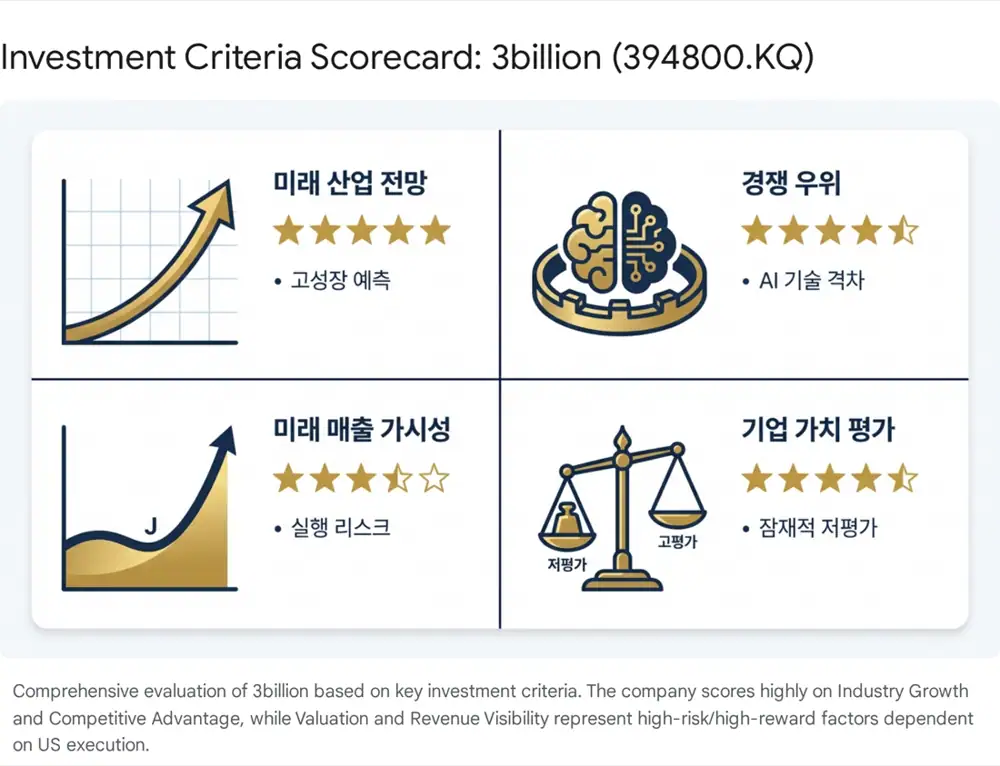
Interpretation: The source valuation logic is that if 2026 target revenue of KRW 42.9bn is achieved, forward PSR drops to about 12x, approaching GeneDx's range. Until that target is delivered, the high-growth premium is also the risk.
- Overhang: after the November 2024 listing, VC lock-up releases and Magna Investment exit signals can pressure supply-demand.
- Cash burn: at end-Q3 2025, cash was about KRW 5.2bn and liquidity including short-term financial products was about KRW 20bn. Additional financing is possible before 2027 BEP if investment expands.
- Execution risk: in the U.S., 3billion must compete against GeneDx, Labcorp, and other players with strong capital and sales networks.
6. Glossary
| Term | Meaning |
|---|---|
| WGS | Whole genome sequencing, reading all 3 billion base pairs of human DNA. |
| WES | Whole exome sequencing, analyzing the exome, roughly 1-2% of the genome but the key protein-coding region. |
| CLIA | U.S. quality-standard certification for labs testing human specimens. |
| TAT | Turnaround time from sample collection to final report. |
| VUS | Variant of uncertain significance, a variant whose pathogenicity is unclear. |
Sources
- Original: https://m.blog.naver.com/PostView.naver?blogId=star_of_self&logNo=224124181215
- 쓰리빌리언 기업 분석 요청: https://drive.google.com/open?id=1vG5xDq_O6V7OwjC4u1GBlr1kjmw4Ge6TS8ELNH7Bfek
- Invitae - Wikipedia: https://en.wikipedia.org/wiki/Invitae
- Invitae Receives Court Approval for Sale to Labcorp: https://ir.labcorp.com/news-releases/news-release-details/invitae-receives-court-approval-sale-labcorp
- GeneDx Holding 2025 Company Profile: Stock Performance & Earnings - PitchBook: https://pitchbook.com/profiles/company/225754-39
- GeneDx Holdings Market Cap 2020-2025 | WGS - Macrotrends: https://www.macrotrends.net/stocks/charts/WGS/genedx-holdings/market-cap
- Payer Policy and Advocacy | RCIGM - Rady Children's Institute for Genomic Medicine: https://radygenomics.org/clinical-genome-services/payer-policy-advocacy/
- New GeneDx Study Reveals Racial Disparities in Genetic Diagnosis Due to Systemic Barriers, Not Diagnostic Yields: https://ir.genedx.com/news-releases/news-release-details/new-genedx-study-reveals-racial-disparities-genetic-diagnosis
- 쓰리 빌리언 기업 분석 및 전망: https://drive.google.com/open?id=1L6lWYQOf5Q6aUbigWiCDWuGpm_er5xn-aat42xc8L5k
- CLINICAL LABORATORY IMPROVEMENT AMENDMENTS - 3billion: https://3billion.io/documents/CLIA_certificate.pdf
- GeneDx Holdings Corp Ordinary Shares - Class A (WGS) - Morningstar: https://www.morningstar.com/stocks/xnas/wgs/quote
- 3billion (KOSDAQ:A394800) - Stock Analysis - Simply Wall St: https://simplywall.st/stocks/kr/pharmaceuticals-biotech/kosdaq-a394800/3billion-shares