DEEP RESEARCH · HANA MICRON
Exynos 2600 Return and Hana Micron's Strategic Position
A look at Samsung's foundry ecosystem, non-memory testing, Vietnam memory back-end work, and role separation with Nepes.
0. Bottom line first
Hana Micron's key benefit is less about packaging the Exynos 2600 AP itself and more about longer test time and higher utilization at the Asan non-memory test line. If Nepes is closer to PMIC packaging, Hana Micron is closer to final and system testing.
- The source says Samsung spent about KRW 11.732 trillion on mobile AP solutions in 2023, strengthening the case for in-house AP recovery.
- Exynos 2600 is presented as a mobile AP combining 2nm SF2 GAA and HPB packaging.
- Hana Micron is framed as having a two-track model: Vietnam memory back-end growth and Asan system-semiconductor test upgrades.
1. The KRW 11 trillion dilemma and Exynos
Greater Qualcomm Snapdragon dependence raises cost and bargaining-power pressure for Samsung MX. The source cites KRW 11.732 trillion in 2023 mobile AP purchasing, roughly 50% higher than 2021, and more than 20% of smartphone BOM.
Interpretation: Exynos 2600 is a joint proof point for Samsung System LSI, Foundry, MX, and back-end partners.
2. Samsung spin-off DNA and the move into testing
Official fact: The source says Hana Micron was founded in August 2001 as a spin-off of Samsung Electronics' semiconductor packaging division, and founder Chang-ho Choi previously served in Samsung semiconductor planning and management roles.
The company first handled Samsung memory back-end volume, then expanded into system semiconductor testing.
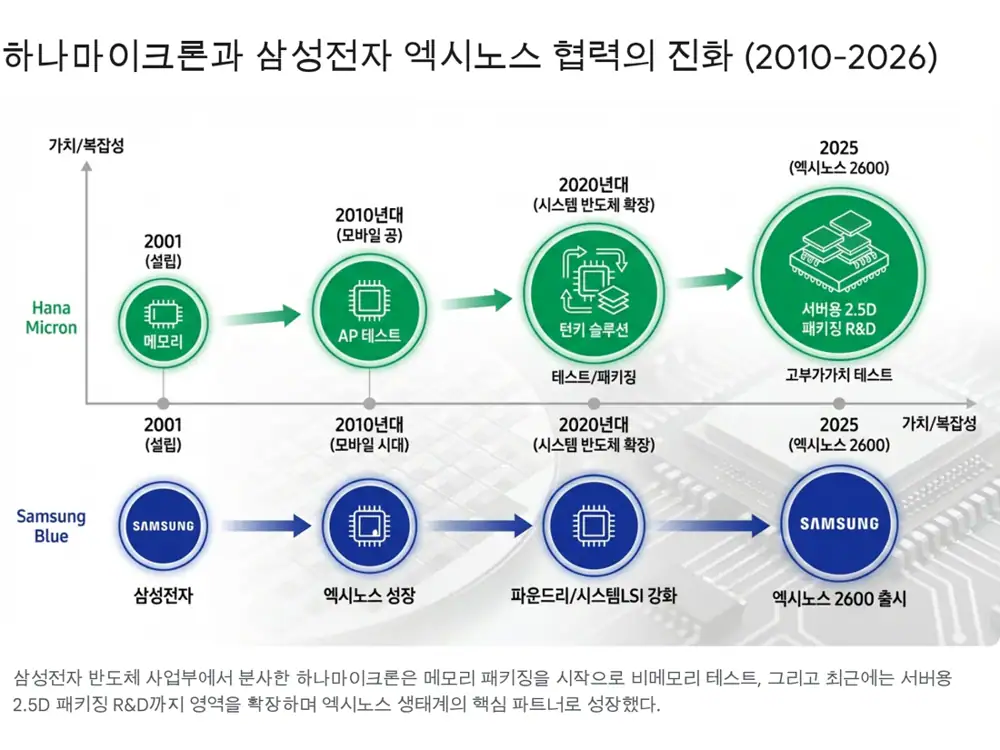
| Period | Role shift | Meaning |
|---|---|---|
| Early 2010s | Exynos 3/4 overflow packaging and basic testing | Built volume-handling trust |
| 2015~2020 | Testing for AP, PMIC, RF, and Touch IC | Shifted toward higher-value testing |
| 2021~present | Asan as a system semiconductor test hub | Strengthened position after Exynos 2100/2200 |
3. CAPEX and two-track strategy
The source interprets 2022~2024 investment as “focus” and “strategic dual production bases.” Vietnam supports quantitative memory back-end growth, while Asan supports qualitative upgrades in system semiconductor testing.
Memory back-end
A defensive pillar tied to server memory volume, including SK hynix-related work.
Non-memory testing
More complex Exynos and companion chips can increase test time.
KRW 70bn investment
The source views Asan test-equipment expansion as a clear demand-preparation signal.
4. Hana Micron vs Nepes: role separation
| Category | Hana Micron | Nepes |
|---|---|---|
| Core role | Final test and packaging | Bumping and packaging |
| Exynos-related focus | Testing for AP, RF, modem | Packaging for PMIC and audio codec |
| Technology | System test, burn-in test, flip-chip | Fan-Out WLP/PLP, solder bumping |
| Benefit point | Longer testing as chip complexity rises | More PMIC demand as 2nm power control matters |
5. Scenario impact
Base Case: Exynos 2600 lands successfully
- Exynos is used in more than 50% of global Galaxy S26 volume and thermal issues are solved.
- The source expects Asan non-memory test utilization above 85% in 2H 2025 and possible double-digit OPM recovery.
- Nepes could see higher FOPLP utilization and a faster turnaround through PMIC growth.
Bear Case: yield issues and limited adoption
- 2nm yield issues limit Exynos to some regions or Snapdragon fully replaces it.
- Hana Micron can defend through server memory volume, but Asan depreciation may pressure margins.
- Nepes' PMIC recovery could be delayed.
My conclusion is to separate Hana Micron as the direct testing beneficiary and Nepes as the PMIC/advanced-packaging turnaround candidate. Watch Exynos 2600 2nm yield, HPB thermal control, and Asan test-line utilization.
Sources
- Source 1: https://m.blog.naver.com/PostView.naver?blogId=star_of_self&logNo=224123743641
- Source 2: https://drive.google.com/open?id=1YVAOi-Eg9lyEUA8np7FNPPlzjbM5mkZYIEcyE99lCM4
- Source 3: https://www.gsmarena.com/samsung_announces_exynos_2600_the_worlds_first_2nm_mobile_chip-news-70790.php
- Source 4: https://www.kedglobal.com/korean-chipmakers/newsView/ked202512190004
- Source 5: https://sammyguru.com/samsung-expands-chip-testing-as-exynos-2600-prepares-for-galaxy-s26-series/
- Source 6: https://semiconductor.samsung.com/processor/mobile-processor/exynos-2600/
- Source 7: https://pestel-analysis.com/blogs/owners/hanamicron
- Source 8: https://www.businesskorea.co.kr/news/articleView.html?idxno=59075
- Source 9: https://www.sisajournal-e.com/news/articleView.html?idxno=403452
- Source 10: https://kind.krx.co.kr/common/disclsviewer.do?method=search&acptno=20240618000288&docno=&viewerhost=&
- Source 11: https://www.nepes.co.kr/en/rnd/electronic_devices.php
- Source 12: https://m.etnews.com/20240415000199?obj=Tzo4OiJzdGRDbGFzcyI6Mjp7czo3OiJyZWZlcmVyIjtOO3M6NzoiZm9yd2FyZCI7czoxMzoid2ViIHRvIG1vYmlsZSI7fQ%3D%3D
- Source 13: https://www.nepes.co.kr/en/ir/ir_news.php?bgu=view&idx=1007
- Source 14: https://www.e4ds.com/sub_view.asp?ch=2&t=0&idx=18768