DEEP RESEARCH · Oriental Precision
Oriental Precision (014940): Core Equipment Supplier in the Shipbuilding Supercycle
A review of the leading marine-crane supplier’s backlog, moat, and green-growth options
0. Bottom line first
The thesis rests on lagged benefits from the shipbuilding supercycle, roughly 70% domestic share in marine cranes, KRW 235.8 billion backlog as of September 30, 2025, and technology expansion into electric, cryogenic, and offshore-wind cranes.
About 70% share
The company is the dominant domestic marine-crane supplier, supported by vendor approvals and class-certification barriers.
KRW 235.8bn
As of September 30, 2025: KRW 211.2bn in machinery and KRW 24.5bn in structures.
45.77%
Oriental Inspection & Service’s stake as of 3Q25, which the source views as stable governance.
1. Company inflection point

Official fact: Oriental Precision was founded in 1980 as Oriental Fitting, changed to its current name in 1990, and listed on KOSDAQ in 2001. It supplies marine cranes, davits, and winches from Busan, while subsidiary Oriental MarineTech supplies deck houses and engine-room casings.
Interpretation: The 2012-2016 workout was painful, but asset sales, workforce efficiency, Dalian factory disposal, and continued crane R&D created the base for later share gains.
2. Portfolio and technology
| Segment | Key content |
|---|---|
| Machinery | Hose-handling cranes, provision cranes, special knuckle/offshore cranes, winches, and davits. |
| Special technology | OCIMF, API-2C, class approvals, AHC, explosion-proof design, and cryogenic cranes form entry barriers. |
| Structures | Oriental MarineTech produces deck houses and engine-room casings, providing scale. |
The source highlights cranes operable at minus 52 degrees Celsius as a competitive asset for icebreaking LNG carriers.
3. Financial and backlog core
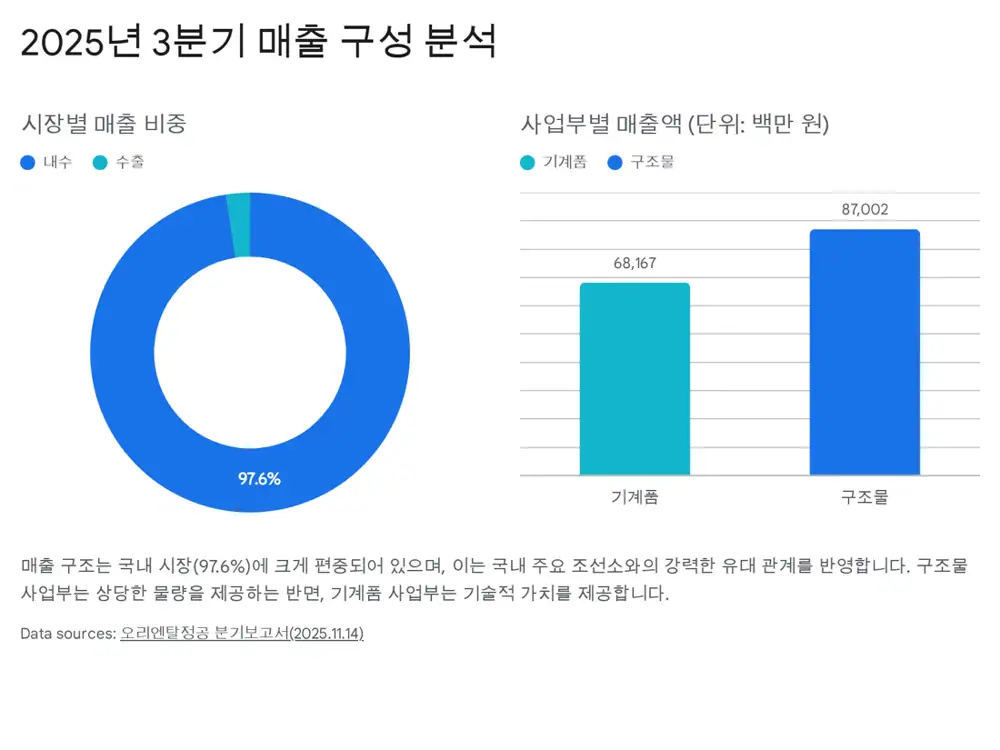
Official fact: Backlog as of September 30, 2025 was KRW 235.8 billion, split into KRW 211.2 billion in machinery and KRW 24.5 billion in structures. The source also says the structures utilization rate is approaching the 18% range.
Interpretation: The high machinery share suggests room for margin-mix improvement as revenue is recognized, while the smaller structural backlog reflects shorter lead times and faster turnover.
4. Future growth drivers
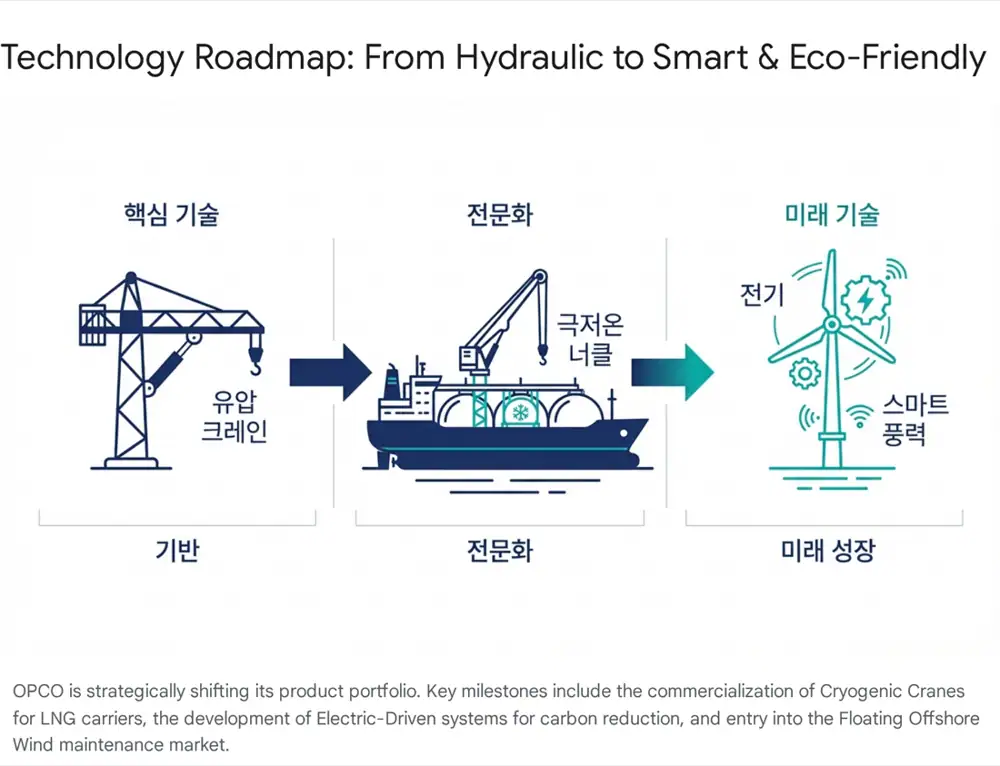
- Electric cranes: Motor-driven systems reduce hydraulic-oil leakage risk and improve efficiency.
- Cryogenic technology: Targets safe handling around LNG at minus 163 degrees Celsius and ammonia at minus 33 degrees Celsius.
- Offshore wind: AHC cranes and wind-propulsion auxiliary equipment are presented as new growth axes.
- Patents: The source cites 11 registered patents including cryogenic marine cranes and emergency drive devices.
5. Risks and responses
| Risk | Response / interpretation |
|---|---|
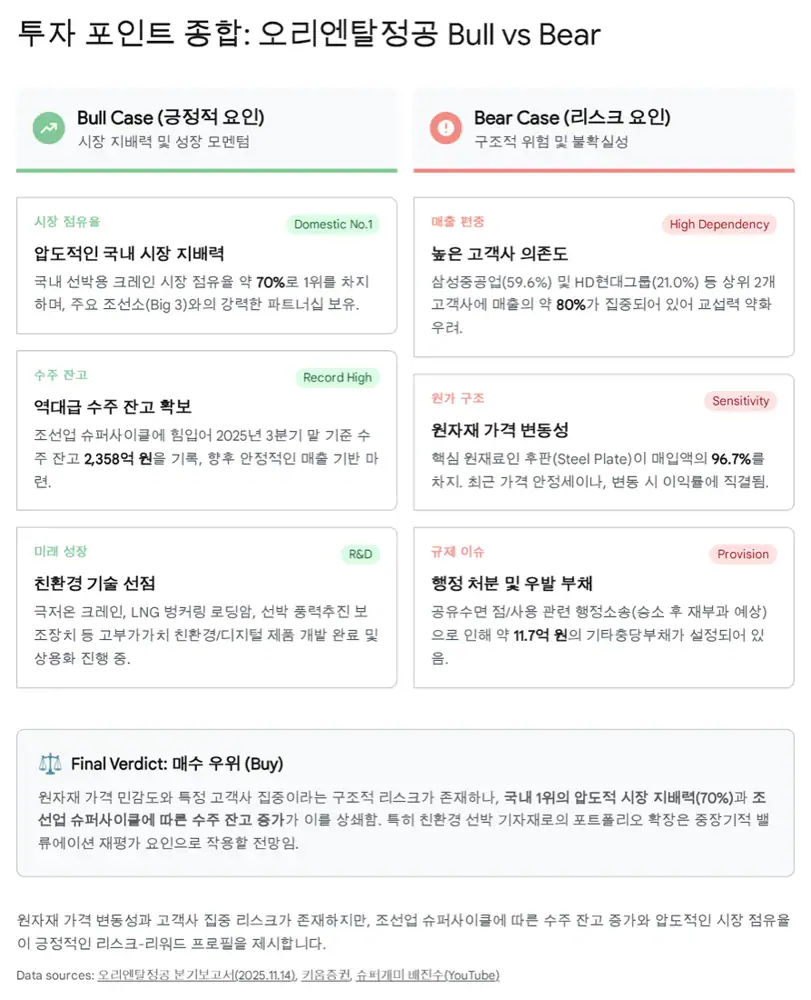
| Steel plate prices | Direct POSCO procurement and seller’s-market pass-through are cited as mitigants. |
| Customer concentration | More than 97% of revenue comes from Korea’s big three yards, but their 3+ years of backlog lowers near-term volume risk. |
| Public-water occupancy issue | The Oriental MarineTech issue is described as resolved through payment, successful administrative litigation, refund, and new permit acquisition. |
6. Investment implications
- The 70% share quantifies the technical and relational moat.
- Clearing low-priced orders and recognizing high-priced orders could entrench double-digit operating margins.
- Green and offshore-wind technologies provide growth options beyond the shipbuilding cycle peak.
Sources
- Original post: https://m.blog.naver.com/PostView.naver?blogId=star_of_self&logNo=224122538200
- 서울신문 산은 차익 반환소송: https://www.seoul.co.kr/news/newsView.php?id=20181107025003&redirect=false
- 인베스트조선 경영권 매각: https://www.investchosun.com/site/data/html_dir/2016/09/21/2016092186025.html
- 조선 엔진 기업 경쟁 분석: https://drive.google.com/open?id=1-BhRij0F6hGVXSmWeYzCqxppeYrj7t5J0dQD6bffdyg
- HD현대마린엔진 분석: https://drive.google.com/open?id=17__BjnRGge95lJyHMPMfOhII6MuC_c2drsjNlyY_Xfo
- 키움증권 오리엔탈정공 리포트: https://invest.kiwoom.com/inv/36851
- 이투데이 극저온 크레인 기사: https://www.etoday.co.kr/news/view/2453069
- 와이드데일리 특징주 기사: https://www.widedaily.com/news/articleView.html?idxno=262693
- 아시아경제 조선기자재 테마: https://www.asiae.co.kr/article/2020112310442737535&mobile=Y?utm_source=kakaotalk&utm_medium=social&utm_campaign=share_btn&utm_content=20250802