DEEP RESEARCH · CSSC vs KOREA BIG THREE
CSSC vs Korea’s Big Three Shipbuilders: Scale Against Technical Premium
A translated comparison of capacity, LNG technology, green vessels, supply chains, and geopolitical risk.
0. Bottom line first
The China-Korea shipbuilding race is not a simple scale-versus-technology contest. CSSC dominates general-purpose vessels through capacity and policy finance, while Korea's big three defend premium segments such as LNG carriers, FLNG, and VLACs through delivery reliability and technical trust.
Economies of scale
After merging with CSIC, CSSC combines mega-yards including Jiangnan, Hudong-Zhonghua, Waigaoqiao, DSIC, and GSI.
Selective booking
HD KSOE, Hanwha Ocean, and Samsung Heavy allocate limited docks to LNG carriers, VLACs, and large container ships.
Geopolitics and quality
China faces sanction and quality risks; Korea faces labor shortages and cost control risk.
1. Capacity: quantity of slots and quality of slots
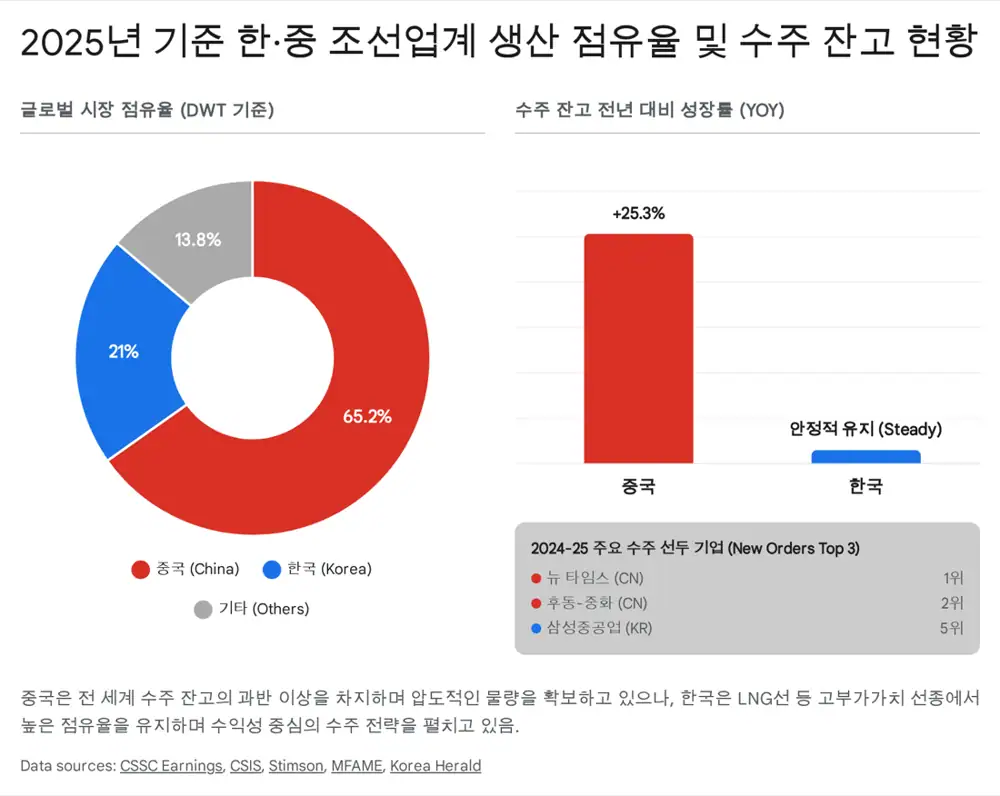
Official fact: Citing CSIS, the source says CSSC has shipbuilding capacity 230 times that of all U.S. shipyards. It also states China's national orderbook reached 242.24 million DWT at the end of September 2025, up 25.3% year over year.
Interpretation: CSSC's strongest weapon is not only price; it is slot availability. When demand surges, earlier delivery options combine with lower prices.
| Category | CSSC/China | Korea big three |
|---|---|---|
| Production strategy | Multi-yard, multi-vessel-type model | Selective high-value use of limited docks |
| Reservation status | Major slots described as full to late 2028-2029 | Major docks booked to 2027-1H28 |
| Main advantage | Physical capacity and policy support | Delivery reliability, cycle time, premium pricing |
2. LNG technology: Korea's deep moat and China's learning curve
LNG carriers handle cargo at minus 163 degrees Celsius and require very high technical execution. The source argues Korea's big three lead in membrane cargo tank construction such as GTT Mark III Flex and NO 96, BOR reduction insulation, and welding stability.
Official fact: The source says Korea won 14 of 16 global LNG carrier orders from January to September 2025, while China won none.
Interpretation: Shipowners choose Korea despite higher prices because removing delivery uncertainty and protecting operating efficiency can be worth more than lower upfront CAPEX.
3. Next-generation green vessels and supply chain
CSSC is specializing yards: Hudong-Zhonghua for LNG, Jiangnan for gas carriers and naval vessels, and Waigaoqiao for cruise and large container ships. It also vertically integrates engines, generators, and equipment through subsidiaries such as WinGD.
Korea's big three respond with automation, smart yards, and overseas bases. Samsung Heavy uses its Ningbo block plant to relieve bottlenecks, while Hanwha Ocean's Philly Shipyard acquisition is positioned as a bridgehead for U.S. commercial and MRO markets.
Jiangnan and WinGD
China is accelerating in ammonia/methanol engines and VLAC orders.
Samsung Heavy
FLNG and complex offshore plants remain high-value areas that are hard to copy quickly.
Hanwha Ocean
Philly Shipyard can become a strategic asset for defense and commercial MRO expansion.
4. Price, customers, and finance
| Item | Korea | China | Read |
|---|---|---|---|
| Price | Premium pricing | Low price and early slots | China leads general-purpose vessels |
| Delivery | Proven reliability | Delay risk from rapid growth | Korea leads high-value LNG segments |
| Equipment | Trusted domestic equipment | Engine/equipment localization underway | China's vertical integration is a long-term threat |
| Finance | Market-rate linked | Policy finance | Chinese financial support is powerful |
5. Conclusion: what keeps the gap open
- CSSC is likely to maintain global leadership in bulkers, tankers, and container ships.
- Korea can keep a super-premium position in LNG carriers through quality and delivery, but must watch China's 3-5 year technology catch-up.
- The standards race has begun in ammonia and hydrogen vessels; falling behind there could weaken today's LNG moat.
- Korean shipbuilding must evolve beyond manufacturing into total marine mobility solutions covering autonomy, green fuel, and lifecycle services.
Sources
- 1. https://m.blog.naver.com/PostView.naver?blogId=star_of_self&logNo=224121664457
- 2. https://www.hellenicshippingnews.com/korean-shipbuilders-sweep-lng-orders-as-chinese-ship-contracts-drop-to-zero/
- 3. https://news.cgtn.com/news/2025-08-13/China-s-shipbuilding-merger-Next-phase-of-SOE-restructuring-1FNFsQUe0ko/p.html
- 4. https://www.csis.org/analysis/threat-chinas-shipbuilding-empire
- 5. https://www.defensenews.com/global/asia-pacific/2025/03/11/chinas-shipbuilding-dominance-a-national-security-risk-for-us-report/
- 6. https://drive.google.com/open?id=167FjaYd_vY9J7ROdU-IpXRUN1FuOwLAw
- 7. https://www.stimson.org/2025/south-korean-shipbuilding-capacity/
- 8. https://drive.google.com/open?id=1mquLbd16ZuuPFRGOy5ELnBVgutJWAUYV
- 9. https://biz.chosun.com/en/en-industry/2025/09/29/EDO62AESDJGF3KQPG3M4PRQUEA/
- 10. https://www.offshore-energy.biz/samsung-heavy-industries-lands-massive-3-4b-order-for-15-lng-carriers/
- 11. https://www.rivieramm.com/news-content-hub/news-content-hub/chinas-hudong-zhonghua-shipyard-hits-record-lng-carrier-deliveries-86921
- 12. https://www.xindemarinenews.com/en/shipbuilding/2025/1222/62290.html
- 13. https://www.offshore-energy.biz/cma-cgm-takes-delivery-of-methanol-dual-fueled-container-ship-from-chinese-shipyard/
- 14. https://www.seatrade-maritime.com/tankers/eps-orders-four-very-large-ammonia-carriers-from-jiangnan-shipyard
- 15. https://www.offshore-energy.biz/jiangnan-shipbuilding-bags-new-order-for-93000-cbm-ammonia-carriers/
- 16. https://wingd.com/news-media/news/wingd-seals-ammonia-fuelled-x-df-a-engine-orders-for-chinese-gas-carriers/
- 17. https://www.kedglobal.com/shipping-shipbuilding/newsView/ked202508040001
- 18. https://think.ing.com/articles/asia-shipbuilding-renaissance/
- 19. https://shipsmonthly.com/news/lng-newbuilding-values-at-record-high/