DEEP RESEARCH · NARA SPACE TECHNOLOGY
Nara Space Technology: A Hybrid Play on Mass-Produced Satellite Constellations and Earth-Observation Data
A review of a New Space company vertically integrating microsatellite manufacturing, launch operations, and AI-driven data analytics.
0. Bottom line first
My key takeaway is that Nara Space is not just a satellite manufacturer. It combines the 16U Observer platform, the NarSha hyperspectral satellite, and the EarthPaper data platform to pursue both manufacturing revenue and data revenue.
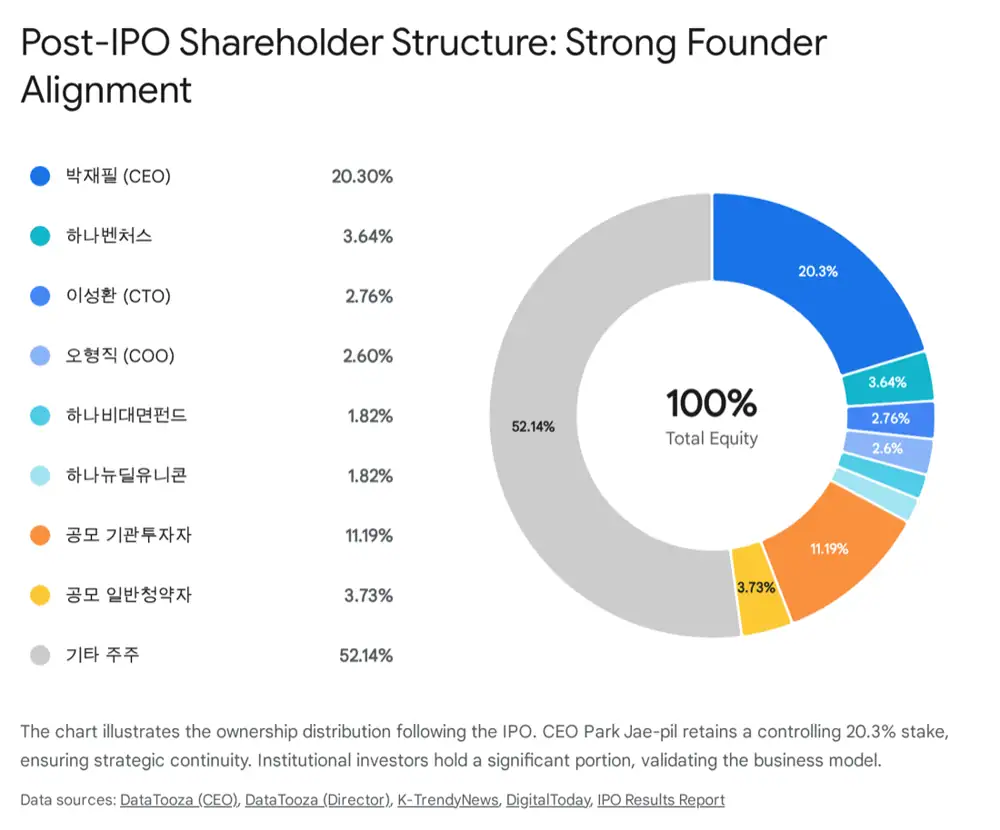
Official fact: The source post says Observer-1A was launched on a SpaceX Falcon 9 in November 2023 and has been operated for more than two years, establishing space heritage. It also lists ownership figures: CEO Jae Pil Park at 20.30% (2,340,900 shares), CTO Sung Hwan Lee at 2.76% (318,724 shares), COO Hyung Jik Oh at 2.60% (300,040 shares), and Hana Ventures at 3.64% (419,945 shares).
Interpretation: In satellites, proven orbital operation is a trust asset for bids and partnerships. The 80~100 satellite constellation target, however, must be assessed together with launch risk, funding needs, and overhang.
1. Business structure: from satellites to data
2. Technology points
TRL 9-oriented asset
Observer-1A’s operating record reads as orbital validation, not just lab-stage technology.
Methane monitoring
NarSha targets methane (CH4) detection using spectral signatures across visible and infrared bands.
Shorter revisit time
The long-term vision centers on an 80~100 satellite constellation by 2030~2031 and a revisit time below one hour.
3. Investment checklist
| Item | Source detail | My read |
|---|---|---|
| IPO price | KRW 16,500 | Presented as a price reflecting future growth |
| New capital | About KRW 28.4bn | Could extend runway into 2027~2028 |
| TAM | Global space economy of about US$1.8tn, roughly KRW 2,400tn, by 2035 | The market story is large, but orders and recurring revenue need verification |
4. Risks
- Launch risk: failure of NarSha or other key satellites could delay the roadmap by 1~2 years.
- Capital intensity: an 80+ satellite constellation requires sustained CAPEX.
- Overhang: post-listing tradable shares and VC exits can weigh on price.
- Dual-use regulation: satellite data is sensitive to export controls and security rules.
Sources
- 원문: https://m.blog.naver.com/PostView.naver?blogId=star_of_self&logNo=224117950092
- 박재필 대표 지분: https://www.datatooza.com/article/20251219163800607352ef37a3e8_80
- 이성환 기술이사 지분: https://www.datatooza.com/article/20251219164247252352ef3c9daa_80
- 오형직 운영이사 지분: https://www.k-trendynews.com/news/articleView.html?idxno=196653
- 하나벤처스 지분: https://www.digitaltoday.co.kr/news/articleView.html?idxno=614364
- Nara Space Media: https://naraspace.com/naraspace/media
- Series B funding: https://en.wowtale.net/2024/05/31/77631/
- NarSha eoPortal: https://www.eoportal.org/satellite-missions/narsha-constellation
- SmallSat NarSha paper: https://digitalcommons.usu.edu/smallsat/2024/all2024/226/
- EarthPaper: https://naraspace.com/earthpaper
- CEO interview: https://www.globalnewstop.com/news/articleView.html?idxno=1187
- Methane monitoring article: http://www.impacton.net/news/articleView.html?idxno=17243
- THE VC comparison: https://thevc.kr/compare/innospace-vs-naraspacetechnology-vs-satrecinitiative-vs-spacex
- Satrec report: https://file.alphasquare.co.kr/media/pdfs/company-report/_3Q25_%EC%8E%84%ED%8A%B8%EB%A0%89%EC%95%84%EC%9D%B4_Preview_%EC%B5%9C%EC%A0%95%ED%99%98_48_Online%20report%20_%206_10p_%EC%8E%84%ED%8A%B8%EB%A0%89%EC%95%84%EC%9D%B4.pdf
- ChosunBiz IPO valuation: https://biz.chosun.com/en/en-finance/2025/10/14/SQHILFUYZ5G2JOPHR6GRBTFWQM/
- Lumir balance sheet: https://www.valueline.co.kr/finance/balancesheet/474170
- Korean space stocks: https://www.chosun.com/english/industry-en/2024/07/25/PCABZCKREBB73HLXQ5BQ4FY6QM/
- Exoswan space stocks: https://exoswan.com/space-technology-stocks
- PlanetLabs Reddit: https://www.reddit.com/r/PlanetLabs/comments/1l687ko/which_earth_imagery_and_analytics_should_i_invest/
- SpaceInvestorsDaily Reddit: https://www.reddit.com/r/SpaceInvestorsDaily/comments/1k1at1y/scott_o_pl_planet_labs_vs_bksy_blacksky_an/
- Valuation concern: https://www.globalnewstop.com/news/articleView.html?idxno=488
- 2031 84-satellite plan: https://www.mt.co.kr/future/2025/12/02/2025120211151773309
- KSAT partnership: https://www.ksat.no/news/news-archive/20152/ksat-and-nara-space-expand-partnership/
- WEF Space opportunity: https://www3.weforum.org/docs/WEF_Space_2024.pdf