DEEP RESEARCH · DJT / TAE
TMTG and TAE Technologies: Meme-Stock Capital Meets Fusion Infrastructure
A review of the USD 6B stock swap, TAE's p-B11/FRC technology, AI power demand, and regulatory variables
0. Bottom line first
This is not merely an odd pairing of a social-media company with a fusion company. It is a structure where richly valued public-market capital and a deep-tech company needing long-duration R&D funding solve each other's constraints. The major risks are the physics difficulty of p-B11 fusion and volatility in TMTG's asset base.
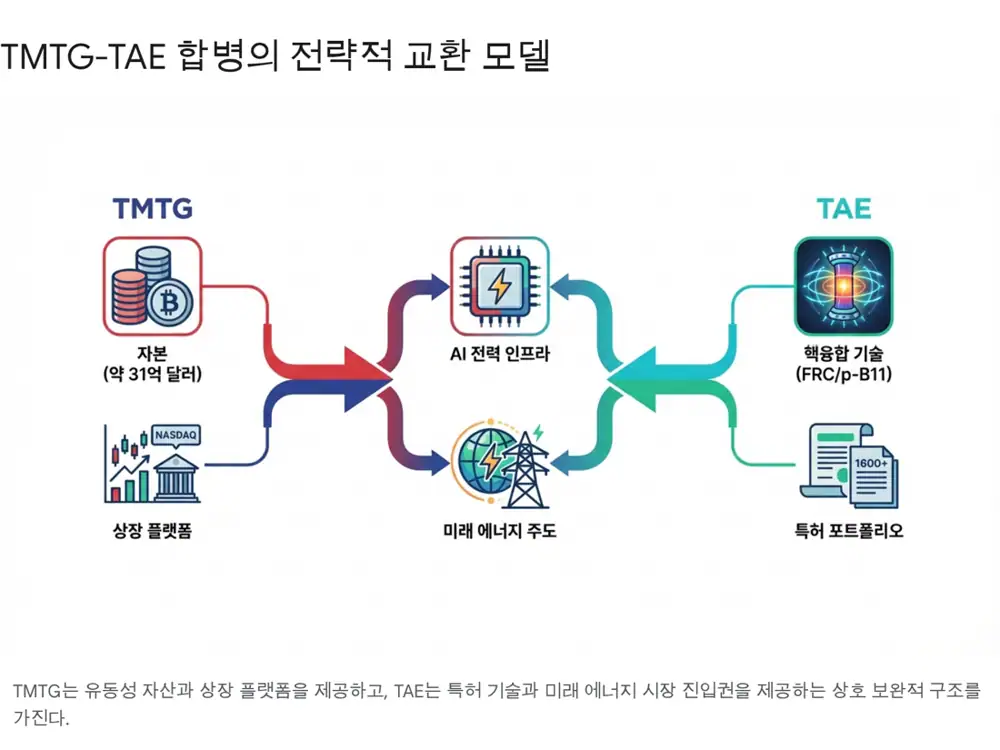
Official fact: The source says TMTG and TAE Technologies announced a USD 6 billion all-stock transaction in December 2025. After closing, existing TMTG and TAE shareholders would each own about 50% on a diluted basis. TMTG also agreed to provide USD 200 million at signing and potentially another USD 100 million upon initial S-4 filing.
Interpretation: TMTG is trying to move beyond political-theme social media and redefine itself as an AI infrastructure and energy technology company. TAE gets a public listing route and liquid assets to cross the commercialization death valley.
1. Strategic synergy: redeploying meme-stock capital
Since listing, TMTG has behaved like a meme stock tied to Donald Trump's political brand and fan base. The source says that even with 2025 Q3 revenue below USD 1 million and ongoing net losses, TMTG maintained a multi-billion-dollar market capitalization.
The merger reallocates that valuation and liquidity from low-growth social media into clean energy and AI infrastructure. For TAE, which had raised USD 1.3 billion from investors including Google, Chevron, and Goldman Sachs but still needed major capital for the commercial prototype Da Vinci, TMTG offers a reverse-merger route and funding source.
2. Financial structure: USD 6B, 50/50 ownership, and bitcoin option income
| Item | Source content | Meaning |
|---|---|---|
| Transaction type | All-stock transaction | More like equity redistribution than cash acquisition |
| Combined value | About USD 6B | Compromise between TMTG's public value and TAE's technology potential |
| Ownership | TMTG shareholders 50%, TAE shareholders 50% | Merger of equals structure |
| Cash injection | USD 200M at signing, possible additional USD 100M at initial S-4 filing | Operating and initial R&D funding for TAE |
| TMTG financial assets | USD 3.1B as of 2025 Q3 | Balance sheet resembles an investment company more than a media firm |
Official fact: The source says TMTG generated USD 15.3 million of realized gains in 2025 Q3 and USD 61.1 million year-to-date from a bitcoin option income strategy.
Interpretation: A strategy likely involving covered calls and cash-secured puts can create cash flow to offset operating losses, but bitcoin volatility can destabilize quarterly earnings and R&D funding plans.
3. TAE technology: attraction and difficulty of FRC and p-B11
TAE's differentiation is that it pursues field-reversed configuration (FRC), not a tokamak, and ultimately targets proton-boron (p-B11) reactions instead of deuterium-tritium. The source says p-B11 can sharply reduce neutron output, radioactive waste, and shielding burden, but it requires extreme conditions around 3 billion degrees and must overcome bremsstrahlung losses.
Field-Reversed Configuration
Aims for a more compact system than tokamaks, supporting the case for siting near data centers.
Low-neutron fusion
If successful, it lowers waste and regulatory burden, but commercialization difficulty is very high.
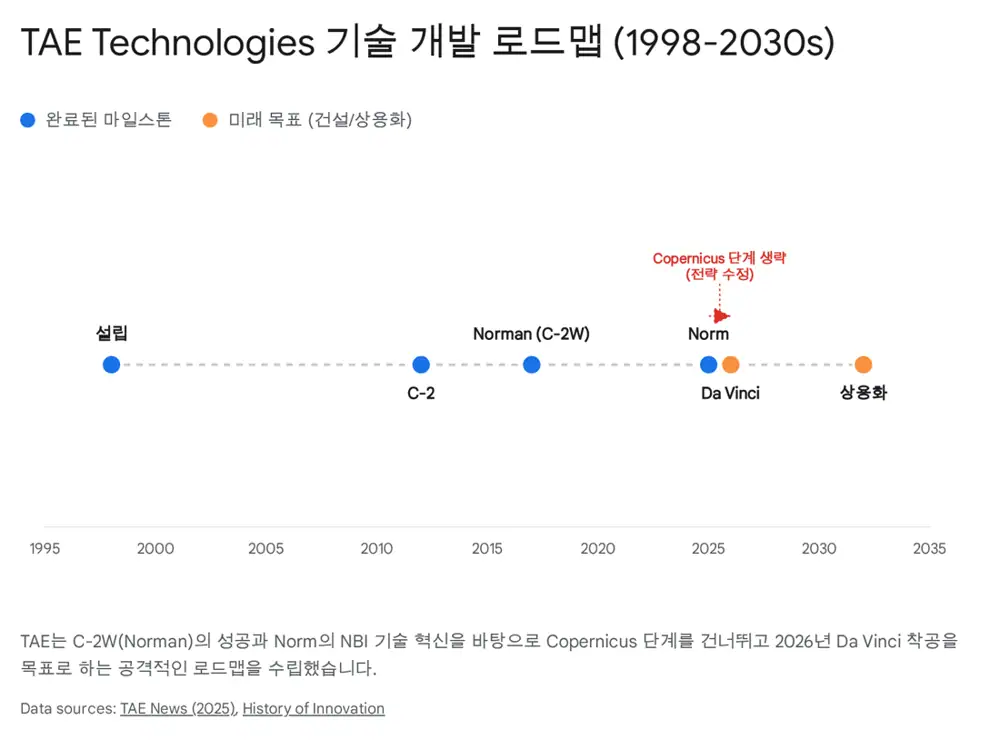
Early 2030s target
The source links TAE's commercialization target to the Da Vinci project.
4. Competitive landscape and AI data-center power demand
| Company | Technology / commercialization target | Key investors |
|---|---|---|
| TAE | FRC, p-B11, Da Vinci in early 2030s | TMTG, Google, Chevron |
| Helion | Polaris, 2028 target | Sam Altman, Microsoft |
| Commonwealth Fusion Systems | ARC, early 2030s | Bill Gates, ENI |
| General Fusion | Early 2030s | Jeff Bezos |
The source sees TAE's initial market as hyperscale data centers rather than the whole grid. AI data-center rack density is rising from about 10kW to 50-100kW, and TAE's FRC reactor is presented as modularly scalable from 50MWe to 500MWe.
5. Regulation and politics: NRC Part 30 and America First energy
Official fact: The source says that in April 2023 the U.S. NRC decided to regulate fusion power plants under Part 30, used for byproduct material such as accelerators and medical isotope facilities, rather than the stricter Part 50 framework for fission reactors.
- Permitting timeline: The source says procedures that took years could shorten to months.
- Cost: Lower safety and compliance costs improve economics.
- Siting: Lower EPZ burden could allow plants near data centers or industrial parks.
- Political variable: Donald Trump's large ownership is both a possible policy advantage and a conflict-of-interest risk.
6. Risks and overall outlook
- Physics uncertainty: Commercial p-B11 fusion is unproven; maintaining 3 billion degrees and producing net energy are central challenges.
- Engineering scale-up: NBI proven in Norm must still work at the much larger Da Vinci scale, including materials and heat-load limits.
- Financial volatility: TMTG share-price swings and bitcoin asset volatility can disrupt stable R&D execution.
- Policy continuity: Energy independence and AI dominance are bipartisan themes, but a structure tied to one political figure can deserve a discount.
My conclusion is that this transaction is a large experiment combining capital markets, technology, and politics. If it works, TMTG can move from a political-theme platform to an AI energy infrastructure company, while TAE gains the capital to cross the death valley. If it fails, overvalued equity, bitcoin volatility, and unproven fusion technology can all derate at once.
Sources
- 원문 블로그: https://m.blog.naver.com/PostView.naver?blogId=star_of_self&logNo=224117872024
- InvestingNews TMTG-TAE merger: https://investingnews.com/trump-media-technology-group-to-merge-with-tae-technologies-a-premier-fusion-power-company-in-all-stock-transaction-valued-at-more-than-6-billion/
- World Nuclear News TMTG-TAE: https://world-nuclear-news.org/articles/trump-media-announces-merger-with-fusion-firm-tae-technologies
- ANS TMTG-TAE USD 6B deal: https://www.ans.org/news/article-7632/trump-media-to-merge-with-fusion-startup-tae-technologies-in-6b-deal/
- Market Chameleon TMTG Q3 assets: https://marketchameleon.com/articles/b/2025/11/7/trump-media-q3-2025-financial-assets-cashflow-cro
- Charles Schwab covered call: https://www.schwab.com/learn/story/options-strategy-covered-call
- XBTO crypto options yield: https://www.xbto.com/resources/crypto-options-trading-a-new-way-to-generate-yield-2025
- TAE fusion breakthrough: https://tae.com/tae-technologies-delivers-fusion-breakthrough-that-dramatically-reduces-cost-of-a-future-power-plant/
- TAE Technologies Wikipedia: https://en.wikipedia.org/wiki/TAE_Technologies
- Academic Journals p6Li fusion critique: https://academicjournals.org/journal/IJPS/article-full-text/75DD9E465789
- GWPF fusion critique: https://thegwpf.org/nuclear-fusion-should-we-bother-critique-and-debate/
- TAE roadmap: https://tae.com/tae-shortens-device-roadmap-prepares-for-commercial-era/
- PR Newswire TAE breakthrough: https://www.prnewswire.com/news-releases/tae-technologies-delivers-fusion-breakthrough-that-dramatically-reduces-cost-of-a-future-power-plant-302429115.html
- Reddit Helion Polaris discussion: https://www.reddit.com/r/fusion/comments/ukeisj/if_polaris_hits_net_electricity_helion_plans_to/
- CFS USD 863M funding: https://blog.cfs.energy/how-863m-in-new-funding-fast-tracks-commercial-fusion-power/
- Fusion Industry Association NRC decision: https://www.fusionindustryassociation.org/nrc-decision-separates-fusion-energy-regulation-from-nuclear-fission/
- Morgan Lewis NRC fusion systems: https://www.morganlewis.com/blogs/upandatom/2023/10/nrc-issues-proposed-rule-language-for-fusion-systems