DEEP RESEARCH · QUANTUM COMPUTING
Q2B 2025: Photon Queue, XeedQ, Phaseshift, and the Start of Quantum Utility
The technology, policy, and investment meaning of quantum memory, room-temperature diamond processors, and metasurface photonics
0. Bottom line first
Q2B 2025 points toward utility and integration rather than raw qubit counts. Photon Queue targets synchronization bottlenecks in quantum networks, XeedQ targets access through room-temperature mobile quantum processors, and Phaseshift targets miniaturized optical control. The source selects Photon Queue as the three-year Top Pick.
Official fact: The source says the U.S. DOE is reinvesting USD 625 million into five national QIS research centers. It also says Germany is running an action plan to invest EUR 3 billion in quantum technology by 2026.
Interpretation: Quantum investment is shifting from the date of universal quantum advantage to enablers that solve current bottlenecks. Memory, control chips, and room-temperature processors are becoming more valuable because they make systems work now.
1. Market environment: from science projects to deep convergence
The source argues that after the 2020-2023 quantum hype cycle, the industry has entered an era of utility and integration. Physical qubit count is no longer enough; fidelity, error correction, and integration with HPC and communication networks matter more.
Funds such as 55 North and Quantonation are described as emphasizing deep convergence, where quantum technology combines with AI, HPC, and biotech to solve specific bottlenecks. The question becomes less “when does quantum advantage arrive?” and more “who makes today's systems work?”
2. Policy background: U.S. networks and German procurement
NQI 2.0 and quantum networking
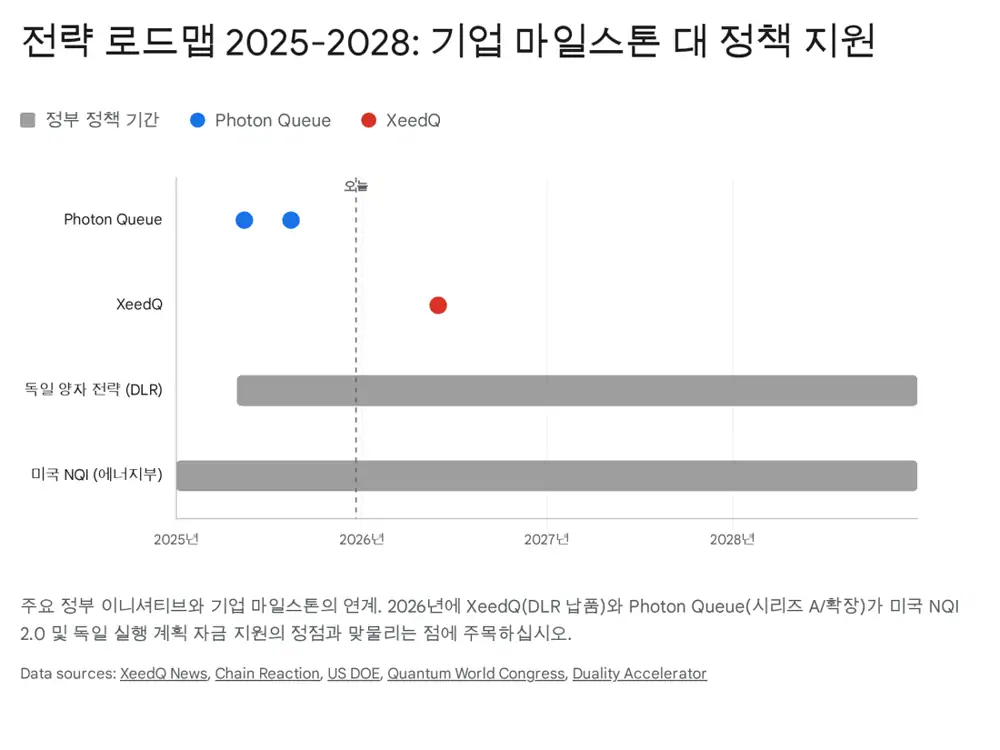
The DOE's USD 625 million QIS center support targets distributed quantum computing and sensing networks, opening public-market opportunities for quantum memory and interconnect companies.
Technology sovereignty and procurement
Germany's EUR 3 billion plan through 2026 includes agencies such as DLR acting as customers that order quantum computers to specific specifications.
3. Photon Queue: memory for quantum networks
Official fact: Photon Queue is a 2024 UIUC spinout headquartered in Urbana, Illinois. The source names Nathan Arnold, Colin Lualdi, Kelsey Ortiz, and Kai Shinbrough as key people and identifies Professor Paul Kwiat's lab as the technical root.
Photon Queue focuses on the synchronization bottleneck. Photons generated at different nodes must arrive at the same time to interact, but photons cannot simply stop. A low-loss quantum memory is therefore required.
| Technology | Source description | Meaning |
|---|---|---|
| Free-space loop | Ultra-low-loss optical switches and high-reflectivity mirrors hold photons in a loop | Aims to avoid conversion loss and complexity from matter-based memory |
| Room-temperature/no cryogenics | Works without cryogenic cooling or vacuum chambers, using ordinary power | Could reduce data-center OPEX and complexity |
| Wavelength agnostic | Can support multiple wavelengths by changing optical coatings | Platform neutrality and broader market reach |
4. XeedQ and Phaseshift: room-temperature processors and optical control chips
XeedQ is described as improving access to quantum computing with diamond NV-center processors that operate at room temperature and can be mobile. The source highlights its roadmap from 4 qubits to 32 and then 256 qubits, plus a EUR 30 million DLR contract.
Phaseshift uses metasurface photonics to miniaturize and integrate optical control systems. Its strategy is not to build the final computer, but to supply the control chips that quantum hardware makers need, becoming the “NVIDIA of quantum optics.”
5. Three-company comparison: finance, scalability, policy fit
| Company | Finance/awards | Scalability | Policy fit |
|---|---|---|---|
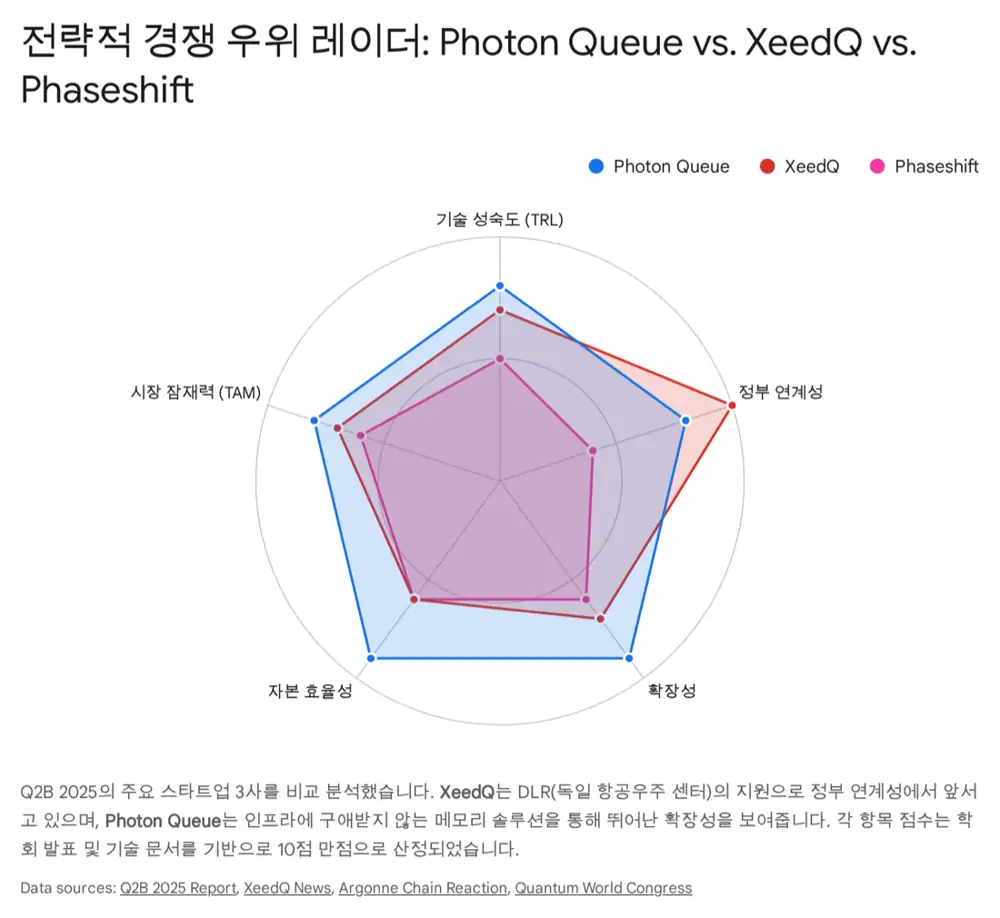
| Photon Queue | USD 3.6m SAFE, CRI fellowship, 2nd at 2025 Quantum World Congress pitch, 3rd at Q2B 2025 pitch | Applicable across photonic quantum computing, communication, and sensing | Potential direct beneficiary of U.S. quantum internet strategy and the Chicago-Argonne corridor |
| XeedQ | EUR 30m DLR contract | 4-qubit to 32-qubit to 256-qubit roadmap, with NV-center connectivity as long-term challenge | Symbolic company for German technology sovereignty |
| Phaseshift | Early stage, relying on pitch prizes and early investment | Metasurfaces offer manufacturability, but standard-component validation is still needed | Linked to miniaturization demand from hardware companies such as IonQ and Xanadu |
6. Top Pick: Photon Queue
Interpretation: The source's Photon Queue selection is clear. If modular computing and the quantum internet are the key themes, memory is the indispensable link. Room-temperature operation and a simpler free-space loop structure are commercialization advantages.
- Bottleneck solution: Without memory, there is no quantum network.
- Policy capital: Much of the DOE's USD 625 million QIS support could flow toward network infrastructure.
- Venture upside: Photonics-based quantum companies such as PsiQuantum, Xanadu, and Quandela are potential customers.
7. Conclusion
The Q2B 2025 winners show quantum technology moving from laboratory demonstrations toward products. Photon Queue is building router memory for the future internet, XeedQ is bringing quantum computers to the desk, and Phaseshift is making a new chip for controlling light. I share the source's view that connectivity, integration, and government procurement will shape quantum startup survival and valuation over the next three years.
Sources
- Original blog: https://m.blog.naver.com/PostView.naver?blogId=star_of_self&logNo=224117704827
- Source 1: https://drive.google.com/open?id=1hTgOngr5dPvywpya1izaMTm2o00LSHTOsrFJg1btoOY
- Source 2: https://www.energy.gov/articles/energy-department-announces-625-million-advance-next-phase-national-quantum-information
- Source 3: https://thequantuminsider.com/2025/08/11/what-is-germanys-high-tech-agenda-and-what-does-it-mean-for-quantum/
- Source 4: https://www.qureca.com/quantum-initiatives-worldwide/
- Source 5: https://chainreaction.anl.gov/cohort-2025/
- Source 6: https://iquist.illinois.edu/news/photon-queue
- Source 7: https://www.dualityaccelerator.com/2024/08/16/photon-queue-a-simple-quantum-memory-solution/
- Source 8: https://chainreaction.anl.gov/free-space-quantum-memory/
- Source 9: https://www.dualityaccelerator.com/2025/01/14/photon-queue-takes-first-place-at-q2b-startup-pitch/
- Source 10: https://researchpark.illinois.edu/photon-queue-selected-entrepreneurship-program/
- Source 11: https://chainreaction.anl.gov/2025/12/12/2025-startup-milestones/
- Source 12: https://xeedq.com/
- Source 13: https://www.dlr.de/en/latest/news/2022/04/how_diamonds_become_qubits
- Source 14: https://xeedq.com/category/news/
- Source 15: https://www.quantumworldcongress.com/news-and-updates/announcing-the-winners-of-the-2025-quantum-startup-pitch-competition
- Source 16: https://qci.dlr.de/en/all-tests-passed-dlr-qci-accepts-4-qubit-demonstrators-sq-rt-and-xq1i/
- Source 17: https://quantumcomputingreport.com/privatestartup/
- Source 18: https://xeedq.com/xeedqs-baby-diamond-inaugurated-at-goethe-university-frankfurt/
- Source 19: https://thequantuminsider.com/2024/10/02/xeedq-to-set-up-quantum-information-technology-centers-in-india/
- Source 20: https://spie.org/profile/Rezlind.Bushati-4433416
- Source 21: https://www.ccny.cuny.edu/news/demand-room-temperature-single-photon-array-quantum-communication-breakthrough-ccny-physicists