DEEP RESEARCH · QUANTUM COMPUTING
Quantinuum and the Winner-Take-Most Quantum Economy
A 2026-2028 view of Helios, full-stack software, policy momentum, and public-market proxies
0. Bottom line first
My conclusion is that Quantinuum is the key private benchmark in quantum computing, while public-market investors should consider indirect exposure to the same technology and policy cycle through IonQ and quantum ETFs.
Official fact: The source says Quantinuum launched Helios in 2025 with 98 physical qubits, 99.9975% single-qubit gate fidelity, and 99.921% two-qubit gate fidelity.
Interpretation: The central question is no longer whether quantum computers can be built. It is who can commercialize industrial quantum utility first by combining hardware and software.
Quantinuum
A full-stack company combining Honeywell hardware with Cambridge Quantum software.
IonQ
A listed trapped-ion alternative pushing barium qubits and photonic networking.
KIWOOM ETF
A basket of pure quantum names, big tech, and cybersecurity companies that reduces single-technology risk.
1. From quantum supremacy to quantum utility
The source frames 2025 as the year when quantum supremacy, an academic milestone, became quantum utility, an industrial objective. In 2019, Google claimed its 53-qubit Sycamore processor completed in 200 seconds a calculation that would take a supercomputer 10,000 years, but the business value was still unclear.
By 2025, Quantinuum's Helios and IonQ's growing commercial revenue changed the question. The focus is now what business value quantum computers can create now. Hybrid integration with HPC infrastructure, the convergence of generative AI and quantum, and post-quantum cryptography turn quantum from future technology into a present industrial variable.
2. Quantinuum: full-stack hardware and software
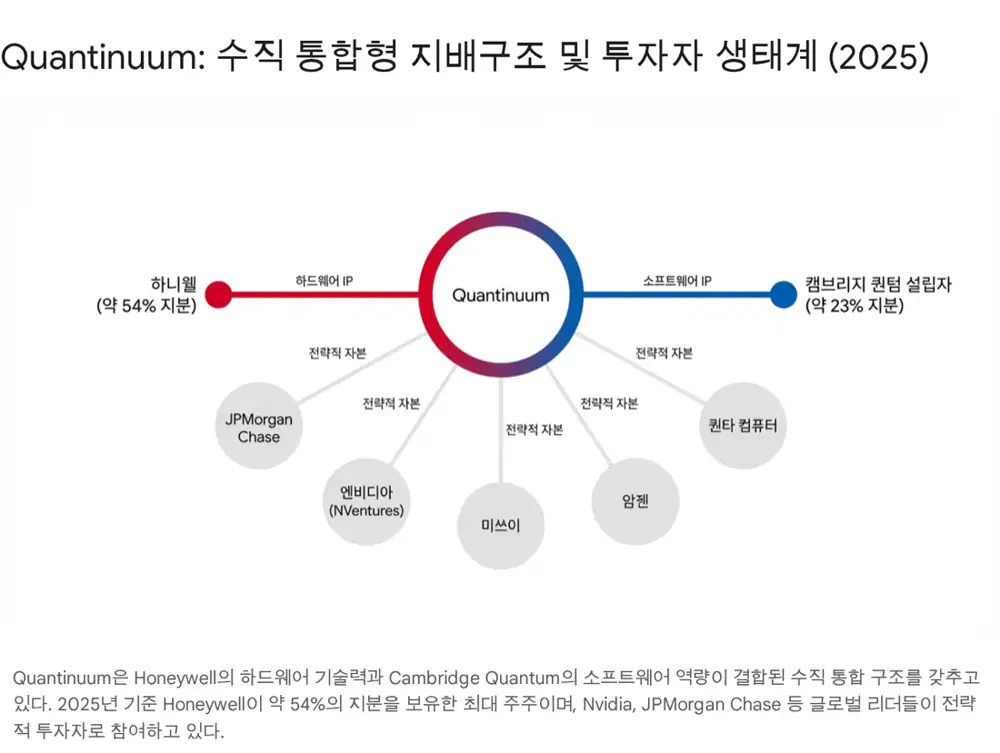
Official fact: Quantinuum was founded on November 30, 2021 through the merger of Honeywell Quantum Solutions and Cambridge Quantum Computing. The source describes it as the largest quantum-computing M&A at the time.
The leadership also reflects the hardware-software combination. CEO Rajeeb Hazra brought HPC and data-center experience from Intel and Micron, while CQC founder Ilyas Khan serves as vice chairman and chief product officer, leading technical vision and product roadmap.
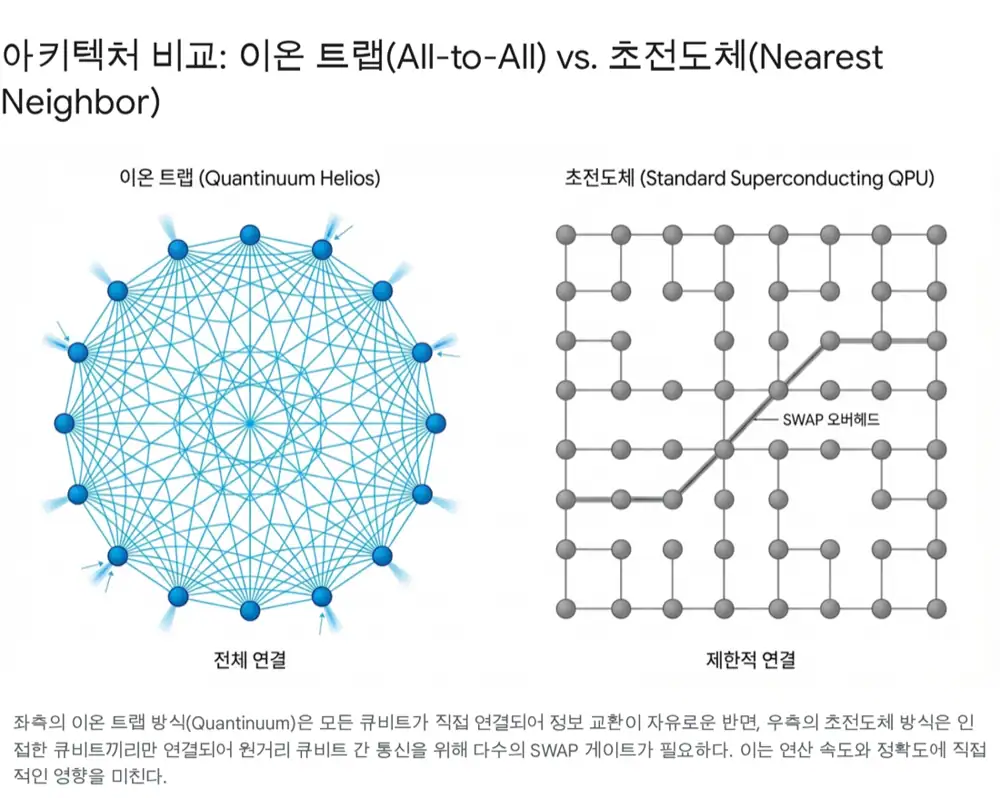
| Pillar | Source detail | Investor meaning |
|---|---|---|
| H-Series and Helios | Trapped-ion system, 98 physical qubits, high gate fidelity | Technical credibility on the path to fault tolerance |
| All-to-all | Physically shuttles ions to reduce complex SWAP-gate burden | Structural advantage in reducing circuit depth and accumulated errors |
| TKET | Translates and optimizes algorithms for IBM, Google, IonQ, Honeywell, and others | Hardware-agnostic platform strategy |
| InQuanto | Quantum chemistry package used by BMW, Amgen, JSR, and others | Early industrial use in pharma and materials |
| Quantum Origin | Cryptographic-key platform based on quantum randomness | Immediate revenue path in cybersecurity |
3. Valuation, IPO, and policy momentum
Official fact: The source says Quantinuum raised USD 300mn in January 2024 at a USD 5bn valuation, then raised about USD 600mn in September 2025 at a USD 10bn pre-money valuation.
The shareholder structure matters. Honeywell is described as holding about 54%, while Ilyas Khan, founding members, management, and employees hold about 23%. Strategic investors named in the source include JPMorgan Chase, Amgen, Mitsui & Co., Quanta Computer, and Nvidia's NVentures. Nvidia's participation signals the potential standard of hybrid QPU-GPU computing.
Annual revenue is estimated at below USD 100mn, and the company is still loss-making because of R&D investment. Still, Honeywell's plan to split into three independent listed companies by 2026, focused on automation, aerospace, and advanced materials, raises the possibility of a Quantinuum IPO or spin-off. The source sees late 2026 to early 2027 as a plausible window and mentions a possible USD 20bn valuation scenario.
NQI 2.0
Reauthorization and expansion in 2025-2026 shift support from basic research toward demonstration and commercialization.
KRW 3tn strategy
More than KRW 3tn of public-private investment through 2035, plus K-cloud and QCaaS infrastructure.
MLS and PQC
The 2025 multi-level security shift may lift demand for post-quantum cryptography and DRM.
4. Public-market top picks: IonQ and KIWOOM ETF
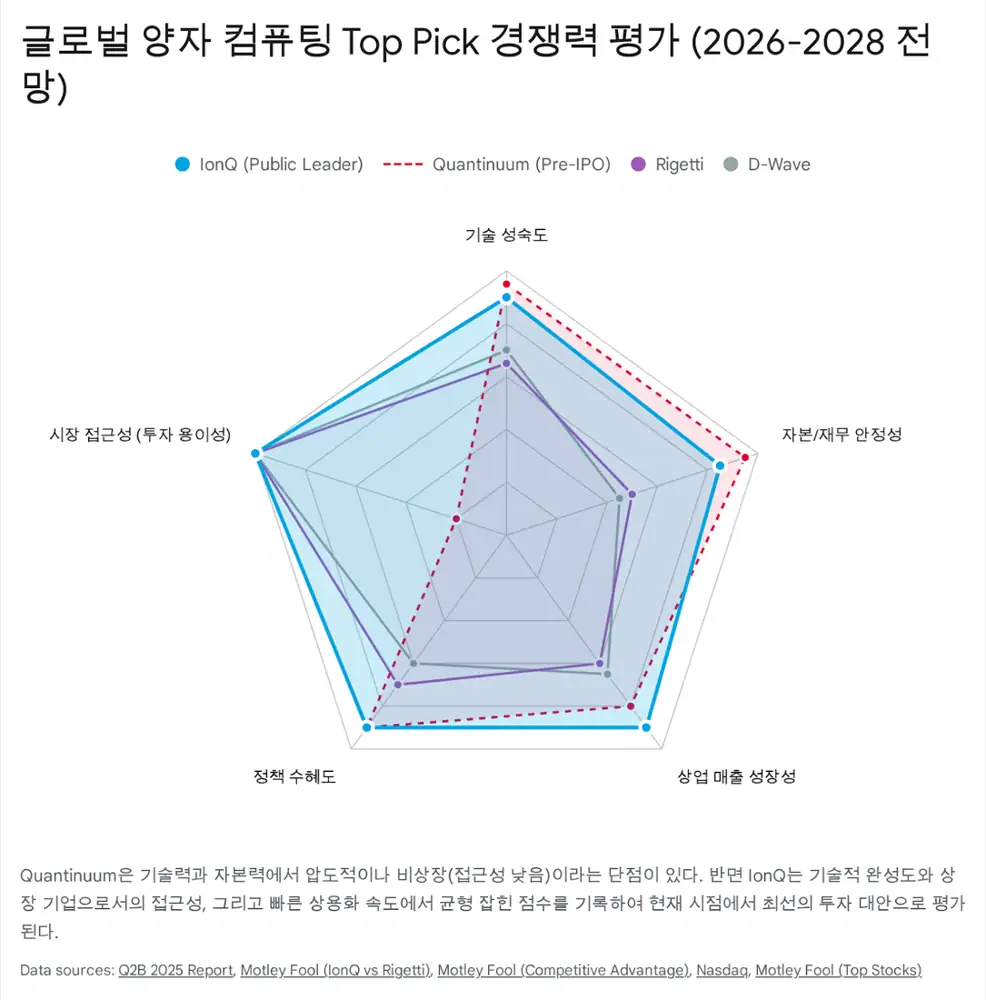
Because investors cannot directly buy private Quantinuum, the source presents IonQ as the top practical public-market pick. IonQ uses the same trapped-ion architecture, and the source argues that its market capitalization of roughly USD 4-5bn looks attractive compared with Quantinuum's USD 10bn valuation.
IonQ's technical points are the shift from ytterbium to barium qubits and photonic networking. Barium ions can use visible-light lasers, improving component availability and control, while connecting multiple QPUs by optical fiber is presented as a key to overcoming trapped-ion scalability limits.
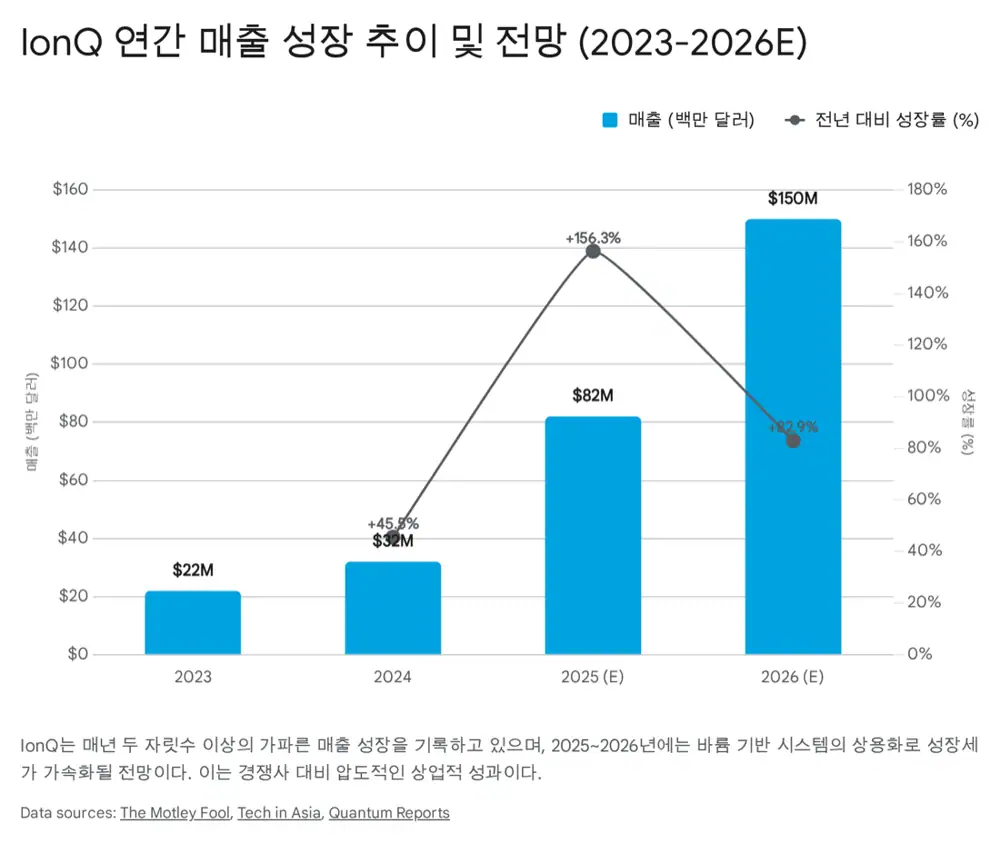
Official fact: The source says IonQ beat revenue expectations in 3Q24, is available on AWS Braket, Google Cloud, and Microsoft Azure, has worked with Hyundai on battery-material simulation and Airbus on aircraft loading optimization, and holds more than about USD 400mn in cash equivalents.
For conservative investors, the KIWOOM U.S. Quantum Computing ETF (498270) is presented as an alternative. It includes pure quantum companies such as IonQ, Rigetti, and D-Wave, along with big tech such as Microsoft, Alphabet, Amazon, and Nvidia. The source also highlights its inclusion of cybersecurity companies such as Palo Alto Networks and Cloudflare.
5. My execution plan
- Aggressive investors can treat IonQ as a core satellite position and track barium-system commercialization plus expectations for a 2025-2026 profit turn.
- Moderate and conservative investors can use the KIWOOM quantum ETF to combine big-tech stability with pure-play quantum upside.
- Watch whether a Quantinuum IPO actually emerges in late 2026 to early 2027, and whether valuation moves from the USD 10bn mark toward the USD 20bn scenario.
- In Korea, MLS adoption and PQC demand should be monitored for possible revenue opportunities for security companies such as Fasoo.
Sources
- 원문 / Original: https://m.blog.naver.com/PostView.naver?blogId=star_of_self&logNo=224117703551
- Quantinuum - Wikipedia: https://en.wikipedia.org/wiki/Quantinuum
- QCE24 Rajeeb Hazra keynote: https://qce.quantum.ieee.org/2024/program/rajeeb-hazra-keynote/
- Rajeeb Hazra biography: https://www.theofficialboard.com/biography/rajeeb-hazra-8e306
- Ilyas Khan - Topos Institute: https://topos.institute/people/ilyas-khan/
- Ilyas Khan - Wikipedia: https://en.wikipedia.org/wiki/Ilyas_Khan
- Quantinuum Helios launch press release: https://www.quantinuum.com/press-releases/quantinuum-announces-commercial-launch-of-new-helios-quantum-computer-that-offers-unprecedented-accuracy-to-enable-generative-quantum-ai-genqai
- Quantinuum benchmark blog: https://www.quantinuum.com/blog/setting-the-benchmark-independent-study-ranks-quantinuum-1-in-performance
- Honeywell $600M Quantinuum raise: https://www.quantinuum.com/press-releases/honeywell-announces-600-million-capital-raise-for-quantinuum-at-10b-pre-money-equity-valuation-to-advance-quantum-computing-at-scale
- Quantinuum raises $800M article: https://postquantum.com/industry-news/quantinuum-raises-800m/
- Honeywell $300M Quantinuum round: https://www.quantinuum.com/press-releases/honeywell-announces-the-closing-of-300-million-equity-investment-round-for-quantinuum-at-5b-pre-money-valuation
- Honeywell investor release on $600M raise: https://investor.honeywell.com/news-releases/news-release-details/honeywell-announces-600-million-capital-raise-quantinuum-10b-pre
- Honeywell SEC filing: https://www.sec.gov/Archives/edgar/data/773840/000077384025000010/hon-20241231.htm
- Honeywell investor presentation: https://investor.honeywell.com/static-files/aec48bc3-f922-4ecb-9769-7e7dc2676ed3
- The Quantum Insider on Honeywell restructuring and IPO: https://thequantuminsider.com/2025/02/07/as-honeywell-announces-restructuring-ceo-confirms-intention-to-ipo-its-52-owned-quantinuum/
- The Quantum Insider valuation article: https://thequantuminsider.com/2024/12/18/research-analyst-quantinuums-valuation-could-hit-20-billion/
- U.S. quantum industry leaders article: https://thequantuminsider.com/2025/05/08/u-s-quantum-industry-leaders-press-congress-to-expand-u-s-support/
- DOE quantum research centers funding: https://www.energy.gov/articles/energy-department-announces-625-million-advance-next-phase-national-quantum-information
- Korea national quantum strategy: https://quantuminkorea.org/national-quantum-strategy/
- SOMANSA MLS roadmap: https://www.somansa.com/wp-content/uploads/2024/12/20240911_mls.pdf
- Motley Fool IonQ vs Rigetti article: https://www.fool.com/investing/2025/12/04/ionq-vs-rigetti-computing-which-quantum-stock-wins/
- Q2B 2025 discussion report: https://drive.google.com/open?id=13HjxxNioKBs16J0IZ1lSCBpDFIez2nqTIRZ_Zv1l0_w
- Quantum fiscal second quarter 2025 results: https://investors.quantum.com/news-events/press-releases/detail/207/quantum-reports-fiscal-second-quarter-2025-financial-results