DEEP RESEARCH · KOREAN QUANTUM COMPUTING
Norma vs SDT: Korea’s Quantum Ecosystem Enters Industrialization
A three-year comparison of Norma as a platform aggregator and SDT as a hardware foundry.
0. Bottom line first
My conclusion favors SDT. Norma has platform scalability through Q Platform and PQC, but SDT has a stronger moat from QPU and control-electronics hardware plus closer policy alignment.
1. Industry backdrop after Q2B
The Q2B 2024/2025 message is “from lab to fab.” The market now demands error correction, logical qubits, and industrial utility rather than simple qubit counts. Neutral-atom approaches are rising alongside superconducting systems, so the hardware race remains open.
Official fact: The source summarizes Korea’s goal to become a leading quantum science and technology country by 2035 through technology sovereignty, large-scale infrastructure, and private-sector ecosystem support.
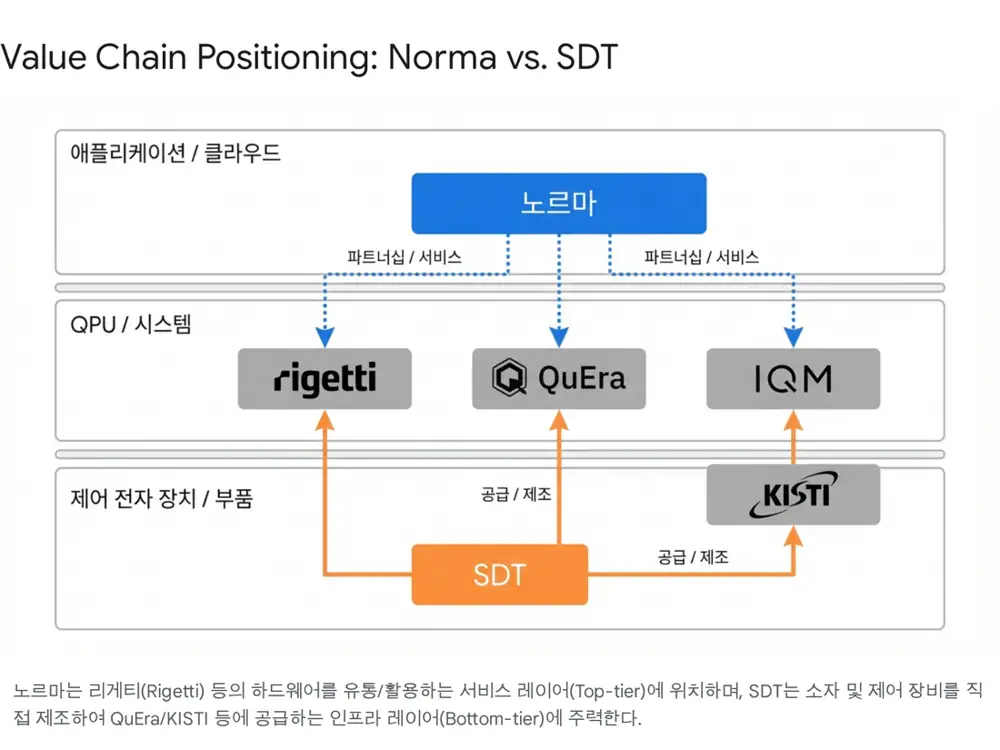
2. Norma: platform aggregator upside and risk
Norma was founded in 2011 by CEO Hyun-cheol Jung and initially focused on wireless network and IoT security. It later pivoted into PQC and quantum-computing software platforms.
- Q Platform connects global hardware such as Rigetti and IQM to Korean researchers through the cloud.
- At Q2B Tokyo 2025, Norma announced a plan with Rigetti for an 84-qubit cloud service.
- PQC products such as Q Care Connect can be upsold to existing defense and public-sector security customers.
- Temasek-linked investment and headline growth are positives, but Saudi contract counterparty uncertainty, lack of hardware manufacturing, and weaker financial health are risks.
3. SDT: hardware foundry and domestic control electronics
SDT focuses on domestic QPU and control-electronics capabilities under leadership with MIT and Harvard backgrounds. The source views its QuEra alliance participation and KISTI government project wins as evidence that it is entering the national core infrastructure supply chain.
Interpretation: SDT is asset-heavy and R&D-intensive, but once its equipment is installed into a production or research line, customers cannot easily switch vendors. Reliability and compatibility create lock-in in quantum hardware.
4. Business-model comparison
| Category | Norma | SDT |
|---|---|---|
| Strategy | Software platform aggregator, asset-light | Hardware foundry, asset-heavy |
| Revenue source | Licensing, services, cloud brokerage fees | Equipment sales, manufacturing services, maintenance |
| Revenue profile | Volatile and competitive | Contract-based revenue with high entry barriers |
| Scalability | Easier global expansion but platform-dependence risk | Slower early expansion but stronger lock-in |
| Risks | Hardware vendor policy changes and Saudi deal risk | High CAPEX, supply-chain issues, R&D failure risk |
5. Policy alignment and final pick
For the next three years, the Korean quantum industry’s largest buyer is more likely to be the government than the private sector. The key policy words are technology independence and localization of materials, parts, and equipment.
- Norma improves research access by importing foreign hardware access, but this is less directly tied to domestic original technology.
- SDT’s domestic control equipment and research-institute partnerships align more directly with the 2035 strategy.
- The source names SDT as the top pick based on tangible manufacturing capability, the QuEra alliance, policy support, and higher-quality B2B/B2G revenue from institutions such as KISTI.
In conclusion, investors should look past headlines and focus on intrinsic value creation. Norma has potential but needs validation of finances and business substance, while SDT offers manufacturing fundamentals plus global scalability.
Sources
- Original post: https://m.blog.naver.com/PostView.naver?blogId=star_of_self&logNo=224117606005
- Reference 1: https://investors.rigetti.com/news-releases/news-release-details/rigetti-computing-announces-strategic-collaboration-agreement
- Reference 2: https://www.pasqal.com/events/q2b24-silicon-valley-event/
- Reference 3: https://www.norma.co.kr/eng/about/historyaward.php
- Reference 4: https://theguru.co.kr/news/article_print.html?no=75548
- Reference 5: https://thequantuminsider.com/2025/05/16/norma-partners-with-rigetti-to-launch-84-qubit-quantum-cloud-service-in-south-korea/
- Reference 6: https://www.kjebi.com/search/smart/bidder/detail/2098154271
- Reference 7: https://tracxn.com/d/companies/light-vision-it/__9gjc6LG9KVLfayawAKe6-9jOeZrWLU7x9PHhVinzVKk
- Reference 8: https://www.mk.co.kr/en/it/11061753
- Reference 9: https://sdt.inc/en/
- Reference 10: https://www.quera.com/press-releases/sdt-joins-quera-alliance-to-advance-neutral-atom-quantum-computing
- Reference 11: https://www.kisti.re.kr/eng/news/post/eng_news;jsessionid=JVQ2znptPzkJqboh8ItbJPlrlnmaGyztq37IybGhjbvd7RU8v14ibl5aZS8pngzh.ar211_servlet_engine23?t=1741996800062
- Reference 12: https://q2b.qcware.com/
- Reference 13: https://www.msit.go.kr/eng/bbs/view.do?sCode=eng&nttSeqNo=828&searchOpt=ALL&bbsSeqNo=42&mId=4&mPid=2
- Reference 14: https://quantuminkorea.org/national-quantum-strategy/
- Reference 15: https://quantuminkorea.org/2025/05/15/norma-partners-with-rigetti-to-introduce-84%E2%80%91qubit-quantum-cloud-in-korea/
- Reference 16: https://www.prnewswire.com/in/news-releases/norma-completes-quantum-ai-algorithm-validation-on-nvidia-302541607.html
- Reference 17: https://quantumzeitgeist.com/norma-achieves-73%E2%80%91fold-speedup-of-quantum-ai-drug%E2%80%91discovery-on-nvidia-cuda%E2%80%91q/
- Reference 18: https://thequantuminsider.com/2025/05/02/norma-to-build-quantum-rd-center-in-uae-supporting-ai-and-cybersecurity-growth/
- Reference 19: https://www.datanet.co.kr/news/articleView.html?idxno=198265
- Reference 20: http://www.itdaily.kr/news/articleView.html?idxno=229403
- Reference 21: https://thequantuminsider.com/2024/12/05/sdt-secures-14-1m-pre-ipo-investment-to-advance-koreas-quantum-technology-leadership/
- Reference 22: https://koreatechdesk.com/quantam-technology-startup-sdt-secures-14-million-in-pre-ipo-investment-eyes-ipo-in-2025