DEEP RESEARCH · K-SPACE/KOSDAQ
2025 K-Space and KOSDAQ Reset: An Investment Roadmap for the Genesis Mission and National Growth Fund Era
An asset-allocation research note on where U.S. AI/security industrial policy, Korea's KOSDAQ repair agenda, and KRW 150 trillion of policy capital converge in the space value chain
0. Bottom line first
The core idea is to treat space not as a short-lived theme but as a structural asset class where policy capital, national-security demand, and AI data infrastructure meet. The U.S. Genesis Mission on November 24, 2025, Korea's KOSDAQ trust and innovation plan on December 19, 2025, and the KRW 150 trillion National Growth Fund planned over five years from 2026 all point in the same direction.
Genesis Mission
A U.S. industrial reset combining AI, energy, scientific data, and security. Satellite data and trusted supply chains are key variables.
High Birth, High Death, Institutional Demand
Tailored technology listings for AI, space, and energy, stricter delisting, and pension benchmark changes could alter the valuation base for innovation companies.
KRW 150 Trillion Fund
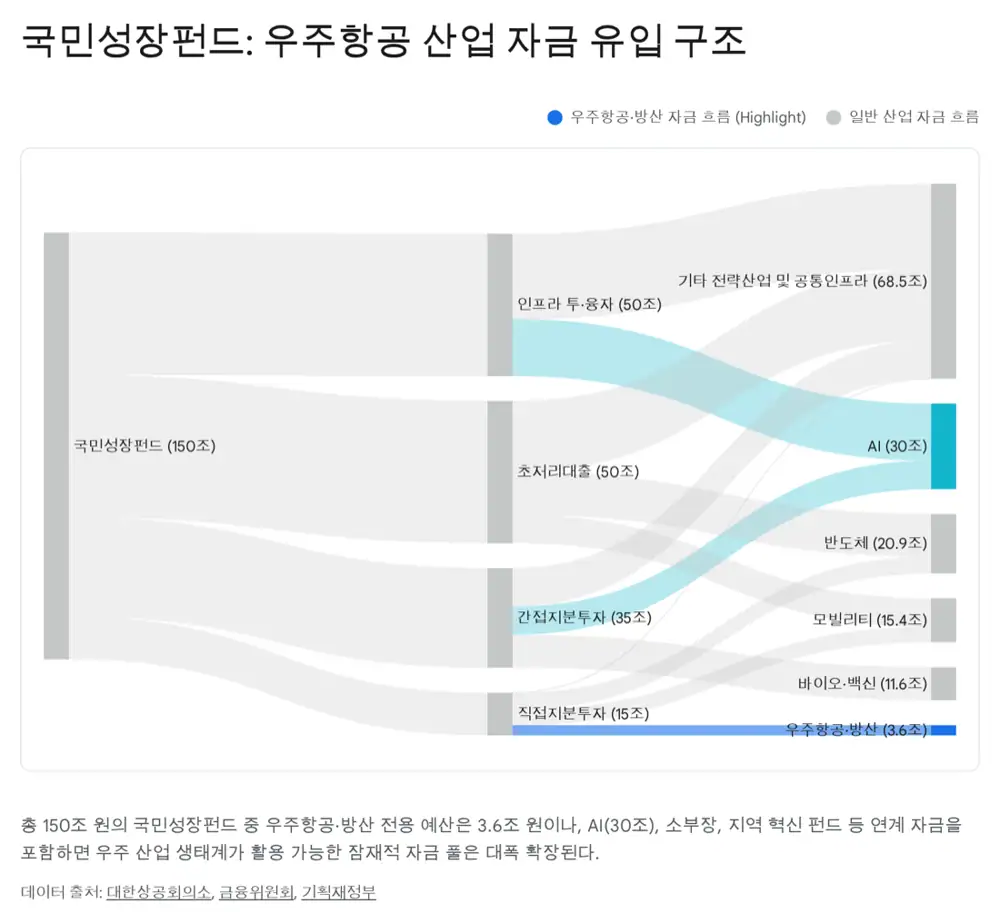
The plan combines KRW 75 trillion backed by government-guaranteed bonds and KRW 75 trillion of private capital, with KRW 3.6 trillion directly allocated to aerospace/defense and more linked through AI, semiconductors, and materials/equipment.
1. Structural Shift: Space Is No Longer Just an R&D Theme
As of December 2025, the source frames Korea's capital market as being at a structural inflection point. Externally, the United States is combining AI, energy, and security dominance to rebuild supply chains around itself and trusted allies while excluding China. Domestically, Korea is addressing the Korea discount and the weakened financing function of KOSDAQ through a KOSDAQ innovation package and the National Growth Fund.
I read this as the first major fusion of manufacturing and advanced finance in roughly 30 years, after the late-1990s internet revolution. Korea can no longer rely only on the old model in which the U.S. consumed and Korea produced. Korean companies need technological moats in security-sensitive, high-value domains such as space, aerospace, and defense.
Interpretation: Space has moved from government R&D to private New Space, cash-flow generation, and national-security infrastructure. The right lens is not only launch companies, but the whole chain: satellites, launchers, ground stations, data analytics, communications antennas, navigation, and trusted components.
2. External Setup: The Genesis Mission Creates a Korean Opening
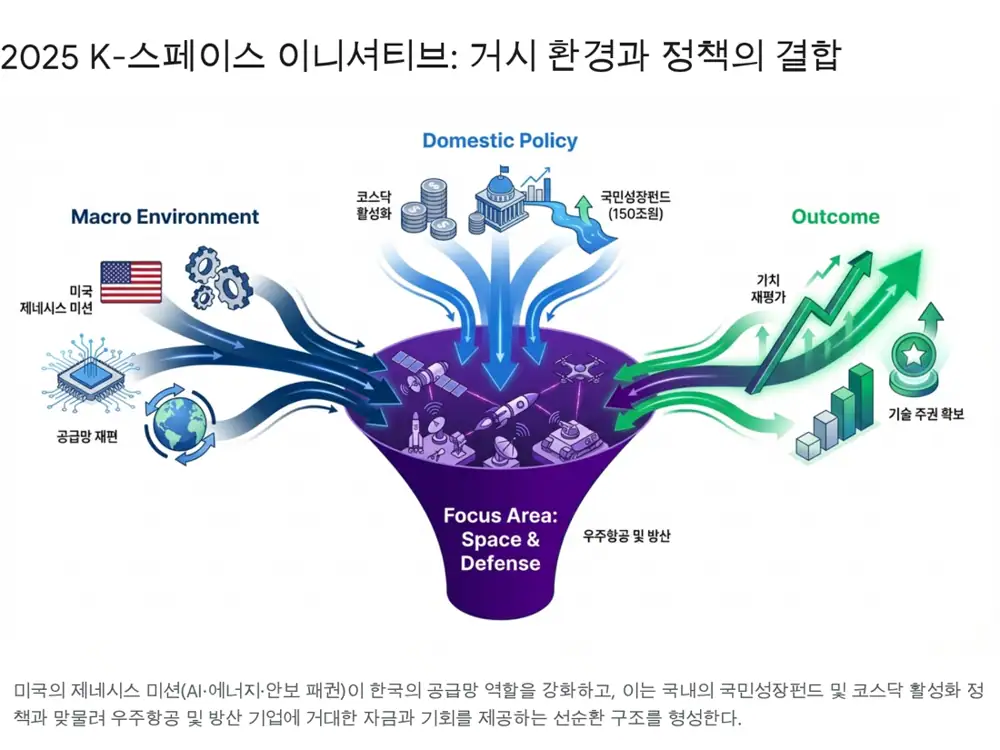
Official fact: Based on the cited materials in the source, the Genesis Mission was formalized by an executive order signed by President Donald Trump on November 24, 2025. The source compares it to national mobilizations such as the Manhattan Project in the 1940s and the Apollo program in the 1960s.
The first axis is data capture and processing. AI training requires scientific data and computing power, and satellite data from earth observation, weather, and communications becomes core fuel for those models. A Department of Energy platform that connects national-lab supercomputers and scientific data naturally increases the strategic value of space-data collection.
The second axis is exclusion and inclusion in supply chains. The source argues that as the U.S. excludes Chinese suppliers and rebuilds supply chains around allies, Korean companies can become key Tier-1 partners in space and defense. Simple manufacturing volume may be pressured by the U.S. manufacturing renaissance, but high-end materials, components, equipment, and modules can gain strategic value.
Interpretation: As Nvidia, Microsoft, Google, OpenAI, and other major technology firms become tied to the Genesis Mission, the strategic value of satellite imagery, low-earth-orbit communications, ground stations, secure components, and defense-grade modules rises. Korea's opportunity is not cheap manufacturing; it is trusted high-value supply.
3. Domestic Policy: KOSDAQ Repair and the KRW 150 Trillion National Growth Fund
Official fact: According to the source, Korea's Financial Services Commission announced a plan to improve KOSDAQ trust and innovation after a presidential work report on December 19, 2025. The core is not artificial index support but rationalized entry, stricter exits, and broader institutional demand.
- High birth: Tailored technology-special listing rules apply to nationally important technologies such as AI, space, and energy including ESS and renewables. Space companies can be evaluated across upstream launch/satellite systems and downstream ground equipment/satellite services.
- High death: Faster removal of weak or zombie companies is intended to restore market trust and reduce the valuation discount on KOSDAQ overall.
- Institutional demand: The plan encourages KOSDAQ index inclusion in performance benchmarks for the National Pension Service and other pension funds. It also reviews expanded tax benefits for KOSDAQ venture funds and tax benefits for BDCs expected in 2026.
Official fact: The National Growth Fund is planned at KRW 150 trillion over five years from 2026. The structure is KRW 75 trillion from an advanced-strategy-industry fund backed by government-guaranteed bonds plus KRW 75 trillion of private capital.
| Category | Source number | Space-industry connection |
|---|---|---|
| Total fund | KRW 150 trillion | Focused investment in advanced strategic industries over five years from 2026 |
| Direct aerospace/defense allocation | KRW 3.6 trillion, 2.4% of total | The direct bucket looks small, but the policy signal is clear |
| AI | KRW 30 trillion | Connects to satellite-image analytics and AI-based earth-observation data companies |
| Semiconductors | KRW 20.9 trillion | Connects to high-reliability chips and parts for satellites and launch vehicles |
| Practical ecosystem capital | More than KRW 10 trillion in the source's analysis | Includes AI, semiconductor, and materials/equipment links to the space ecosystem |
From a mega-project perspective, next-generation launch vehicles, the Korea Positioning System (KPS), and lunar exploration matter. If private space companies are constrained by capex and R&D funding, the National Growth Fund becomes a policy-capital tool for easing that bottleneck.
4. Listed Companies: KOSDAQ-Centered Space Value Chain
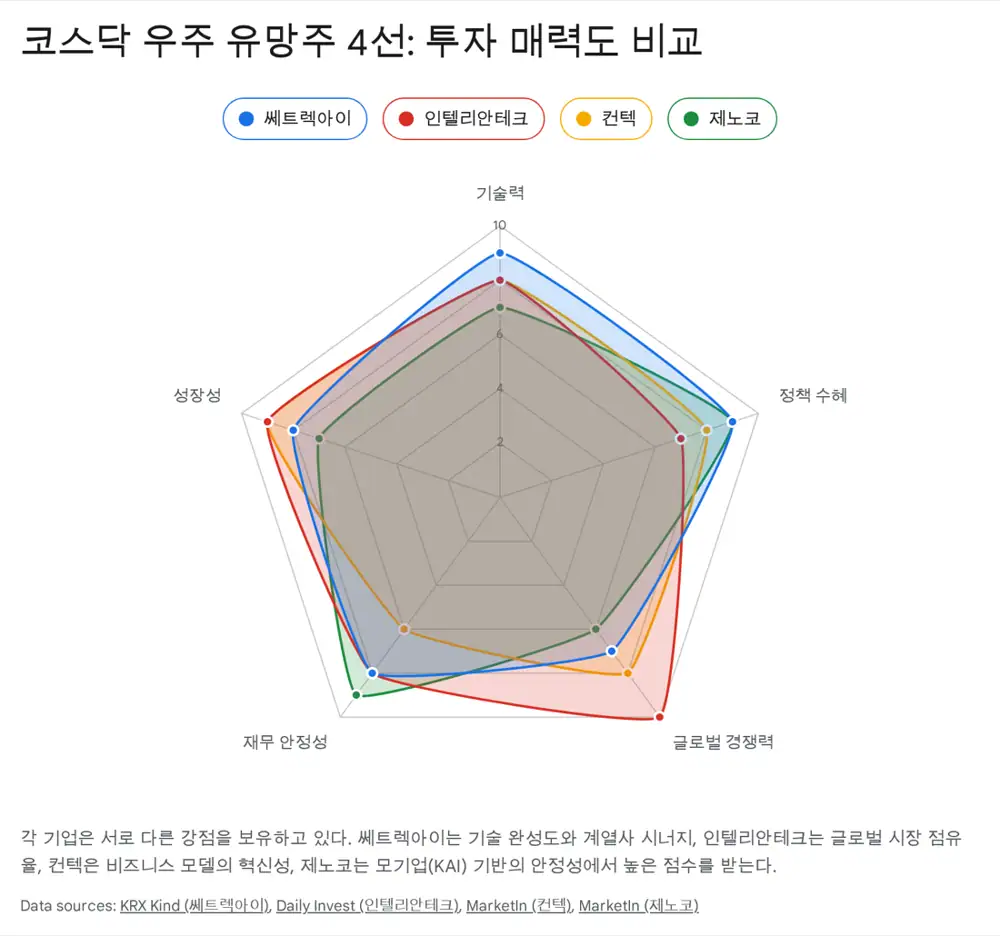
The selection criteria for listed companies are technological moat, strength of policy benefit, likelihood of entry into global supply chains, and earnings-turnaround potential. The value chain should be split across satellite systems, communications antennas, ground stations, and aerospace/defense electronics.
| Company | Core position | Source investment point | Risk to verify |
|---|---|---|---|
| Satrec Initiative (099320) | Vertically integrated satellite bus, payload, and ground systems | A rare Korean company that can integrate satellite systems. The source highlights SI Imaging Services satellite-image sales and Hanwha Aerospace as the largest shareholder, plus expected 2025 turnaround and order growth. | Next-generation midsize satellite schedule and how quickly group captive demand converts into revenue |
| Intellian Tech (189300) | Low-earth-orbit satellite communications antennas | A hardware supplier connected to global satellite-communications operators such as OneWeb and SES. The source cites 2025 revenue of KRW 372.2 billion, operating profit of KRW 32.4 billion, and backlog exceeding KRW 100 billion. | LEO investment-cycle volatility, customer concentration, flat-panel antenna competition |
| Contec (451760) | Ground-station-as-a-service (GSaaS) | A scarce model that provides global ground stations as a service. The source cites expected year-end 2025 backlog above KRW 50 billion, roughly KRW 30 billion of orders over the latest month, and the IPO-period target of KRW 70 billion in 2025 revenue. | Speed of initial investment recovery and timing of order conversion into revenue and profit |
| Genoco (361390) | Satellite payloads, ground stations, and avionics | After KAI acquired management control, Genoco gained greater captive-demand potential from FA-50, KF-21, and next-generation midsize satellite programs. The source also includes its 2025 Defense Innovation 100 selection. | How KAI integration shows up in earnings and defense project timing |
Interpretation: The direct benefit of KOSDAQ policy is not merely easier listing review. If long-duration capital from pensions, venture funds, and BDCs flows in, space infrastructure and data companies with visible revenue should be among the first to receive institutional valuation.
5. Private and Early-Listed Candidates: Potential 2026 Leaders
The National Growth Fund and tailored technology-listing system can become a strong growth engine for space startups approaching public markets. This group carries more technology-option value than earnings stability, so I would treat it as Satellite exposure rather than Core exposure.
| Company | Status | Source core point | Investment lens |
|---|---|---|---|
| Naraspace Technology | KOSDAQ listing on December 17, 2025 | First-day share price rose 169% versus the offering price. It operates its self-developed Observer microsatellites as a constellation and has Defense Innovation 100 selection, NASA cooperation history, and a plan for 100+ constellation satellites by 2027. | Public-sector demand and pace of constellation-data commercialization |
| Perigee Aerospace | IPO planned for 2026; currently private | Targets small launch demand through Blue Whale 1, liquid methane engines, and flexible launch concepts such as offshore launch near Jeju. | Technology and schedule risk remain high until launch success is proven |
| Lumir | KOSDAQ listing in October 2024 | Owns SAR satellite technology that can observe day/night and through bad weather. The source discusses a temporary adjustment to KRW 9.2 billion of 2025 revenue and a 2026 rebound as national satellite programs normalize. | SAR demand is attractive, but earnings normalization must be confirmed |
| Duksan Navcours | Preliminary listing review filed in November 2025; 2026 listing target | A navigation-system company with GNSS and anti-jamming technology. The source frames it as a KPS beneficiary and cites 2024 revenue of KRW 45.2 billion and operating profit of KRW 2.0 billion. | Among special-listing candidates, it has defense-revenue-backed cash flow |
| InnoSpace | KOSDAQ listing in July 2024 | It attracted attention as the first listed launch-vehicle company, but the first commercial launch delay and Q3 2025 operating loss of KRW -18.6 billion are burdens. Re-rating remains possible if its hybrid rocket technology is proven. | A turnaround candidate, but launch schedule and funding needs require strict monitoring |
6. Portfolio Strategy: Separate Core From Satellite
The source proposes dividing the portfolio according to policy certainty and company stage. I agree with that framing. Even with strong policy support, these companies do not carry the same risk profile.
| Group | Investment character | Companies | Investment points |
|---|---|---|---|
| Core | Lower risk, clearer policy benefit, earnings base | KAI, Hanwha Systems, Satrec Initiative, Intellian Tech | Direct and indirect beneficiaries of the KRW 150 trillion fund, stable captive markets and global backlog, first candidates for pension inflow |
| Satellite | Higher risk, higher return, explosive growth potential | Naraspace, Contec, Lumir, Duksan Navcours, Perigee Aerospace | New Space trend, tailored technology listings and venture-fund inflow, specific moats in SAR, microsatellites, launch, and navigation |
The Core group anchors the portfolio. The source especially views KAI and Satrec Initiative as large beneficiaries of Korea's space-industry policy and the supply-chain reset created by the U.S. Genesis Mission. The Satellite group is where newly listed names such as Naraspace or pre-listing candidates such as Duksan Navcours can seek alpha above the market average.
December 2025 may be, in the source's words, a golden window for Korean space investing. But the conclusion is not to chase short-term theme spikes. The point is to place long-term capital where the policy roadmap and corporate technological moats intersect.
Sources
- Original Naver Blog: https://m.blog.naver.com/PostView.naver?blogId=star_of_self&logNo=224117481835
- Energy Department Launches 'Genesis Mission': https://www.energy.gov/articles/energy-department-launches-genesis-mission-transform-american-science-and-innovation
- National Growth Fund plan summary PDF: https://jincci.korcham.net/file/dext5uploaddata/2025/[%EC%B6%94%EC%A7%84%EA%B3%84%ED%9A%8D]%20%EA%B5%AD%EB%AF%BC%EC%84%B1%EC%9E%A5%ED%8E%80%EB%93%9C%20%EC%B6%94%EC%A7%84%20%EA%B3%84%ED%9A%8D(%EC%9A%94%EC%95%BD).pdf
- Launching the Genesis Mission - JD Supra: https://www.jdsupra.com/legalnews/launching-the-genesis-mission-an-4737888/
- White House Genesis Mission fact sheet: https://www.whitehouse.gov/fact-sheets/2025/11/fact-sheet-president-donald-j-trump-unveils-the-genesis-missionto-accelerate-ai-for-scientific-discovery/
- OpenAI, Nvidia, Google, Microsoft join Genesis Mission: https://www.tradingview.com/news/invezz:1ec50bdbc094b:0-openai-nvidia-google-microsoft-among-firms-joining-trump-s-genesis-mission/
- NVIDIA Genesis Mission blog: https://blogs.nvidia.com/blog/nvidia-us-government-to-boost-ai-infrastructure-and-rd-investments/
- Naraspace KOSDAQ listing - Newswell: https://www.newswell.co.kr/news/articleView.html?idxno=15046
- FSC KOSDAQ reforms - ChosunBiz: https://biz.chosun.com/en/en-finance/2025/12/20/XKA4UQNKLRFSJOS23WG67XQJLA/
- Seoul to rewrite Kosdaq - KED Global: https://www.kedglobal.com/korean-stock-market/newsView/ked202512190009
- Tailored technology listings for AI and other sectors - Yonhap: https://www.yna.co.kr/view/AKR20251219157300002
- National Growth Fund formation and operating strategy - FSC: https://www.fsc.go.kr/comm/getFile?srvcId=BBSTY1&upperNo=85265&fileTy=ATTACH&fileNo=4
- 2026 National Growth Fund operating plan - MOEF: https://www.moef.go.kr/com/cmm/fms/FileDown.do;jsessionid=EmyCeHvYSaaoWUueHFpaKW_V4PDId7BShyo9Ut_v.node20?atchFileId=ATCH_000000000030583&fileSn=6
- Satrec Initiative semiannual report - KRX: https://kind.krx.co.kr/common/disclsviewer.do?method=search&acptno=20250811000430&docno=&viewerhost=&
- SI Imaging Services company profile - THE VC: https://thevc.kr/siimagingservices
- Satrec turnaround and order growth outlook - Marketin: https://marketin.edaily.co.kr/News/ReadE?newsId=02515766642271256
- Intellian low-earth-orbit satellite communications - Korea Economic Daily: https://www.hankyung.com/article/202510212586i
- Intellian orders exceed KRW 100 billion - Pinpoint News: https://www.pinpointnews.co.kr/news/articleView.html?idxno=408629
- Contec IPO and KRW 70 billion 2025 revenue target - The Stock: https://www.the-stock.kr/news/articleView.html?idxno=19083
- Contec year-end backlog expected at KRW 50 billion - Marketin: https://marketin.edaily.co.kr/News/ReadE?newsId=02325526642398848
- Contec backlog expected to exceed KRW 50 billion - Global Epic: https://www.globalepic.co.kr/view.php?ud=2025121508483342995ebfd494dd_29
- Contec backlog expected to exceed KRW 50 billion - Consumer Times: https://www.cstimes.com/news/articleView.html?idxno=683602
- Contec orders of roughly KRW 30 billion in one month - Pax Economy TV: https://www.paxetv.com/news/articleView.html?idxno=255352
- Contec 451760 report PDF: https://file.alphasquare.co.kr/media/pdfs/company-report/%EB%A9%94%EB%A6%AC%EC%B8%A020250224%EC%BB%A8%ED%85%8D.pdf
- Genoco vision ceremony with KAI - Marketin: https://marketin.edaily.co.kr/News/ReadE?newsId=03542406642235832
- Naraspace first-day double - Finance Today: https://www.fntoday.co.kr/news/articleView.html?idxno=372076
- Naraspace new listing - Naver Premium Contents: https://contents.premium.naver.com/pqpqyoustock/pqpqyou/contents/251216112601798km
- Naraspace listing and space startup IPOs - Hankook Ilbo: https://www.hankookilbo.com/News/Read/A2025121713180005798
- Nara Space media: https://naraspace.com/ko/naraspace/media
- Naraspace selected for Defense Innovation 100 - Platum: https://platum.kr/archives/277318
- Lumir IPO analysis - ChosunBiz: https://biz.chosun.com/stock/market_trend/2024/08/20/BDIBEVEPFNEHNH7K2X5333J4J4/
- Perigee PitchBook profile: https://pitchbook.com/profiles/company/338683-24
- Perigee Aerospace - Wikipedia: https://en.wikipedia.org/wiki/Perigee_Aerospace
- Lumir KOSDAQ listing - ZDNet Korea: https://zdnet.co.kr/view/?no=20241021142116
- Lumir new listing notice - Samsung Securities: https://www.samsungpop.com/ux/kor/customer/notice/notice/noticeViewContent.do?MenuSeqNo=21455
- Lumir 474170 report PDF: https://file.alphasquare.co.kr/media/pdfs/company-report/%EB%A9%94%EB%A6%AC%EC%B8%A020251030%EB%A3%A8%EB%AF%B8%EB%A5%B4.pdf
- Duksan Navcours preliminary listing application - ChosunBiz: https://biz.chosun.com/stock/stock_general/2025/11/17/VH2KTM4NQBDXLGBFY56ODQF62E/
- Duksan Navcours KOSDAQ listing review - Marketin: https://marketin.edaily.co.kr/News/ReadE?newsId=02296006642365064
- Duksan Navcours preliminary listing company - KIND: https://kind.krx.co.kr/listinvstg/listinvstgcom.do?method=searchListInvstgCorpDetail&bizProcNo=20250929000071
- End-market expansion proceeding - The Stock: https://www.the-stock.kr/news/articleView.html?idxno=31641
- InnoSpace first trading day - Yonhap Infomax: https://news.einfomax.co.kr/news/articleView.html?idxno=4315523
- InnoSpace first commercial launch delay - ChosunBiz: https://biz.chosun.com/stock/market_trend/2025/11/26/XJ4IPHTS6BHGBMPES3GGOGN6SY/
- InnoSpace Q3 operating result of KRW -18.6 billion - News FC: https://www.newsfc.co.kr/news/articleView.html?idxno=75530
- InnoSpace investment analysis - Judal: https://www.judal.co.kr/?view=stockAI&shareToken=tHOqox3HNNPXGgGB