DEEP RESEARCH · NPU/KOSDAQ
NPUs and KOSDAQ Revitalization: Capital-Market Strategy for AI Semiconductor Sovereignty
A policy-investment framework for K-Cloud, the National Growth Fund, and listed/unlisted AI semiconductor value chains
0. Bottom line first
The source's core idea is that building a domestic NPU ecosystem is both industrial policy and a KOSDAQ revitalization strategy. K-Cloud creates early demand, the National Growth Fund supplies scale-up capital for fabless, IP, and design-house companies, and KOSDAQ should become the long-term financing platform for technology firms.
Official fact: The source presents a K-Cloud Phase 1 goal of 23% domestic data-center share for Korean NPUs by 2025 and mentions more than KRW 100 billion of budget support. It presents the National Growth Fund as KRW 150 trillion, KRW 30 trillion per year for five years, with KRW 6 trillion allocated to AI and KRW 4.2 trillion to semiconductors.
Interpretation: Korea's recurring weakness after memory semiconductors has been insufficient scale-up capital and early customers in system semiconductors. This framework works only if technology, public procurement, private capital markets, and KOSDAQ rules are designed together.
1. Why NPUs matter
Generative AI has exploded demand for NVIDIA GPU-centric compute infrastructure, but the source argues that GPU dominance creates problems in power consumption, acquisition cost, and supply shortages. NPUs are optimized for AI algorithms and can offer better power and cost efficiency in inference and on-device AI.
Korea's policy goal is to extend its memory-semiconductor strength into system semiconductors, especially NPUs, and become an AI G3 country. This should be read as a national strategy combining semiconductor sovereignty, cloud infrastructure, and capital-market policy.
2. K-Cloud roadmap and policy capital
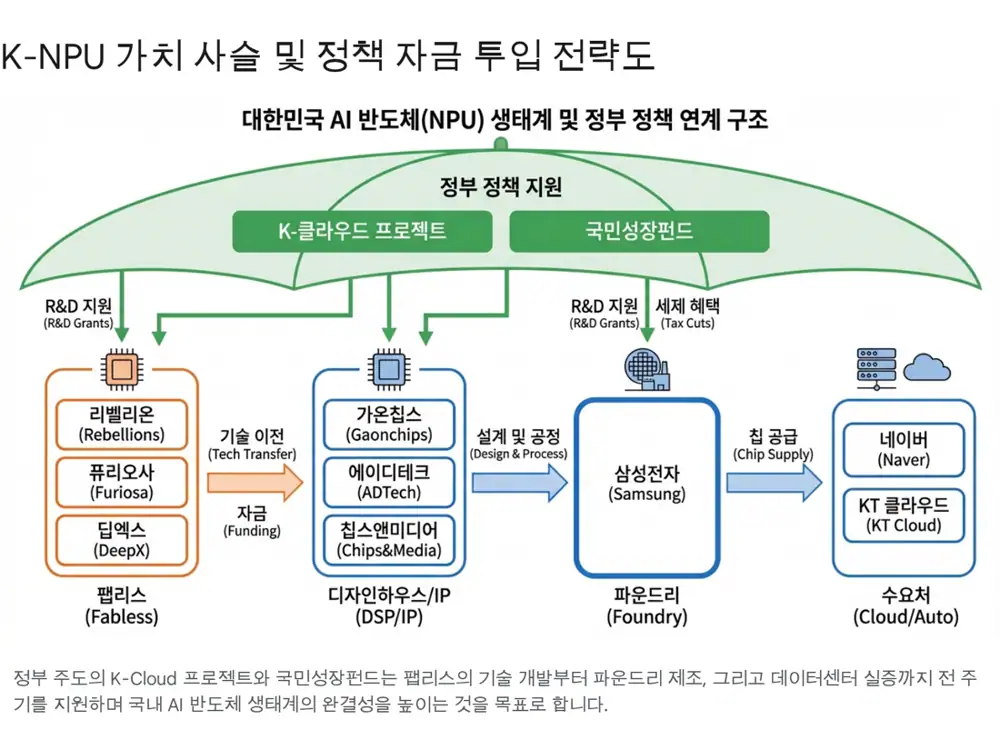
| Phase | Period | Core content |
|---|---|---|
| Phase 1 | 2023-2025 | Apply commercial-stage domestic NPUs to data centers, create early markets and references, and target 23% domestic data-center share by 2025. |
| Phase 2 | 2026-2028 | Combine DRAM-based low-power PIM with NPUs to reduce the memory bottleneck and maximize compute efficiency. |
| Phase 3 | 2029-2030 | Develop non-volatile-memory-based ultra-low-power PIM and secure ultimate AI semiconductor technology. |
The source says 17 consortia were selected for 2025 K-Cloud R&D, including not only fabless firms but also universities such as Seoul National University and Yonsei, next-generation hardware firms such as Denotisia and Panmnesia, and software firms such as Lablup and Okestro.
3. Listed KOSDAQ infrastructure companies
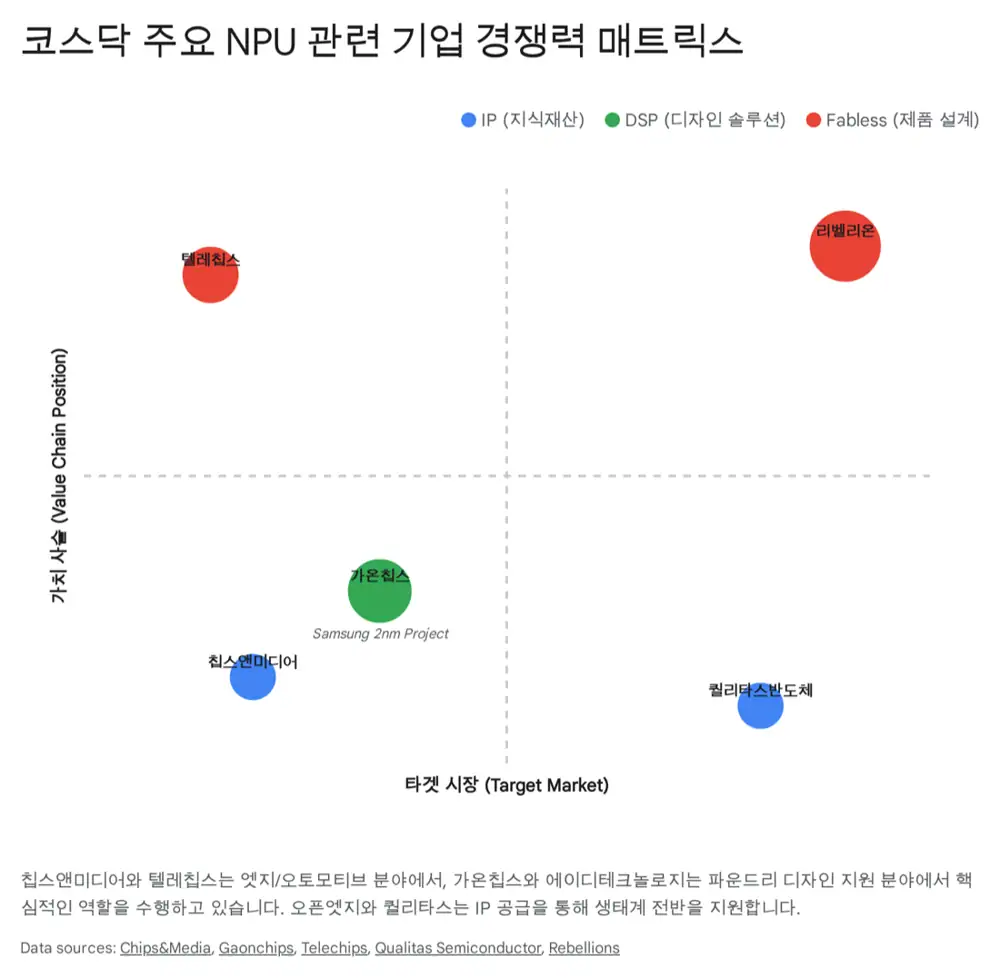
Chips&Media
Positioned around video-specialized NPUs and video IP in edge AI and image-processing value chains. The source references Q3 revenue of KRW 7.03 billion and operating profit of KRW 1.73 billion.
Openedges Technology
Presented as an infrastructure layer through memory subsystem IP, HBM3 test-chip validation, and Renesas collaboration.
Gaonchips/ADTechnology
Design houses linked to the Samsung Foundry ecosystem and potential beneficiaries of AI chip projects and 2nm/3nm process migration.
Telechips/Qualitas
The source mentions Telechips' automotive AI accelerator A2X at 200 TOPS and Qualitas' 4nm UCIe and PCIe Gen 6.0 IP license.
4. Private fabless companies and Pre-IPO strategy
| Company | Key fact from source | Policy meaning |
|---|---|---|
| Rebellions | Launched as Korea's first AI chip unicorn after merging with Sapeon; source references USD 250m financing backed by Arm and Samsung | National representative candidate for AI data-center inference chips |
| FuriosaAI | USD 125m investment round and LG AI Research material showing 2.25x better LLM inference versus GPUs are cited | Requires rules that make KOSDAQ more attractive than Nasdaq |
| DEEPX | 2024 Series C of USD 80.5m, USD 529m valuation, and 2027 IPO plan are cited | Connects on-device generative AI with Samsung 2nm process |
| Mobilint | CES 2025 LLM demo, MLA100 MXM 80 TOPS module, and Lanner/Aetina partnerships are cited | Candidate for edge AI and Physical AI pilots |
| SemiFive | KOSDAQ listing and IPO-related materials are cited | Capital-market bridge for a design-platform company |
5. Portfolio and policy proposals
- Listed infrastructure 30%: Invest in proven enablers such as Chips&Media, Openedges, Gaonchips, and ADTechnology.
- Unlisted late-stage 50%: Supply capital to Rebellions and FuriosaAI through Pre-IPO and IPO rounds to reduce dependence on foreign capital.
- Early/growth 20%: Connect on-device AI firms such as DEEPX and Mobilint to smart-factory, robot, and drone PoCs.
Interpretation: KOSDAQ revitalization cannot stop at liquidity injection. Public data-center procurement, domestic performance standards, tax benefits for large-company M&A, and super-gap technology listings must move together.
6. Conclusion
Korea's AI semiconductor window will not stay open forever. The government should build a One Team Korea structure where IP companies such as Chips&Media, Openedges, and Qualitas, and design houses such as Gaonchips, ADTechnology, and SemiFive, support Rebellions, FuriosaAI, DEEPX, and Mobilint as they scale toward global unicorn status. KOSDAQ should be the capital engine for that structure.
Sources
- Original blog: https://m.blog.naver.com/PostView.naver?blogId=star_of_self&logNo=224117383043
- Source 1: https://www.msit.go.kr/eng/bbs/view.do?sCode=eng&mId=4&mPid=2&pageIn-dex=2&bbsSeqNo=42&nttSeqNo=827&searchOpt=ALL&searchTxt=
- Source 2: https://www.kedglobal.com/electronics/newsView/ked202212130010
- Source 3: https://w.media/korea-forms-ai-semiconductor-and-cloud-team-to-rival-nvidia/
- Source 4: https://www.msit.go.kr/eng/bbs/view.do?sCode=eng&nttSeqNo=1114&bbsSeqNo=42&mId=4
- Source 5: https://www.koreaherald.com/article/10640375
- Source 6: https://www.mk.co.kr/news/economy/11496256
- Source 7: https://drive.google.com/open?id=1L5p-WuAe8zXvDJn1Ukffi19yxj4fHEj0_H2PqZEfBh0
- Source 8: https://stockanalysis.com/quote/kosdaq/094360/market-cap/
- Source 9: https://www.chipsnmedia.com/en/company/news.php?boardid=news_en&mode=view&idx=21&sk=&sw=&offset=18&category=
- Source 10: https://www.chipsnmedia.com/en/company/news.php?mNum=2&sNum=1&boardid=news_en&mode=view&idx=24
- Source 11: https://www.edge-ai-vision.com/2025/07/us-export-controls-on-ai-chips-boost-domestic-innovation-in-china/
- Source 12: https://www.edge-ai-vision.com/2025/11/wave-n-v2-chipsmedias-custom-npu-retains-16-bit-fp-for-superior-efficiency-at-high-tops/
- Source 13: https://www.chipsnmedia.com/en/company/news.php?mNum=2&sNum=1&boardid=news_en&mode=view&idx=14
- Source 14: https://www.stockopedia.com/share-prices/openedges-technology-KOSDAQ:394280/
- Source 15: https://www.openedges.com/milestone
- Source 16: https://www.design-reuse-embedded.com/news/202506070/openedges-collaborates-with-renesas-on-memory-subsystem-ips-for-next-generation-mpu-platform-development/
- Source 17: https://www.openedges.com/ko/post/news071524-ko
- Source 18: https://in.tradingview.com/symbols/KRX-399720/
- Source 19: https://stockanalysis.com/quote/kosdaq/399720/market-cap/
- Source 20: https://www.gaonchips.com/en/sub/news/view.php?idx=296
- Source 21: https://www.gaonchips.com/en/sub/news/view.php?idx=268
- Source 22: https://news.samsung.com/global/samsung-electronics-to-provide-turnkey-semiconductor-solutions-with-2nm-gaa-process-and-2-5d-package-to-preferred-networks
- Source 23: https://stockanalysis.com/quote/kosdaq/200710/market-cap/
- Source 24: https://fintel.io/s/kr/200710
- Source 25: https://semiconductor.samsung.com/news-events/tech-blog/samsung-foundry-partners-with-arm-adtechnology-and-rebellions-to-develop-an-innovative-ai-cpu-chiplet-platform-ideal-for-modern-ai-datacenters/
- Source 26: https://semiconductor.samsung.com/foundry/advanced-package/
- Source 27: https://www.varindia.com/news/samsung-to-start-producing-3nm-chips-for-servers
- Source 28: https://fintel.io/s/kr/054450
- Source 29: https://www.prnewswire.com/news-releases/telechips-unveils-automotive-ai-accelerator-a2x-featuring-200tops-npu-for-powerful-ai-processing-performance-ready-for-global-market-launch-302394144.html
- Source 30: https://autotechinsight.spglobal.com/news/5280837/telechips-introduces-south-koreas-first-automotive-ai-accelerator
- Source 31: https://www.thelec.net/news/articleView.html?idxno=5042
- Source 32: https://stockanalysis.com/quote/kosdaq/432720/market-cap/
- Source 33: https://www.design-reuse-embedded.com/news/202511001/qualitas-semiconductor-expands-global-presence-with-4nm-ucie-and-pcie-gen-6-0-ip-licensing-agreement-in-the-u-s-ai-market/
- Source 34: https://www.businesswire.com/news/home/20251114952016/en/Qualitas-Semiconductor-Expands-Global-Presence-with-4nm-UCIe-and-PCIe-Gen-6.0-IP-Licensing-Agreement-in-the-U.S.-AI-Market
- Source 35: https://pitchbook.com/profiles/company/454235-23
- Source 36: https://www.leeko.com/leenko/news/workHistoryView.do?lang=EN&boardNo=16914
- Source 37: https://rebellions.ai/newsroom/rebellions-and-sapeon-korea-complete-merger-launching-koreas-first-ai-chip-unicorn/
- Source 38: https://internationalfinance.com/technology/start-up-week-rebellions-here-reimagine-ai-compute/
- Source 39: https://www.lightreading.com/semiconductors/skt-backed-ai-chip-firm-sapeon-in-1b-merger
- Source 40: https://www.siliconrepublic.com/start-ups/rebellions-raises-250m-arm-samsung-ai-chip-inference
- Source 41: https://rebellions.ai/newsroom/rebellions-raises-250-million-to-advance-the-next-generation-ai-infrastructure-backed-by-arm-and-samsung/
- Source 42: https://koreatechdesk.com/upstage-ipo-korea-ai-venture-policy-future-rebellions-deepx
- Source 43: https://www.businesswire.com/news/home/20250730613509/en/FuriosaAI-Closes-%24125M-Investment-Round-to-Scale-Production-of-Next-Gen-AI-Inference-Chip
- Source 44: https://www.verdict.co.uk/semiconductor-firm-furiosaai-secures-funding/
- Source 45: https://www.trendforce.com/news/2025/07/23/news-south-koreas-furiosaai-lands-lg-deal-after-turning-down-metas-acquisition-offer/
- Source 46: https://furiosa.ai/blog/lg-ai-research-taps-furiosaai-to-achieve-2-25x-better-llm-inference-in-production-vs-gpus
- Source 47: https://www.chosun.com/english/market-money-en/2025/11/27/YLVRFN5Q5NDLFJ4BIMPGMASEUA/
- Source 48: https://www.techinasia.com/news/korean-chipmaker-furiosaai-seeks-300m-in-pre-ipo-sources
- Source 49: https://tracxn.com/d/companies/deepx/__hb0RRMtU1kLFbWQnC0EPp-jJDh-9_o5fyee_hxvE9WA
- Source 50: https://pitchbook.com/profiles/company/466596-82
- Source 51: https://investclub.sv/2024/05/10/deepx-raises-80-million-at-529-million-valuation/
- Source 52: https://www.globenewswire.com/news-release/2025/08/20/3136461/0/en/DEEPX-Signs-2nm-Process-Agreement-with-Samsung-Foundry-to-Develop-World-s-First-On-Device-Generative-AI-Chip-DX-M2.html
- Source 53: https://www.semiconductor-digest.com/deepx-signs-2nm-process-agreement-with-samsung-foundry-to-develop-worlds-first-on-device-generative-ai-chip-dx-m2/
- Source 54: https://deepx.ai/deepx-ramps-up-mass-production-chip-supply-for-the-global-market-bolstering-tangible-business-expansion/
- Source 55: https://www.techinasia.com/news/s-korean-ai-chip-firm-deepx-hires-morgan-stanley-for-ipo
- Source 56: https://www.caproasia.com/2025/08/09/south-korea-ai-semiconductor-startup-deepx-plans-ipo-in-2027-hires-morgan-stanley-for-fundraising-round-raised-80-5-million-in-series-c-funding-at-529-million-valuation-in-2024-founded-in-2018-b/
- Source 57: https://pitchbook.com/profiles/company/495425-17
- Source 58: https://www.startus-insights.com/innovators-guide/ai-hardware-companies/
- Source 59: https://www.prnewswire.com/news-releases/mobilint-unveils-llm-demo-on-high-efficiency-edge-ai-accelerator-at-ces-2025-302345545.html
- Source 60: https://embeddedvisionsummit.com/posts/2025-04-mobilint-introduces-mla100-mxm-an-80-tops-npu-module-for-high-efficiency-embedded-ai-pcs/
- Source 61: https://www.lannerinc.com/news-and-events/latest-news/mobilint-signs-strategic-mou-with-lanner-to-drive-edge-ai-innovation
- Source 62: https://www.aetina.com/about-news-detail.php?i=1247
- Source 63: https://www.ajupress.com/view/20251217140215952
- Source 64: https://www.ipox.com/ipo-calendar/semifive
- Source 65: https://www.prnewswire.com/news-releases/semifive-submits-securities-registration-for-kosdaq-listing-302587451.html
- Source 66: https://www.chosun.com/english/industry-en/2025/12/18/IA5RAVUAYNCHPK7URYQYV4TYB4/
- Source 67: https://www.mk.co.kr/en/it/11495509