DEEP RESEARCH · NUCLEAR TRF
Tritium Removal Technology: The Radiological Safety Valve for CANDU Life Extension
CANDU tritium buildup, TRF process engineering, the Cernavoda project, and fusion-fuel value
0. Bottom line first
TRF is not merely an environmental facility; it is a radiological enabler for extending aging CANDU reactor lives. At the same time, separated tritium is being revalued as fusion fuel, creating the possibility that a former cost center becomes a strategic resource production base.
Official fact: The source gives the average tritium production rate in CANDU moderator as about 7.5 × 10¹⁰ Bq per kg of heavy water per year. A representative CANDU 6 contains about 281m³, or roughly 309,100kg, of moderator; this implies about 2.3 × 10¹⁶ Bq of tritium generated per reactor per year in the moderator system.
Interpretation: Tritium is both an operating risk and a future resource. Without removal, worker dose and environmental release risk rise; if separated and stored properly, it becomes an option in the fusion fuel supply chain.
1. CANDU and tritium buildup
Unlike light-water reactors, CANDU reactors use heavy water (D₂O) as moderator and coolant. Heavy water's low neutron absorption enables natural uranium fuel, but deuterium (²H) captures neutrons during operation and turns into tritium (³H).
| Item | Source figure/content | Meaning |
|---|---|---|
| Production rate | About 7.5 × 10¹⁰ Bq per kg of heavy water per year | Concentration management is essential in long-term operation |
| CANDU 6 moderator | About 281m³, about 309,100kg | Large heavy-water inventory per reactor |
| Annual generation | About 2.3 × 10¹⁶ Bq | Buildup risk in the moderator system |
| Concentration gap | Moderator concentration at least 10x higher than heat transport system | Moderator TRF is critical |
2. Core mechanism for life extension
Refurbishment replaces core components such as pressure tubes and feeder pipes to extend plant life by 25-30 years. This work includes cutting and replacing pipes inside and around the calandria, one of the highest-radiation work areas.
Official fact: The source gives Wolsong's moderator tritium concentration management target as 370 GBq/kg, or 10 Ci/kg, and says this can be achieved only through TRF operation.
Interpretation: TRF's real product is workable time and space. If tritium concentration remains high, workers can reach dose limits quickly, making refurbishment physically impractical.
Lower occupational dose
Reduces internal dose from high-concentration tritiated vapor.
Minimize environmental release
Provides the technical basis for license renewal and community acceptance.
Heavy-water reuse
Detritiated heavy water can return to moderator service and reduce replacement cost.
3. Process technology: LPCE and cryogenic distillation
Modern TRF combines liquid phase catalytic exchange (LPCE) with cryogenic distillation. LPCE uses hydrophobic catalyst to trigger isotope exchange between liquid heavy water and deuterium gas, transferring tritium into gas phase.
The source says older VPCE required large energy input to vaporize heavy water, while LPCE reacts in liquid state, improving energy efficiency and simplifying the process. High-performance hydrophobic catalyst developed by KAERI and others is presented as a key competitive element.
4. Market ecosystem: KHNP, Iljin Power, Kinectrics, and Veolia
The source frames TRF not as a single-company market but as an ecosystem of plant operators, EPC contractors, equipment suppliers, and original technology holders. KHNP has Wolsong TRF operating experience and the Cernavoda EPC reference; Iljin Power supplies tritium storage and processing equipment and maintenance capability.
- KHNP: Prime contractor, overall project management, commissioning, and interface with SNN.
- Iljin Power: Core equipment for tritium storage and processing systems, supported by long cooperation with KAERI.
- Kinectrics and Veolia: Global technology and service providers in tritium and heavy-water treatment.
- Other supply chain: Doosan Enerbility, Iljin Electric, and others provide BOP equipment and expand Team Korea's footprint.
5. Fusion fuel and supply cliff
Official fact: The source says ITER is expected to need about 12.3kg of tritium for full deuterium-tritium experiments in the mid-2030s. It also cites private-market tritium pricing of USD 30,000 per gram, or about KRW 40 million.
Interpretation: Operating CANDU reactors could function as commercial fuel factories for future fusion plants. If DEMO-stage reactors require tens of kilograms, supply shortage could completely change TRF economics.
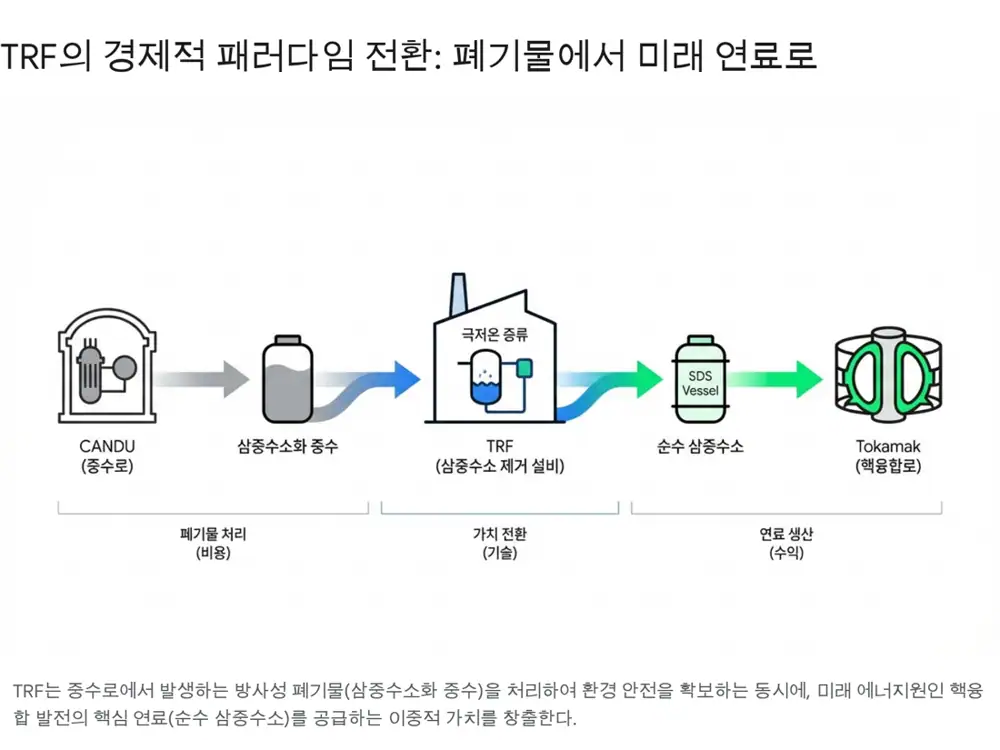
6. Case study: Romania's Cernavoda TRF
The source views KHNP's Cernavoda TRF order as a successful model for Korean nuclear exports. The June 2023 contract is worth about KRW 260 billion, or EUR 195 million, started construction in July 2023, and targets completion in August 2027 over a 50-month period.
| Item | Content | Strategic meaning |
|---|---|---|
| Contract size | About KRW 260B / EUR 195M | Korean TRF EPC reference |
| Schedule | July 2023 start, August 2027 target completion | Links to Cernavoda Unit 1 refurbishment |
| Technology strategy | Adopts LPCE technology from Romania's ICSI | Reduces licensing risk by respecting customer technology |
| Korean role | Design optimization, procurement, and construction management | Exports EPC strength and operating know-how |
7. Strategic recommendations
- Adopt a fusion-ready strategy that treats TRF as tritium production and supply infrastructure, not just removal equipment.
- Export long-term O&M packages after EPC to improve lifetime profitability.
- Expand hydrogen isotope separation technology into derivative markets such as high-purity hydrogen purification and SMR coolant management.
- Work with original technology holders such as Kinectrics and ICSI to lead next-generation TRF standards.
8. Overall view
The TRF market is entering an early supercycle where current nuclear life-extension demand overlaps with future fusion-fuel demand. Korea's nuclear industry has proven competitiveness through Wolsong operating experience and the Cernavoda order. The next task is connecting that record to European refurbishment and the fusion fuel supply chain.
Sources
- 원문 블로그: https://m.blog.naver.com/PostView.naver?blogId=star_of_self&logNo=224116432651
- Assisted UI content: http://googleusercontent.com/assisted_ui_content/2
- CANDU reactor: https://en.wikipedia.org/wiki/CANDU_reactor
- Tritium Releases and Dose Consequences in Canada in 2006: https://www.nrc.gov/docs/ML1029/ML102990113.pdf
- CANTEACH CANDU reactor systems: https://canteach.candu.org/content%20library/19930203.pdf
- IAEA Point Lepreau life extension: https://www-pub.iaea.org/MTCD/publications/PDF/P1500_CD_Web/htm/pdf/topic4/4S02_K.%20Stratton.pdf
- Long-term Operation of Wolsong TRF: https://tritium2025.com/wp-content/uploads/Burgundy-Room_Sep-26_0900_2_Yeonduck-Han_ID289_SENT-09-10-0912-reckE0eWK2jIGj3Wi.pdf
- World Nuclear News Romania TRF works: https://www.world-nuclear-news.org/articles/works-begins-on-romania-s-tritium-removal-facility
- World Nuclear News Cernavoda TRF contract: https://www.world-nuclear-news.org/articles/contract-for-cernavoda-tritium-removal-facility
- Kinectrics Tritium & Deuterium: https://www.kinectrics.com/capabilities/services/chemistry-assaying/tritium-deuterium
- Veolia Tritium Removal System: https://www.nuclearsolutions.veolia.com/sites/g/files/dvc2436/files/document/2017/03/Tritium_MDS_Tearsheet_January_2017.pdf
- Iljin Power Romania CTRF contract: https://consulateroinko.com/g5/bbs/board.php?bo_table=ro_invest&wr_id=48
- NEI KHNP transformers Cernavoda: https://www.neimagazine.com/news/khnp-wins-order-to-supply-transformers-to-cernavoda-8968859/
- KDI ITER tritium storage/supply procurement: https://eiec.kdi.re.kr/policy/callDownload.do?num=264826&filenum=1&dtime=20250327153504
- Iljin Power annual report KRX: https://kind.krx.co.kr/common/disclsviewer.do?method=search&acptno=20250320001345&docno=&viewerhost=&
- Verified Market Research Tritium market: https://www.verifiedmarketresearch.com/product/global-tritium-hydrogen-3-market/
- AtkinsRealis CANDU technology: https://www.atkinsrealis.com/en/projects/candu-technology
- Bruce Power nuclear refurbishment: https://www.brucepower.com/wp-content/uploads/2020/01/Nuclear-Refurb-EN.pdf
- Ontario Pickering refurbishment: https://news.ontario.ca/en/release/1006772/ontario-greenlights-pickering-nuclear-generating-station-refurbishment-to-create-nearly-37000-jobs
- TradeTech uranium review: https://www.uranium.info/resources/uploaded/sc250130.pdf
- NEI Qinshan life extension: https://www.neimagazine.com/news/snc-lavalin-supports-life-extension-of-chinas-qinshan-reactors-9896505/
- World Nuclear News CANDU contracts: https://www.world-nuclear-news.org/articles/contracts-support-candu-projects-in-china-and-cana
- Eurofusion tritium resource assessment: https://scipub.euro-fusion.org/wp-content/uploads/eurofusion/WPPMIPR17_17185_submitted-1.pdf
- IAEA global supply of tritium: https://nucleus.iaea.org/sites/fusionportal/Shared%20Documents/FEC%202018/fec2018-preprints/preprint0461.pdf
- Nuclearelectrica KHNP EPC contract: https://nuclearelectrica.ro/snn/en/2023/06/27/nuclearelectrica-and-korea-hydro-nuclear-power-khnp-sign-the-engineering-procurement-and-construction-epc-contract-for-the-completion-of-europes-first-tritium-removal-facility-at-cerna/
- Transformers Magazine KHNP shipment: https://transformers-magazine.com/tm-news/khnp-ships-main-transformers-for-romanian-nuclear-power-plant/
- Nuclearelectrica Unit 1 refurbishment works: https://nuclearelectrica.ro/snn/en/2025/09/03/sn-nuclearelectrica-sa-has-started-today-the-civil-construction-works-for-the-cernavoda-npp-unit-1-refurbishment-project/