DEEP RESEARCH · NANOTEAM
NanoTeam Deep Dive: EV Safety Materials and Aerospace Thermal Management
From gap fillers and pads to thermal-runaway protection and aerospace thermal materials
0. Bottom line first
NanoTeam's thesis is that it is moving from basic heat-dissipation materials into EV fire-propagation prevention. The source frames 2025 as the first year of the new plant and thermal-runaway pad supply, and 2026 as the year of a potential earnings jump. EV chasm risk, Hyundai Motor Group concentration, and CB overhang remain key risks.
Gap filler and gap pad
The company built references by supplying E-GMP-based Hyundai/Kia EV models.
Thermal-runaway pad
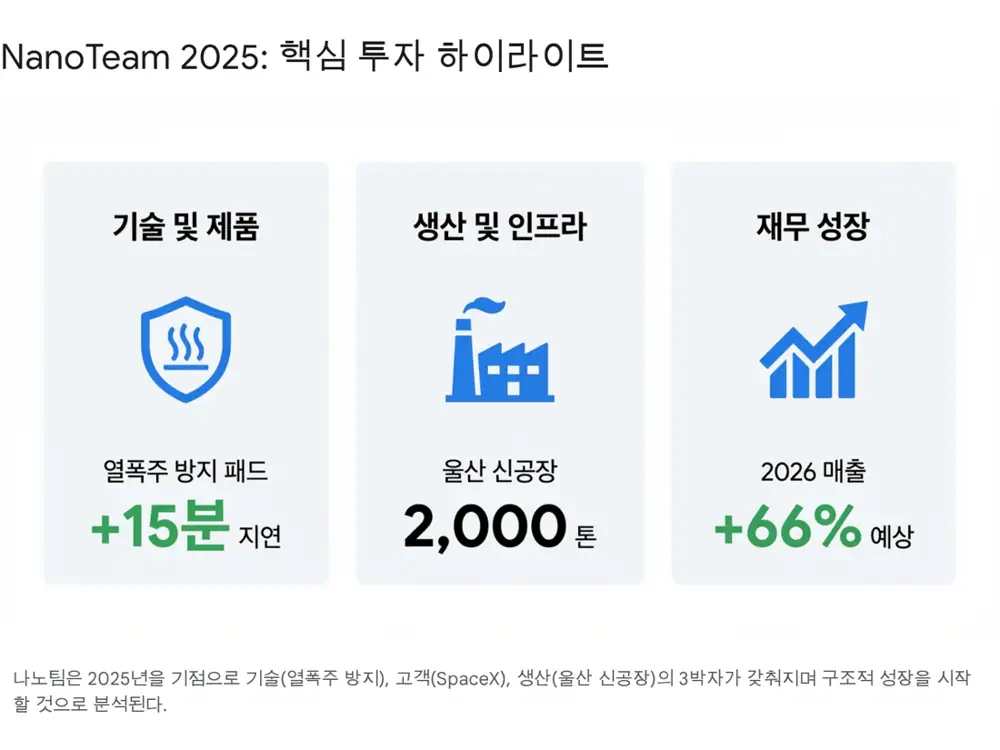
The source emphasizes more than 15 minutes of flame blocking, and over 30 minutes for next-generation products.
Ulsan new plant
Targeted for 2025 operation with annual capacity of 2,000 tons of thermal-runaway protection pads.
1. Industry inflection: from heat to safety
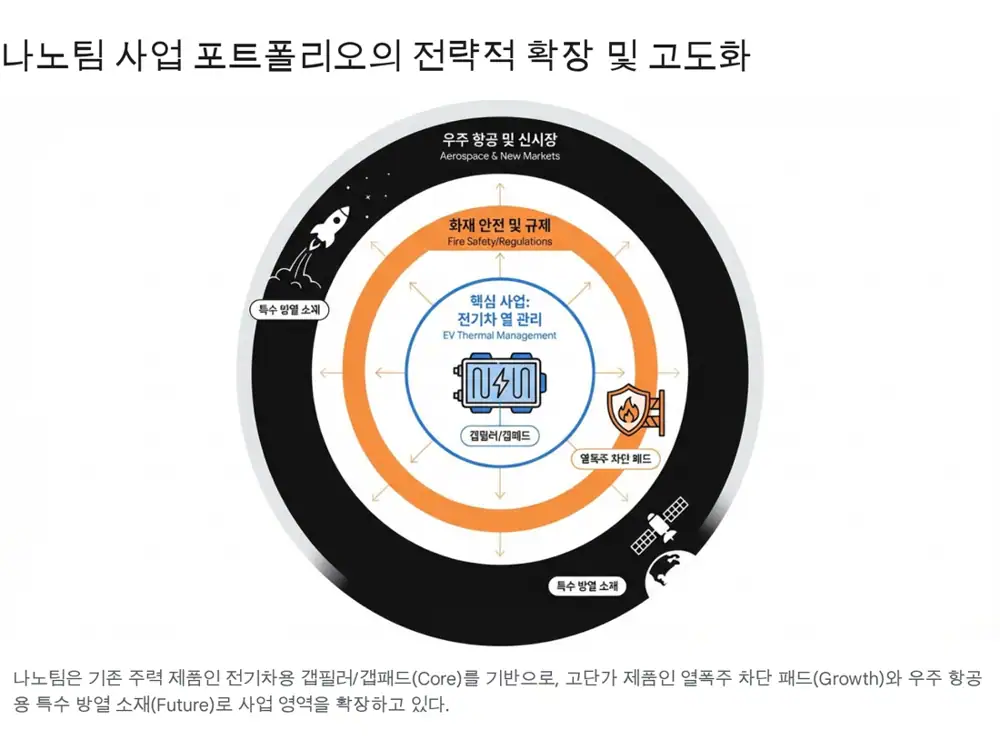
Official fact: NanoTeam was founded in 2016, localized thermal interface materials, and supplied gap fillers and gap pads to Hyundai Motor Group E-GMP EVs according to the source.
Interpretation: The EV chasm is a near-term demand burden, but fire safety regulation and consumer anxiety raise the strategic value of safety materials. NanoTeam may be valued less like a component supplier and more like a safety-solutions company.
2. Product portfolio
Official fact: The source states that air has very low thermal conductivity, about 0.025 W/mK, so unfilled air gaps can create thermal bottlenecks.
| Category | Gap filler | Gap pad |
|---|---|---|
| Form | Liquid before curing, solid after curing | Solid sheet |
| Advantages | Automation, complex shapes, thin application | Easy handling, reworkable, stable insulation thickness |
| Applications | Battery modules/packs, large-area heat dissipation | Inverters, converters, electronics |
| NanoTeam status | Supplies main Hyundai/Kia models | Expanding around electronics components |
3. Thermal-runaway pads and regulation
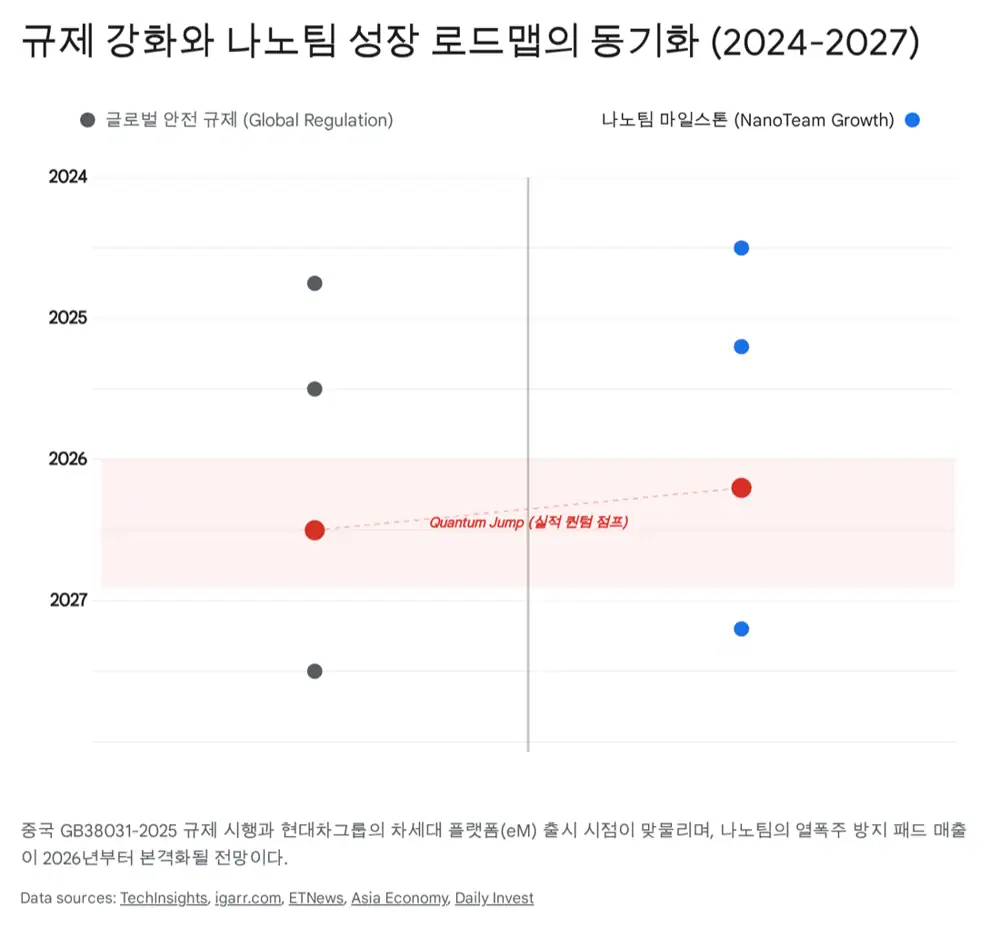
Official fact: The source says competing mica or aerogel products withstand flame for about five minutes, while NanoTeam's new material blocks flame for more than 15 minutes and next-generation products for more than 30 minutes. It also cites China's GB38031-2025 safety regulation as taking effect in July 2026.
Interpretation: This is a higher-value safety component, so the valuation logic can differ from legacy gap fillers. Adoption in Hyundai's next-generation platform and higher-value models such as GV90 is crucial.
4. Earnings and capacity
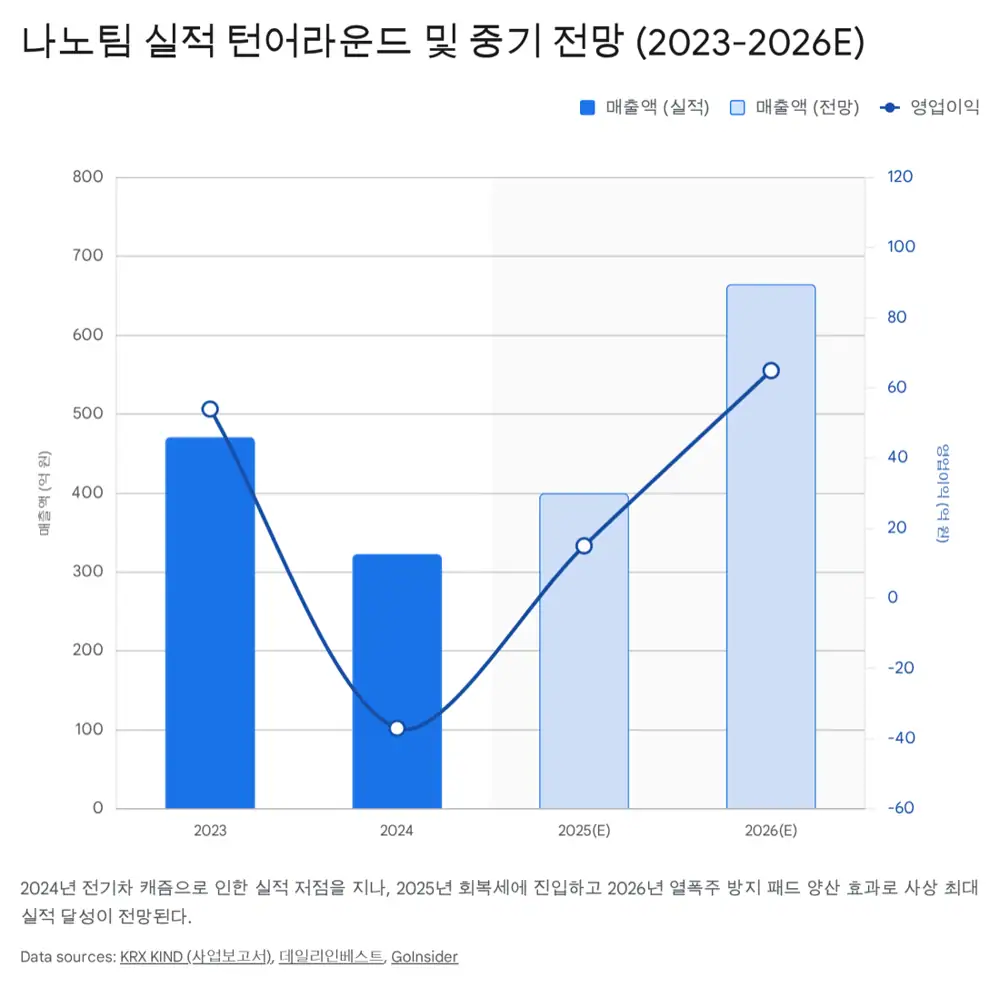
Official fact: The source forecasts 2026 revenue of KRW 66.5 billion, about 66% growth from 2025, and operating profit of KRW 6.5 billion, up 274% YoY. It also states Q3 revenue was KRW 10.3 billion, up 52% YoY.
Official fact: The Ulsan plant is targeted for 2025 operation and annual capacity of 2,000 tons of thermal-runaway pads. Silicone prices as of December 2025 are cited as rising 4.8% in North America and 5.3% in Northeast Asia.
Interpretation: If demand materializes, the Ulsan plant becomes operating leverage. If utilization stays low or raw-material pass-through lags, margin recovery can slow.
5. Competition and risks
Official fact: The source lists Dow, Shin-Etsu, Henkel, and 3M as major global competitors, and says Asia Pacific represented more than 39% of the thermal materials market in 2024.
- A delayed EV demand recovery can postpone earnings improvement.
- Convertible bonds can dilute shareholders if converted.
- High dependence on Hyundai Motor Group creates customer-concentration risk.
- Expansion into Stellantis, GM, and other customers is a key test.
6. Checkpoints
I read NanoTeam as a specialized materials company with two growth wings: EV fire safety and aerospace thermal management. The items to track are GV90 and next-generation platform adoption, global spread of GB38031-2025-like rules, real sales from the SpaceX sample-supply history, and Ulsan plant utilization.
Sources
- 네이버블로그 원문: https://m.blog.naver.com/PostView.naver?blogId=star_of_self&logNo=224115313484
- 나노팀 Company Guide: https://comp.fnguide.com/SVO2/ASP/SVD_Main.asp?gicode=A417010&MenuYn=Y
- 나노팀 리서치 PDF: https://ssl.pstatic.net/imgstock/upload/research/company/1706051057287.pdf
- 아시아경제 열폭주 차단패드 기사: https://cm.asiae.co.kr/article/2025061908220521440
- Daily Invest 나노팀 분석: http://www.dailyinvest.kr/news/articleView.html?idxno=54685
- Asiae English SpaceX supply article: https://cm.asiae.co.kr/en/article/2025121609513667138
- 매일경제 5천억 프로젝트 수주: https://www.mk.co.kr/news/business/10780814
- 전자신문 울산 공장 신설: https://www.etnews.com/20230602000115
- 마켓인 스페이스X 샘플 공급 이력: https://marketin.edaily.co.kr/News/ReadE?newsId=03758886642399176
- TechInsights China EV safety standard: https://library.techinsights.com/public/sectioned-blog-viewer/e663975a-cb0a-4daf-80e9-57e315f7c63a
- H&Z GB38031 insight: https://hz.group/insight/gb38031-battery-safety-ev-regulation/
- EEPower EV battery safety standard: https://eepower.com/tech-insights/no-fire-no-explosion-safety-standards-for-ev-batteries/
- Carrar Chinese EV safety standard: https://www.carrar.net/resources/the-new-chinese-ev-safety-standard/
- IGARR GB 38031-2025: https://igarr.com/de/2025/04/24/china-new-standard-gb-38031-2025-safety-requirements-for-power-batteries-for-electric-vehicles/
- China government EV battery safety standard: https://english.www.gov.cn/news/202504/15/content_WS67fe4271c6d0868f4e8f1b70.html
- Tech in Asia Hyundai Kia EV safety: https://www.techinasia.com/news/hyundai-kia-partner-with-korean-battery-makers-on-ev-safety
- 아시아경제 CORE 열폭주 패드: https://core.asiae.co.kr/article/2025061908220521440
- DartPoint AI 나노팀: https://dartpoint.ai/01524118
- KRX 공시: https://kind.krx.co.kr/common/disclsviewer.do?method=search&acptno=20250610000441&docno=&viewerhost=&
- 주달 2025.12.10: https://www.judal.co.kr/?view=stockAI&shareToken=cVjoSB7Q5SS2MG8e
- Goinsider 나노팀: https://goinsider.kr/stock/01524118
- 울산MBC EV공장 YouTube: https://www.youtube.com/watch?v=Q_eRECVmxhM
- Silicone price index: https://businessanalytiq.com/procurementanalytics/index/silicone-price-index/
- Silicone market 2026-2035: https://www.fundamentalbusinessinsights.com/ko/industry-report/silicone-market-4540
- Grand View Research TIM market: https://www.grandviewresearch.com/industry-analysis/thermal-interface-materials-market
- 주달 2025.12.02: https://www.judal.co.kr/?view=stockAI&shareToken=noGJMjdybUbBrOPE