DEEP RESEARCH · S2W/QUAXAR
S2W QUAXAR: An Asia-Native Data Intelligence Strategy for Cross-Border CTI
Analysis centered on DarkBERT, knowledge graphs, INTERPOL references, and public-first global expansion
0. Bottom Line First
S2W's differentiation is the combination of DarkBERT, multi-domain knowledge graphs, and INTERPOL references, then expanding from public agencies into private enterprise. It avoids a head-on fight with global giants and attacks gaps in Asia, the Middle East, virtual assets, and public-sector CTI.
The source links back to the prior analysis [Getting to know S2W] and then focuses on QUAXAR.

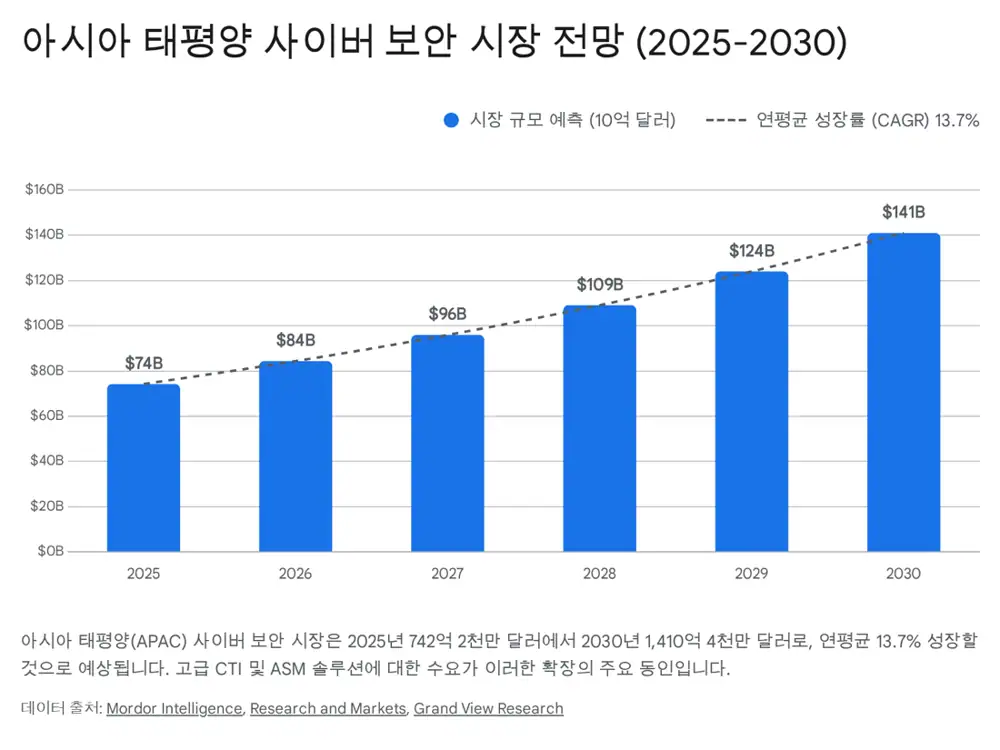
Official fact: The source cites global cybersecurity market growth from $218.9 billion in 2025 to $562.7 billion in 2032. It also frames APAC cybersecurity at a 13.7% CAGR from 2025 to 2030, reaching $141.0 billion.
Interpretation: Generative AI, RaaS, and dark-web zero-day trading create demand for predictive intelligence. The weakness of English-centric CTI in non-English dark-web ecosystems is S2W's opening.
1. Architecture: DarkBERT and Knowledge Graphs
QUAXAR is framed as more than a threat feed. It unifies ASM, DRP, and TI in an AI intelligence platform. DarkBERT is based on RoBERTa and trained on a dark-web corpus described as 5.83GB, or 5.20GB after preprocessing.
Language-Specific
The goal is more accurate interpretation of slang, obfuscation, and forum context than general models.
Relationship Reasoning
It links handles, Telegram channels, ransomware, and crypto wallets into a full threat picture.
ASM/DRP/TI
Attack-surface, digital-risk, and threat-intelligence outputs match user objectives.
2. Competitive Landscape
The source argues Western CTI leaders have brand, data scale, and enterprise sales strengths, while S2W differentiates in Asian local languages, non-English underground economies, and public-investigation references.
| Axis | S2W QUAXAR | Global competitors |
|---|---|---|
| Language/region | Asian underground analysis including Korean, Chinese, and Southeast Asian languages | English-centric and global-enterprise strengths |
| References | INTERPOL, Korean police, Indonesia, Saudi Arabia, Greece | Large private enterprises and global security organizations |
| Expansion | Public first, private later | Private enterprise first |
3. INTERPOL Reference and Public-First Strategy
Official fact: The source describes S2W supplying INTERPOL and domestic/international investigative agencies in 2020-2023, then expanding in 2023-2024 through Indonesia's XARVIS, a Saudi national-security AI platform, and a Greek government QUAXAR contract.
Interpretation: Public-sector references are evidence of trust, not just revenue. The key is spillover into private customers such as TWSE, Taiwan Railway, and Evergreen Marine.
4. Finance, Crypto, and Regional Expansion
S2W combines QUAXAR language analysis with EYEZ virtual-asset ledger analysis. The source's scenario is tracing a ransomware actor from dark-web activity into bitcoin laundering. Upbit, Bithumb, and Shinhan Bank are cited as Korean virtual-asset and finance references.
5. Risks and Final View
- Brand awareness: S2W needs stronger global recognition against Recorded Future and other leaders.
- Resource limits: marketing and R&D resources are smaller than Google or CrowdStrike.
- Regulatory compliance: GDPR and data-protection rules require ongoing investment.
If IPO capital funds local entities in Japan and Singapore plus data-center expansion, S2W can first prove its 'Palantir of Asia' positioning in public, virtual-asset, and APAC CTI niches.
Sources
- 원문: https://m.blog.naver.com/PostView.naver?blogId=star_of_self&logNo=224114421977
- 이전 S2W 원문 링크: https://m.blog.naver.com/star_of_self/224105582128
- Fortune Business Insights - Cybersecurity Market: https://www.fortunebusinessinsights.com/industry-reports/cyber-security-market-101165
- Mordor Intelligence - APAC cybersecurity: https://www.mordorintelligence.com/industry-reports/asia-pacific-cyber-security-market
- Research and Markets - APAC IT security: https://www.researchandmarkets.com/report/asia-pacific-it-security-market
- S2W QUAXAR product: https://s2w.inc/en/product/pd02
- AWS Marketplace - S2W QUAXAR: https://aws.amazon.com/marketplace/pp/prodview-jj46ctw64kucs
- S2W QUAXAR overview: https://s2w.inc/file/download/6670ab0a-83b0-4bd1-8ecc-0bd50add1368
- S2W EYEZ product: https://s2w.inc/en/product/pd05
- DarkBERT paper: https://ar5iv.labs.arxiv.org/html/2305.08596
- S2W Medium - DarkBERT: https://medium.com/s2wblog/part1-getting-to-know-darkbert-a-language-model-for-the-dark-side-of-the-internet-7c4c178faf3d
- S2W website: https://s2w.inc/
- S2W technology: https://s2w.inc/en/technology
- Innovation in Business - threat intelligence platforms: https://www.innovationinbusiness.com/5-best-threat-intelligence-platforms-for-businesses/
- GBHackers - CTI companies: https://gbhackers.com/best-cyber-threat-intelligence-companies/
- Reddit - Mandiant vs Recorded Future: https://www.reddit.com/r/cybersecurity/comments/1mz1jjn/mandiant_vs_recorded_future_in_threat_intelligence/
- Recorded Future AWS Marketplace: https://aws.amazon.com/marketplace/pp/prodview-e2ttyopt6btwa
- Cyberpress - CTI companies: https://cyberpress.org/best-cyber-threat-intelligence-companies/
- CrowdStrike threat intelligence: https://www.crowdstrike.com/en-us/platform/threat-intelligence/
- SpaceWatch - S2W and INTERPOL: https://spacewatch.global/2020/03/south-korean-cyber-start-up-s2w-lab-agrees-to-support-interpol-in-dark-web-data-analysis/
- ChosunBiz - INTERPOL renewal: https://biz.chosun.com/en/en-it/2025/09/03/FKFYHSY3NVDIXD6PVJA3IRBX64/
- PR Newswire - XARVIS INTERPOL: https://www.prnewswire.com/news-releases/s2w-has-signed-contribution-agreement-with-interpol-for-cti-solution-xarvis-enterprise-301452148.html
- DBR - S2W leadership: https://dbr.donga.com/kfocus/view/en/article_no/14
- Korea Times - S2W after IPO: https://www.koreatimes.co.kr/business/tech-science/20250805/s2w-targets-broader-industry-global-expansion-following-ipo
- MK - S2W AI data intelligence: https://www.mk.co.kr/en/it/11123075
- ChosunBiz - Greece QUAXAR: https://biz.chosun.com/en/en-it/2025/12/18/N6BDN2PBQJCAXIVMEZRFY5XHYY/
- Korea Herald - crypto exchanges AML: https://www.koreaherald.com/article/2643677
- Chosun - banks and crypto exchanges: https://www.chosun.com/english/market-money-en/2025/03/25/OCJ7GFEQYREOZJPZOY4YFDU4ZQ/
- BusinessKorea - KOSDAQ listing: https://www.businesskorea.co.kr/news/articleView.html?idxno=252462
- MK - S2W overseas expansion: https://www.mk.co.kr/en/it/11040574
- ChosunBiz - IPO after 7 years: https://biz.chosun.com/en/en-it/2025/11/29/7USNXM24UJGSTCQIZLW4T3SEKA/