DEEP RESEARCH · XPENG/PHYSICAL AI
XPeng's Pivot: From EV Challenger to Physical AI Company
A 2025-2035 roadmap reframed across finance, technology, products, and competition
0. Bottom Line First
My read is that XPeng is no longer just an EV sales story. It is using EV cash flow and data to expand into Turing chips, VLA 2.0, robotaxis, the IRON humanoid, and AeroHT flying cars.
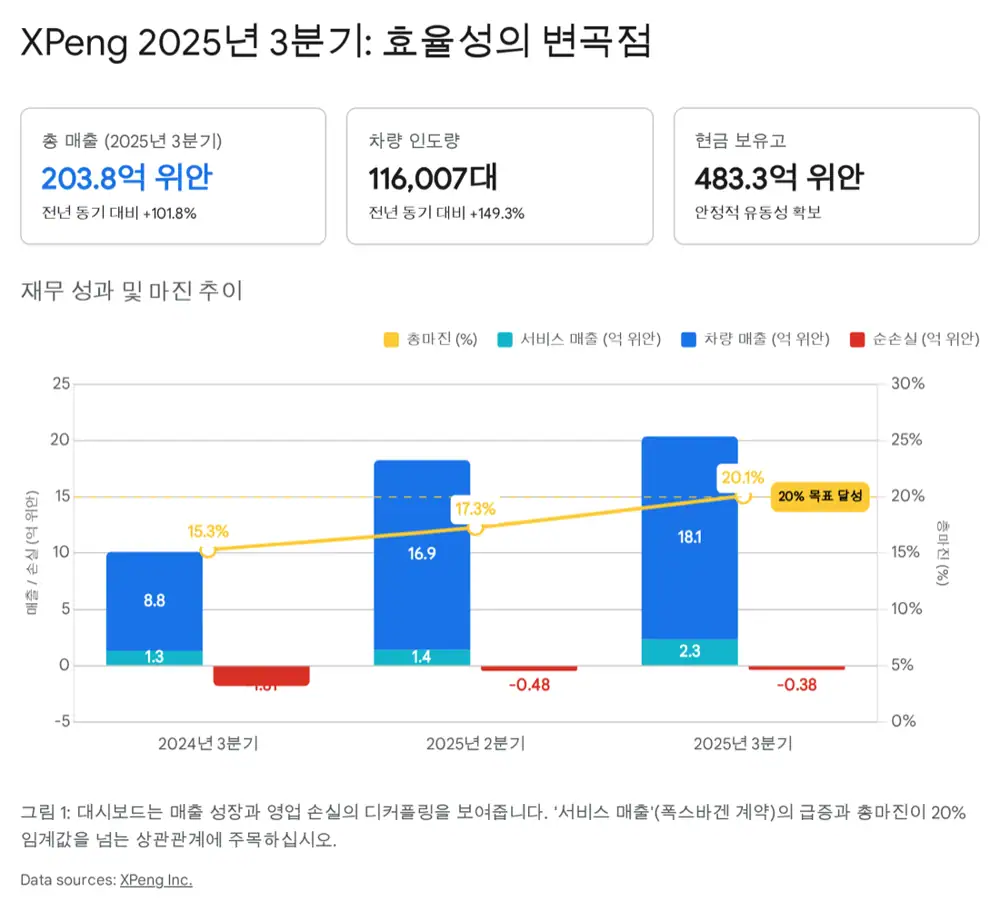
Official fact: In Q3 2025, vehicle deliveries were 116,007 units, up 149.3% YoY. Gross margin reached 20.1%, up 4.8 percentage points YoY. Services and other revenue was RMB 2.33 billion, up 78.1% YoY.
Interpretation: Mona volume, SEPA 2.0 scaling, and Volkswagen technology-service revenue together suggest a shift from cash burn toward technology monetization.
1. Financial Base: Volkswagen and Margin Expansion
XPeng's AI and robotics ambitions require a stronger financial base. Q3 2025 looks like a turning point from cash burn toward structural profitability.
SEPA 2.0
Shared architecture diluted fixed costs and helped gross margin reach 20.1%.
Service Revenue
Volkswagen technology R&D services highlight a higher-margin software-like revenue stream.
Supplying the Vehicle Brain
The model is not simple components, but integrated E/E architecture and intelligence solutions.
2. Technology Core: Turing Chip and VLA 2.0
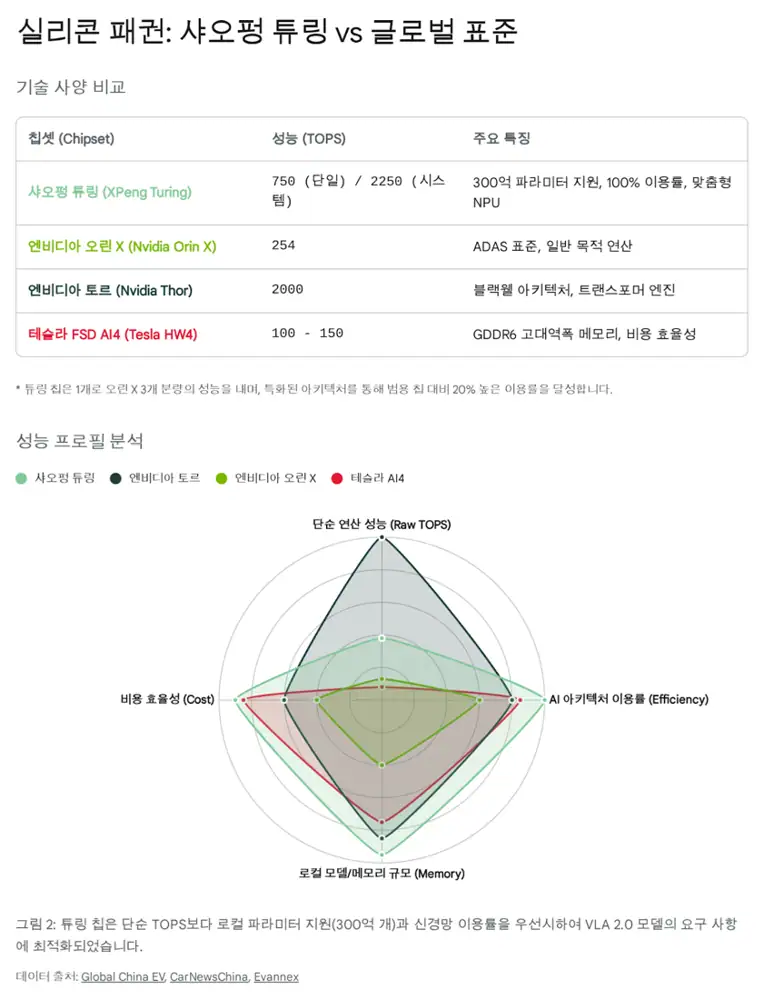
Official fact: The Turing AI chip is described as a 40-core DSA processor. One chip is said to match three Nvidia Orin X chips, while Ultra vehicles and robotaxis are described at 2,250-3,000 TOPS.
Interpretation: The chip strategy aims to reduce Nvidia dependence, mitigate export-control risk, and optimize hardware around VLA 2.0.
VLA 2.0 is framed as an end-to-end neural approach rather than a rule-based perception-planning-control stack. The source highlights more than 100 million driving clips, response to traffic-police gestures, HD-map-free construction zones, and a data flywheel between vehicles and robots.
3. Productization: Robotaxi, IRON, AeroHT
| Product | Source takeaway | Investment lens |
|---|---|---|
| Robotaxi | Three models planned for 2026 | Test of L4 autonomy and data network effects |
| IRON humanoid | 178 cm, 70 kg, 62 DoF, 22-DoF hands, solid-state battery mentioned | Factory/service applicability and differentiation versus Optimus |
| AeroHT | Six-wheel ground carrier plus detachable eVTOL, 2026 delivery target | Showcase for Turing and VLA in 3D space |
4. Competition and Risks
Tesla mirror strategy
XPeng resembles Tesla in custom chips, vision-centered end-to-end AI, and humanoids, while leaning on China home-market advantages, Volkswagen validation, and IRON's 62 DoF and 22-DoF hands.
Huawei ecosystem battle
Huawei supplies HarmonyOS and ADS through partners, while XPeng vertically integrates chips, code, and vehicles. Huawei may have near-term scale, but XPeng may have long-term optimization advantages.
- Execution risk: simultaneous 2026 launches across L4 robotaxi, humanoid, and flying car.
- Semiconductor risk: Turing is self-designed but may still depend on advanced foundries.
- Data risk: XPeng still trails Tesla and BYD in absolute fleet scale, though the source notes 84% XNGP usage as a partial offset.
- Market opportunity: Goldman Sachs projects a $38 billion humanoid market by 2035, while Deloitte discusses more than two million humanoids in industrial sites by 2035.
5. Final View
XPeng can be reframed as a robotics/AI company funded by vehicle sales. 2025-2026 is both a launchpad and a valley of death. IRON mass production, Turing-based robotaxi deployment, and continuing Volkswagen technology revenue are the rerating conditions.
Sources
- 원문: https://m.blog.naver.com/PostView.naver?blogId=star_of_self&logNo=224112299764
- XPENG·Volkswagen E/E architecture agreement: https://ir.xiaopeng.com/news-releases/news-release-details/xpeng-and-volkswagen-group-announce-entry-agreement-expanding-ee?mobile=1
- The EV Report - XPeng Volkswagen E/E collaboration: https://theevreport.com/xpeng-volkswagen-e-e-collaboration-expands
- TechInsights - Turing SoC: https://library.techinsights.com/sectioned-blog-viewer/64ddca32-15ea-4659-a51c-93f0664d5a65
- GlobalChinaEV - Turing AI chip: https://globalchinaev.com/post/xpengs-self-developed-turing-ai-chip-is-3-times-greater-than-nvidias
- Car News China - G7 in-house AI chip: https://carnewschina.com/2025/06/11/xpeng-to-debut-g7-suv-with-its-in-house-ai-chip-promising-unprecedented-computing-power/
- electrive - three robotaxi models: https://www.electrive.com/2025/11/06/xpeng-to-launch-three-robotaxi-models-next-year/
- Car News China - reducing Nvidia reliance: https://carnewschina.com/2025/04/16/decoupling-begins-xpengs-turing-ai-chip-rolls-out-q2-reducing-nvidia-reliance/
- NYU Tandon - XPENG VLA2.0: https://engineering.nyu.edu/events/2025/12/02/xpeng-vla20-foundation-model-physical-ai
- InsideEVs - XPeng and Tesla playbook: https://insideevs.com/news/779701/xpeng-tesla-china-ai-robots/
- Electrek - XPeng AI Day: https://electrek.co/2025/11/05/xpeng-ai-day-new-ai-model-powering-robots-robotaxis-and-flying-cars/
- YouTube - XPENG IRON humanoid: https://www.youtube.com/watch?v=RcNoQICjsLs
- Xpert.Digital - Iron robot: https://xpert.digital/en/iron-robot-by-xpeng/
- Notebookcheck - Iron solid-state battery: https://www.notebookcheck.net/Solid-state-battery-powers-lifelike-Iron-humanoid-robot-set-to-beat-Tesla-Optimus-to-mass-production.1156983.0.html
- XPENG official AI achievements: https://www.xpeng.com/news/019a56f54fe99a2a0a8d8a0282e402b7
- Gasgoo - IRON mass production: https://autonews.gasgoo.com/new_energy/70039692.html
- China Daily - flying car factory: https://www.chinadaily.com.cn/a/202511/04/WS6909e34ba310f215074b8f1d.html
- Electrek - AeroHT: https://electrek.co/guides/aeroht/
- Reddit - XPeng CEO on FSD 14: https://www.reddit.com/r/electricvehicles/comments/1pka9qw/xpeng_ceo_hails_tesla_fsd_14_as_close_to_level_4/
- SEC filing EX-99.1: https://www.sec.gov/Archives/edgar/data/1810997/000119312525303892/d935523dex991.htm
- Goldman Sachs - humanoid robot market: https://www.goldmansachs.com/insights/articles/the-global-market-for-robots-could-reach-38-billion-by-2035
- Deloitte - physical AI: https://www.deloitte.com/us/en/insights/topics/technology-management/tech-trends/2026/physical-ai-humanoid-robots.html