DEEP RESEARCH · ADEL/ADEL-Y01
ADEL: A New Tau-Targeted Alzheimer's Treatment Paradigm
A biotech deep dive into the Sanofi license, ADEL-Y01's tau-acK280 mechanism, and Phase 1a data
0. Bottom Line First
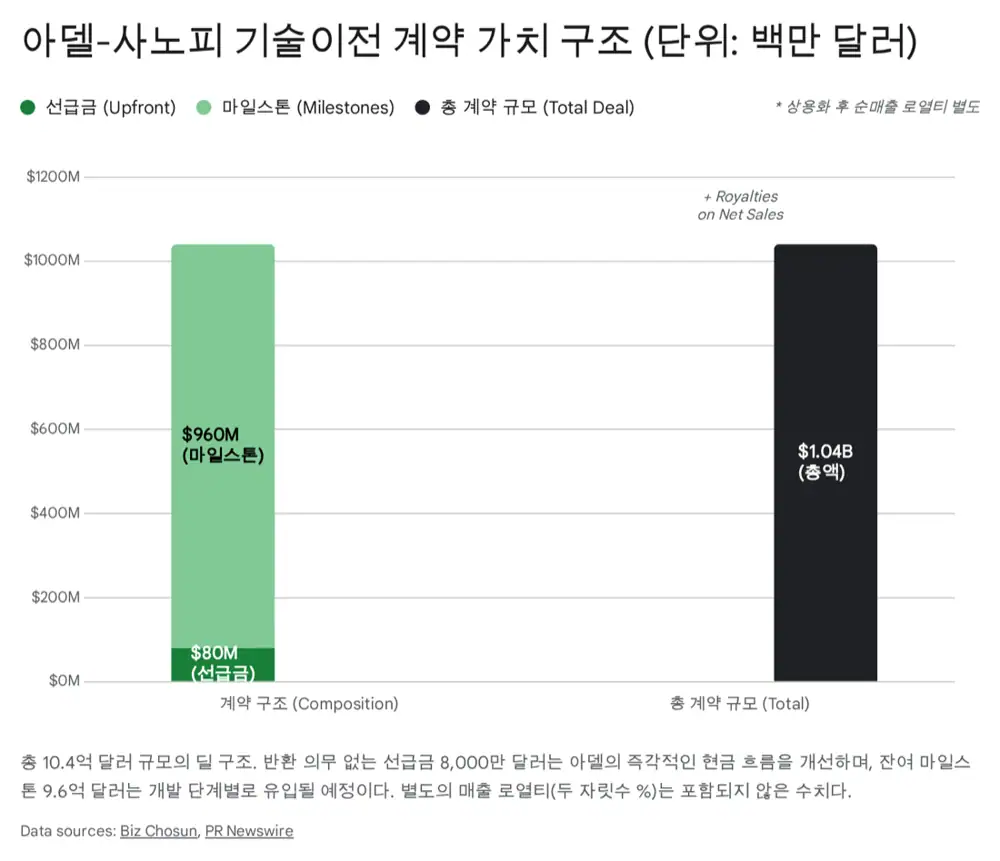
ADEL is still an early clinical-stage story, but Sanofi's deal value of up to $1.04 billion, including an $80 million non-refundable upfront payment, is the central signal. The market is not only valuing another tau antibody; it is valuing a precision approach to pathological tau-acK280.
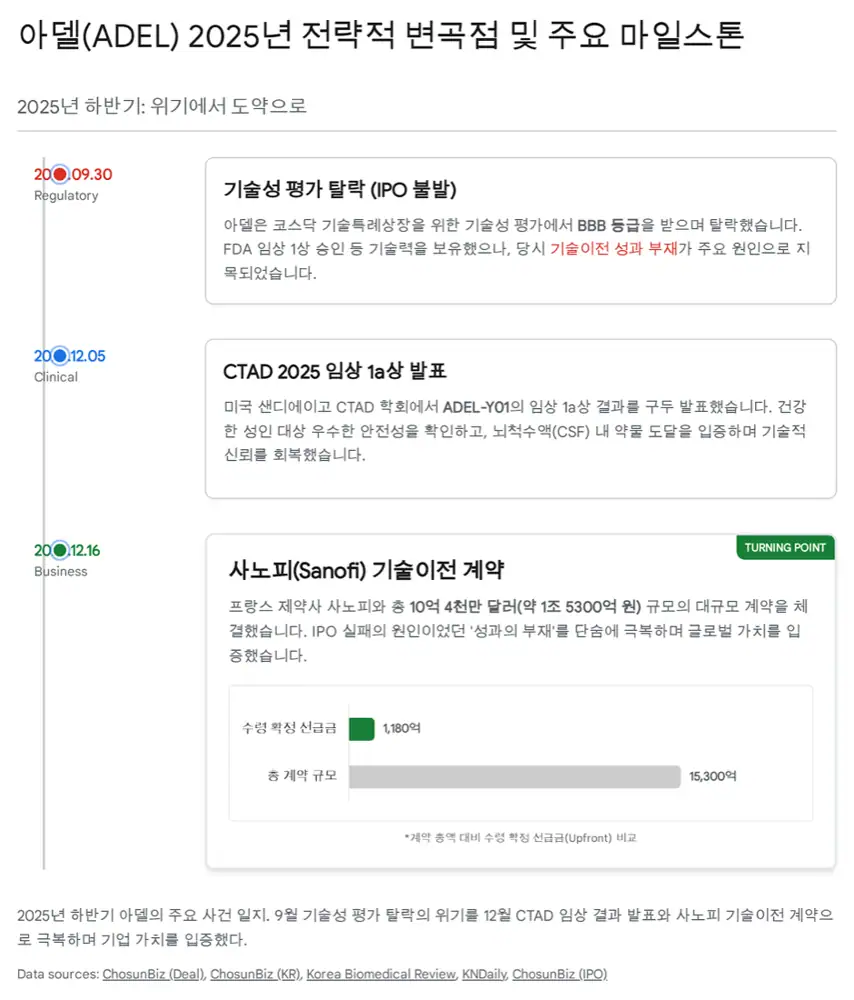
Official fact: The source says ADEL failed Korea's KOSDAQ technology-special listing evaluation in September 2025, then signed a major Sanofi license deal roughly three months later. It also says Phase 1a safety, tolerability, and dose-dependent CSF delivery were presented at CTAD in December 2025.
Interpretation: The gap between domestic listing review and global pharma validation is notable. It shows that Korean biotech assets can be revalued first by global clinical and BD markets.
1. Why Tau: The Post-Amyloid Axis
For more than two decades, Alzheimer's drug development focused on removing amyloid beta. Aduhelm, Leqembi, and Kisunla gained approvals, but the source frames cognitive-decline slowing at roughly 27-35% and notes remaining ARIA safety issues.
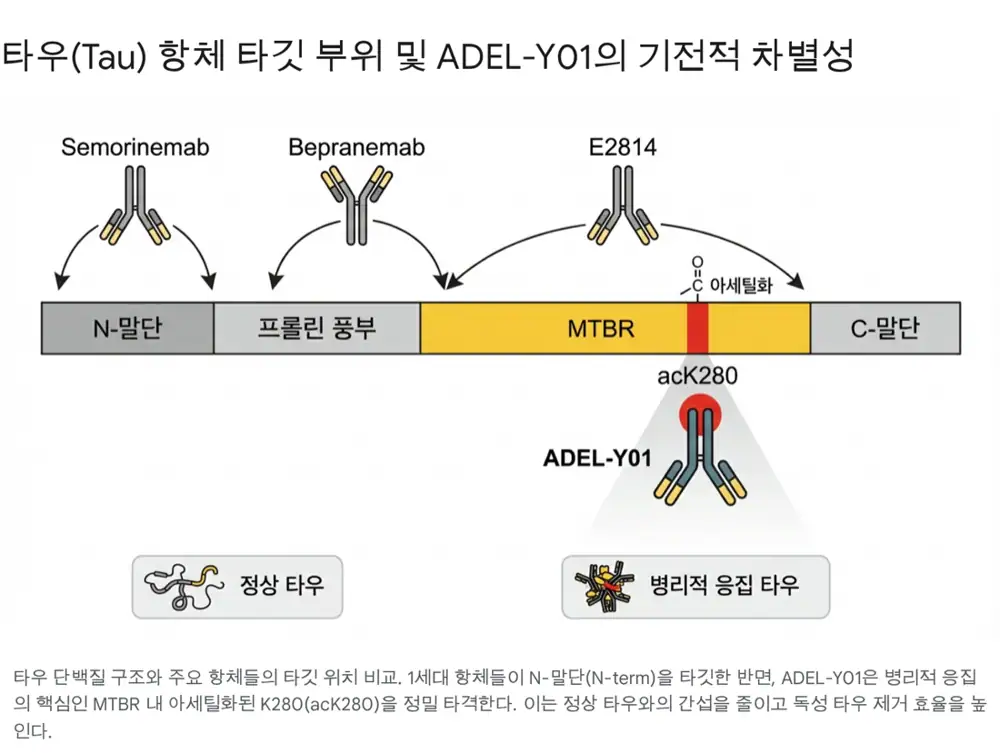
Interpretation: If amyloid is the trigger, tau is closer to the bullet that maps to neuronal death and cognitive decline. That is why antibodies targeting pathological tau modifications are emerging as next-generation DMT candidates.
2. ADEL-Y01 Mechanism: Pathological Tau, Not Normal Tau
ADEL-Y01 is framed as targeting acetylated tau at lysine 280 within the microtubule-binding region. The key claim is preserving normal tau function while attacking the modified tau associated with neurotoxicity and aggregation.
tau-acK280
The approach tries to solve the historical failure mode of antibodies that could not distinguish normal from pathological tau.
CSF Delivery
Dose-dependent antibody delivery into CSF in Phase 1a is an important signal for CNS development.
Sanofi
The $80 million upfront is interpreted in the source as strong conviction in an early-stage asset.
3. Clinical Path: From 1a to 1b
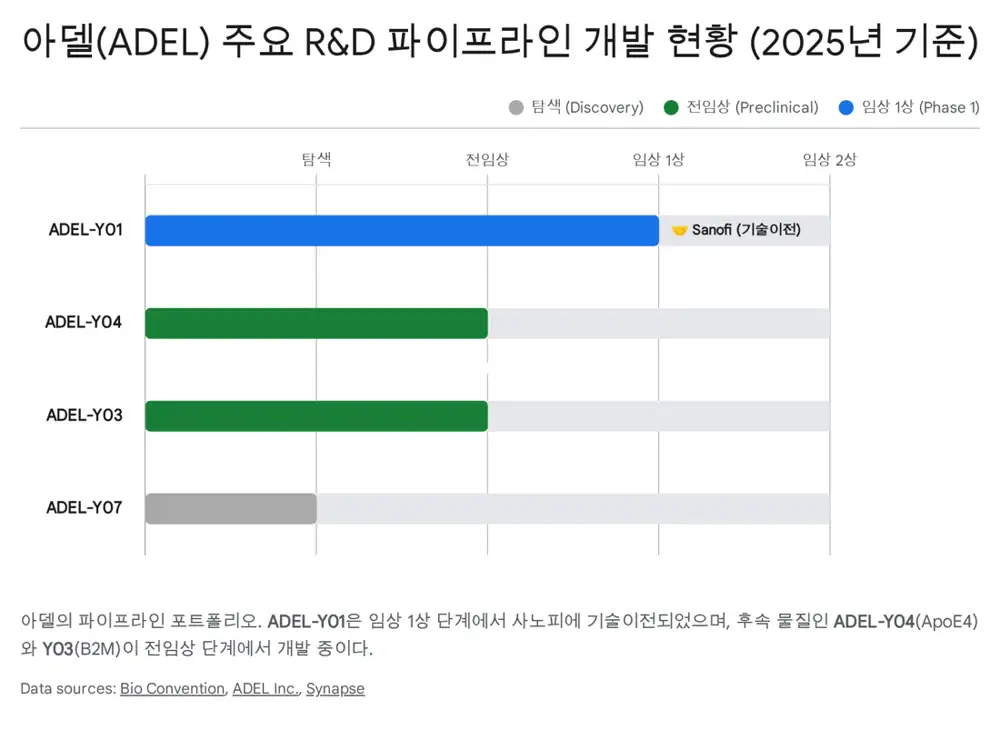
The source says Phase 1a in healthy adults supported safety and tolerability. A Phase 1b study is underway in 40 patients with MCI and early Alzheimer's disease, focused on biomarker changes and proof of concept.
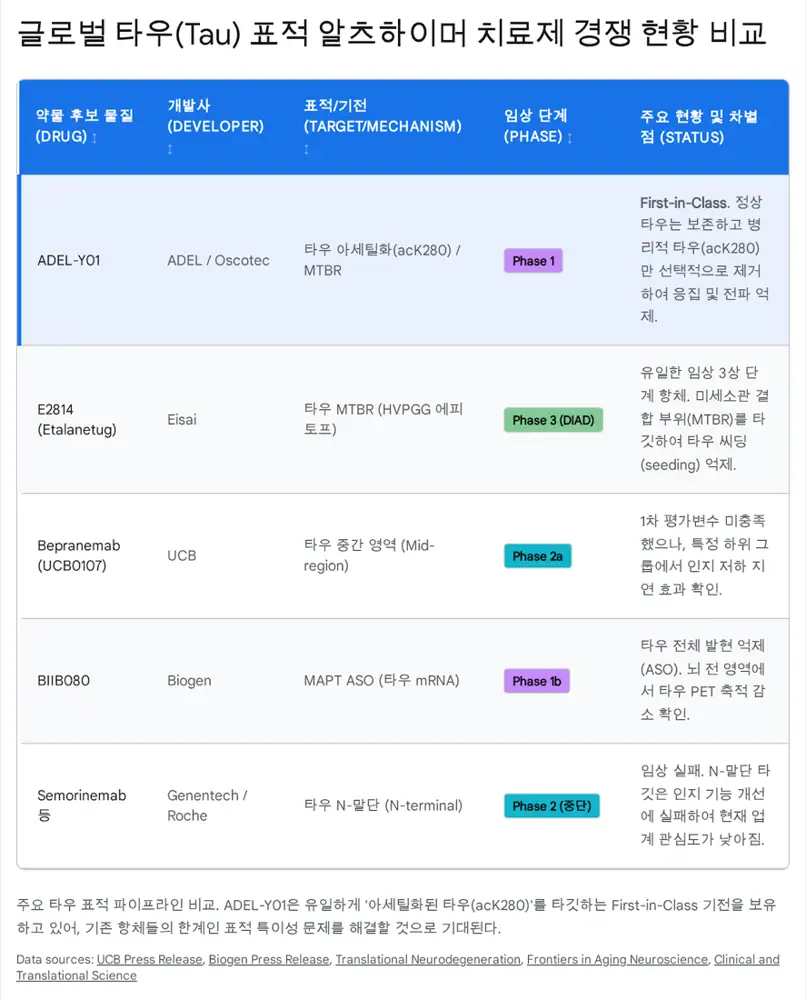
| Drug | Target/mechanism | Stage | Difference versus ADEL-Y01 |
|---|---|---|---|
| ADEL-Y01 | MTBR, acK280 | Phase 1 | Specific binding to acetylated pathological tau |
| Bepranemab | Mid-region aa 235-250 | Phase 2a | Lower PTM specificity; primary endpoint miss mentioned |
| E2814 | MTBR HVPGG motif | Phase 2 | Sequence motif rather than acetylation; genetic AD focus |
| BIIB080 | Tau mRNA ASO | Phase 2 | ASO rather than antibody; intrathecal dosing required |
| Semorinemab | N-terminal | Discontinued | Extracellular N-terminal tau focus; Phase 2 failure case |
4. Deal Structure and Valuation Read
The Sanofi deal is important not only for total headline value, but for the upfront payment. The source notes early-stage license upfronts are often around 5-10% of total value, making the $80 million upfront a meaningful validation signal.
Official fact: The deal is presented as up to $1.04 billion with an $80 million upfront payment.
Interpretation: ADEL gains financial runway and access to Sanofi's global clinical and commercialization network. Patient efficacy risk remains until later data arrive.
5. Final View
ADEL's story is a sharp reversal from a failed technology-special listing review to global out-licensing. The real test is whether tau-acK280 selectivity translates into patient efficacy after Phase 1b.
Sources
- 원문: https://m.blog.naver.com/PostView.naver?blogId=star_of_self&logNo=224112062386
- ChosunBiz English - Sanofi deal: https://biz.chosun.com/en/en-science/2025/12/16/SADD7RWHFJEZDDF6VSKE22OL4A/
- ChosunBiz Korean - Sanofi deal: https://biz.chosun.com/science-chosun/bio/2025/12/16/OAR5MCHN2JGVVM2KIMND45IVU4/
- PR Newswire - ADEL license agreement: https://www.prnewswire.com/news-releases/adel-signs-1-04-billion-global-license-agreement-with-sanofi-for-adel-y01--a-novel-investigational-alzheimers-disease-therapy-302642662.html
- ChosunBiz - KOSDAQ tech evaluation: https://biz.chosun.com/en/en-finance/2025/10/01/3ZPD7KRQLBF4ZK3H2LJ3MAY3BU/
- PMC - tau acetylation reference: https://pmc.ncbi.nlm.nih.gov/articles/PMC10104896/
- Contract Pharma - Sanofi profile: https://www.contractpharma.com/top-company-profile/sanofi/
- Korea Biomedical Review - CTAD data: https://www.koreabiomed.com/news/articleView.html?idxno=29873
- Clinical Trials Arena - AD market: https://www.clinicaltrialsarena.com/analyst-comment/alzheimers-disease-market-17bn-8mm-2033/
- Frontiers - tau and AD: https://www.frontiersin.org/journals/neuroscience/articles/10.3389/fnins.2018.00025/full
- MDPI Cells - tau review: https://www.mdpi.com/2073-4409/14/19/1506
- Fierce Biotech - posdinemab: https://www.fiercebiotech.com/biotech/jjs-5b-alzheimers-hope-fades-anti-tau-antibody-posdinemab-flops-phase-2
- Fierce Pharma - Alzheimer tipping point: https://www.fiercepharma.com/pharma/are-we-nearing-tipping-point-alzheimers-disease
- J-STAGE - AD review: https://www.jstage.jst.go.jp/article/cpb/72/7/72_c24-00069/_html/-char/en
- PMC - semorinemab/tau reference: https://pmc.ncbi.nlm.nih.gov/articles/PMC9241406/
- PMC - tau antibody reference: https://pmc.ncbi.nlm.nih.gov/articles/PMC10965012/
- ADEL company: https://adelpharm.com/company/
- BIO convention - ADEL: https://convention.bio.org/exhibitors/adel-inc
- PMC - ADEL-related science: https://pmc.ncbi.nlm.nih.gov/articles/PMC11713122/
- Practical Neurology - IND clearance: https://practicalneurology.com/news/novel-monoclonal-antibody-which-targets-tau-protein-accumulation-receives-ind-clearance-from-fda/2470293/
- KN Daily - ADEL: https://www.kndaily.co.kr/news/articleView.html?idxno=307740
- UCB - bepranemab CTAD: https://www.ucb.com/newsroom/press-releases/article/ucb-presents-encouraging-data-on-bepranemab-in-early-alzheimer-s-disease-in-phase-2a-study-at-ctad-2024
- Fierce Biotech - UCB tau drug: https://www.fiercebiotech.com/biotech/ucbs-tau-drug-flunks-phase-2-alzheimers-trial-days-after-roches-exit-120m-bet
- PMC - E2814 reference: https://pmc.ncbi.nlm.nih.gov/articles/PMC12135284/
- Eisai - E2814: https://www.eisai.com/news/2025/news202564.html
- Biogen - BIIB080 data: https://investors.biogen.com/news-releases/news-release-details/new-data-presented-adpdtm-2023-show-biogens-biib080-mapt-aso
- Biogen PDF: https://investors.biogen.com/static-files/75a32d30-01ce-4816-87a6-20735ff25b3c
- Fierce Biotech - Sanofi biobucks: https://www.fiercebiotech.com/biotech/sanofi-signs-1b-biobucks-pact-alzheimers-asset-2nd-biotech-deal-day
- Morningstar - ADEL/Sanofi release: https://www.morningstar.com/news/pr-newswire/20251215cn48033/adel-signs-104-billion-global-license-agreement-with-sanofi-for-adel-y01-a-novel-investigational-alzheimers-disease-therapy
- Google Drive reference 1: https://drive.google.com/open?id=1_zkmN37k2G3OQbTwzkiki9Ze73_4jRkF
- The Bio News: https://www.thebionews.net/news/articleView.html?idxno=431
- Google Drive reference 2: https://drive.google.com/open?id=1TuPavvQemivb80Zw3ua1M2PUHpGcGoKbVEPZtsu1Lo4
- Patsnap ADEL: https://synapse.patsnap.com/organization/cadf0aec90fc66954b03897c54e18ab3
- Patsnap proxy reference: https://synapse-patsnap-com.libproxy1.nus.edu.sg/organization/2cd623765c25e4147e2e03060eaabe3a
- ResearchGate ApoE4/Tau: https://www.researchgate.net/publication/387855976_ApoE4_antibody_ameliorates_cognitive_impairments_and_synapse_loss_in_ApoE4Tau-P301S_mice
- Grand View Research - AD diagnostics: https://www.grandviewresearch.com/industry-analysis/alzheimers-disease-diagnostics-market-report