DEEP RESEARCH · CS BEARING
CS Bearing: Vietnam Production Strategy and the Reshaping of the Global Wind Supply Chain
A review of wind pitch and yaw bearings, Vietnam-centered production, and customer diversification.
0. Bottom line first
My core takeaway is that the near-term numbers matter less than the post-restructuring cost base. CS Bearing has consolidated production into Vietnam after disposing of the Haman plant, rebuilding its cost, trade-barrier, and customer-diversification strategy at the same time.
Official fact: Cumulative revenue for 3Q 2025 was KRW 92.4 billion and operating loss was KRW 0.9 billion. The Haman plant sale was completed in April 2024, and production has been reorganized around Vietnam.
Interpretation: The turnaround is not fully visible in earnings yet, but narrowing losses and lower debt create the base for operating leverage when wind orders recover.
1. Company and governance
CS Bearing was founded in November 2007 as Samhyun Engineering and shifted its focus to slewing bearings for wind turbines. It joined the CS Wind group in 2018, changed to the current name, and listed on KOSDAQ in November 2019.
| Item | Content |
|---|---|
| Largest shareholder | CS Wind, 14,606,797 shares, 53.56% |
| Founding | November 2007, Samhyun Engineering |
| Vietnam entity | CS Bearing Vietnam established in July 2019 |
| Haman plant | Production stoppage decided in 2022, sale completed in April 2024 |
Interpretation: Sharing CS Wind's global turbine-customer network lowers entry barriers for new customers. The tradeoff is high sensitivity to group strategy and the wind-investment cycle.
2. Products and technology
Blade angle control
Connects blades to the hub and adjusts blade angle according to wind conditions.
Nacelle direction control
Connects the tower and nacelle so the turbine faces the wind; large-diameter precision gearing and vertical load capacity matter.
Large offshore wind
The company has completed development and qualification of 8MW, 14MW, and 15MW offshore yaw bearings.
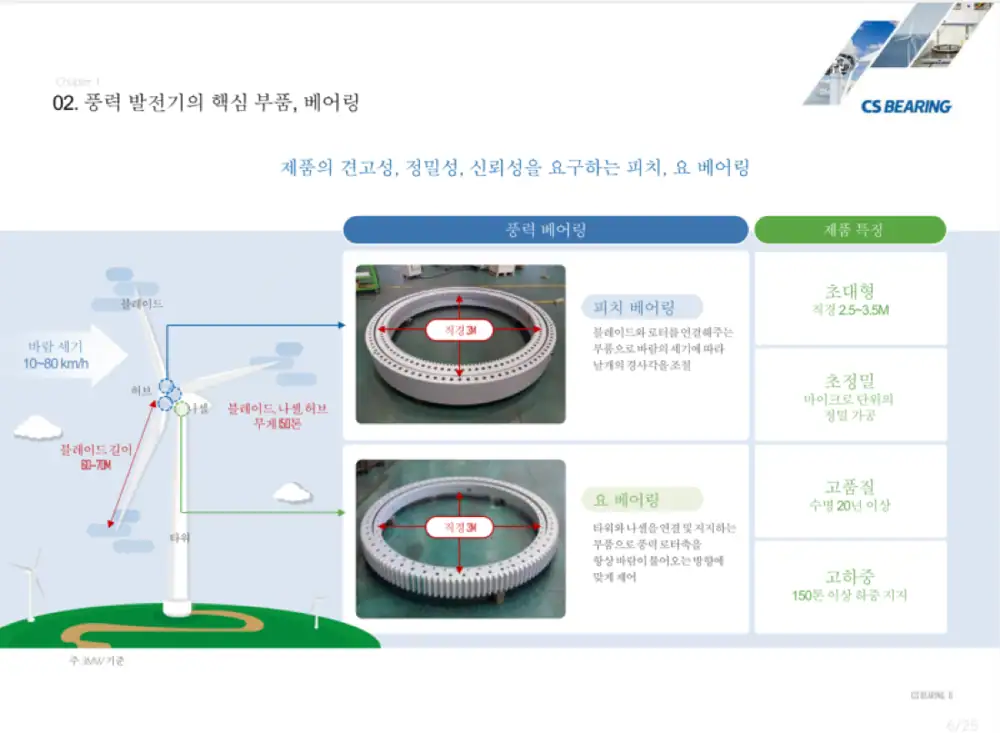
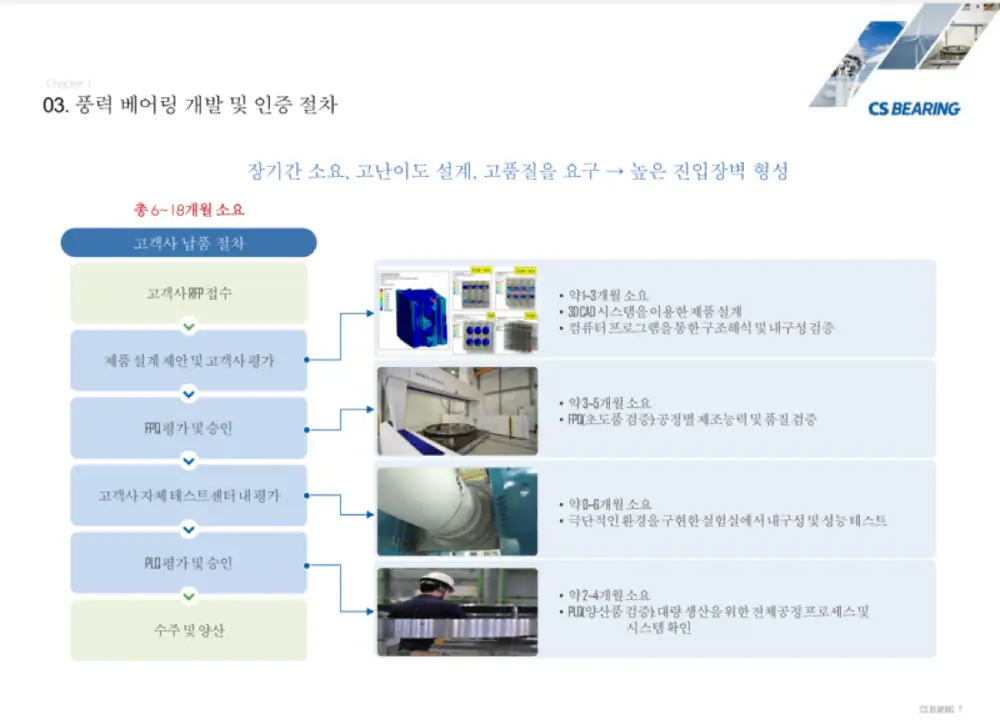
Triple roller bearings address the point-contact limitations of ball bearings with line contact that disperses load in large turbines. The post notes 5MW-class development and delivery in 2022, and a 15MW yaw ring with an outer diameter of about 5,700mm and thickness of 740mm.
3. Market, customers, and financials
Official fact: Global wind demand is supported by carbon-neutrality and energy-security needs. Offshore wind has larger turbines and higher ASP potential. Korea's offshore wind target is cited at 14.3GW by 2030.
GE was historically the dominant customer. Siemens Gamesa supplier approval was obtained in the second half of 2019 with deliveries from 2020. Higher Vestas exposure would signal entry into a more global-standard customer base.
| Financial point | Figure or content |
|---|---|
| 3Q 2025 cumulative revenue | KRW 92.4 billion |
| 3Q 2025 cumulative operating loss | KRW 0.9 billion |
| Total liabilities | Down from KRW 64.1 billion at end-2023 to KRW 40.2 billion in 3Q 2025 |
| Potential normalized revenue scenario | The source mentions 5-7% operating margin potential if annual revenue recovers to KRW 150 billion |
4. Risk checklist
- US policy and possible IRA changes can affect wind-project orders.
- Steel price volatility directly affects bearing costs, and pass-through can lag.
- Production concentration in Vietnam creates geopolitical and trade-policy exposure.
- Customer quality issues at GE or Siemens Gamesa can spill over into component orders.
5. What I would monitor
- Vietnam plant utilization and yield
- Revenue mix from Vestas and Siemens Gamesa
- Mass-production orders for 14-15MW offshore bearings
- Further narrowing of operating losses and stable leverage