DEEP RESEARCH · HD Hyundai Energy Solutions
HD Hyundai Energy Solutions — A Solar Player Pivoting to the U.S. on a Broken Grid
3Q25 quality growth, plus the map ahead drawn by Korea's grid crisis — LMP, HVDC, and ESS
0. Bottom line first
Even as Korea's domestic solar market stalls on grid saturation and stable SMP, HD Hyundai Energy Solutions more than doubled its U.S. revenue share from 16% to 35% and posted a 3Q25 OPM of 12.1% (+8.7 pp YoY). With effectively zero net debt (debt ratio 25.5%, net-debt ratio -34.3%, cash KRW 154 bn), it has the balance sheet to meet the coming ESS/solutions cycle. As Korea's market is upgraded around LMP, west-coast HVDC, and ESS, the key question for valuation is whether the firm can complete its shift from pure module maker to "energy solutions provider."
Geographic hedging works
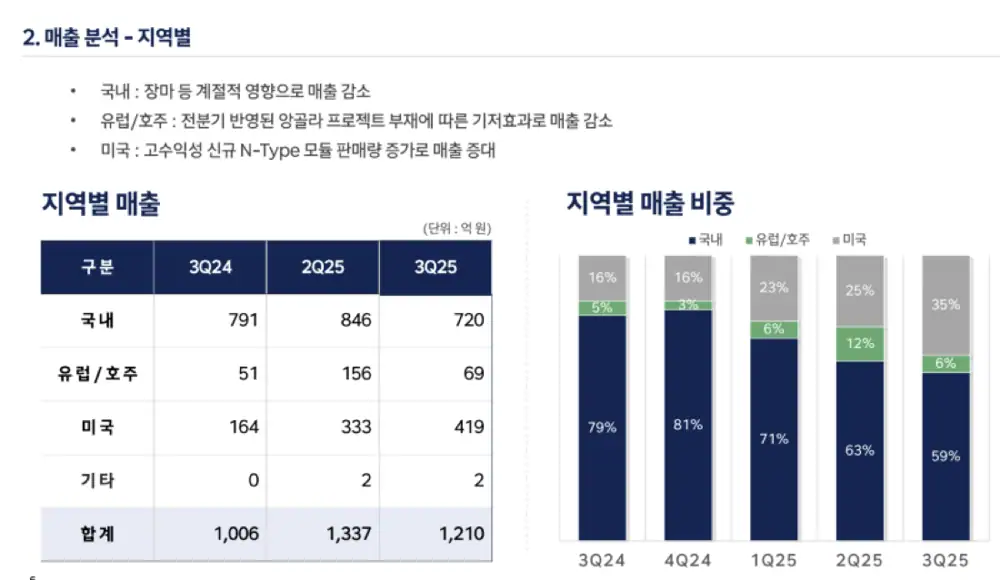
U.S. revenue 3Q25 KRW 41.9 bn (vs KRW 16.4 bn YoY). U.S. weight 16%→35%. Domestic weakness offset by U.S. boom.
Shift to N-Type TOPCon
From P-Type PERC to higher-efficiency, lower-degradation N-Type TOPCon. Holds premium ASP/margin in the U.S. residential market.
Selective high-margin orders
Solutions revenue KRW 28.6 bn (YoY -10.6%) — a deliberate qualitative shift into ESS-linked, high-difficulty projects.
Effectively debt-free
Debt ratio 25.5% · Net-debt ratio -34.3% · Cash KRW 154 bn vs borrowings KRW 17.4 bn. A shield against high rates and downstream uncertainty.
1. Introduction — Korea's energy paradigm at an inflection point
In 2025 Korea's energy industry faces an unprecedented structural transition and a physical bottleneck at the same time. The "Renewable 3020" and "2050 Net Zero" roadmaps drove rapid quantitative expansion of solar and wind, but the source mix has outpaced the evolution of the grid and the market design, creating severe imbalance.
Official fact: Greater Seoul's power self-sufficiency stays around 65%, while non-metropolitan areas exceed 120%; curtailment of solar in Honam and Jeju is now frequent.
Interpretation: Saying "the grid is broken" is not rhetoric — it pinpoints the physical and economic inefficiency of throwing away usable electricity because there are no transmission lines. This report reads HD Hyundai Energy Solutions on top of that macro backdrop, together with the three-pronged remedy of LMP, HVDC, and ESS.
2. Deep dive — quality growth inside a crisis
2.1 3Q25 — margins over scale
3Q25 consolidated revenue was KRW 121.0 bn (QoQ -9.5%, YoY +20.3%), operating profit KRW 14.7 bn, with OPM 12.1%. That is +8.7 pp better than the 3.4% OPM of the same quarter last year — exceptional for a commodity-like module business.
Revenue mix: away from home, into the U.S.
- Korea revenue KRW 72.0 bn (vs KRW 84.6 bn QoQ, -15%). Not just a seasonal monsoon effect — it is structural, driven by grid saturation in Honam/Jeju (interconnection denials/delays) and cooled IPP sentiment from stable SMP.
- U.S. revenue KRW 41.9 bn — more than 2.5x the KRW 16.4 bn of the same quarter last year. Strong pull-forward demand ahead of the U.S. residential ITC cut.
- U.S. share of total revenue: 16% in 3Q24 → 35% in 3Q25, more than doubling.
Margin revolution: N-Type and stable inputs
- Accelerated shift to N-Type TOPCon (Tunnel Oxide Passivated Contact). Higher efficiency and lower degradation than P-Type PERC let it defend ASP in the premium U.S. residential market. The company itself cites "strong sales of new N-Type modules" as the primary driver of the operating-profit jump.
- Shipping rates and polysilicon volatility — the headaches of 2022–2023 — have normalized in 2025, easing variable cost pressure.
2.2 By segment — beyond modules, into "solutions"
Revenue KRW 91.7 bn
YoY +35.1%. Pure read-through of U.S. expansion and N-Type mix shift.
Revenue KRW 28.6 bn
YoY -10.6%. The company calls it "selective high-margin order intake" — a deliberate qualitative pivot, not topline trouble.
Interpretation: Moving out of low-margin pure-EPC into ESS-linked grid-stabilization solutions. The more unstable the grid, the higher the marginal value of complex solutions over simple plant construction — and the firm is positioning ahead of that curve.
2.3 Balance sheet — cash fortress for an uncertain cycle
- Debt ratio 25.5%, net-debt ratio -34.3% — effectively zero debt.
- Cash and equivalents KRW 154 bn vs total borrowings KRW 17.4 bn.
- 3Q non-operating P/L was +KRW 0.9 bn — while peers fight interest expense, this firm earns interest income that cushions net profit.
Interpretation: Next-generation R&D (e.g., perovskite tandem cells) and U.S. CAPEX can be funded internally without external capital — possibly the most under-appreciated strength this cycle.
Table 1. HD Hyundai Energy Solutions — 3Q25 results summary (KRW bn)
| Item | 3Q24 | 2Q25 | 3Q25 | QoQ | YoY |
|---|---|---|---|---|---|
| Revenue | 100.6 | 133.7 | 121.0 | -9.5% | +20.3% |
| Operating profit | 3.4 | 15.1 | 14.7 | -2.6% | +332.4% |
| OPM | 3.4% | 11.3% | 12.1% | +0.8 pp | +8.7 pp |
| Net income | 0.7 | 11.4 | 12.0 | +5.3% | +1,614.3% |
*Source: reconstructed from HD Hyundai Energy Solutions 3Q25 earnings disclosure*
3. The structural breakdown of Korea's grid — causes and symptoms
3.1 Physical breakdown — vanishing inertia and the duck curve
Grid stability rests on a steady 60 Hz frequency and stable voltage. Nuclear and coal plants spin massive turbines whose physical inertia cushions sudden frequency drops during a fault. Solar and wind, by contrast, are inverter-based resources (IBR) with essentially zero inertia. In regions where solar already exceeds 20–30% of supply (Honam, Jeju), even small daytime faults raise the risk of a large blackout.
Meanwhile, between noon and 2 pm, net demand (total demand minus renewables) collapses, producing the duck curve. Baseload plants (nuclear, coal) have to ramp down or cycle off — eroding efficiency and accumulating mechanical fatigue.
3.2 Geographic mismatch — power that cannot travel north
- Supply: nuclear on the east coast (Uljin, Gyeongju), coal on the west coast (Dangjin, Taean), solar/wind in Honam and Jeju.
- Demand: 40%+ of consumption is in Greater Seoul. Self-sufficiency: 65% in the metropolitan area vs 120%+ outside.
- The "East Coast–Singapyeong HVDC" line is now more than 66 months behind schedule due to public-acceptance issues; west-coast 345 kV lines are also delayed. As a result, perfectly good Honam solar plants are routinely curtailed.
3.3 Market design failure — the single-price SMP
Today's SMP is one nationwide price. Curtailed Honam solar and short-supplied Seoul-area generators get the same settlement. The signal told developers: "don't bother with expensive land near Seoul — go south where the sun and land are cheap." That accumulated bias has concentrated supply in the south and overloaded transmission.
4. Three strategic remedies for the grid
4.1 Market design — Locational Marginal Pricing (LMP)
The government plans to introduce LMP in the wholesale market targeting 2026: divide the country into nodes/zones and let prices reflect local supply, demand, and transmission constraints.
- Non-metro (oversupply): Honam and Gangwon LMPs fall — discouraging unrestrained new solar entry and pulling data centers and semiconductor fabs to the regions (distributed energy activation).
- Metro (undersupply): Higher LMPs push distributed generation (fuel cells, BIPV) and demand response.
- KEPCO finances: By buying cheaper non-metro power, KEPCO is expected to save more than KRW 1.5 trillion per year in power-purchase costs.
4.2 Infrastructure — "energy highway" and HVDC
- HVDC has lower losses than AC and carries far more power over long distances. Lower EMI also makes it easier to bury or run subsea, easing public-acceptance issues.
- West-coast energy highway: route Honam solar and offshore-wind power to Greater Seoul via subsea HVDC under the Yellow Sea — bypassing land-acquisition fights and accelerating construction.
- Direct beneficiaries: HD Hyundai Electric, Hyosung Heavy Industries, LS ELECTRIC. HD Hyundai Energy Solutions also gains indirectly — once grid constraints ease, module sales recover.
4.3 Technical buffer — ESS and inertia mandates
- Grid-forming inverter ESS provides virtual inertia, taming the frequency instability that comes with rising IBR share.
- Time shifting: store the solar that would otherwise be curtailed at midday, discharge it in the evening peak — flattening the duck curve.
- Public auctions are being redesigned to reward ESS-linked plants rather than standalone solar — a fresh runway for the firm's Solutions division.
Table 2. Self-sufficiency by region and expected effect of LMP
| Region | Main sources | Self-sufficiency | Expected wholesale price under LMP | Industry implications |
|---|---|---|---|---|
| Greater Seoul | LNG (partial) | Under 65% (deficit) | Higher (premium) | Incentive for distributed gen (fuel cells, etc.), active demand response (DR) |
| Non-metro (Honam/Gangwon) | Solar, nuclear, coal | Over 120% (surplus) | Lower (discount) | Discourages new entry; attracts data centers and other power-heavy industry |
| Jeju | Wind, solar | Extreme surplus (frequent curtailment) | High volatility | Urgent need for ESS and P2G (hydrogen); plus-DR activation |
According to Gyeonggi Research Institute, metro LMP would sit around KRW 134/kWh, while non-metro could fall into the high KRW 80s/kWh. That accelerates the "cannibalization" effect on solar.
*Source: Eugene Investment Research and EPSIS data, reconstructed*
5. Outlook — diverging fates of solar and wind
5.1 Solar — quantitative saturation, qualitative upgrade (Survival of the Fittest)
- Quantity: Past-style explosive installation growth is unlikely. As LMP pulls Honam prices down, small solar's economics weakens and new entry falls.
- Quality: With limited siting, more energy must come from each panel — driving demand for N-Type and eventually tandem cells. Rooftop BIPV and self-consumption markets in the metro area, where grid constraints are smaller, become the new blue ocean.
5.2 Wind, especially offshore — structural growth (The Next Big Thing)
- Wind runs day and night with a capacity factor of 30%+ vs solar's ~15% — more predictable and closer to baseload from a system-operator's view.
- Large complexes like Shinan 8.2 GW offshore wind are planned with dedicated HVDC lines from day one — bypassing legacy distribution-network limits.
- CS Wind, the global #1 tower maker, is already growing explosively on U.S./EU backlog. If Korea's Offshore Wind Special Act materializes, the industry could pair with shipbuilding/heavy-industry infrastructure to become an export-led sector — almost a second shipbuilding wave.
LMP + HVDC + ESS in sync
2026 LMP and west-coast HVDC progress together → high-efficiency N-Type and ESS solutions demand both rise; U.S. revenue keeps its strong trend even after ITC changes.
U.S. share grows + solutions improve qualitatively
Korea modules flat, but U.S. share stays above 35%; ESS-linked solutions supplement module margins. Debt-free balance sheet self-funds R&D and CAPEX.
Post-ITC demand vacuum in the U.S.
End of ITC pull-forward + renewed Chinese low-price push + prolonged Korean grid constraints. If the solutions pivot lags, the firm converges back into a plain module maker.
6. Conclusion and personal takeaway
Korea's power industry has moved from "deploy at any cost" to "harmony with the grid." HD Hyundai Energy Solutions sensed the shift early and started restructuring its body.
- Strategy: Overcome domestic limits via U.S. expansion + N-Type high-efficiency mix. Use balance-sheet strength to prepare for the ESS/solutions expansion. Timely and effective.
- Fixing the grid: Requires LMP (normalized price signals), west-coast HVDC backbone, and large-scale ESS rollout — all at once. It is not a repair, but the birth pangs of a distributed energy system.
- Investment/industry outlook: Short term, grid gear (transformers, cables) and ESS-related firms are the most direct beneficiaries. Mid- to long-term, offshore wind becomes the renewables flagship, while solar consolidates around top players with high-efficiency tech and ESS-fused solutions.
HD Hyundai Energy Solutions is defending the current downturn well via technology and overseas diversification. As the Korean market is upgraded around LMP and ESS, the capability to act as a true "energy solutions provider" — beyond a pure manufacturer — will be the core of valuation. I would tell myself to focus less on short-term Korean ups and downs, and more on U.S. results and the expansion of the ESS/Solutions business.
Sources
- Original Naver blog post: https://m.blog.naver.com/PostView.naver?blogId=star_of_self&logNo=224100134310
- Lecture 11 — Utilities (Basics), Moon Kyung-won, 2021-01-15: https://drive.google.com/open?id=1pWnHCy_VLHXG5qKhWzpWLsFTpDmw4UdV
- Combined Utilities 2026 Outlook — Butterfly effect of locational tariffs (KEPCO, KOGAS, KEPCO KPS, KEPCO E&C): https://drive.google.com/open?id=13YslijtXUpsupuWXR50jSBh53iI-lT8x
- Nuclear & Power Equipment — Expanding U.S. power market (Doosan Enerbility, KEPCO, Hyosung Heavy, LS ELECTRIC, SANIL Electric): https://drive.google.com/open?id=1TQTpQjBZjH-nxJ6L-vQs-sEkyNUnU1qa
- Lecture 8 — Refining/Chemicals Outlook, Roh Woo-ho: https://drive.google.com/open?id=1xMlI40gVXUwj5YC8UoKUOop1fGBOXzrb
- LG Energy Solution business analysis report: https://drive.google.com/open?id=1g84i2Yrby123W0Lk-IBsB6Vpm-q6SH-UoMrCxWvIToM
- CS Wind IR Book KOR 2025.11: https://drive.google.com/open?id=1ehQ7XMjpKIDc9JhFjAHpJJ4G1qBwWA4Q
- HD Hyundai Energy Solutions 3Q25 earnings disclosure
- Eugene Investment Research and EPSIS data