DEEP RESEARCH · ALPHABET CAPITAL ALLOCATION
Capital Allocation in the AI Era: Alphabet Versus Big Tech
How Alphabet is balancing shareholder returns with aggressive AI investment in the Hyper-CapEx era.
0. Bottom line first
Alphabet now looks like both a growth company and a mature technology giant. It began dividends and large buybacks in 2024, but it is also not slowing AI infrastructure investment, with about $75 billion of 2025 CapEx expected.
The source links to a Gemini shared summary. This report uses that structure to compare the capital-allocation philosophies of Alphabet, Apple, Microsoft, Amazon, and Meta.

1. Alphabet’s strategic shift: from reinvestment to rewards
Official fact: Alphabet started paying its first-ever dividend in 2024. It began with a quarterly dividend of $0.20 per share, then raised it 5% to $0.21. Total dividends for fiscal 2024 were cited at $7.4 billion.
Official fact: Buybacks continued alongside dividends. Alphabet repurchased $62 billion of stock in fiscal 2024, and in April 2025 the board approved an additional $70 billion buyback program.
Interpretation: The dividend is not only a cash distribution; it is a market signal. Alphabet followed a growth-investment model for more than 20 years, but now that annual net income is above $100 billion, management needs to show it can fund the AI race while directly rewarding shareholders.
2. Future investment: CapEx, R&D, and Other Bets
Official fact: Alphabet CapEx rose 63%, from $32.3 billion in 2023 to $52.5 billion in 2024. About $75 billion of CapEx is expected for 2025, mostly directed at AI infrastructure such as servers, data centers, and networking equipment.
Official fact: 2024 R&D spending was $49.3 billion, equal to 14% of total revenue. That funding goes to core AI models such as Gemini 2.5, cloud innovation, and next-generation products.
Official fact: Other Bets generated $450 million of revenue and a $1.2 billion operating loss in Q1 2025. Waymo was valued above $45 billion in an October 2024 funding round, and Verily has raised billions of dollars of private investment.
Interpretation: Alphabet’s CapEx and R&D are not only for Google Search. Foundational AI models and infrastructure such as Gemini and TPUs are platform technologies that also support Waymo and Verily. In return, real-world problems from those businesses can provide data and feedback that improve Google’s AI models.
3. Financial capacity across the five big tech companies
| Metric | Alphabet | Apple | Microsoft | Amazon | Meta |
|---|---|---|---|---|---|
| Market cap | $2.04T | Over $3T | $3.57T | Over $2T | $1.6T |
| FY 2024 revenue | $350.02B | $391.04B | $245.12B | $637.96B | $164.50B |
| FY 2024 net income | $100.12B | $93.74B | $88.14B | $59.25B | $62.36B |
| Cash and marketable securities | $95.33B | $132.92B | $79.62B | $94.57B | $70.23B |
| Employees | 183,323 | Not specified | Over 221,000 | Over 1,525,000 | 74,067 |
| Revenue per employee | $1.91M | $2.38M | $1.08M | $0.42M | $2.19M |
Employee counts are based on fiscal year-end or the nearest disclosed figures. Amazon and Microsoft use approximations. Revenue per employee is calculated by dividing FY 2024 revenue by employee count.
4. Different shareholder-return philosophies
Capital-return champion
In 2024, Apple returned $110.2 billion to shareholders through $94.9 billion of buybacks and $15.2 billion of dividends. It also approved another $100 billion buyback.
Balanced compounder
Microsoft paid $21.8 billion of dividends and repurchased $12.0 billion of stock in 2024, balancing investment with shareholder rewards.
New converts
Alphabet began paying dividends in 2024. After its year of efficiency, Meta paid $5.1 billion of dividends and repurchased $29.8 billion of stock.
Perpetual reinvestor
Amazon has never paid a cash dividend, and despite having an authorized buyback program, it bought no shares in 2023 or 2024.
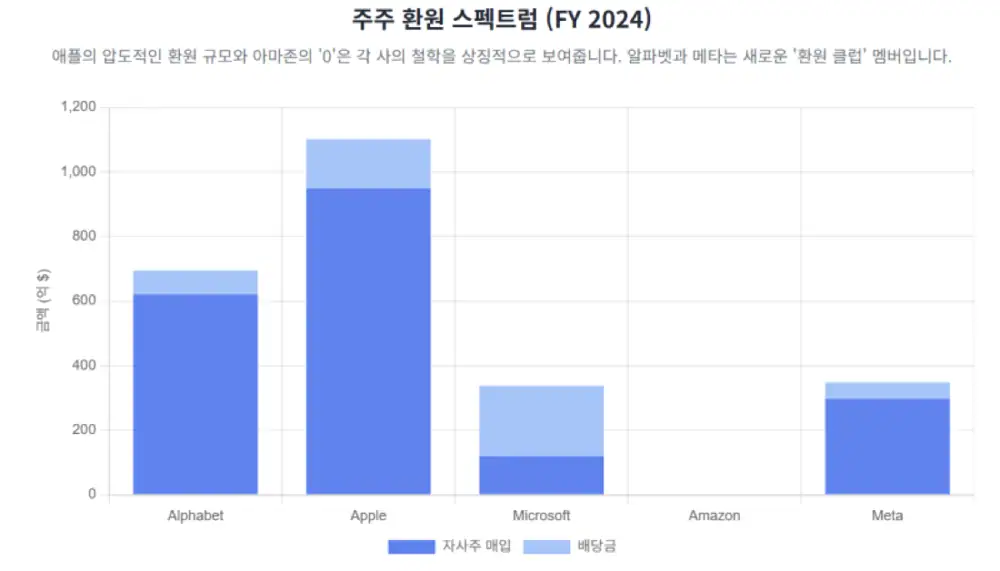
Interpretation: Apple is the mature cash machine, Microsoft is balanced, Amazon is the reinvestor, and Meta plus Alphabet are the recent shareholder-return converts. Alphabet’s shift is a financial strategy to maintain investor trust during AI competition and regulatory pressure.
5. The AI arms race in the Hyper-CapEx era
Official fact: The source says Alphabet, Microsoft, Meta, and Amazon together spent more than $251 billion of CapEx in 2024, up 62% from 2023.
| Company | 2024 CapEx | Growth/details | Interpretation |
|---|---|---|---|
| Microsoft | $44.5B | +83% YoY | Mostly cloud and AI infrastructure |
| Alphabet | $52.5B | +63% YoY | Gemini and cloud competitiveness |
| Meta | $39.2B | +40% YoY | 2025 CapEx planned at $64-72B |
| Amazon | $83B | AWS CapEx $53.3B, +114% | Cloud infrastructure reacceleration |
| Apple | $9.4B | Relatively modest | Focused on product ecosystem rather than public infrastructure |
Official fact: In absolute R&D dollars, Amazon is cited as the leader with $88.5 billion in 2024. By R&D intensity as a share of revenue, Meta is presented as the most aggressive.
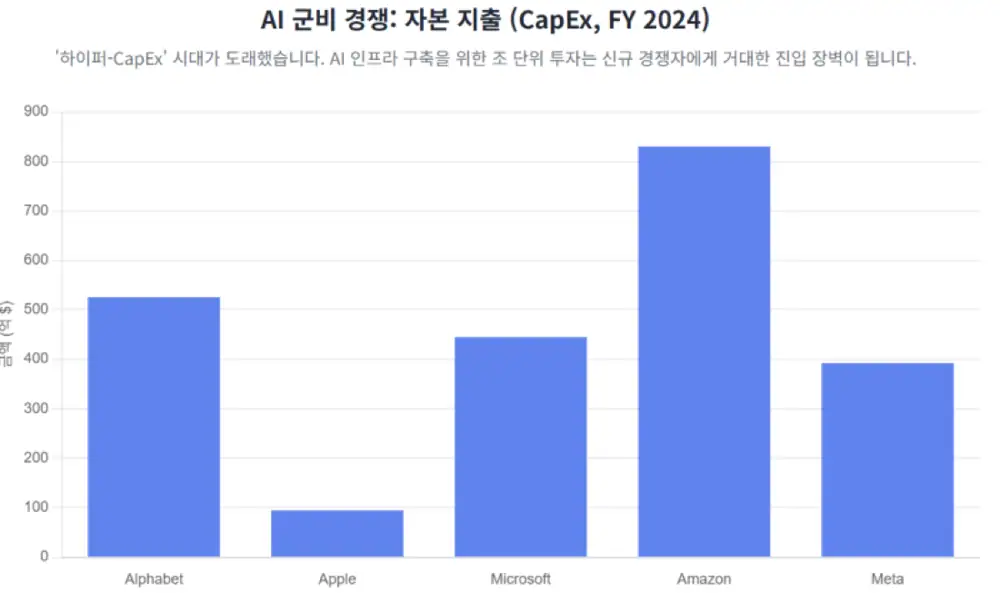
Interpretation: AI infrastructure spending creates an almost impossible entry barrier for new competitors. Alphabet’s roughly $75 billion 2025 CapEx guide shows that this market has become a capital-expenditure contest, not just a product contest.
6. Strategic intent by company
- Apple returns cash from its highly profitable hardware and services franchise while defending the existing ecosystem.
- Microsoft integrates AI across Office, Azure, Windows, and gaming while balancing monetization and shareholder returns.
- Meta uses the cash generation of its core ad business to fund high-risk long-term projects in AGI and the metaverse.
- Amazon rejects dividends and keeps reinvesting to build long-term dominance in AWS and logistics.
- Alphabet defends its search monopoly, invests aggressively in AI, nurtures Other Bets, and now adopts mature-company capital returns.
7. Alphabet’s challenges
Official fact: The source identifies U.S. Department of Justice antitrust litigation and the EU Digital Markets Act as Alphabet’s largest uncertainties. Outcomes could force business-unit separation or fundamental changes to the business model.
Official fact: Search faces a mix of pressure from complaints about result quality, younger users shifting to tools such as TikTok, Reddit, and ChatGPT, algorithm updates targeting spam and low-quality AI content, and the rollout of AI Overviews.
Official fact: AI Overviews can improve user satisfaction but may reduce clicks, which are the base of traditional search advertising. Google claims AI Overviews monetize at the same rate as traditional search and increase total search volume, while integrating ads into AI Overviews and AI Mode.

Interpretation: Alphabet’s dividends and buybacks are not detached from external threats. DOJ litigation and the AI search transition can pressure valuation multiples. Capital returns give investors immediate, visible returns and can act as a confidence support for the stock.
8. Final assessment
Alphabet is using the cash flow of the old search world to fund the transition into the new AI world. Its strategy is a hybrid: the aggression of growth companies such as Meta and Amazon combined with the discipline of mature value-oriented companies such as Apple and Microsoft.
- AI monetization: Can AI Overviews and AI Mode offset lower traditional search ad clicks and create new revenue?
- Regulatory outcome: How severe will remedies from the DOJ and EU regulators be?
- Other Bets progress: Can businesses such as Waymo prove the long-term investment case through commercial traction?
Alphabet remains a powerful competitor for the AI era because of its data advantage, world-class R&D, and now more shareholder-friendly capital allocation. But those strengths must pass three tests: regulation, search monetization change, and the burden of Hyper-CapEx.
Sources
- Naver Blog original: https://m.blog.naver.com/PostView.naver?blogId=star_of_self&logNo=223907581967
- Gemini summary: https://g.co/gemini/share/d5cb23d70f35
- Entrepreneur: https://www.entrepreneur.com/finance/alphabet-rebounds-after-strong-earnings-and-buyback/490765
- SEC Q1 2025 Alphabet release: https://www.sec.gov/Archives/edgar/data/1652044/000165204425000040/googexhibit991q12025.htm
- Economic Times: https://m.economictimes.com/markets/stocks/news/google-parent-alphabet-buys-back-stock-extends-dividend-in-earnings-beat/articleshow/120601270.cms
- Alphabet FY 2024 results PDF: https://abc.xyz/assets/a3/91/6d1950c148fa84c7d699abe05284/2024q4-alphabet-earnings-release.pdf
- Platformonomics: https://platformonomics.com/2025/02/follow-the-capex-cloud-table-stakes-2024-retrospective/
- IO Fund: https://io-fund.com/artificial-intelligence/market-trends/big-tech-ai-stocks-to-showcase-ai-gains-capex-in-q4-reports
- UBS: https://www.ubs.com/us/en/wealth-management/insights/article.1886863.html
- SEC Q3 2024 Alphabet release: https://www.sec.gov/Archives/edgar/data/1652044/000165204424000115/googexhibit991q32024.htm
- Alphabet Investor Updates: https://abc.xyz/investor/
- Macrotrends highlighted net income page: https://www.macrotrends.net/stocks/charts/GOOGL/alphabet/net-income#:~:text=Alphabet%20annual%20net%20income%20for,a%2023.05%25%20increase%20from%202022.
- Macrotrends net income: https://www.macrotrends.net/stocks/charts/GOOGL/alphabet/net-income
- Alphabet Q1 2025 earnings call: https://abc.xyz/2025-q1-earnings-call/
- Fireflies Gemini vs GPT-4: https://fireflies.ai/blog/gemini-vs-gpt-4
- Bito AI Gemini 1.5 Pro vs GPT-4 Turbo: https://bito.ai/blog/gemini-1-5-pro-vs-gpt-4-turbo-benchmarks/
- Alphabet Investor Relations: https://abc.xyz/
- YCharts/Fiscal.ai: title listed in the source without a URL