DEEP RESEARCH · BOOK REVIEW
Soros Lectures: Reading Markets Through Fallibility and Reflexivity
A review of George Soros's five lectures through investment philosophy, open society, and market distortion
0. Bottom line first
I had mainly known Soros through the famous British-pound short, but after reading the book I was more struck by the fact that he studied philosophy and has a very clear framework of his own. The core point is that money is not the objective; it follows as the result of applying a framework of thought to reality.
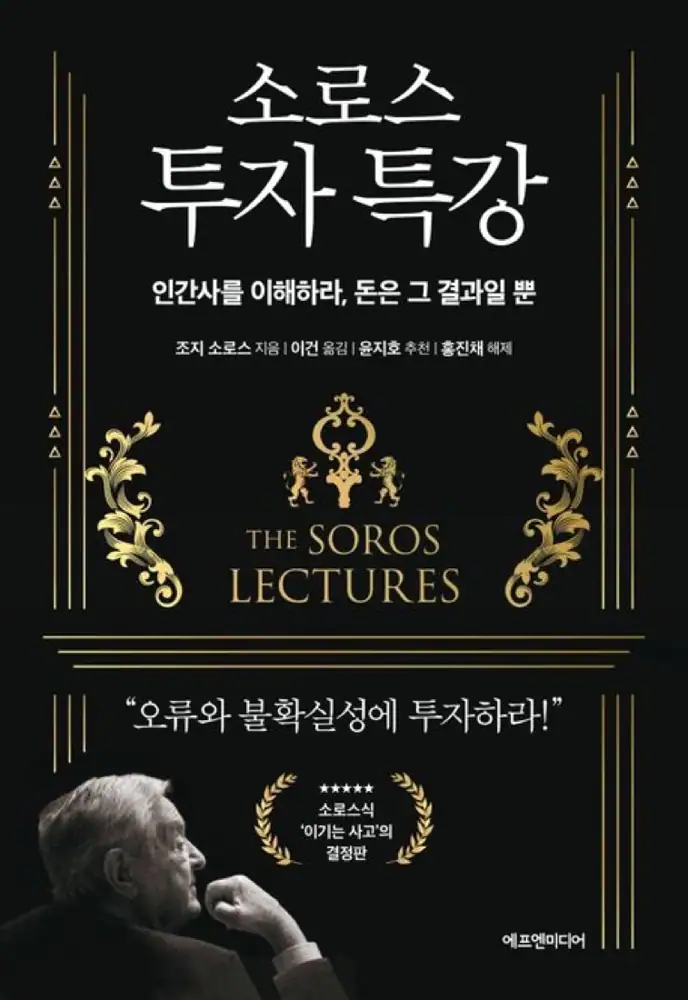
Official fact: The original book link is Soros Lectures. The listed author is George Soros, the publisher is FN Media, and the publication date shown is 2021.10.20.
1. Structure and first impression
The book collects five lectures delivered over five days at Central European University, with one chapter for each lecture. It mainly explains Soros's lifelong framework of fallibility and reflexivity, then extends it into examples from finance, philosophy, and politics. The latter part also includes his views on U.S. and Chinese politics, which made it an interesting read.
Interpretation: The Korean translation dates back to 2010, and the 2023 edition includes an afterword by Hong Jin-chae that is also worth reading. I read this less as a pure investment book and more as an epistemological tool for understanding markets.
2. Core ideas of the five lectures
| Concept | Core idea | Meaning for investors |
|---|---|---|
| Fallibility and reflexivity | Human perception is incomplete, and human action affects reality. | Money follows as the result of applying a framework, rather than being the primary goal. |
| Reflexive feedback loop | Prices and fundamentals are not simply independent or dependent variables; they dynamically affect each other. | Positive feedback can create bubbles and collapses, so identifying disequilibrium matters. |
| Fertile fallacies and open society | Both Enlightenment-style absolute reason and postmodern relativism can misread human affairs. | An open society recognizes error and keeps correcting itself. |
| Critique of market fundamentalism | Markets cannot guarantee truth and morality by themselves. | Policy, regulation, and public-opinion manipulation can distort market perception and should enter investment strategy. |
| Global financial regulation | Financial markets are global, while regulation remains local. | Monetary policy, international cooperation, and open-society principles shape long-term investment conditions. |
3. Two components of reflexivity
Cognitive function
This is the function of understanding and interpreting reality. But cognition is always incomplete and somewhat distorted.
Manipulative function
This is the function through which people intervene in reality and create change based on their perception. In markets, buying and selling are examples.
Both functions at once
Cognition cannot perceive reality perfectly, while action cannot control reality as intended; uncertainty emerges from the interaction.
Interpretation: Efficient-market and rational-expectations theories assume rational people and rational prices, but actual markets are reflexive systems where irrational behavior and expectations change reality.
4. Investor response
- The belief that markets always return to fundamentals, or equilibrium, does not fully explain reality.
- The investor's core task is to find disequilibrium, error, and distortion.
- Trying to evaluate fundamentals objectively is important, but not sufficient by itself.
- Investors need to understand and use the cycle of changing perceptions -> changing reality -> changing perceptions again.
Soros used this concept in famous investments such as the collapse of the British pound and as a philosophical foundation for explaining financial markets and human affairs.
5. Open society and market distortion
Interpretation: What impressed me most was that Soros actively tried to implement what he believed in the real world. Through the Open Society Foundations, he contributed to democratization in Eastern Europe and also attempted work in China, though that failed.
The warning that market fundamentalism can undermine democracy and open society also matters for investors. Political power and media can collude to distort truth for economic gain. It also makes me think of the idea that investors can warn governments through markets, like bond vigilantes warning Trump.