DEEP RESEARCH · Semiconductors / Memory Cycle
IM Securities Monthly Semiconductor (April) — Song Myung-sup's Bearish View and How I'm Responding
HBM density stuck, DRAM prices likely to roll over after Q2, my plan around hybrid bonding and glass substrates
0. Bottom line first
Analyst Song Myung-sup's tone is quite bearish: HBM growth is stuck at 12-Hi through the Blackwell 200/300 and Rubin generations; Chinese smartphone inventory builds suggest DRAM prices roll over after Q2. My response: lay a base position via SOXX, push single-name calls to H2. Long term, the next leg of the cycle will be led by hybrid bonding and glass substrates — whoever solves those bottlenecks.
1. Summary of Song Myung-sup's bear case
Video link: https://youtu.be/tlWmnaMa2qo?si=TKMNuBJHGG1APvGy
Official fact (key points as relayed):
- Through Blackwell 200/300 and Rubin, HBM growth past 12-Hi is capped, so capacity expansion is limited. The next generation after Rubin "Cheap" is where density grows again → HBM capacity growth pessimistic through next year.
- Chinese smartphone inventory builds → DRAM prices likely roll over after Q2.
- Samsung's HBM plan called for +120% this year — risk is closer to 0% growth. If the plan misses, capacity reverts to legacy → legacy supply increases (Chinese players are also adding).
- Chinese demand uplift will be smaller than expected. Module players like Adata are stacking more inventory despite already being heavy — and there is some tariff-front-running.
- Q2 contract prices fix at end-April through customer negotiations. Micron's +10% and Samsung's +5% are memory makers' hopes; the agreed result is unknown.
- HBM equipment vendor numbers will likely deteriorate into Q2–Q3.
- If H2 was really a recovery setup, semis would already be turning — instead they have broken to new lows.
- Assume: cycle weak through H1 next year, recovery in H2 next year → then this year's H2 stock action could improve, but "we'll only know when we get there."
- Tariffs: temporarily 10%, but semis likely face component-level tariffs aimed at forcing US production — material drag.
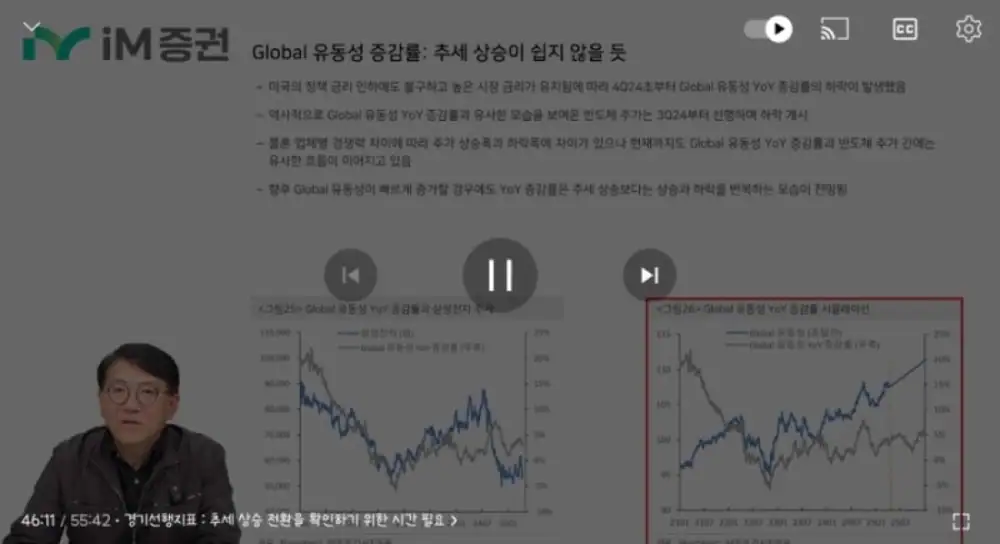
- Global liquidity YoY has rolled and re-accelerated. China's subsidies — doubled this round — are losing punch as unemployment ticks up again.
- Samsung Electronics: KRW 55,000 = PBR 0.9 floor defensible. Quick rebound unlikely. In a recession/crisis scenario, PBR 0.75 = KRW 47,000 is open. Suitable for a one-year-horizon buy.
- SK Hynix is "more complicated."
2. How I'm responding
Interpretation / playbook:
- I can't go entirely empty at these prices. For semis exposure I am laying a base position via SOXX through retirement accounts; single-name calls wait until H2.
- The structural answer is HBM going higher stack count via hybrid bonding, plus glass substrates expanding substrate size → more HBM packages per device → real demand growth. That cycle is where momentum comes back.
- Targets to follow: hybrid-bonding leaders and companies solving the glass-substrate problems. I'm willing to be more flexible on valuation here — build positions gradually while learning.
Diversified via SOXX
Base position in the ETF rather than single names. Executed inside retirement accounts.
Samsung buy zone
KRW 55,000 PBR 0.9 floor scenario; recession case opens KRW 47,000 PBR 0.75.
Hybrid bonding · glass substrate
The keys to higher-stack HBM and bigger substrates — leads in the next memory cycle.
3. Implications
- This cycle's next momentum will be next-gen packaging innovation more than raw HBM capacity additions.
- Macro variables (tariffs, Chinese demand, liquidity) drive near-term price action; technology lineup positioning matters separately for the next cycle.
Sources
- Original Naver Blog post: https://m.blog.naver.com/PostView.naver?blogId=star_of_self&logNo=223833236714
- IM Securities Monthly Semi (Song Myung-sup, April) video: https://youtu.be/tlWmnaMa2qo?si=TKMNuBJHGG1APvGy