DEEP RESEARCH · IT DISPLAY SUPPLY CHAIN
If U.S.-Bound iPhones Had to Exclude Chinese Components
A tariff and supply-chain scenario review of U.S. assembly, Chinese-component exclusion, and shifts to India, Brazil, or Vietnam
0. Bottom line first
After running several scenarios through Google Gemini, U.S. iPhone assembly does not look easy. More than half of current iPhone components are Chinese, so bringing those parts into the United States for assembly would trigger tariffs. U.S. assembly is not merely a change in final assembly location; it would require changing component suppliers as well.
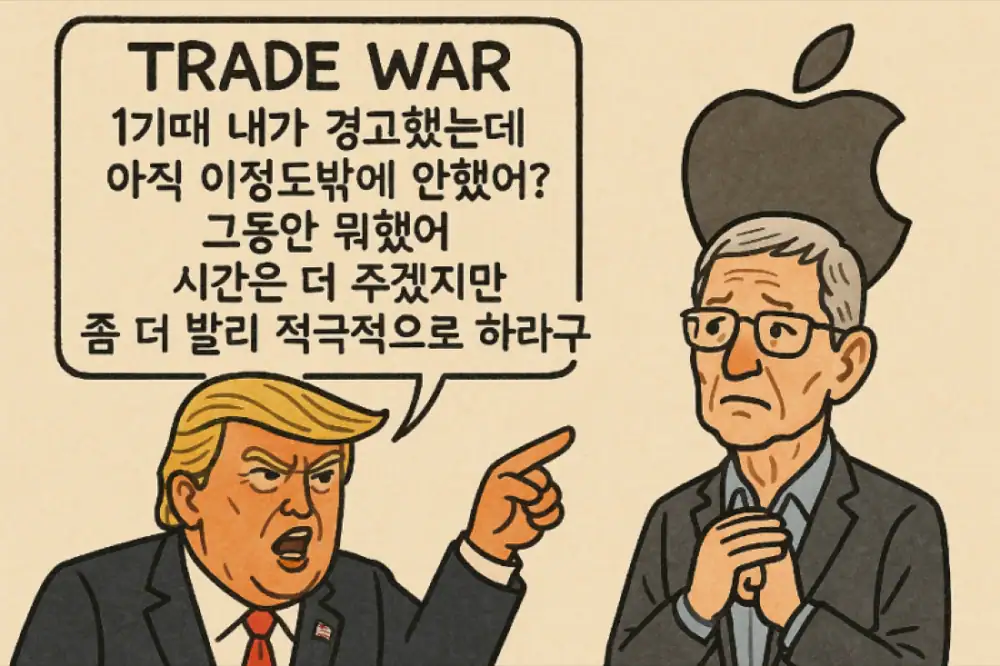
Interpretation: The more realistic candidates may be Brazil and India rather than U.S. assembly. Vietnam has value in component sourcing and FTA use, but a 46% U.S. finished-product tariff is too high. The tariff war feels like a message to Apple: “I warned you in the first term. Is this all you have done?” The likely meaning is not immediate impossibility, but pressure to diversify faster and more aggressively.
1. U.S. electronics tariff environment
Official fact: The main HTS code for finished smartphones is 8517.13.00, and the base MFN tariff is described as Free. OLED display modules are classified under HTS 8524.12.00 or 8524.92.00, memory semiconductors under 8542.32.00, and processors under 8542.31.00, with base MFN tariffs mostly free or low.
Interpretation: Therefore, the tariff burden for iPhones is not ordinary tariffs but additional country-specific trade measures. Section 301 tariffs, the March 2025 additional tariff, and the April 2025 reciprocal tariffs are the variables changing the cost structure.
| Origin country | Base MFN | Section 301 | Mar. 2025 add-on | Apr. 2025 reciprocal | Estimated cumulative |
|---|---|---|---|---|---|
| Vietnam | Free | N/A | N/A | 46% | 46% |
| Korea | Free | N/A | N/A | 25% | 25% |
| Japan | Free | N/A | N/A | 24% | 24% |
| Brazil | Free | N/A | N/A | 10% | 10% |
| India | Free | N/A | N/A | 26% | 26% |
| China | Free | N/A | 20% | 125% | 145% |
Finished smartphones under 8517.13 may not have been directly covered by Section 301, but Chinese components can separately face Section 301 tariffs of 7.5-50%. For China, the 145% figure is the sum of the 20% additional tariff and 125% reciprocal tariff; Section 301 tariffs on components are separate.
2. iPhone global value chain
Official fact: Apple does not manufacture or assemble iPhones directly; it outsources production and assembly. The original note states that the iPhone supply chain spans more than 20 countries across four continents and more than 600 companies, while the top 200 suppliers represent 98% of procurement spend.
| Component | Main supplier countries | Example suppliers | Typical assembly locations |
|---|---|---|---|
| Display (OLED/LCD) | Korea, China | Samsung Display, LG Display, BOE | China, Vietnam, India |
| NAND flash | Korea, Japan, U.S. | Samsung Electronics, SK Hynix, Kioxia, Micron | China, Vietnam, India |
| DRAM | Korea, U.S. | Samsung Electronics, SK Hynix, Micron | China, Vietnam, India |
| Application SoC | Taiwan manufacturing | TSMC | China, Vietnam, India |
| Camera module | Japan sensors, Taiwan lenses, China/Vietnam assembly | Sony, Largan Precision | China, Vietnam, India |
| Battery | China, Korea | Sunwoda, Desay, LG Chem, Samsung SDI | China, Vietnam, India |
Interpretation: Even if final assembly moves, key component sources remain concentrated in Korea, Taiwan, Japan, the United States, and China. Moving assembly to India still leaves tariffs and FTA questions for Korean and Taiwanese components entering India or Vietnam, while the finished phone still receives U.S. reciprocal tariffs based on assembly country.
3. FTAs and intermediate-goods tariffs
- China tends to apply low tariffs on intermediate goods, but the rate depends on component type and origin. Because China relies heavily on Korean, Japanese, and Taiwanese core components, the Korea-China FTA and RCEP matter.
- Vietnam depends heavily on components from China, Korea, Japan, and Taiwan, so AKFTA, VKFTA, and RCEP are important for competitiveness.
- India was criticized for electronic-component tariffs as high as 20%, but it has recently cut or eliminated duties on key inputs such as camera-module parts and PCB parts to encourage local production.
- KORUS has limited direct impact on component flows from Korea to China or Vietnam, but it shows Korea's FTA-centered trade policy.
- RCEP's regional cumulation rules can simplify origin documentation and encourage regional component sourcing in complex supply chains.
Interpretation: FTAs reduce component-stage costs, but they do not eliminate U.S. reciprocal tariffs on finished products based on final assembly location. That is why Vietnam's ability to manage component costs is overwhelmed by the 46% tariff on finished products.
4. Competitiveness by assembly location
| Assembly location | Estimated component tariff impact | U.S. tariff on finished product | Total tariff burden | Tariff-based rank |
|---|---|---|---|---|
| China | High (Section 301) | >145% | Very high | 6 |
| Vietnam | Medium (FTA benefits) | 46% | High | 5 |
| India | Medium/high (limited FTA, recent cuts) | 26% | Medium/high | 2 |
| Korea | Low (domestic sourcing) | 25% | Medium | 4 |
| Japan | Low (domestic sourcing) | 24% | Medium | 3 |
| Brazil | Medium/high | 10% | Low/medium | 1 |
Mexico and Canada are excluded from the ranking because USMCA makes reciprocal-tariff exemption more likely. The competitiveness ranking is based only on tariff burden.
China and Vietnam
China at more than 145% and Vietnam at 46% lose substantial competitiveness for U.S.-bound production.
India and Brazil
India at 26% and Brazil at 10% are much more attractive than China or Vietnam on tariff burden alone.
U.S. assembly
Excluding Chinese components would require supplier replacement, and the cost increase may be too large versus other brands.
5. Effects on the U.S. market and corporate strategy
- Higher tariffs on finished products from China, Vietnam, India, and other suppliers are likely to raise U.S. iPhone retail prices.
- Price increases could weaken demand among price-sensitive consumers and raise preference for older or refurbished models.
- Brands with high dependence on high-tariff countries become disadvantaged versus competitors with diversified production bases.
- India, Brazil, Mexico, and Canada become relatively more attractive, while some onshoring possibilities may be raised.
- Broad import tariffs can increase U.S. inflation pressure, raise retaliation risk, and disrupt global trade flows.
6. Government and corporate responses
Official fact: The original note lists Vietnam's proposal to eliminate tariffs on U.S. imports, India's cuts to component tariffs, China's retaliation, Korea-China-Japan joint-response discussions, and possible damage to Taiwan's ICT and machine-tool sectors.
Interpretation: The corporate response ultimately comes down to supply-chain diversification. Apple has been diversifying assembly from China to India and Vietnam, but because roughly 90% of iPhones were historically produced in China, it is especially exposed. Samsung has large Vietnam exposure, but may be relatively better positioned because it already has production bases in Korea, India, Brazil, and elsewhere.
- Apple: urgently needs to adjust production bases for U.S. market supply.
- Samsung/LG: may consider Mexico or U.S. relocation because Vietnam's 46% tariff is burdensome.
- Foxconn/Pegatron: expand capacity in India, Vietnam, Mexico, and other locations to meet customer demand for China diversification.
- Component suppliers: direct semiconductor exports may be exempt, but parts included in finished products assembled in tariffed countries are indirectly affected.
- Mitigation tools: FTZs, duty drawback, maximizing FTA benefits, and reducing exposure to high-tariff countries become important.
7. Final judgment
Based on the tariff structure alone, China and Vietnam have become unattractive for U.S.-bound iPhone production, while India and Brazil stand out relatively. But the iPhone component network is too deep and complex for a simple assembly-location change to solve the problem. Even if Apple receives some tariff relief, it likely has no choice but to diversify the supply chain further.
Sources
- Original Naver Blog post: https://m.blog.naver.com/PostView.naver?blogId=star_of_self&logNo=223830543598
- Reference 1: https://hts.usitc.gov/: https://hts.usitc.gov/
- Reference 2: https://www.cbp.gov/trade/programs-administration/determining-duty-rates: https://www.cbp.gov/trade/programs-administration/determining-duty-rates
- Reference 3: https://hts.usitc.gov/search?query=smartphone: https://hts.usitc.gov/search?query=smartphone
- Reference 4: https://www.flexport.com/data/hs-code/8517-telephone-sets-including-smartphones-: https://www.flexport.com/data/hs-code/8517-telephone-sets-including-smartphones-and-other-telephones-for-cellular-networks-or-for-other-wireless-networks-other-apparatus-for-the-transmission-or/index.html
- Reference 5: https://www.flexport.com/data/hs-code/8524-flat-panel-display-modules-whether-or: https://www.flexport.com/data/hs-code/8524-flat-panel-display-modules-whether-or-not-incorporating-touchsensitive-screens/index.html
- Reference 6: https://www.flexport.com/data/hs-code/852492-of-organic-lightemitting-diodes-ole: https://www.flexport.com/data/hs-code/852492-of-organic-lightemitting-diodes-oled/index.html
- Reference 7: https://www.zauba.com/import-NAND+FLASH+4GB/hs-code-8542-hs-code.html: https://www.zauba.com/import-NAND+FLASH+4GB/hs-code-8542-hs-code.html
- Reference 8: https://rulings.cbp.gov/ruling/H296912: https://rulings.cbp.gov/ruling/H296912
- Reference 9: https://www.customsmobile.com/rulings/docview?doc_id=NY+N237199: https://www.customsmobile.com/rulings/docview?doc_id=NY+N237199
- Reference 10: https://www.zauba.com/import-memory-module-dram/hs-code-84733030-hs-code.html: https://www.zauba.com/import-memory-module-dram/hs-code-84733030-hs-code.html
- Reference 11: https://www.volza.com/hs-codes/search/memory-chip/malaysia/: https://www.volza.com/hs-codes/search/memory-chip/malaysia/
- Reference 12: https://www.flexport.com/data/hs-code/8542-electronic-integrated-circuits-parts-: https://www.flexport.com/data/hs-code/8542-electronic-integrated-circuits-parts-thereof/index.html
- Reference 13: https://www.datamyne.com/hts/85/8542320023: https://www.datamyne.com/hts/85/8542320023
- Reference 14: https://hts.usitc.gov/search?query=8542: https://hts.usitc.gov/search?query=8542
- Reference 15: https://www.zauba.com/import-mobile+applications/hs-code-8542-hs-code.html: https://www.zauba.com/import-mobile+applications/hs-code-8542-hs-code.html
- Reference 16: https://www.volza.com/imports-india/india-import-data-of-camera+module-and-hscod: https://www.volza.com/imports-india/india-import-data-of-camera+module-and-hscode-8543
- Reference 17: https://www.zauba.com/import-camera-module/hs-code-85258020-hs-code.html: https://www.zauba.com/import-camera-module/hs-code-85258020-hs-code.html
- Reference 18: https://www.customsmobile.com/rulings/docview?doc_id=HQ%20W968349&highlight=8529: https://www.customsmobile.com/rulings/docview?doc_id=HQ+W968349&highlight=8529.90.81*
- Reference 19: https://www.wita.org/wp-content/uploads/2022/08/CTA_Section-301-Tariff-Whitepape: https://www.wita.org/wp-content/uploads/2022/08/CTA_Section-301-Tariff-Whitepaper.pdf
- Reference 20: https://shop.cta.tech/products/analysis-of-section-301-tariff-impacts-on-imports: https://shop.cta.tech/products/analysis-of-section-301-tariff-impacts-on-imports-of-consumer-technology-products
- Reference 21: https://usacustomsclearance.com/process/section-301-tariffs-a-comprehensive-guid: https://usacustomsclearance.com/process/section-301-tariffs-a-comprehensive-guide/
- Reference 22: https://www.piie.com/blogs/realtime-economics/2022/four-years-trade-war-are-us-a: https://www.piie.com/blogs/realtime-economics/2022/four-years-trade-war-are-us-and-china-decoupling
- Reference 23: https://mahometdaily.com/new-trump-tariffs-on-china-begin-the-impact-on-u-s-cons: https://mahometdaily.com/new-trump-tariffs-on-china-begin-the-impact-on-u-s-consumers-and-industries/
- Reference 24: https://www.cegsupport.com/the-phone-repair-industry-affected-by-tariffs/: https://www.cegsupport.com/the-phone-repair-industry-affected-by-tariffs/
- Reference 25: https://ustr.gov/issue-areas/enforcement/section-301-investigations/tariff-actio: https://ustr.gov/issue-areas/enforcement/section-301-investigations/tariff-actions
- Reference 26: https://www.whitecase.com/insight-alert/united-states-finalizes-section-301-tari: https://www.whitecase.com/insight-alert/united-states-finalizes-section-301-tariff-increases-imports-china
- Reference 27: https://www.sino-shipping.com/us-customs-duties-import-taxes-goods-china/: https://www.sino-shipping.com/us-customs-duties-import-taxes-goods-china/
- Reference 28: https://www.usitc.gov/publications/332/pub4382.pdf: https://www.usitc.gov/publications/332/pub4382.pdf
- Reference 29: https://www.procurementiq.com/blog/tariff-buyer-guide-electronics: https://www.procurementiq.com/blog/tariff-buyer-guide-electronics
- Reference 30: https://www.gibsondunn.com/immediate-impacts-risks-and-uncertain-future-of-presi: https://www.gibsondunn.com/immediate-impacts-risks-and-uncertain-future-of-president-trumps-unprecedented-worldwide-tariffs/
- Reference 31: https://timesofindia.indiatimes.com/business/india-business/donald-trump-tariffs: https://timesofindia.indiatimes.com/business/india-business/donald-trump-tariffs-impact-on-india-explained-united-states-reciprocal-tariffs-sector-wise-analysis-trade-deal/articleshow/119917017.cms
- Reference 32: https://www.tradeimex.in/blogs/trump-reciprocal-tariffs-us-global-import-export-: https://www.tradeimex.in/blogs/trump-reciprocal-tariffs-us-global-import-export-trends
- Reference 33: https://www.kedglobal.com/business-politics/newsView/ked202504030004: https://www.kedglobal.com/business-politics/newsView/ked202504030004
- Reference 34: https://www.tomshardware.com/tech-industry/trump-administration-exempts-computer: https://www.tomshardware.com/tech-industry/trump-administration-exempts-computer-chips-and-copper-from-sweeping-tariffs-but-only-for-now-report-says-chip-tariffs-coming-later
- Reference 35: https://worldview.stratfor.com/article/trumps-tariffs-pose-structural-threat-vie: https://worldview.stratfor.com/article/trumps-tariffs-pose-structural-threat-vietnams-economy
- Reference 36: https://www.independent.co.uk/news/world/americas/trump-tariffs-countries-list-c: https://www.independent.co.uk/news/world/americas/trump-tariffs-countries-list-china-uk-canada-russia-b2729975.html
- Reference 37: https://www.vietnam-briefing.com/news/understanding-the-us-tariff-list-implicati: https://www.vietnam-briefing.com/news/understanding-the-us-tariff-list-implications-for-vietnam.html/
- Reference 38: https://m.economictimes.com/news/economy/foreign-trade/trumps-tariff-bombshell-h: https://m.economictimes.com/news/economy/foreign-trade/trumps-tariff-bombshell-hits-india-with-26-import-tax-but-some-desi-sectors-like-agriculture-farm-pharma-textile-electronics-steel-medicinesdodge-the-shrapnel-while-trump-odi-relation-remains-india-us-trade-ties-ariff-impact/articleshow/119929599.cms
- Reference 39: https://www.chosun.com/english/industry-en/2025/04/04/RQXUEUNARBF4JIINJFZQSQCJIE: https://www.chosun.com/english/industry-en/2025/04/04/RQXUEUNARBF4JIINJFZQSQCJIE/
- Reference 40: https://focustaiwan.tw/business/202504040006: https://focustaiwan.tw/business/202504040006
- Reference 41: https://semianalysis.com/2025/04/10/tariff-armageddon-gpu-loopholes/: https://semianalysis.com/2025/04/10/tariff-armageddon-gpu-loopholes/
- Reference 42: https://blocksandfiles.com/2025/04/07/storage-and-trump-tariffs/: https://blocksandfiles.com/2025/04/07/storage-and-trump-tariffs/
- Reference 43: https://hts.usitc.gov/search?query=99038803: https://hts.usitc.gov/search?query=99038803
- Reference 44: https://hts.usitc.gov/reststop/file?release=currentRelease&filename=China%20Tari: https://hts.usitc.gov/reststop/file?release=currentRelease&filename=China+Tariffs
- Reference 45: https://rhg.com/research/china-and-the-future-of-global-supply-chains/: https://rhg.com/research/china-and-the-future-of-global-supply-chains/
- Reference 46: https://iphone-supply-chain.netlify.app/: https://iphone-supply-chain.netlify.app/
- Reference 47: https://www.astutegroup.com/news/industrial/indias-tariff-tweaks-a-boon-for-elec: https://www.astutegroup.com/news/industrial/indias-tariff-tweaks-a-boon-for-electronics-manufacturing/
- Reference 48: https://en.wikipedia.org/wiki/Apple_supply_chain: https://en.wikipedia.org/wiki/Apple_supply_chain
- Reference 49: https://www.thomasnet.com/insights/iphone-supply-chain/: https://www.thomasnet.com/insights/iphone-supply-chain/
- Reference 50: https://s203.q4cdn.com/367071867/files/doc_downloads/2024/04/Apple-UNGP-Mapping.: https://s203.q4cdn.com/367071867/files/doc_downloads/2024/04/Apple-UNGP-Mapping.pdf
- Reference 51: https://www.apple.com/au/supplier-responsibility/pdf/Apple_SR_2022_Progress_Repo: https://www.apple.com/au/supplier-responsibility/pdf/Apple_SR_2022_Progress_Report.pdf
- Reference 52: https://www.thestreet.com/apple/news/three-facts-best-supply-chain: https://www.thestreet.com/apple/news/three-facts-best-supply-chain
- Reference 53: https://www.statista.com/chart/27730/iphone-design-by-country/: https://www.statista.com/chart/27730/iphone-design-by-country/
- Reference 54: https://www.apple.com/nz/supplier-responsibility/pdf/Apple-Supplier-List.pdf: https://www.apple.com/nz/supplier-responsibility/pdf/Apple-Supplier-List.pdf
- Reference 55: https://s203.q4cdn.com/367071867/files/doc_downloads/2024/04/Apple-Supplier-List: https://s203.q4cdn.com/367071867/files/doc_downloads/2024/04/Apple-Supplier-List.pdf
- Reference 56: https://www.researchgate.net/figure/Classification-of-Apple-iPhone-parts-supplie: https://www.researchgate.net/figure/Classification-of-Apple-iPhone-parts-suppliers-by-country_tbl1_351635410
- Reference 57: https://gesrepair.com/where-are-iphones-manufactured/: https://gesrepair.com/where-are-iphones-manufactured/
- Reference 58: https://flowingdata.com/2023/08/29/apples-global-suppliers/: https://flowingdata.com/2023/08/29/apples-global-suppliers/
- Reference 59: https://www.digitimes.com/news/a20250207VL206/donald-trump-budget-electronics-in: https://www.digitimes.com/news/a20250207VL206/donald-trump-budget-electronics-infrastructure-data-center.html
- Reference 60: https://www.apple.com/supply-chain/: https://www.apple.com/supply-chain/
- Reference 61: https://www.piie.com/sites/default/files/publications/pb/pb15-24.pdf: https://www.piie.com/sites/default/files/publications/pb/pb15-24.pdf
- Reference 62: https://japantoday.com/category/politics/china-japan-south-korea-will-jointly-re: https://japantoday.com/category/politics/china-japan-south-korea-will-jointly-respond-to-us-tariffs-chinese-state-media-says
- Reference 63: https://wtocenter.vn/file/18742/rcep%E7%94%B5%E5%AD%90%E6%8C%87%E5%8D%97chapter-: https://wtocenter.vn/file/18742/rcep%E7%94%B5%E5%AD%90%E6%8C%87%E5%8D%97chapter-9-.pdf
- Reference 64: https://www.china-briefing.com/news/china-import-export-tariffs-in-2025/: https://www.china-briefing.com/news/china-import-export-tariffs-in-2025/
- Reference 65: https://www.cbp.gov/trade/free-trade-agreements/korea: https://www.cbp.gov/trade/free-trade-agreements/korea
- Reference 66: http://www.atoseoul.com/fta/how%20to%20determine%20tariffs.asp: http://www.atoseoul.com/fta/how%20to%20determine%20tariffs.asp
- Reference 67: http://www.atoseoul.com/fta/step2.asp: http://www.atoseoul.com/fta/step2.asp
- Reference 68: https://www.trade.gov/country-commercial-guides/south-korea-import-tariffs: https://www.trade.gov/country-commercial-guides/south-korea-import-tariffs
- Reference 69: https://ustr.gov/sites/default/files/uploads/agreements/fta/korus/asset_upload_f: https://ustr.gov/sites/default/files/uploads/agreements/fta/korus/asset_upload_file786_12756.pdf
- Reference 70: https://www.trade.gov/fta-tariff-tool-home: https://www.trade.gov/fta-tariff-tool-home
- Reference 71: https://www.iea.org/policies/18405-korea-china-free-trade-agreement: https://www.iea.org/policies/18405-korea-china-free-trade-agreement
- Reference 72: https://english.mofcom.gov.cn/: https://english.mofcom.gov.cn/
- Reference 73: https://edit.wti.org/document/show/b06eafa3-c28e-47e2-98cd-ed1ebc56d00a: https://edit.wti.org/document/show/b06eafa3-c28e-47e2-98cd-ed1ebc56d00a
- Reference 74: https://www.chinadaily.com.cn/a/202402/13/WS65cb10baa3104efcbdaeabfc.html: https://www.chinadaily.com.cn/a/202402/13/WS65cb10baa3104efcbdaeabfc.html
- Reference 75: https://english.www.gov.cn/news/202402/13/content_WS65cb1a49c6d0868f4e8e3fee.htm: https://english.www.gov.cn/news/202402/13/content_WS65cb1a49c6d0868f4e8e3fee.html
- Reference 76: https://www.dfat.gov.au/trade/agreements/in-force/chafta/official-documents/Page: https://www.dfat.gov.au/trade/agreements/in-force/chafta/official-documents/Pages/official-documents
- Reference 77: https://vntr.moit.gov.vn/fta/21/2: https://vntr.moit.gov.vn/fta/21/2
- Reference 78: https://vntr.moit.gov.vn/fta/7/2: https://vntr.moit.gov.vn/fta/7/2
- Reference 79: https://en.wikipedia.org/wiki/Regional_Comprehensive_Economic_Partnership: https://en.wikipedia.org/wiki/Regional_Comprehensive_Economic_Partnership
- Reference 80: https://mag.wcoomd.org/magazine/wco-news-96/rcep-from-a-customs-perspective/: https://mag.wcoomd.org/magazine/wco-news-96/rcep-from-a-customs-perspective/
- Reference 81: https://wtocenter.vn/file/18735/rcep%E7%94%B5%E5%AD%90%E6%8C%87%E5%8D%97chapter-: https://wtocenter.vn/file/18735/rcep%E7%94%B5%E5%AD%90%E6%8C%87%E5%8D%97chapter-2-.pdf
- Reference 82: https://wtocenter.vn/file/18736/rcep%E7%94%B5%E5%AD%90%E6%8C%87%E5%8D%97chapter-: https://wtocenter.vn/file/18736/rcep%E7%94%B5%E5%AD%90%E6%8C%87%E5%8D%97chapter-3-.pdf
- Reference 83: https://www.customs.go.jp/english/epa/rcep/rcep_gensankoku_E.pdf: https://www.customs.go.jp/english/epa/rcep/rcep_gensankoku_E.pdf
- Reference 84: https://www.customs.go.jp/english/epa/rcep/rcep1.html: https://www.customs.go.jp/english/epa/rcep/rcep1.html
- Reference 85: https://www.asiafinancial.com/china-japan-south-korea-boost-trade-ties-as-us-tar: https://www.asiafinancial.com/china-japan-south-korea-boost-trade-ties-as-us-tariffs-loom
- Reference 86: https://apnews.com/article/trump-tariffs-global-trade-us-markets-670c72738d08073: https://apnews.com/article/trump-tariffs-global-trade-us-markets-670c72738d08073ea15cb0ac0c493618