DEEP RESEARCH · CHINA AUTO / EV
China's EV restructuring begins — alliances, mergers, and US/EU pushback
From the Changan–Dongfeng merger and Huawei–SAIC–CATL alliances to US/EU containment — a check on how the global auto and battery map is being redrawn
0. Bottom Line First
China's government-led consolidation of domestic automakers and cross-industry tie-ups with IT and battery firms are accelerating. The global EV and battery balance is likely to be redrawn quickly over the next five years; US and EU pushback will intensify; Korea and Japan face risk and opportunity at the same time.
- A Changan + Dongfeng merger would yield combined annual sales of 5.16M units — surpassing BYD (4.27M) to become China's #1 and a global top-7 OEM.
- SAIC × Huawei / × CATL tie-ups prep a mid-priced smart EV line.
- CATL + BYD = 52.6% global battery share (36.8% + 15.8%); China controls 75%+ of cell capacity and 70%+ of cathode/anode refining.
- The EU plans to vote on 10–35% extra duties for 5 years: BYD 17%, Geely 18.8%, SAIC 35.3% (Oct 2024).
- Korean battery majors aim to capture the "de-China" upside via JVs with GM, Ford, and Stellantis.
Source article: JoongAng Ilbo — Fighting Trump together: Huawei, SAIC, and CATL join hands
1. Shifts in Global Auto Competition
Chinese OEMs are responding to a fast-changing market through alliances and mergers. State-owned #2 Changan and #3 Dongfeng are pursuing a merger; if completed, their combined 5.16M annual unit sales would overtake BYD (4.27M) and make them China's largest automaker — and a global top-7 player. The Korea Institute for Industrial Economics & Trade reads this as "the government trying to consolidate an over-saturated field of 100+ OEMs into globally competitive scale."
OEM–IT–battery cross-industry tie-ups are also accelerating. SAIC × Huawei is co-developing a mid-priced smart EV line; SAIC × CATL launched a joint EV program. Same-industry and cross-industry combinations are pursuing scale and technology fusion simultaneously.
Changan + Dongfeng
Combined 5.16M units → past BYD (4.27M), into the global top-7.
SAIC × Huawei
Co-developing a mid-priced (~170k yuan-class) smart EV line.
SAIC × CATL
Joint EV program targeting price and performance together.
VW × Xpeng / Honda–Nissan–Mitsubishi
Crisis-driven cross-border alliances forming.
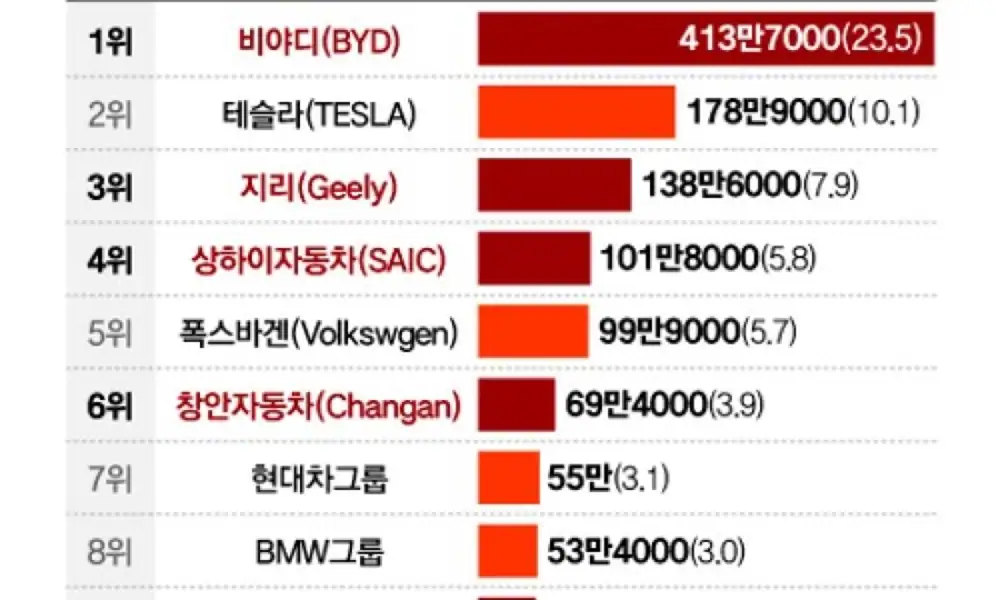
Official fact: BYD became the global #1 in EV sales in 2023 at 4.13M units, overtaking Tesla; six Chinese makers (BYD, Geely, SAIC, Changan, etc.) ranked in the global EV top 10.
Interpretation: As Chinese cars catch up on both price and tech, Tesla and VW are responding with price cuts and local partnerships — a defensive pattern that's becoming the new norm.
2. Battery Materials and Supply Chain
Powered by government subsidies and a deep resource base, CATL and BYD took 52.6% of the global battery market in 2023 (36.8% + 15.8%). China controls more than 75% of cell capacity and more than 70% of cathode/anode refining. From late 2023, Beijing began controlling exports of graphite and other critical minerals as well.
The US responded with the IRA, requiring battery minerals to be sourced from FTA countries — designed to exclude Chinese inputs — and working with allies to lock in mineral chains in Australia, Canada, and Africa. The EU released the Critical Raw Materials Act (CRMA) in 2023, targeting 10% self-mining and 40% self-refining of lithium and rare earths by 2030.
| Indicator | China | Counter-bloc (US/EU/KR/JP) |
|---|---|---|
| Battery market share (2023) | CATL 36.8% + BYD 15.8% = 52.6% | Korean trio + Panasonic share the rest |
| Cell production capacity | Over 75% | US/EU building under IRA & CRMA |
| Cathode/anode refining | Over 70% | EU 2030 target: 40% |
| Key policy | Graphite export controls (late 2023) | IRA, CRMA |
Korea's battery trio are building US JVs (LG-GM, Ford-SK, Stellantis-SDI), taking Australian lithium stakes, and investing in battery recycling — positioning for the "de-China" tailwind.
3. Outlook for Chinese OEMs' Global EV Share
2023 Chinese auto exports hit 5.85M units — about 23% of the 25.57M domestic market — yet enough to overtake Japan as the world's largest auto exporter. BYD, Chery, and Geely lead the charge.
- BYD posted +40% growth in both 2022 and 2023, cementing its global #1 EV position.
- SAIC's MG is a top-3/4 EV brand in Europe.
- Chinese-brand EV share in the EU reached about 8% in 2023; double-digit share is plausible by 2030 even without subsidies.
- In Thailand, Chinese brands took 11% of the new-car market (more than 2× the prior year); BYD and MG account for roughly half of EVs.
- In Russia, Chinese share is over 60% — effectively dominating the market after Western OEMs withdrew.
4. US and EU Pushback Intensifies
Official fact: The returning Trump administration in 2025 is signaling an extra 10% tariff on Chinese goods and is considering banning imports/sales of Chinese vehicles equipped with vehicle communication (VCS) and autonomous-driving (ADS) systems. In Oct 2024 the EU plans to vote on five-year extra tariffs of 10–35% — BYD 17%, Geely (incl. Volvo and Polestar) 18.8%, SAIC (MG) 35.3%.
Interpretation: The pushback is no longer a pure trade matter — it's tied to tech hegemony and supply-chain security, which is exactly why a block-economy split in EVs and batteries is becoming more plausible.
5. Impact on Korea, Japan, and Other Competitors
OEMs
- Hyundai/Kia: Strong EV reception (IONIQ 5, EV6). The US market favors them as Chinese entry is restricted. A strategic alliance with GM in North America is being explored — sharing production lines and sales networks to address the IRA and Chinese competition.
- Toyota: Targeting a next-gen EV with solid-state batteries by 2026.
- Honda–Nissan–Mitsubishi alliance: Aiming for a "mega alliance" of 8M+ units. Skeptics note "scale without a clear EV edge."
Battery
- Tailwind — US/EU pushback against Chinese batteries is expanding JV order books for LG Energy Solution, SK On, Samsung SDI, and Panasonic (GM-LG, Ford-SK, Stellantis-SDI).
- Headwind — China still controls lithium refining and graphite processing, keeping cost pressure on.
- Response — Securing lithium in Australia and Chile; accelerating cobalt-free and solid-state R&D.
China's Workaround Expansion
With the US door closed, Chinese makers are pivoting to local production in the EU and ASEAN. CATL is running its Erfurt (Germany) plant and building one in Hungary; BYD opened an EV plant in Thailand; SAIC MG and Great Wall built plants in Thailand and Indonesia; NIO is reviewing a European plant.
6. Synthesis and Scenarios
The next five years of the global EV/battery industry will likely move between two scenarios.
Scenario A — Bloc fragmentation
- A stage split between China and the US/EU camps.
- Firms transact and compete largely within their own bloc.
Scenario B — Competition-driven acceleration of EV adoption
- Competition drives tech innovation and cost cuts.
- Global EV adoption accelerates.
Reality is likely to land in between. US–China tension raises the fragmentation risk, but supply-chain interdependence is hard to fully sever. Scale expansion, technology alliances, and supply-chain control are the central survival levers.
Sources
- Original Naver Blog post: https://m.blog.naver.com/PostView.naver?blogId=star_of_self&logNo=223775975798
- JoongAng Ilbo — Fighting Trump together: Huawei, SAIC, and CATL join hands: https://www.joongang.co.kr/article/25316829
- Reference: CAAM (China Assn. of Automobile Manufacturers), SNE Research, Reuters, JoongAng Ilbo, Politico, BusinessKorea