DEEP RESEARCH · INVESTING BOOK REVIEW
What I Learned from What I Learned About Investing from Darwin
A review of Pulak Prasad’s investing philosophy through survival, selection, adaptation, signals, and compounding.
0. Bottom line first
Most of the book’s message is right. I still wonder whether “invest forever” worked partly because the author invested in a strong Indian market, and whether the same line would have worked as well in Korea. Still, the evolutionary analogies make the investing principles more persuasive.
I picked up the book after hearing it discussed on Y-Street, which I watch often. The content is broadly good, though some points feel familiar. I am summarizing it here so I can revisit the ideas later.
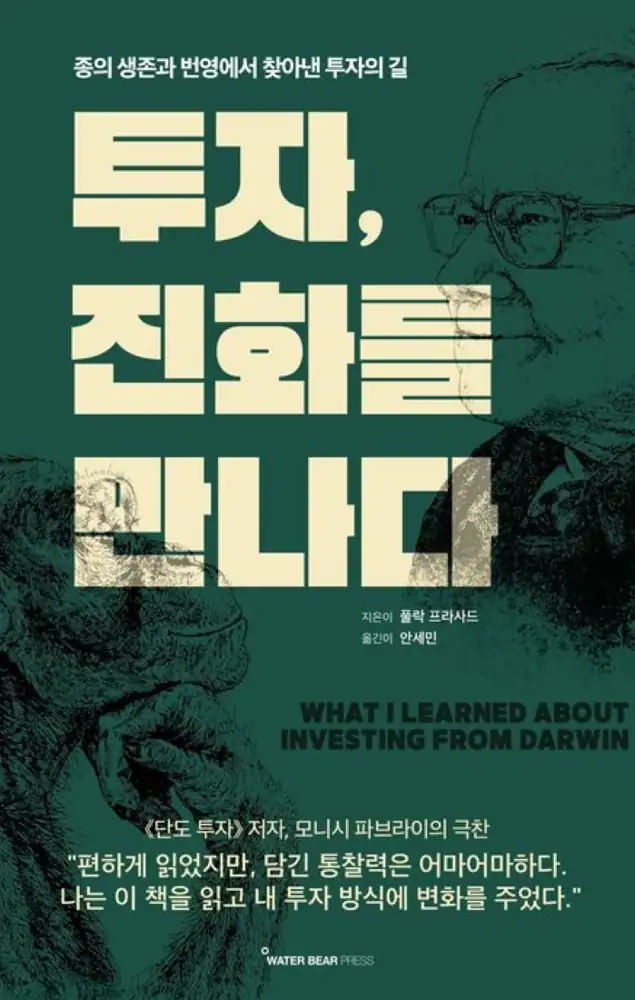
Official fact: The source links to the Naver Shopping book page: What I Learned About Investing from Darwin. The source lists Pulak Prasad as author, Water Bear Press as publisher, and 2025.02.10 as the release date.
1. Survival: avoiding fatal risk
In nature, avoiding extinction is the precondition for prosperity. In investing, avoiding fatal losses is the first principle. Just as living organisms avoid unnecessary existential risk, good investors should not put principal at risk simply to chase higher returns.
Warren Buffett’s rule about not losing money fits this idea. From an evolutionary perspective, risk management is tied directly to survival; in investing, minimizing the chance of collapse is what allows long-term success.
2. Selection pressure: focusing on core indicators
The silver fox experiment connects to stock selection: when one desirable trait was selected, other favorable traits appeared together. The investing analogy is to focus on the key metric that separates durable quality businesses from the rest.
The book uses historically high ROCE, return on capital employed, as an example. Companies with high ROCE may also tend to show growth, profitability, and financial strength.
3. Adaptation and resilience
As the sea urchin example suggests, resilience against external shocks is essential to evolution. In investing, that means owning companies that can endure crises, technological change, and tougher competition.
Strong balance sheets, adaptability, and the ability to recover from temporary pressure matter. Former leaders often decline after failing to adapt; companies that gain share during difficult periods can move to the next stage.
4. Causes and signals: removing noise
The dung beetle example points to a core analytical habit: do not rely only on surface indicators or immediate events. Ask where the company’s durable advantage comes from and whether current improvement is cyclical or structural.
Investors also need to separate honest signals from false ones. Management optimism is cheap talk, while an owner buying a large amount of stock with real money is a costlier and potentially more credible signal.
News and interviews
Short-term information can interfere with judgment.
Costly action
Actions such as owner buying or buybacks carry more weight than words.
Ask why
Identify the root cause of growth and competitive advantage.
5. Long-term view and compounding
Evolution is a long project measured in millions of years. Investing should also be viewed over years or decades, not months. The book emphasizes looking at investing and life through a 10-year-plus lens.
The author cites his experience of concentrated long-term investing in Indian equities for 16 years, earning more than 20% annually. Once a great company is bought at a fair price, the argument is to hold for as long as possible and let compounding work.
6. A simple, consistent process
Honeybees use waggle dances to evaluate possible new homes and converge on a decision. The lesson is that complex choices can be handled through a simple, repeatable, rational process.
Investing also requires a process that can be followed consistently. It may not take genius to believe that investing in great businesses with great managers can work over time, but following that theory every day is difficult. In the end, consistency determines the result.