DEEP RESEARCH · Governance/Book review
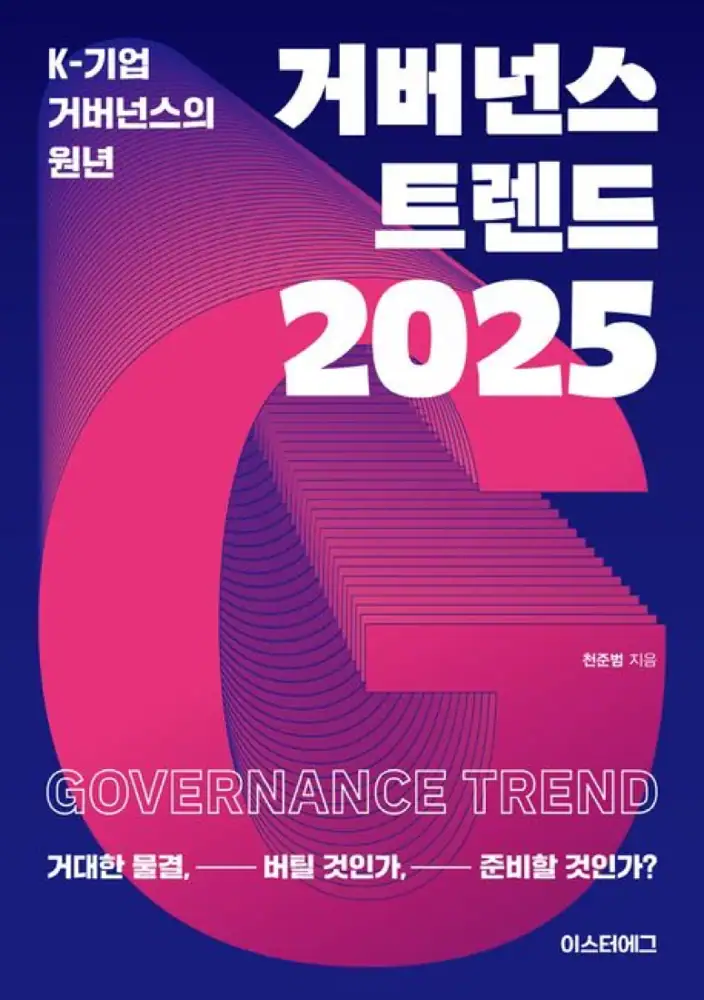
[Book Review] Governance Trend 2025
A memo on Korean corporate governance reform after reading Chun Joon-bum’s governance outlook book
0. Bottom line first
This book views 2024 as the first year of change in Korean corporate governance and expects the debate to continue in 2025. However, I think conflicts of interest in holding-company and duplicate-listing structures remain difficult to solve through Commercial Act reform alone.
I received this book from the Korea Corporate Governance Forum. The book is linked through Naver’s book information page, and it was useful for organizing Korea’s governance debate from 2024 into 2025.
1. The book and the author
Official fact: The book is “Governance Trend 2025.” The author is Chun Joon-bum, the publisher is Easter Egg, and the release date is listed as January 2, 2025.
The author is introduced as the CEO of Wise Forest and a lawyer. He graduated from Seoul National University’s Department of Economics, earned a master’s degree in law from Seoul National University School of Law, and the source also mentions studies related to New York University School of Law. He is described as having broad experience across companies and legal practice, including M&A, management-control disputes among shareholders, fair trade matters, and administrative litigation.
Official fact: The original post says he currently serves as vice chair of the Korea Corporate Governance Forum.
Chun Joon-bum
Introduced as the CEO of Wise Forest and a lawyer.
Corporate law and disputes
The post mentions M&A, management-control disputes, fair trade matters, and administrative litigation.
Governance forum
The author is described as vice chair of the Korea Corporate Governance Forum.
2. The book’s core concern
The book fundamentally frames 2024 as the first year of change in Korean corporate governance. Starting from remarks early in the year by President Yoon Suk Yeol and the head of the Financial Supervisory Service regarding Commercial Act reform, it discusses the governance reform debate in Korea.
Interpretation: I read the corporate crisis described in the book as a problem of decision-making vacuum, where final decisions are not being made.
- The book presents the need for corporate governance reform as large Korean groups enter third-generation succession.
- It also makes a strong argument that failure to reform could become a crisis for Korea.
- One unusual feature in Korea is that individual shareholders have increased sharply and are emerging as actors in corporate governance reform.
3. Governance issues likely to continue in 2025
Among the many debates, issues involving Doosan Group and Korea Zinc are described as events that further fueled the governance debate. The book expects this trend to continue in 2025 and describes the current situation as just before the door opens.
4. My view on holding companies and duplicate listings
Interpretation: Holding companies may have been temporarily allowed around the IMF crisis, but today the key remaining task is how to resolve the conflicts of interest created by that structure.
I do not think this part will be easy to solve even through Commercial Act reform. If individual shareholders exist on both sides and both companies are listed, there needs to be a separate debate on how to resolve conflicts of interest between those companies.
In conclusion, I personally think it may be better for only one company to be listed. Compared with “The Shareholder Who Speaks Up,” which I had read before, much of this book covered things I already knew, so it was somewhat disappointing. Still, those interested can take a look.