DEEP RESEARCH · EXPECTATIONS INVESTING
Expectations Investing: A New Approach Beyond Traditional Value Investing
A book review on starting with the expectations embedded in price, then refining investment judgment through long-term cash flows and expectation revisions
0. Bottom line first
I think this book is required reading for investors who already have some experience with value investing. It lays out the limitations of traditional value investing in the most plausible and logical way I have seen.
I still fundamentally lean toward value investing, but after reading this book I began to treat the market as at least partly right by default. I also built the habit of first analyzing what expectations the market already has for a company.
The book also strengthened my view that the market ultimately values companies based on long-term cash flows, and that changed my thinking. Through many examples, the method of analyzing what level of expectations is embedded in a company’s share price felt very practical.
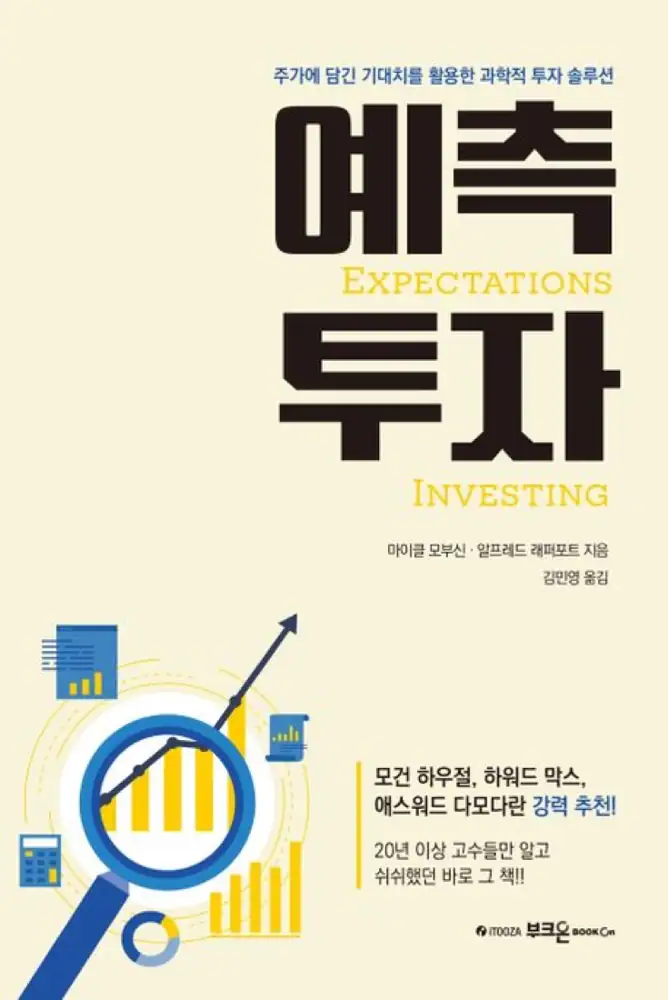
Official fact: The book is Expectations Investing, by Michael Mauboussin and Alfred Rappaport. The Korean publisher is Bookon, and the release date shown in the source is 2024.04.30.
1. The core problem the book addresses
Traditional value investing estimates intrinsic value by forecasting future sales, earnings, and growth. But this approach has limits: uncertainty in forecasting, a static model, and disconnection from the market.
Forecast uncertainty
Small changes in assumptions about future performance can create large changes in value.
Static approach
Traditional models often fail to capture a company’s potential growth options or possible market changes.
Market disconnect
Without analyzing expectations already reflected in the share price, it is hard to identify overvaluation or undervaluation.
Interpretation: The book’s starting point is that investors should first read “the performance required by the current price,” rather than only “the value I estimate.” That was the part that landed most strongly for me.
2. What is expectations investing?
Expectations investing complements traditional value investing by analyzing the market expectations embedded in the share price to find opportunities. Where traditional analysis begins with forecasts, expectations investing begins with the expectations already reflected in price.
Start with price
- Expectations investing begins by analyzing the market expectations embedded in the share price.
- The core question is: “Are the expectations reflected in price reasonable?”
Forecast possible expectation changes
- Compare current market expectations with actual company financial performance.
- Look for growth potential the market is underestimating.
- Avoid companies priced with excessive expectations.
Real-options analysis
Expectations investing evaluates a company’s growth opportunities, or real options, to complement the limits of traditional valuation models. Examples include technological innovation, new business entry, and market expansion potential.
Actionable investment framework
- Use tools such as an expectation-revision framework to make decisions structurally.
- Analyze revenue growth, operating margin, and reinvestment rate.
- Compare market expectations with actual performance to judge timing.
3. Why read it?
Market-connected analysis
Analyzing expectations embedded in price improves clarity in investment judgment.
Future opportunity evaluation
Quantifying potential opportunities such as real options helps uncover long-term investment value.
Reduced uncertainty
Comparing against market expectations offsets some of the subjective assumptions in traditional value investing.
Structured investment strategy
Investment strategy can be built around the likelihood of expectation revisions.
In the end, expectations investing is a powerful tool that goes beyond the limits of traditional value investing and makes investment decisions more precise and flexible. Understanding market expectations and anticipating their changes is an important strategy in a fast-changing investment environment.
4. Related analysis example
I also wrote a separate example applying the book’s idea to evaluate corporate expectations.
Company analysis: an example of current market-price analysis using discounted future cash flows

Sources
- Original post: https://m.blog.naver.com/PostView.naver?blogId=star_of_self&logNo=223707631667
- Book information: https://search.shopping.naver.com/book/product/s%2BX4nBWzObWxkc6sVImng5S4MkFP27bc4mZU01PiBYU%3D
- Related analysis example: https://blog.naver.com/star_of_self/223639302404
- Book thumbnail: https://shopping-phinf.pstatic.net/main_4688257/46882570672.20240407071010.jpg