DEEP RESEARCH · BOOK REVIEW
LOSS: How Not to Personalize Losses
A research-style reading note on market loss, ego, and planning through Jim Paul and Brendan Moynihan’s LOSS
0. Bottom line first
The core message of LOSS is simple. Market losses are objective and natural. But when emotion and ego enter the process, an ordinary loss can become a complete exit from the market. The way to avoid that is to make a plan before entering the market and then follow it.
I read this book in September 2020, and it stayed with me. It seriously describes the trader’s mind and attitude. There are many ways to succeed, but successful people tend to say similar things about risk management and how not to lose. Book link: Naver Book LOSS
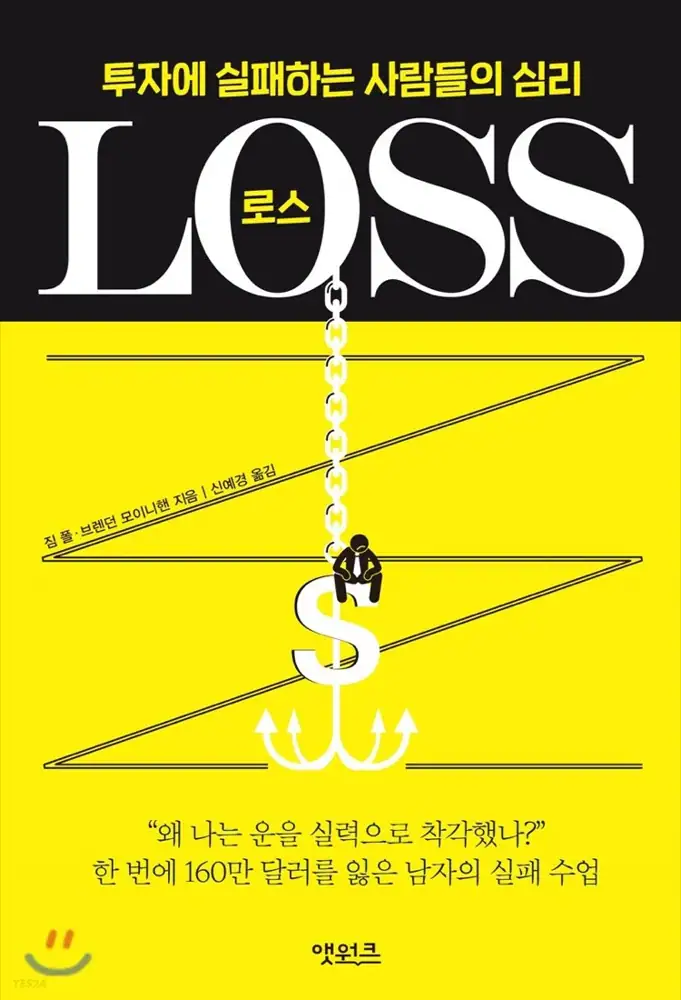
1. Book and authors
Official fact: The book is LOSS, written by Jim Paul and Brendan Moynihan. The Korean publisher is At Work, and the release date is 2018-09-13.
Official fact: Jim Paul spent 25 years in the futures industry. He worked as a retail broker, a floor trader trading his own account, and a research director supporting clients’ investment and decision-making. He also served on the Chicago Mercantile Exchange’s board of governors and executive committee. In 2001, while serving as the first executive vice president of Morgan Stanley’s New York international energy division, he died in the World Trade Center during the September 11 attacks.
2. What the book is about
The cause of dangerous trades is not only outside the market. A major cause is the change that happens inside the trader’s own mind. To understand and prevent losses, we need to enter the individual’s mind, and this book tries to do that.
Interpretation: If failure is not treated as a personal problem, repeated failures can become material for success. Conversely, if success is treated as purely personal ability, failure can arrive on top of repeated success.
3. Why Jim Paul’s early story matters
- From school years into his trading career, he believed he was better than others, and the results seemed to confirm it.
- As those successes became personalized, his certainty grew, and one failure led to a loss of USD 1.6 million.
- He also experienced the death of his parents around that period.
- After analyzing the failure, he admitted that past success was not only trading skill, but also sales ability, luck, and relationships.
- When he studied books, articles, and interviews about successful people, the methods of success were extremely diverse.
- Advice about failure, however, was surprisingly similar. That led him to study how people fail.
4. When market loss becomes internal loss
Market loss is an objective event that occurs because markets rise and fall. The problem begins when the loss is internalized. Once a loss combines with ego, the issue is no longer money; it becomes reputation, pride, and failure.
Official fact: The source organizes the five stages of internal loss as denial, anger, bargaining, depression, and acceptance.
5. Inherent risk and created risk
Risk already in the market
This risk naturally arises when current resources are committed to future expectations. It exists in both financial and non-financial markets.
Risk made by the person
This is less about the market itself and more about risk created by actions driven by emotion and ego.
The point is to avoid taking on emotional, newly created risk on top of the risk already inherent in the market.
6. Five types of market activity
| Type | Core definition | My note |
|---|---|---|
| Investing | Committing capital with an expectation of principal plus adequate return through dividends, interest, or excess profit | Generally assumes a longer period. |
| Trading | Making a market in financial instruments and finding the bid-ask spread | In essence, it is closer to maintaining a flat position. |
| Speculating | Buying for resale and price appreciation rather than use or income | Price appreciation is the core return. |
| Betting | Putting something at stake on whether the result of an uncertain event is right or wrong | It becomes an issue of being right. |
| Gambling | Putting money on the result of a game, contest, or event | It derives from betting. |
7. Emotion, crowds, and decision-making
Emotion itself is neither good nor bad. The problem is emotionalism: making decisions based on emotion. Individuals can act after reasoning, reflection, and analysis, while crowds tend to act on feeling, emotion, and impulse.
Interpretation: This does not mean one should always go against the crowd. It means not relying on emotionalism. A long position creates fear when the market falls; a short position creates the opposite emotion. That is why stop levels and exit conditions must be planned before entering the market.
8. Exit strategy and the plan
- Decide what kind of participant you will be.
- Select an analysis method.
- Develop rules.
- Establish control.
- Build a plan.
Official fact: The source argues that because you cannot calculate whether a trade will be profitable, the only thing you can do is manage losses rather than predict profits.
A plan must include where, when, and why you will no longer hold the position. Entry, stop-loss, and target price matter, but first you must specify where you want to exit and how much you are willing to lose.
Missed trades cost nothing. But a trade entered without a plan can turn investing or trading into betting or gambling once losses grow and pride, ego, and emotion attach to the position.

9. Scenario planning and following the plan
Scenario planning does not tell the future. Its purpose is not to decide which scenario will be correct, but to define in advance what I will do under each scenario.
Interpretation: Even if you know why the market rises or falls, that knowledge does not return your money. What matters is not being the person who guesses correctly, but remaining the person who defines entry and exit conditions and executes the plan.
The instruction to write the plan on paper is also memorable. The moment you deviate from the original plan based on intuition, emotion, or inspiration, the probability of psychological loss rises. Bluffing can bring luck sometimes, but if that success repeats, it can eventually lead to a bad decision.
10. Final reading note
This book is worth reading. I especially recommend reading Jim Paul’s real experience. The message that pain in the market moves inversely with success, and the warning not to search for reasons to stay in an unfavorable position, remains with me.
Sources
- Source post: content/네이버블로그/2024-12-28-[Book Review] LOSS.md
- Book link: https://search.shopping.naver.com/book/product/uaU6pj1ql9EngefxToI%2BxUHLqQe4yQhGcJOC92sLWtQ%3D
- Image: pstatic image