DEEP RESEARCH · Samsung Electro-Mechanics MLCC and Silicon Capacitor
Samsung Electro-Mechanics: Why AI Servers Can “Use Less Power”
The role of MLCCs and silicon capacitors in GPU/HBM power stability and the meaning of the KRW 1.5tn supply contract.
0. Bottom line first
Samsung Electro-Mechanics’ existing MLCCs remain essential power-stabilization components around AI server boards, power stages, GPUs, and HBM. Silicon capacitors are higher-value complements that suppress ultra-high-frequency power noise from extremely close positions such as inside GPU/HBM packages.
Interpretation: “Using less power” does not mean capacitors directly save electricity. It means they reduce ESR, ESL, leakage, dielectric loss, voltage margin, and power noise, lowering system-level loss, heat, errors, and voltage headroom.
1. Capacitors stabilize electricity; they do not consume it ideally
An ideal capacitor does not consume electricity. It stores energy in an electric field and releases it again.
Stored energy E = 1/2 · C · V²Real capacitors are not perfect, so heat and loss appear.
Ptotal ≈ Irms² · ESR + Vdc · Ileak + Pac,dielectricSo a “capacitor that uses less power” more accurately means a capacitor with lower power loss, heat, and power-supply noise under the same conditions.
2. Why MLCC matters in AI servers
MLCC stands for Multi-Layer Ceramic Capacitor. It stacks ceramic dielectric and internal electrodes in many layers to create large capacitance in a small volume.
Lower ripple loss
Low ESR helps reduce heat loss from ripple current.
High-frequency decoupling
Low ESL and small size help supply transient current close to GPUs and CPUs.
Many parts close to load
Small packages allow broad placement across servers, smartphones, automotive electronics, and industrial devices.
When a GPU or CPU suddenly draws current, voltage can droop. MLCCs supply momentary current near the chip to suppress voltage droop.
Voltage noise ≈ L · di/dtHere L is loop inductance. The farther the part is from the chip and the longer the wiring, the larger L becomes. However, Class II MLCCs such as X5R/X7R can lose effective capacitance under DC bias; a nominal 10µF part may behave like 3-5µF at operating voltage, so designers must look at effective capacitance, not only rated capacitance.
3. Why expensive silicon capacitors are used
Silicon capacitors are wafer-based capacitors using MOS, MIM, or trench structures. Based on Samsung Electro-Mechanics’ product page, they are formed by stacking dielectric and internal electrodes on silicon, can be thinned below 100µm by wafer grinding, can be applied inside packages, and their Low ESL helps power stability.
The key is proximity. MLCCs sit on the board, while silicon capacitors can enter the GPU/HBM package substrate, near the interposer, or directly below/next to the chip.
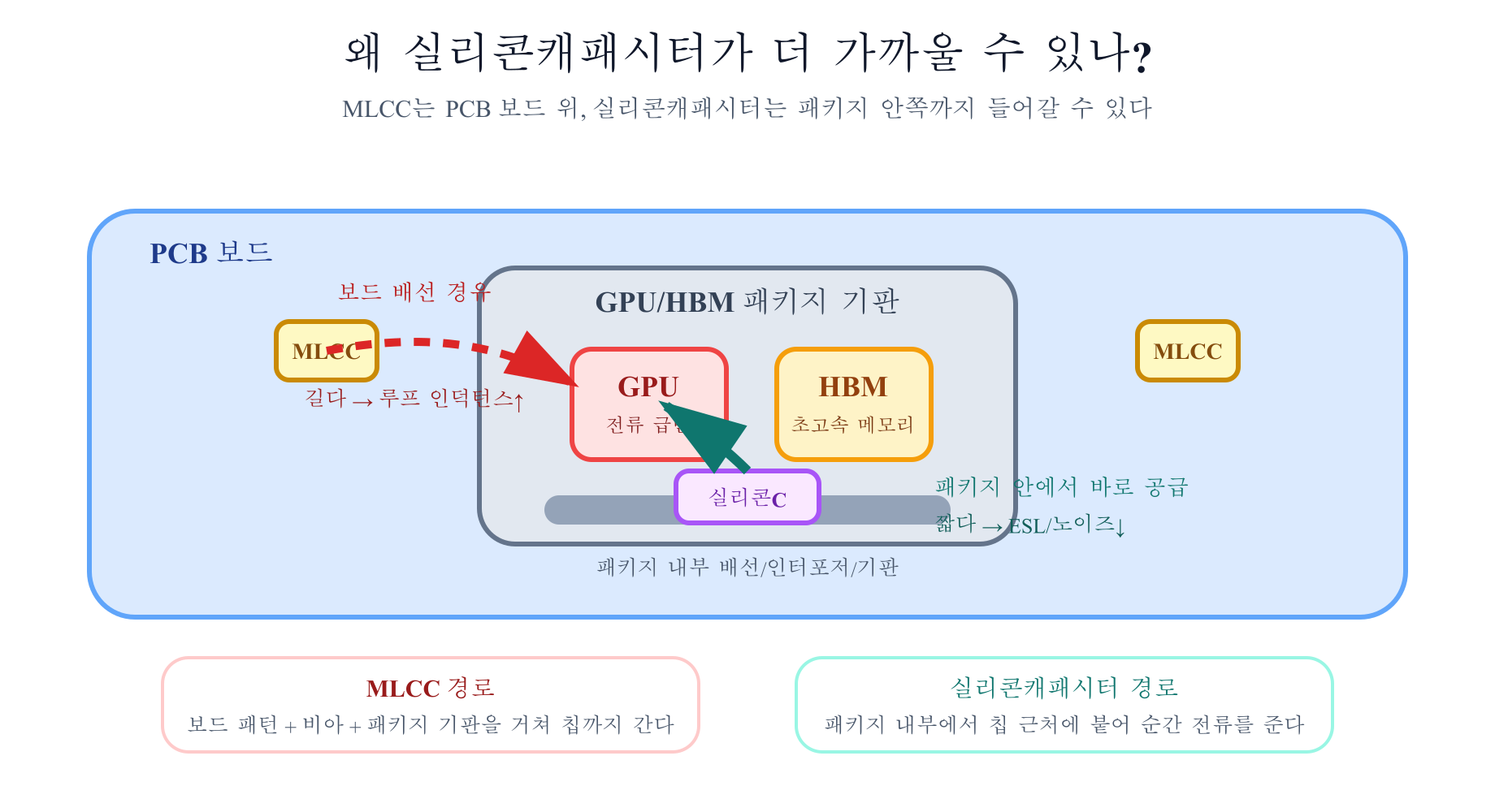
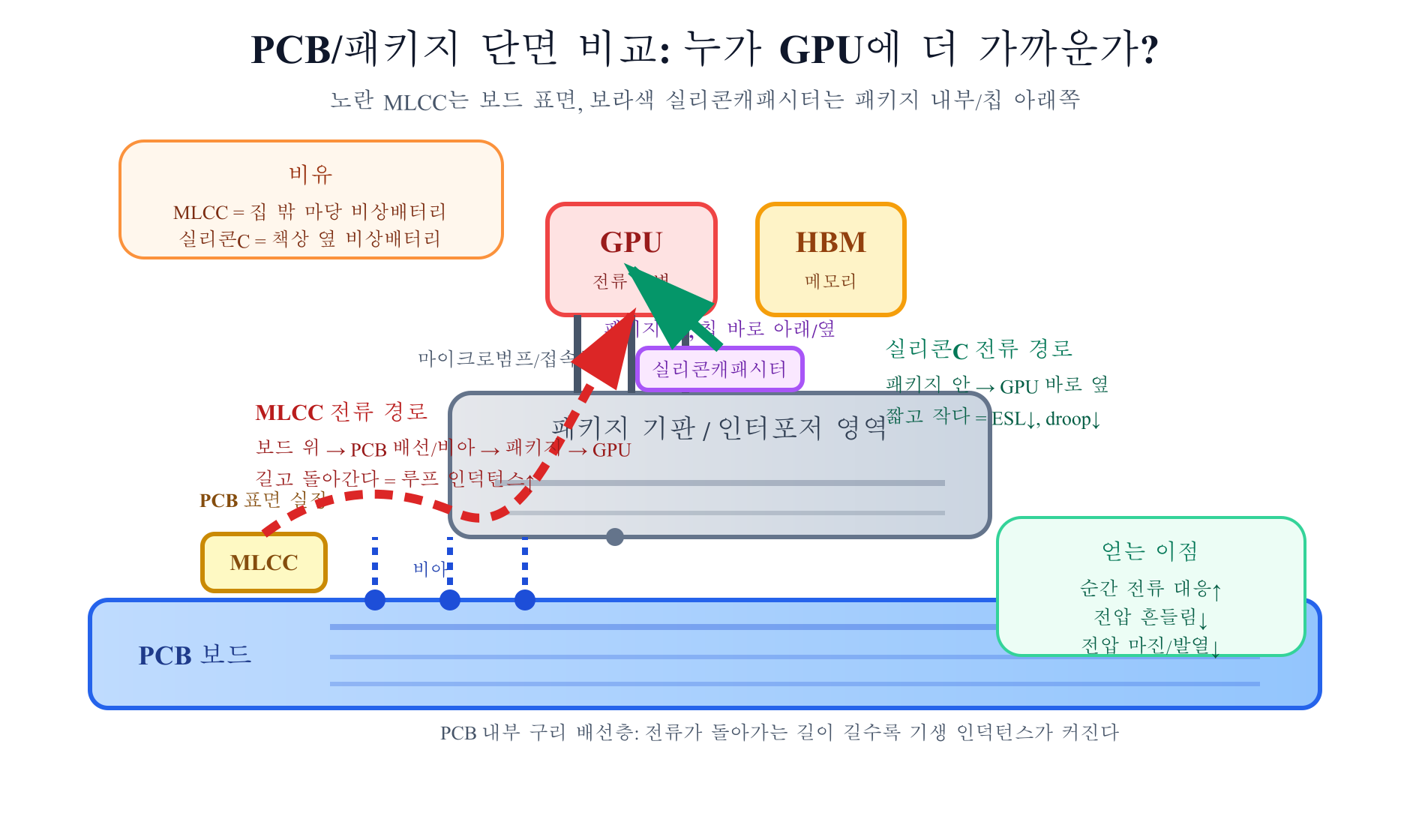
When silicon capacitors move inside the package, the current path shortens, ESL falls, and voltage droop and ripple decline. Lower noise can reduce the voltage margin intentionally added for stability, while reducing heat and throttling risk.
4. AI server power network
AI servers have much higher power density than normal servers. GPUs, HBM, CPUs, high-speed networking ASICs, VRMs, and POL stages all demand fast current.
Target impedance Ztarget ≈ allowable voltage variation / load-current variationIf allowable droop is 20mV and transient current is 100A, target impedance is about 0.2mΩ, a very demanding condition.
5. Where data centers benefit
Lower voltage droop/ripple
If GPU/HBM voltage suddenly moves, errors, throttling, resets, ECC errors, or timing violations can occur. MLCCs and silicon capacitors reduce that movement.
Possible voltage-margin reduction
AI chips are often supplied above the minimum needed voltage for stability. This headroom is guardband, and better PDN can reduce it.
Pdynamic ∝ C · V² · f| Voltage reduction on a 0.80V rail | Potential dynamic-power reduction |
|---|---|
| 10mV | about 2.48% |
| 20mV | about 4.94% |
| 30mV | about 7.36% |
| 50mV | about 12.11% |
Actual whole-server savings depend on the rail’s power share and workload. But the direction is clear: capacitors do not directly save electricity; they make lower-voltage stable operation possible.
Lower ESR loss
P = Irms² · ESR| At 10A ripple current | Loss |
|---|---|
| ESR 100mΩ | 10W |
| ESR 10mΩ | 1W |
| ESR 1mΩ | 0.1W |
Lower ESR reduces capacitor self-heating and surrounding power-stage hotspots. MLCCs can be placed densely on boards, while silicon capacitors can move inside packages, improving liquid-cooling layout freedom, shortening power paths, increasing server density, and improving signal integrity.
6. The most important Samsung Electro-Mechanics event
Official fact: According to Samsung Electro-Mechanics’ newsroom, on 2026-05-20 the company announced a silicon capacitor supply contract worth about KRW 1.5tn. The contract period is 2027-01-01 to 2028-12-31, implying a simple average of about KRW 750bn per year.
Official fact: The application is inside high-performance semiconductor packages such as AI server GPUs and HBM, and the role is to improve power-supply stability. The company says ESL/ESR resistance is more than 100x lower than existing MLCCs, minimizing signal loss in high-performance semiconductors.
| Assumed annual revenue | KRW 750bn share |
|---|---|
| KRW 10tn | 7.5% |
| KRW 11tn | 6.82% |
| KRW 12tn | 6.25% |
Interpretation: This is not small for a single new product group. Actual revenue recognition, margin, customer concentration, and additional orders still need separate confirmation.
7. Investment points and risks to verify
Existing cycle recovery
The story should include not only smartphones but also automotive and server high-value MLCC mix improvement.
AI package supply-chain entry
The KRW 1.5tn contract officially confirms commercialization, customer qualification, and entry into a large supply chain.
Yield, margin, new customers
2027-2028 revenue recognition, actual margin, yield, customer concentration, and follow-on orders must be checked.
8. Points of caution
- MLCC remains an inventory and price-cycle industry.
- Japanese players such as Murata and TDK have strong technology and customer bases.
- Chinese and Taiwanese players create price competition in commodity products.
- Silicon capacitors are high-performance complements, not replacements for all MLCCs.
- The KRW 1.5tn contract’s actual margin, yield, and customer concentration need more confirmation.
- Revenue recognition is centered on 2027-2028, so this is more of a mid- to long-term option than near-term earnings.
9. Final judgment
The Samsung Electro-Mechanics MLCC story is no longer enough if viewed only as smartphone recovery. AI servers raise the importance of power-stabilization components because they are high-power, high-speed, and highly integrated. MLCCs are core at the board level, while silicon capacitors handle the high-value area inside packages.
The reason to use expensive parts is simple: they reduce voltage movement, enable lower voltage margin, improve performance per watt, reduce errors and throttling, save package/board space, and ease AI server power-density problems.
Samsung Electro-Mechanics winning a KRW 1.5tn silicon capacitor contract signals that this shift has already entered commercialization. Still, 2027-2028 revenue recognition, margin, additional customers, yield, and competitor responses need continuous monitoring.
Sources
- STARFOLIO source: https://starofself.github.io/starofself/posts/samsung-electro-mechanics-mlcc-silicon-capacitor-ai-server/
- Samsung Electro-Mechanics, MLCC product page
- Samsung Electro-Mechanics, Silicon Capacitor product page
- Samsung Electro-Mechanics Newsroom, 2026-05-20, “Samsung Electro-Mechanics Signs 1.5 Trillion KRW Silicon Capacitor Supply Contract with Global Large-Scale Company”
- Murata, Silicon Capacitors / IPDiA product resources
- TDK, MLCC decoupling and capacitor application resources
- JEDEC HBM standard overview
- NVIDIA/AMD data center accelerator public materials